I spent three weekends last spring staring at a wall of soil testers on Amazon. Every listing claimed to be accurate, easy, and perfect for vegetables. Half the reviews felt fake. The specs were a mess of pH ranges, probe counts, and battery types I didn’t understand. I just wanted to know why my tomatoes were splitting and my peppers were yellow.
Here’s what I learned. A good soil tester for a vegetable garden does one of two jobs well. Either it gives you quick, repeatable readings you can act on right away, or it sends your soil to a lab and comes back with a full nutrient breakdown. The cheap meters that promise seven functions in one are usually fine for moisture and pH, but they won’t tell you if your nitrogen is low. The lab kits cost more per test but give you real numbers.
Below are five testers I’d actually recommend, split between instant-read meters and mail-in lab kits. The Rapitest kit is the best all-around starter for most vegetable gardeners. The MySoil kit is the one to buy if you want professional-grade nutrient data. The three digital meters are solid budget picks for moisture and pH checks. Pick the one that matches how you garden, not the one with the longest feature list.
Here’s a quick side-by-side of the key specs before we dig into each one.
| Features | Rapitest Soil Kit | MySoil Lab Kit | SONKIR pH Meter | Buladeke 7-in-1 | YAMRON 4-in-1 |
|---|---|---|---|---|---|
| Testing Method | Capsule color change | Mail-in lab analysis | Analog probe | Digital probe | Digital probe |
| What It Measures | pH, N, P, K | 13 nutrients plus pH | Moisture, pH, light | Moisture, pH, temp, light, EC, TDS | Moisture, pH, temp, light |
| Power Source | None needed | None needed | No battery | 4 AAA batteries | 4 AAA batteries |
| Results Speed | Minutes per test | 6-8 days | Instant | 10 seconds | 10 seconds |
| Best Use Case | Beginners, spot checks | Serious growers, full analysis | Quick moisture checks | Tech-savvy gardeners | Everyday garden monitoring |
Rapitest Soil Test Kit for Gardens

Luster Leaf
Rapitest Soil Test Kit for Gardens, Vegetables, Flowers and Lawns. USA designed and assembled soil tester completely, quickly and accurately measures/analyzes soil pH acidity and garden nutrients.
- Quick, at home results for Soil pH, Nitrogen, Phosphorous and Potash Innovative and inexpensive soil test kit features an easy-to-…
- Contains all components needed for 20 tests. 5 for each of pH, N, P and K
- Contains all components needed to test all variables in several spots in the yard or garden
This is the classic capsule kit that’s been around for years, and it’s still the best first soil tester for most vegetable gardeners. You get 20 tests total, split evenly between pH, nitrogen, phosphorus, and potassium. Each test takes a few minutes. You mix soil with water, add a capsule, shake, and match the color against a chart. It sounds low-tech because it is, but the results are consistent enough to guide real decisions.
The standout feature is the plant preference list. It covers over 450 plants, so you can look up what pH your tomatoes, peppers, or beans actually want and compare it to your reading. That alone saves you from guessing. The patented color comparators are easier to read than generic test strips, and the capsule system means you’re not measuring powders or counting drops. For a beginner, this is the least frustrating way to get real data.
The trade-off is precision. Color matching is subjective, and two people can read the same test slightly differently. It’s also not a lab test, so you won’t get exact ppm numbers for nutrients. But for a home vegetable garden, knowing whether your soil is acidic, neutral, or alkaline, and whether nitrogen is low or adequate, is enough to make smart amendments. If you want lab-grade accuracy, you’ll need to step up to the MySoil kit below. For everyone else, this is the practical choice.
- 20 tests total, 5 each for pH, nitrogen, phosphorus, and potassium
- No batteries or calibration needed
- Includes pH preference list for over 450 plants
- Capsule system is faster than powder or strip kits
- Results in minutes, not days
Best for: Vegetable gardeners who want a cheap, reliable way to check pH and major nutrients before planting or amending.
MySoil Soil Test Kit, Unlock Your Lawn

My Soil
MySoil Soil Test Kit, Unlock Your Lawn & Garden Potential, Complete & Accurate Nutrient and pH Analysis with Recommendations Tailored to Your Soil and Plant Needs
- KNOW BEFORE YOU GROW | Grow the healthiest, sustainable lawn and garden with the most accurate and easy to use professional soil t…
- FAST & ACCURATE | Unlike at-home pH meters and test strips, our mail-in professional lab analysis accurately measures 13 plant-ava…
- FOR ANY GROWING SCENARIO | Tests any soil type and growing condition - lawn & turf, vegetable gardening, flowers, compost, trees,…
This is the one to buy if you’re done messing around with color charts. MySoil is a mail-in lab kit. You collect a soil sample, send it in, and get back a full report on 13 plant-available nutrients plus pH. Results come in 6-8 days. It works for any growing setup, including raised beds, containers, and even hydroponics, so it’s flexible if your garden isn’t a traditional in-ground plot.
What makes it worth the cost is the custom recommendation. You don’t just get numbers. You get a specific plan: what to apply, how much, and when. It includes both organic and non-organic options, so you can choose the approach that fits your garden philosophy. If you’ve ever wondered whether you actually need to add lime, sulfur, or a specific fertilizer, this takes the guesswork out. It also saves money long-term because you stop buying products you don’t need.
The obvious downside is the wait. You won’t get results the same day, so this isn’t a tool for quick checks before a weekend planting session. It’s also more expensive per test than a capsule kit. And you need to follow the sampling instructions carefully. If you mix soil from different beds into one sample, your results won’t tell you which bed needs what. Use it once or twice a season per bed for the best value.
- Lab analysis measures 13 nutrients plus pH
- Results in 6-8 days via email or app
- Custom organic and non-organic recommendations
- Works for soil, compost, containers, and hydroponics
- No meter to store or calibrate
Best for: Serious vegetable gardeners who want professional nutrient data and a specific amendment plan, not just a pH reading.
SONKIR Soil pH Meter, MS02 3-in-1

SONKIR
SONKIR Soil pH Meter, MS02 3-in-1 Soil Moisture/Light/pH Tester Gardening Tool Kits for Plant Care, Great for Garden, Lawn, Farm, Indoor & Outdoor Use (Green)
- Kindly NOTE: This soil tester can not be applied to test pH value of any other liquid. If the soil is too dry the indicator will n…
- 3 METERS IN ONE: Soil moisture level, Soil pH value and Sunlight level could be tested easily according to your need by switching…
- NO BATTERY NEEDED: Simply insert the meter into soil, wait few minutes, accurate test results will be displayed on the readout pan…
If the MySoil kit felt like overkill, this next pick is the opposite. The SONKIR MS02 is a simple analog meter with two metal probes and a dial. It reads moisture, pH, and light. No batteries, no calibration, no apps. You stick it in the soil, wait a few minutes, and read the needle. It’s the tool you keep by the back door for quick checks while you’re watering.
The moisture reading is the most useful part. Vegetables like consistent moisture, and this tells you whether the soil is dry, moist, or wet at root level. The pH reading is less precise than a capsule test, but it’s fine for spotting big swings. The light meter is a bonus if you’re unsure whether a spot gets full sun or partial shade. The build is sturdy enough for regular use, and the probe length works for standard raised beds and containers.
Here’s the honest limitation. This meter doesn’t work well in dry or hard soil. The needle won’t move if the soil is too dry, so you have to water first and wait. It also can’t test liquids, and the pH accuracy is not lab-grade. Treat it as a quick-check tool, not a diagnostic instrument. For vegetable gardens, it’s best paired with a capsule kit or lab test for the full picture.
- 3-in-1 readings: moisture, pH, and light
- No batteries required
- Analog dial with clear markings
- Works for indoor and outdoor plants
- Needs moist soil for accurate readings
Best for: Gardeners who want a quick, no-fuss moisture and pH check without batteries or apps.
Buladeke Moisture Meter for Plants, 7-in-1
Buladeke
Buladeke Moisture Meter for Plants,7-in-1 Digital Soil Tester Kit | Soil pH Tester with LCD - Measures pH, EC, TDS, Fertility, Temp, Moisture & Sunlight, Garden Tools for Indoor & Outdoor
- 【7-in-1 Features】This is a 7-in-1 multi-function soil tester. Our soil tester quickly measures soil moisture, pH, temperature and…
- 【Large Screen & LCD Backlight】The Soil Moisture Meter has a large LCD display with white backlight that clearly shows the numerica…
- 【Fast and accurate measurement】With the latest 2025 probe technology, it can quickly and accurately measure soil pH, moisture, tem…
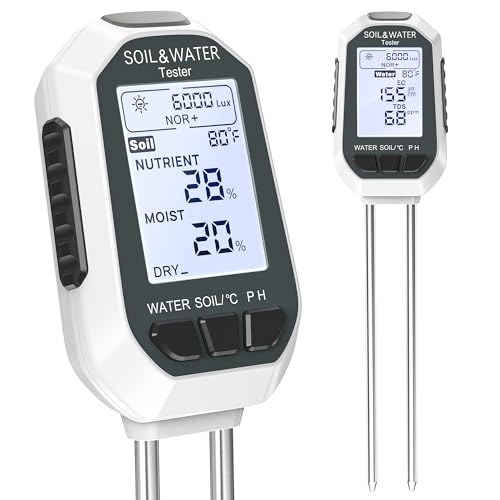
The Buladeke 7-in-1 is the tech-forward option. It’s a digital meter with a large backlit LCD screen that shows moisture, pH, temperature, light intensity, EC, and TDS. That’s a lot of functions for a handheld tool. The screen is genuinely easy to read, even in bright sun or at dusk, and the probe design lets you push it about 10 cm into the soil for a reading in 10 seconds.
What sets it apart is the EC and TDS functions. These measure electrical conductivity and total dissolved solids, which give you a rough idea of nutrient concentration in the soil. For vegetable gardeners who use liquid fertilizers, that’s useful feedback. You can tell if you’ve over-fertilized or if your soil is depleted. The temperature reading also helps you avoid planting too early in cold soil. It’s powered by four AAA batteries, which aren’t included, and it warns you when they’re low.
The catch is that EC and TDS readings in soil are not as straightforward as they are in water. The meter measures what’s in the soil solution, but that can change quickly with watering. It’s a helpful trend tool, not a precise lab measurement. The probe also shouldn’t be forced into dry, hard soil, and it can’t test liquids directly. For the price, you get a lot of features, but you need to understand their limits.
- 7 functions including moisture, pH, temp, light, EC, and TDS
- Large backlit LCD screen
- Reads in about 10 seconds
- Powered by 4 AAA batteries (not included)
- Fertility function helps guide feeding
Best for: Tech-savvy gardeners who want digital readings and don’t mind learning what EC and TDS actually mean.
YAMRON 4-in-1 Soil Moisture Meter Digital

YAMRON
4-in-1 Soil Moisture Meter Digital Plant Temperature/Soil Moisture/PH Meter/Sunlight Intensity Backlight LCD Display Soil Test Meter for Gardening, Farming and Outdoor Plants
- 【4 in 1 function】This is a 4-in-1 multifunctional soil tester.Our soil tester fastly to measure soil moisture, pH, temperature and…
- 【Large Screen & Backlight LCD Display】The Soil Tester uses a large LCD screen and white backlight to conveniently display and read…
- 【Quick Accurate measurement】The latest probe detection technology in 2026 can quickly and accurately measure the pH, moisture and…
The YAMRON 4-in-1 is the middle ground between the simple SONKIR and the feature-heavy Buladeke. It measures moisture, pH, temperature, and sunlight on a digital screen. The display has a white backlight and a 45-degree rotating head, which is a small but genuinely useful design touch. You can read it without bending over or blocking the light. It runs on four AAA batteries, which aren’t included.
Accuracy is decent for a consumer-grade meter. The probe reads about 10 cm deep, and you get results in 10 seconds. YAMRON recommends taking readings from at least five spots and averaging them, which is good advice for any soil meter. The screen uses intuitive symbols alongside numbers, so beginners won’t be confused by raw data. It’s a solid choice for raised beds, containers, and in-ground plots.
The main limitation is the same as other digital probes: it doesn’t like dry, hard soil. You need to water the test area and wait 10 minutes before pushing the probe in. The pH reading is also less precise than a lab test, so don’t rely on it for fine-tuning soil chemistry. Use it for monitoring trends and catching problems early. For the price, it’s a reliable everyday tool.
- 4-in-1: moisture, pH, temperature, and sunlight
- Large backlit LCD screen with 45-degree rotating head
- Reads in about 10 seconds
- Works for indoor and outdoor plants
- Requires 4 AAA batteries (not included)
Best for: Gardeners who want a digital all-rounder for moisture, pH, and temperature without paying for lab analysis.
How We Chose These Products
We started by filtering out the obvious junk. Any tester that promised lab-grade accuracy for a few dollars got cut. So did meters with no clear instructions or a history of broken probes. We looked for tools that matched the actual needs of vegetable gardeners: checking pH, moisture, and major nutrients without a chemistry degree.
From there, we compared testing methods. Capsule kits and lab kits give you nutrient data. Analog and digital probes give you instant readings but limited nutrient info. We picked at least one from each category so you can choose based on how you garden. We also weighed real-world feedback about durability, ease of use, and whether the readings stayed consistent over time. No product made the list based on marketing claims alone.
Buying Guide: What Really Matters
First, decide what you actually need to measure. If your main question is ‘why are my plants yellow,’ you need a nitrogen reading. That means a capsule kit or a lab test. If you just want to know when to water and whether your pH is in range, a digital or analog probe is enough. Don’t pay for features you won’t use.
Second, think about accuracy versus convenience. Lab kits are the most accurate but take days. Capsule kits are accurate enough for home gardens and take minutes. Digital probes are instant but less precise, especially for pH. For most vegetable gardeners, a capsule kit plus a cheap moisture meter covers all the bases. If you’re growing in raised beds or containers, a digital meter with a longer probe is more convenient.
Third, check the soil type you’re working with. Sandy soil drains fast and can give weird readings on analog meters. Clay soil is hard to push a probe into. If you’re dealing with either, read our guide to the best soil tester for sandy soil before you buy. And if you’re gardening in small spaces, the best soil tester for balcony plots has different requirements than a full-size garden.
Our Top Recommendation
The Rapitest Soil Test Kit is our top pick for most vegetable gardeners. It’s cheap, it tests the four things that matter most (pH, nitrogen, phosphorus, potassium), and it gives you a plant preference list so you know what your vegetables actually want. It’s not lab-accurate, but it’s accurate enough to make smart decisions about lime, sulfur, and fertilizer. For a beginner or a casual gardener, this is the best starting point.
If you want professional-grade data, the MySoil kit is the runner-up. It costs more per test, but you get a full nutrient breakdown and a custom amendment plan. It’s worth it if you’re serious about soil health or you’ve been struggling with unexplained plant problems. For a quick moisture and pH check, the SONKIR meter is the budget pick. The Buladeke 7-in-1 and YAMRON 4-in-1 are both solid digital options if you prefer a screen over color charts. Pick the one that matches your budget and how much detail you actually want.
Frequently Asked Questions
Can I use a soil tester for my vegetable garden if I also have flowers?
Yes. Most soil testers measure the same basic things: pH, moisture, and nutrients. The main difference is the plant preference list. The Rapitest kit covers over 450 plants, so it includes both vegetables and flowers. Digital meters don’t care what you’re growing. Just make sure you’re comparing your readings to the right plant’s needs.
How often should I test my vegetable garden soil?
Twice a year is plenty for most home gardens: once in early spring before planting and once in late summer if you’re growing a fall crop. If you’re using a lab kit, once a year per bed is enough. If you’re using a cheap digital meter, you can check moisture weekly and pH monthly. Testing too often with a capsule kit wastes supplies and doesn’t give you new information.
Why does my soil tester give different readings in the same spot?
Soil isn’t uniform. Moisture, nutrients, and pH can vary inches apart. That’s why most manufacturers recommend taking multiple readings and averaging them. For digital meters, clean the probes between readings and make sure the soil is moist but not soaking wet. For capsule kits, mix your sample thoroughly before testing. If readings still swing wildly, your soil may have pockets of different material, like compost or sand.
Do I need a lab test if I already have a digital meter?
Not necessarily, but they answer different questions. A digital meter tells you moisture, pH, and maybe temperature. It won’t tell you if your nitrogen is low or if your phosphorus is high. If your plants are struggling and you can’t figure out why, a lab test is worth the money. For routine watering and pH checks, a digital meter is fine. Many gardeners use both: a cheap meter for weekly checks and a lab kit once a season for the full picture.