Balcony vegetable gardening is a different beast from backyard growing. Your plants live in a closed system. Container soil drains fast, nutrients leach out with every watering, and the pH can shift in a matter of weeks. A tomato plant in a 10-gallon pot has maybe a cup of usable soil volume per root tip. When something goes wrong, you have days, not weeks, to fix it.
That’s where a soil tester earns its keep. The right one tells you whether your basil is yellowing from nitrogen hunger or from overwatering. It reveals if your potting mix has drifted alkaline, which locks out iron and makes peppers stall. A good tester also saves money. You stop guessing at fertilizer and start applying only what your soil actually lacks. The best soil tester for balcony vegetable plots needs to be accurate at low volumes, easy to read in tight spaces, and fast enough to act on before a crop fails.
We looked at five testers that cover the full range of balcony grower needs. There’s a capsule kit for quick checks, a high-count liquid kit for serial testers, a mail-in lab test for precision, a digital 7-in-1 meter for daily monitoring, and a professional colorimetric kit for the detail-obsessed. The Rapitest kit is our top pick for most balcony growers, but the right choice depends on how you garden.
Here’s a quick side-by-side of the key specs to help you narrow it down before reading the full reviews.
| Features | Rapitest Soil Test Kit | Dewilde 140 Tests | MySoil Soil Test Kit | Buladeke Moisture Meter | NewTest Soil Test Kit |
|---|---|---|---|---|---|
| Test Method | Capsule color comparator | Liquid colorimetric | Mail-in lab analysis | Digital probe meter | Liquid colorimetric |
| Parameters Measured | pH, N, P, K | pH, N, P, K, ammonia | 13 nutrients plus pH | Moisture, pH, temp, light, EC, TDS | pH, N, P, K |
| Total Tests | 20 (5 per parameter) | 140 (40 per parameter) | 1 lab analysis | Unlimited spot checks | 40 (10 per parameter) |
| Results Speed | Minutes | Minutes | 6-8 days | 10 seconds | Minutes |
| Best Use Case | Quick seasonal checks | Frequent monitoring | Precise amendment planning | Daily watering decisions | Beginner-friendly accuracy |
Rapitest Soil Test Kit for Balcony Growers

Luster Leaf
Rapitest Soil Test Kit for Gardens, Vegetables, Flowers and Lawns. USA designed and assembled soil tester completely, quickly and accurately measures/analyzes soil pH acidity and garden nutrients.
- Quick, at home results for Soil pH, Nitrogen, Phosphorous and Potash Innovative and inexpensive soil test kit features an easy-to-…
- Contains all components needed for 20 tests. 5 for each of pH, N, P and K
- Contains all components needed to test all variables in several spots in the yard or garden
The Rapitest kit from Luster Leaf suits the balcony gardener who wants a straightforward read on soil health without a steep learning curve. You get 20 tests total, split evenly across pH, nitrogen, phosphorus, and potassium. Five tests per parameter is enough to check your main containers at the start of a season, mid-season, and again before fall planting. The capsule system works by mixing a soil sample with water, adding a capsule, and matching the resulting color against a comparator. It takes about five minutes per test once you get the rhythm down.
What sets this kit apart is the included pH preference list for over 450 plants. That’s genuinely useful on a balcony where you’re growing a mix of herbs, greens, and fruiting vegetables. You can test your basil container, see the pH is 7.2, check the list, and know you need to bring it down slightly for optimal growth. The color comparators are patented and easier to read than test strips. Results are clear enough to make a decision without second-guessing. For a beginner who just wants to know if the soil is roughly right, this kit delivers.
The trade-off is test count. Five pH tests disappear fast if you’re checking multiple containers every few weeks. You’ll likely need to buy refill capsules or a second kit by mid-season. The color matching also requires decent lighting. On a north-facing balcony in winter, you might struggle to distinguish between two similar shades of green. And the kit doesn’t measure ammonia, which matters if you’re using certain organic fertilizers. It’s not the most precise tool, but it’s reliable for general guidance.
- 20 total tests: 5 each for pH, nitrogen, phosphorus, potassium
- Patented color comparator system for easy reading
- Includes pH preference list for over 450 plants
- Capsule system requires no separate mixing tools
- Detailed instructions suitable for beginners
Best for: The balcony grower who wants a simple, affordable way to check soil basics a few times per season without committing to a digital tool or lab test.
Dewilde Soil Test Kit 140 Tests

Dewilde Trading Co
Soil Test Kit 140 Tests (2026 Updated Instructions) – pH, Nitrogen, Phosphorus, Potassium & Ammonia – Garden, Lawn & Plant Soil Tester Kit for Accurate Fertility Analysis
- Comprehensive Soil Analysis: Liquid soil test kits offer a comprehensive analysis of essential soil parameters, including pH, ammo…
- Customized Fertilizer Recommendations: With data on pH and nutrient levels, liquid soil test kits help users apply the right type…
- Time and Cost-Effective: Liquid soil test kits are relatively quick and easy to use, saving time for gardeners and agricultural pr…
If you test your balcony containers regularly, the Dewilde kit makes more sense than smaller options. You get roughly 140 tests total, with about 40 each for pH, phosphorus, and potassium, and around 20 for nitrogen. That’s enough to monitor your soil every two weeks through an entire growing season and still have supplies left for next year. The kit also measures ammonia, which the Rapitest doesn’t. Ammonia is an early indicator of nitrogen availability, so it’s useful when you’re trying to dial in organic fertilizers or compost teas.
The liquid colorimetric method is more involved than capsules. You’ll need to measure soil, add water, shake, filter, and then add reagent drops. It takes a bit longer per test, maybe 10 minutes once you’re comfortable. But the results are more precise than capsule kits in our experience. The color chart is well-designed and the instructions are updated for 2026. For balcony vegetable plots, the ability to test frequently means you can catch nutrient deficiencies before they show up as yellow leaves or stunted fruit. That alone justifies the higher test count.
The main drawback is the time investment. This isn’t a tool for someone who wants a quick answer once a month. It rewards gardeners who enjoy the testing process and want data. The liquid reagents also have a shelf life, so if you only garden three months a year, you might not use the full kit before it expires. And while 140 tests sounds like a lot, you’ll burn through them faster than expected if you’re testing multiple containers at different depths.
- 140 total tests: 40 each for pH, P, K; about 20 for nitrogen
- Measures ammonia in addition to standard nutrients
- Liquid colorimetric method for precise readings
- Updated 2026 instructions with clear color charts
- Cost-effective for frequent monitoring
Best for: The data-driven balcony gardener who tests soil every couple of weeks and wants a high test count plus ammonia readings without paying for lab analysis.
MySoil Soil Test Kit Lab Analysis

My Soil
MySoil Soil Test Kit, Unlock Your Lawn & Garden Potential, Complete & Accurate Nutrient and pH Analysis with Recommendations Tailored to Your Soil and Plant Needs
- KNOW BEFORE YOU GROW | Grow the healthiest, sustainable lawn and garden with the most accurate and easy to use professional soil t…
- FAST & ACCURATE | Unlike at-home pH meters and test strips, our mail-in professional lab analysis accurately measures 13 plant-ava…
- FOR ANY GROWING SCENARIO | Tests any soil type and growing condition - lawn & turf, vegetable gardening, flowers, compost, trees,…
Some balcony growers want the most accurate picture possible before adding anything to their containers. The MySoil kit is a mail-in lab test. You collect a soil sample, send it in, and receive a detailed report in 6-8 days. The lab measures 13 plant-available nutrient levels, including nitrogen and pH. This isn’t a spot check. It’s a full diagnostic. The results come with custom recommendations for what to apply, how much, and when, with both organic and non-organic options.
For balcony vegetable plots, this level of detail matters when you’re dealing with persistent problems. Maybe your tomatoes keep getting blossom end rot despite consistent watering. A lab test can reveal a calcium deficiency or a pH imbalance that’s locking out calcium. The MySoil report tells you exactly what to fix. It also saves money long-term. You stop buying fertilizers you don’t need and start applying only what your soil lacks. The recommendations are tailored to your specific soil and plant needs, not generic advice.
The obvious limitation is the wait. Six to eight days is a long time when a plant is declining. This kit works best as a preseason or midseason reset, not as a diagnostic tool for an active crisis. It’s also a single-use product. You get one analysis per kit. If you want to test again later, you buy another kit. That makes it more expensive per test than the liquid or capsule options, but the accuracy and depth of recommendations justify the cost for serious growers. And you can’t use it for quick daily decisions like whether to water.
- Mail-in lab analysis measures 13 nutrients plus pH
- Results in 6-8 days with custom amendment recommendations
- Includes organic and non-organic fertilizer suggestions
- Works for any soil type and growing condition
- Single-use kit, one analysis per purchase
Best for: The balcony vegetable gardener who wants professional-grade accuracy and a complete amendment plan, and doesn’t mind waiting a week for results.
Buladeke 7-in-1 Digital Soil Tester
Buladeke
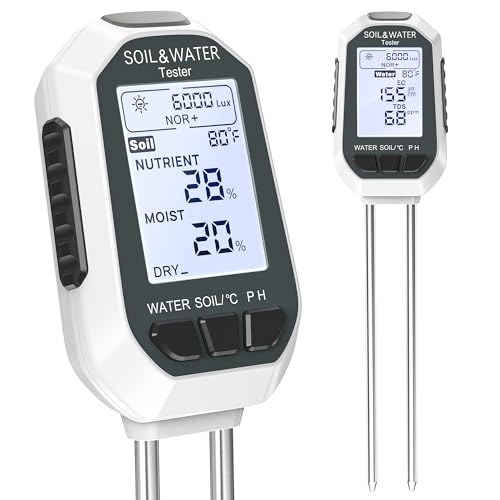
Buladeke Moisture Meter for Plants,7-in-1 Digital Soil Tester Kit | Soil pH Tester with LCD - Measures pH, EC, TDS, Fertility, Temp, Moisture & Sunlight, Garden Tools for Indoor & Outdoor
- 【7-in-1 Features】This is a 7-in-1 multi-function soil tester. Our soil tester quickly measures soil moisture, pH, temperature and…
- 【Large Screen & LCD Backlight】The Soil Moisture Meter has a large LCD display with white backlight that clearly shows the numerica…
- 【Fast and accurate measurement】With the latest 2025 probe technology, it can quickly and accurately measure soil pH, moisture, tem…
Balcony gardeners who want instant feedback will appreciate the Buladeke digital meter. This is a 7-in-1 tool that measures soil moisture, pH, temperature, light intensity, EC, and TDS. The fertility function gives you a rough sense of nutrient availability. You insert the probe about 10 cm into the soil, wait 10 seconds, and read the large LCD screen. The backlight makes it easy to check your containers at night or in a dim corner. It’s powered by four AAA batteries, which aren’t included.
The real strength here is daily monitoring. Moisture readings help you avoid overwatering, which is the number one killer of balcony vegetables. Light intensity readings tell you if your lettuce is getting enough sun or if your peppers need a sunnier spot. The pH function is less precise than a liquid test, but it’s fine for spotting trends. If your pH drifts from 6.5 to 7.5 over a month, you’ll see it. The EC and TDS functions are more relevant for hydroponics, but they can help you understand nutrient concentration in container soil too. For a balcony grower who wants one tool for everyday decisions, this covers a lot of ground.
Accuracy is the trade-off. Digital probes are convenient but not lab-grade. The pH reading can drift, especially in dry or compact soil. You need to moisten the soil slightly before testing, which adds a step. The probe also requires careful handling. Forcing it into hard soil can damage it. And the fertility function is more of a general indicator than a precise measurement. It won’t tell you exact nitrogen levels. If you need precise numbers for a specific deficiency, a liquid kit or lab test is better. But for daily watering and light checks, this meter is hard to beat.
- 7-in-1 digital meter: moisture, pH, temp, light, EC, TDS, fertility
- Large backlit LCD screen for easy reading
- 10-second readings after inserting probe 10 cm deep
- Battery powered (4 AAA, not included) with low battery warning
- Not for use in liquids; moisten dry soil before testing
Best for: The balcony gardener who wants a single, affordable tool for daily watering, light, and temperature decisions, and doesn’t need lab-level nutrient precision.
NewTest Soil Test Kit 4 Parameters

NewTest
NewTest Soil Test Kit 4 Parameters: 40 Tests Professional Soil Testing Kits | Accurate Soil Tester for Lawns Gardening Vegetable Garden Nutrients for pH Nitrogen Phosphorus Potassium
- Professional Soil Test Kit: All soil test kits on the market can not accurately detect soil chemical elements, the soil must be se…
- A Total of 40 Tests for 4 Parameters Consisting of 10 Tests each for pH, Nitrogen, Phosphorus & Potassium: NewTest soil test kit f…
- Detailed & Easy to Understand Step-by-Step Instructions for Use: NewTest soil testing kit for gardening come with a quick guide an…
NewTest designed this kit for gardeners who want professional-style testing without the lab wait. You get 40 tests total, split evenly across pH, nitrogen, phosphorus, and potassium. That’s 10 tests per parameter. The kit uses a liquid colorimetric method with test strips or liquid comparison. The instructions are detailed and step-by-step, so even a first-time tester can follow along. The brand claims the kit solves the accuracy problem of other home test kits, and for the most part, it delivers on that promise for the four parameters it covers.
What makes this kit stand out is the reading method. NewTest designed specific reading protocols for each nutrient to reduce subjective color matching. You compare the tested liquid or strip to a colorimetric card, but the card is organized by element, so you’re not flipping between charts. For balcony vegetable plots, this means you can test your tomato container, get a clear phosphorus reading, and know whether to add bone meal or not. The 10 tests per parameter give you enough runway to test at planting, mid-season, and late season across a few containers. The kit works for any soil type, including potting mixes and soil-less media.
The limitation is the same as other liquid kits. It takes time per test, and the reagents have a shelf life. You also don’t get ammonia or micronutrient readings. If you need a full nutrient panel, the MySoil lab test is more comprehensive. But for the core four parameters, this kit is accurate and beginner-friendly. It’s a solid middle ground between the Rapitest capsule kit and the Dewilde high-count kit. The colorimetric cards are well-made and easy to read in good light. Just don’t test in dim conditions.
- 40 total tests: 10 each for pH, nitrogen, phosphorus, potassium
- Liquid colorimetric method with element-specific reading cards
- Detailed step-by-step instructions for beginners
- Works with all soil types and growing conditions
- No ammonia or micronutrient testing
Best for: The balcony gardener who wants accurate, beginner-friendly testing for the four core soil parameters and prefers a kit over a digital meter.
How We Chose These Products
We evaluated these testers on accuracy for small-volume container growing, ease of use for balcony settings, and the range of parameters each measures. Balcony vegetable plots have specific needs. You’re dealing with limited soil volume, frequent watering, and often a mix of sun and shade. A tester that works well in a raised bed might be overkill or underpowered for a 5-gallon pot. We prioritized tools that give actionable results without requiring a lab background. We also considered test count and cost per test, because balcony gardeners often need to test multiple containers throughout the season.
We looked at the trade-offs between speed, precision, and convenience. Digital meters win on speed but lose on precision. Lab tests win on precision but lose on speed. Capsule and liquid kits sit in the middle. The best choice depends on how you garden. We also checked whether each kit includes clear instructions and whether the results are easy to interpret. A tester that gives you numbers but no guidance on what to do with them is less useful. The MySoil kit stood out for its custom recommendations, while the Rapitest kit impressed with its plant pH preference list.
Buying Guide: What Really Matters
The first decision is whether you want a digital meter or a chemical test kit. Digital meters are fast and reusable. You can check moisture daily and pH weekly without buying refills. But they’re less accurate for nutrient levels. Chemical kits, whether capsule or liquid, give you more precise nutrient readings but require buying refills or new kits. For balcony vegetable plots, many growers use both: a digital meter for daily watering and a chemical kit for monthly nutrient checks. If you only buy one, think about which problem you’re trying to solve. If your plants look healthy but you’re not sure when to water, a digital meter is the better first purchase.
Test count matters more than you think. A kit with 20 tests sounds like plenty until you realize you have six containers and want to test each one at three growth stages. That’s 18 tests right there. If you’re testing multiple parameters, you’ll burn through a small kit in one season. A high-count kit like the Dewilde 140-test option costs more upfront but saves money per test. The MySoil lab test is a single analysis, so it’s best for a one-time deep dive rather than routine monitoring. Match the test count to your gardening style. Casual growers can get by with 20 tests. Serious balcony farmers should look at 100 or more.
Finally, consider what you’re actually trying to measure. pH is the most important parameter for balcony vegetables because it controls nutrient availability. If pH is off, adding fertilizer won’t help. Nitrogen, phosphorus, and potassium are the next most critical. Ammonia and micronutrients are nice to have but not essential for most balcony growers. Light and moisture are important for daily care, which is why a digital meter can be a good companion to a chemical kit. Don’t pay for features you won’t use. A simple pH and NPK kit covers 90% of balcony vegetable problems.
Our Top Recommendation
The Rapitest Soil Test Kit is our top pick for most balcony vegetable gardeners. It’s affordable, easy to use, and covers the four parameters that matter most: pH, nitrogen, phosphorus, and potassium. The 20 tests are enough for a season of spot checks, and the plant pH preference list is a genuinely useful reference. It’s not the most precise tool, and you’ll likely need refills if you test frequently, but for a beginner or casual grower, it strikes the best balance of cost, simplicity, and usefulness. You can check the current price on Amazon to see if it fits your budget.
If you want more tests and ammonia readings, the Dewilde 140-test kit is the better runner-up for frequent testers. For lab-grade accuracy and custom amendment plans, the MySoil kit is worth the wait and the higher cost. And if you want a daily-use tool for watering and light decisions, the Buladeke digital meter is a solid companion to any chemical kit. The NewTest kit is a good middle ground for beginners who want accurate core readings without a digital tool. Pick the one that matches how you garden, and you’ll get better results from your balcony vegetables.
Frequently Asked Questions
How often should I test my balcony vegetable soil?
Test pH and nutrients at the start of the season, again when plants begin flowering, and once more before fall planting. If you’re using a digital meter for moisture, check daily. Chemical tests every four to six weeks are enough for most balcony crops. Frequent testing helps you catch deficiencies before they show up as visible damage.
Can I use these testers for hydroponic or soil-less media?
Most of these kits work for soil-less media, but the readings can be different. The MySoil lab test explicitly supports soil-less media and hydroponics. The Dewilde and NewTest kits also work for any soil type. Digital meters like the Buladeke can read EC and TDS, which are more relevant for hydroponics. Just follow the kit instructions for soil-less media, as the calibration may differ from regular soil.
What’s the difference between pH and nutrient readings?
pH measures how acidic or alkaline your soil is. It controls whether nutrients are available to your plants. Nutrient readings tell you how much nitrogen, phosphorus, and potassium are present. You need both. A soil with plenty of nutrients but the wrong pH will still starve your plants. That’s why testing pH first is always a good idea.
Do I need to test every container separately?
Yes, if your containers have different soil mixes or different crops. A tomato container and a lettuce container may have different pH and nutrient levels. Testing each one separately gives you a clearer picture. If all your containers use the same potting mix and the same fertilizer schedule, you can test a representative sample from two or three containers and assume the rest are similar. But for best results, test each one at least once per season.