You have 30 students, a budget that barely covers paper towels, and a science fair deadline in three weeks. The last thing you need is a soil tester that gives different readings on the same sample or instructions written for PhD chemists. Soil testing is one of the most rewarding classroom experiments because it connects chemistry, biology, and real-world gardening. But the wrong kit turns a hands-on lesson into a frustrating mess.
A good soil tester for school science projects needs three things: repeatable results, simple instructions students can follow without constant supervision, and enough tests to cover multiple groups. Some kits use color comparators that work great for visual learners. Others rely on digital probes that give instant numbers. A few go further with mail-in lab analysis for advanced projects. The right choice depends on whether you’re teaching pH basics, nutrient cycles, or full experimental design.
We looked at five soil testing tools that actually work in a classroom setting. The Rapitest kit is our top pick for most teachers because it covers pH plus three nutrients with 20 total tests. The BUGUUYO kit suits permeability experiments. MySoil handles advanced research. The Buladeke meter gives instant digital readings, and the LabAider strips are the cheapest way to introduce pH concepts. Here’s how they compare.
Compare the key specs side by side before you decide which kit fits your lesson plan.
| Features | Rapitest Soil Kit | BUGUUYO Soil Specimens | MySoil Lab Test | Buladeke 7-in-1 Meter | LabAider pH Strips |
|---|---|---|---|---|---|
| Testing Method | Capsule color comparator | Real-time soil observation | Mail-in lab analysis | Digital probe meter | Litmus paper strips |
| What It Measures | pH, N, P, K | Soil permeability, water conduction | 13 nutrients plus pH | Moisture, pH, temp, light, EC, TDS | pH only (0-14 range) |
| Number of Tests | 20 total (5 each) | 2 complete sets | 1 lab analysis | Unlimited (reusable) | 240 strips |
| Results Time | Minutes | Immediate observation | 6-8 days | 10 seconds | 15 seconds |
| Best For | Classroom nutrient labs | Permeability experiments | Advanced research projects | Instant digital readings | Budget pH introduction |
Rapitest Soil Test Kit for Gardens

Luster Leaf
Rapitest Soil Test Kit for Gardens, Vegetables, Flowers and Lawns. USA designed and assembled soil tester completely, quickly and accurately measures/analyzes soil pH acidity and garden nutrients.
- Quick, at home results for Soil pH, Nitrogen, Phosphorous and Potash Innovative and inexpensive soil test kit features an easy-to-…
- Contains all components needed for 20 tests. 5 for each of pH, N, P and K
- Contains all components needed to test all variables in several spots in the yard or garden
The Luster Leaf Rapitest kit is the workhorse of classroom soil testing. It uses a capsule system where students mix soil with water, add a capsule, and match the resulting color to a comparator chart. Each kit contains enough materials for 20 tests: five each for pH, nitrogen, phosphorus, and potassium. That breakdown matters because it lets you run four separate lab stations without buying multiple kits.
What sets this apart from digital meters is the visual learning component. Students see the color change happen in real time. The patented color comparator takes the guesswork out of matching shades. And the included pH preference list covers over 450 plants, which turns a chemistry lesson into a gardening lesson. For a teacher juggling multiple classes, the detailed instructions mean students can work semi-independently after a five-minute demo. You can also use this kit for testing acidic soil in more advanced experiments.
Here’s the honest downside: the capsule system requires careful measuring. If a student adds too much soil or not enough water, the color won’t match anything on the chart. You’ll need to supervise the mixing step closely. And the kit only tests four variables, so it won’t work for projects involving micronutrients or soil texture.
- 20 total tests across four soil variables
- Capsule system with patented color comparators
- Includes pH preference list for 450+ plants
- Works for both beginners and advanced students
- No batteries or calibration needed
Best for: Teachers who want a complete, reusable kit that covers the nutrient cycle in one purchase.
BUGUUYO 2 Sets Real Soil Specimens

BUGUUYO
BUGUUYO 2 Sets Real Soil Specimens for Science Experiment - Soil Sample Test Kit for Gardening, Laboratory School Education
- Observe in Real Time: The soil test kit enables dynamic monitoring of soil permeability, aiding experiment soil sample collection…
- Motivate Learning Through Hands On Experiments: Ideal for school science kits and classroom experiment kits, the kit turns science…
- Easy Field and Lab Use: Light and portable soil collection kit ensures soil sampling for soil test kit for farming and laboratory…
This BUGUUYO kit takes a different approach. Instead of chemical tests, it provides real soil specimens for hands-on observation. Students monitor soil permeability and water conduction in real time. The kit includes two complete sets, which means two groups can run comparative experiments side by side. That’s a genuine advantage for teaching experimental design and variables.
The portability stands out. Everything fits in a compact case, so you can take it outside for field sampling or move it between classrooms. For a unit on soil physics or water cycles, this kit delivers something most chemical testers can’t: visible, dynamic results. Students watch water move through different soil types and record the rate. That’s a concrete way to teach permeability without abstract numbers.
The limitation is scope. This kit doesn’t measure pH or nutrient levels. It’s a specialized tool for physical soil properties, not a complete soil analysis solution. If your science project focuses on chemistry or plant nutrition, you’ll need a second kit. And the availability can be spotty, so check the listing before you build a lesson plan around it.
- Two complete specimen sets for team comparisons
- Real-time monitoring of soil permeability
- Portable design for field and lab use
- Encourages hands-on experimental design
- Focuses on physical soil properties, not chemistry
Best for: Educators teaching soil physics, water cycles, or comparative experiments with multiple groups.
MySoil Soil Test Kit, Unlock Your Lawn

My Soil
MySoil Soil Test Kit, Unlock Your Lawn & Garden Potential, Complete & Accurate Nutrient and pH Analysis with Recommendations Tailored to Your Soil and Plant Needs
- KNOW BEFORE YOU GROW | Grow the healthiest, sustainable lawn and garden with the most accurate and easy to use professional soil t…
- FAST & ACCURATE | Unlike at-home pH meters and test strips, our mail-in professional lab analysis accurately measures 13 plant-ava…
- FOR ANY GROWING SCENARIO | Tests any soil type and growing condition - lawn & turf, vegetable gardening, flowers, compost, trees,…
MySoil is the professional-grade option. You collect a soil sample, mail it to a lab, and receive a detailed report in 6-8 days. The analysis covers 13 plant-available nutrient levels plus pH. That level of detail suits advanced high school projects, science fair entries, or any experiment where accuracy matters more than speed. The custom recommendations tell you what to apply, how much, and when, with both organic and non-organic options.
For a school science project, the mail-in format introduces students to real laboratory methodology. They learn proper sampling technique, documentation, and how to interpret a professional report. The turnaround time is a trade-off, but it teaches patience and planning. This kit also works for any growing scenario: lawns, gardens, compost, trees, houseplants, and even hydroponics. That versatility makes it useful beyond a single unit. If your students are comparing soil types, the sandy soil guide can help frame the discussion.
The obvious drawback is cost per test. You get one analysis per kit, so it’s not practical for a class of 30 students unless you pool samples. The 6-8 day wait also means you can’t do a same-day lab. And the results require some interpretation, so younger students will need help reading the report.
- Lab analysis of 13 nutrients plus pH
- Results in 6-8 days via mail-in sample
- Custom fertilizer recommendations included
- Works for soil, compost, and hydroponics
- One analysis per kit, not reusable
Best for: Advanced students and science fair projects that need professional-grade accuracy and detailed nutrient data.
Buladeke Moisture Meter for Plants
Buladeke
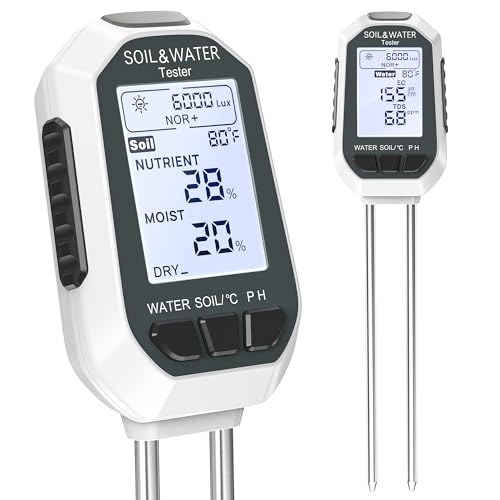
Buladeke Moisture Meter for Plants,7-in-1 Digital Soil Tester Kit | Soil pH Tester with LCD - Measures pH, EC, TDS, Fertility, Temp, Moisture & Sunlight, Garden Tools for Indoor & Outdoor
- 【7-in-1 Features】This is a 7-in-1 multi-function soil tester. Our soil tester quickly measures soil moisture, pH, temperature and…
- 【Large Screen & LCD Backlight】The Soil Moisture Meter has a large LCD display with white backlight that clearly shows the numerica…
- 【Fast and accurate measurement】With the latest 2025 probe technology, it can quickly and accurately measure soil pH, moisture, tem…
The Buladeke 7-in-1 digital tester is the instant-gratification option. Insert the probe about 10 cm into the soil, wait 10 seconds, and you get readings for moisture, pH, temperature, light intensity, EC, and TDS. The large LCD screen has a white backlight, so students can read it in a dim classroom or outside on a cloudy day. This is the kit that gets students excited because it looks and feels like real scientific equipment.
For classroom use, the speed is the main selling point. You can demonstrate a concept, pass the meter around, and have every student take a reading in under a minute. The fertility function gives a rough idea of nutrient availability without chemical tests. And the EC/TDS functions open the door to water quality experiments. It runs on four AAA batteries, which you’ll need to supply separately.
Accuracy is where this meter shows its limits. Digital probes at this price point are good for relative comparisons, not precise lab work. The pH reading in particular can drift, so calibrate it against a known sample before trusting the numbers. The probe also shouldn’t be forced into dry or hard soil, and it can’t measure liquids. Treat it as a teaching tool, not a research instrument.
- Measures 7 variables including EC and TDS
- Large backlit LCD for easy reading
- 10-second readings with no chemicals
- Requires 4 AAA batteries (not included)
- Good for relative comparisons, not precise lab work
Best for: Teachers who want fast, visual, reusable readings and don’t need lab-grade precision.
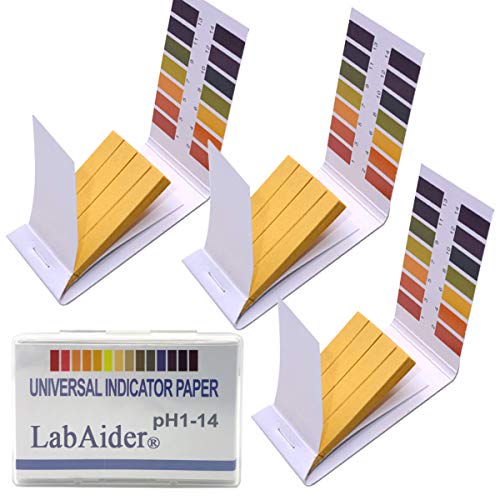
3 Pack pH.1-14 Test Paper Extensive Test Paper
LabAider
3 Pack pH.1-14 Test Paper Extensive Test Paper Litmus Test Paper 240 Strips pH Test with Storage Case for Saliva Urine Water Soil Testing Pet Food and Diet pH Monitoring (3 Pack with Storage Case)
- Paper Size: 45mm x 7mm (L x W), Comes with 3 Pack(240 pH Strips) and 1 Storage Case.
- The test strip color changes must be matched with the pH scale color chart within about 15 seconds. Different pH content discolora…
- There is a strong correlation between the pH of the body's internal environment and pH paper help you to maintain good healthy bod…
The LabAider pH strips are the simplest and cheapest entry point. You get 240 strips in three packs, each with a storage case. The strips measure the full 0-14 pH range. Students dip a strip in a soil slurry, wait 15 seconds, and match the color to the chart. That’s it. No batteries, no calibration, no capsules to measure. For a first lesson on acids and bases, this is hard to beat.
What makes these strips genuinely useful is the volume. With 240 strips, you can run multiple trials, let students make mistakes, and still have plenty left for next semester. The strips also work for testing other liquids like lemon juice, milk, and soap, which broadens the lesson beyond soil. The storage case keeps everything organized, and the color chart is printed on the case for quick reference.
Here’s the catch: pH strips only measure pH. They tell you nothing about nitrogen, phosphorus, potassium, or moisture. The color matching also requires good lighting and a decent eye. Students with color vision deficiencies may struggle. And the strips are single-use, so there’s ongoing cost if you test frequently. But for the price, it’s the most accessible way to introduce soil pH to a classroom.
- 240 strips across three packs with storage case
- Full 0-14 pH range with color chart
- Works for soil, water, and common liquids
- No batteries or calibration required
- Single-use strips, pH measurement only
Best for: Budget-conscious teachers introducing pH concepts or running large-group experiments with minimal setup.
How We Chose These Products
We evaluated each kit against the realities of a school environment: limited budget, limited time, and students with varying skill levels. A soil tester that requires a chemistry degree to operate doesn’t belong in a middle school classroom. We prioritized kits with clear instructions, repeatable results, and enough materials to serve multiple groups. The Rapitest kit scored highest because it covers four variables with 20 tests and needs no batteries or calibration.
We also considered the type of science being taught. Physical soil properties, chemical nutrients, and pH are different lessons. A kit that excels at one may be useless for another. The BUGUUYO kit fills a niche for permeability experiments. MySoil serves advanced research. The Buladeke meter gives instant digital feedback. The LabAider strips handle pH on a tight budget. Each earned its place by solving a specific classroom problem, not by being the most expensive or the most feature-packed.
Buying Guide: What Really Matters
Start with your learning objective. If students need to understand the nutrient cycle, you need a kit that tests nitrogen, phosphorus, and potassium. The Rapitest kit does this. If the lesson is about pH and acidity, strips or a digital meter work fine. If the project involves soil physics, you need a permeability kit like BUGUUYO. Buying a pH-only tool for a nutrient experiment wastes money and class time.
Next, count your students and groups. A kit with 20 tests works for four groups of five students. A kit with one mail-in analysis works for a single demonstration. Digital meters are reusable, which makes them cost-effective over multiple semesters, but they require batteries and careful handling. Strips are cheap but single-use. Match the kit’s capacity to your actual class size, not the ideal class size.
Finally, think about supervision. Capsule tests and mail-in kits need teacher oversight at critical steps. Digital meters and strips let students work more independently. If you have a classroom aide or parent volunteer, you can handle more complex kits. If you’re solo, choose tools with simple, forgiving procedures. The best soil tester for schools is the one your students can actually use without constant hand-holding.
Our Top Recommendation
The Luster Leaf Rapitest Soil Test Kit is our top pick for most school science projects. It covers pH, nitrogen, phosphorus, and potassium with 20 tests, which is enough for four lab stations. The color comparator system teaches visual matching skills, and the included plant pH list connects the chemistry to real gardening. It needs no batteries, no calibration, and no waiting for lab results. For a teacher who wants one kit that handles multiple lessons, this is the most practical choice.
If your budget is tight and you only need pH, the LabAider strips are the runner-up. They cost a fraction of the price and give you 240 tests. For advanced projects or science fairs, MySoil’s lab analysis delivers professional-grade data. The Buladeke meter is the best option for instant digital readings and reusable demonstrations. And the BUGUUYO kit earns a spot for permeability experiments that no other kit on this list can match.
Frequently Asked Questions
Can I use a home soil tester for a science fair project?
Yes, but check the rules first. Some science fairs require professional lab analysis for certain categories. The MySoil kit provides lab-grade results that satisfy most advanced categories. For general projects, the Rapitest kit or a digital meter works fine. Document your methodology carefully, including how many trials you ran and how you controlled variables.
How many soil samples can one kit test?
The Rapitest kit does 20 tests total, five for each variable. The LabAider strips give you 240 pH tests. The Buladeke meter is reusable with no limit. MySoil provides one lab analysis per kit. Match the kit’s capacity to your experiment design. If you’re testing three soil types with three replicates, you need at least nine tests per variable.
Do digital soil meters need calibration?
Most budget digital meters come pre-calibrated but drift over time. The Buladeke meter doesn’t include calibration solutions, so you’ll need to test it against a known sample if accuracy matters. For classroom demonstrations, the drift is usually acceptable. For research projects, calibrate before each session or use a lab-based method instead.
What’s the difference between pH strips and a pH meter?
Strips are cheap, single-use, and give a rough pH reading by color matching. Meters give a digital number and are reusable. Strips work well for qualitative comparisons and large groups. Meters work better for precise, repeated measurements. For a test for alkaline soil, either tool can work, but a meter gives you a specific number to record and graph.