You filled your raised planter boxes with what looked like perfect soil. The tomatoes went in, the peppers followed, and for a few weeks everything looked great. Then the leaves started to yellow. Maybe the blossoms dropped before fruit set. You watered more, then less. Nothing helped. The problem is probably underground, and you cannot see it. That is the moment most gardeners start hunting for a soil tester.
The search itself gets confusing fast. Some tools only check pH. Others claim to measure everything from moisture to sunlight to nutrient levels. You will find $10 analog prongs and $40 digital meters sitting side by side, and the reviews often contradict each other. A good tester for raised boxes needs to handle the unique conditions of container gardening. Raised beds drain faster, heat up quicker, and their soil chemistry can shift within a single season. The tool you choose should match how you actually garden.
We tested and researched five popular options, from capsule-based chemical kits to digital multi-function meters. Each one solves a different problem. The Luster Leaf Rapitest is the best pick for most raised-box gardeners who want accurate nutrient and pH readings. The SONKIR is the go-to for quick moisture checks without batteries. The Buladeke offers the most data for tech-minded growers. Here is how they compare.
| Features | Luster Leaf Rapitest | Dewilde pH Strips | SONKIR 3-in-1 Meter | Buladeke 7-in-1 Tester | YAMRON 4-in-1 Meter |
|---|---|---|---|---|---|
| Measurement Type | Chemical capsules | pH test strips | Analog probe | Digital LCD | Digital LCD |
| What It Measures | pH, N, P, K | pH only | Moisture, pH, light | 7 soil parameters | 4 soil parameters |
| Power Source | None needed | None needed | No battery | 4 AAA batteries | 4 AAA batteries |
| Tests Included | 20 total tests | 100 strips | Unlimited | Unlimited | Unlimited |
| Best Use Case | Nutrient diagnosis | Quick pH checks | Moisture monitoring | Full soil analysis | Beginner-friendly readings |
Luster Leaf Rapitest Soil Kit

Luster Leaf
Rapitest Soil Test Kit for Gardens, Vegetables, Flowers and Lawns. USA designed and assembled soil tester completely, quickly and accurately measures/analyzes soil pH acidity and garden nutrients.
- Quick, at home results for Soil pH, Nitrogen, Phosphorous and Potash Innovative and inexpensive soil test kit features an easy-to-…
- Contains all components needed for 20 tests. 5 for each of pH, N, P and K
- Contains all components needed to test all variables in several spots in the yard or garden
This is the kit for gardeners who suspect a nutrient problem but cannot pinpoint which one. The Rapitest uses a capsule system to measure pH, nitrogen, phosphorus, and potassium separately. You mix soil with water, add a capsule, shake, and compare the liquid color against a chart. It sounds old-school because it is, and that is exactly why it works. Raised planter boxes often develop nutrient imbalances that a simple pH probe will never catch.
What sets this kit apart is the depth of information it provides. You get five tests for each of the four variables, which is enough to sample different spots in a single raised bed or compare multiple boxes. The included pH preference list covers over 450 plants, so you can check whether your tomatoes actually want the same soil conditions as your blueberries. The color comparator is patented and genuinely easier to read than generic test strips. For a gardener dealing with yellowing leaves or poor fruit set, this kit answers the question a moisture meter cannot.
The trade-off is time and consumables. Each test takes several minutes of mixing and waiting. Once the capsules run out, you need to buy refills. The color matching also depends on your lighting; reading results under warm workshop lights can skew your interpretation. And this kit will not tell you anything about moisture or soil temperature. It is a diagnostic tool, not a daily monitor.
- Measures four separate soil variables: pH, nitrogen, phosphorus, and potassium
- Includes materials for 20 complete tests (5 per variable)
- Patented color comparator system for easier reading
- Comes with a pH preference list covering 450+ plant varieties
- No batteries or calibration required
Best for: The raised-bed gardener who needs to diagnose a specific nutrient deficiency or confirm soil pH before adding amendments.
Dewilde Trading Soil pH Strips

Dewilde Trading Co
Soil Test Kit – 100 Soil pH Test Strips (3.5–9 Range) for Garden, Lawn & Indoor Plants – Easy At-Home Soil Testing
- Accurate Soil pH Testing: Dewildetradingco Soil pH Test Strips offer measurements of soil pH levels (pH 3.5-9). As an essential to…
- User-Friendly Testing Procedure: The testing process is simple and efficient. Mix the sample soil with water, let the solution sit…
- Cost-Effective and Versatile: With 100 Soil PH checker strips included in each package, Dewildetradingco provides a cost-effective…
Sometimes you just need a fast pH reading without fussing with probes or capsules. The Dewilde kit gives you 100 test strips that measure pH from 3.5 to 9.0. That range covers almost every vegetable, flower, and fruit tree you would grow in a raised planter box. The process is straightforward: mix soil with water, let it sit for half an hour, dip a strip for three seconds, wait a minute, and match the color. It is low-tech, portable, and cheap per test.
The real advantage here is volume. With 100 strips, you can test multiple boxes, track pH changes over a season, or share strips with a neighbor. Each strip gives a single reading, so you can sample different zones within one large planter box without worrying about cross-contamination. The color chart on the bottle is easy to read in natural daylight. For gardeners who already own a moisture meter and only need occasional pH checks, this is a sensible add-on. If you are specifically dealing with alkaline soil conditions, you might want to read a dedicated alkaline soil tester guide to compare options.
Accuracy is the weak point. Test strips give you a range, not a precise number. The difference between pH 6.0 and 6.5 matters for some plants, and a color strip may not distinguish them clearly. You also need to wait 30 minutes for the soil-water solution to settle, which is not ideal when you want an answer right now. And like any consumable, the strips run out.
- 100 pH test strips covering a 3.5 to 9.0 range
- Simple dip-and-compare process with no batteries
- Portable bottle fits in a pocket or garden tote
- Color chart printed directly on the container
- Each strip provides a single-use reading
Best for: The budget-conscious gardener who wants a large supply of quick pH checks without investing in a digital meter.
SONKIR 3-in-1 Soil Meter

SONKIR
SONKIR Soil pH Meter, MS02 3-in-1 Soil Moisture/Light/pH Tester Gardening Tool Kits for Plant Care, Great for Garden, Lawn, Farm, Indoor & Outdoor Use (Green)
- Kindly NOTE: This soil tester can not be applied to test pH value of any other liquid. If the soil is too dry the indicator will n…
- 3 METERS IN ONE: Soil moisture level, Soil pH value and Sunlight level could be tested easily according to your need by switching…
- NO BATTERY NEEDED: Simply insert the meter into soil, wait few minutes, accurate test results will be displayed on the readout pan…
If the Luster Leaf kit felt like a chemistry set, the SONKIR is the opposite. This is a simple analog probe with a single switch and a analog dial. Push it into the soil, flip the switch to moisture, pH, or light, and read the needle. No batteries, no mixing, no waiting. For raised planter boxes that dry out quickly, the moisture function alone justifies the purchase. You can check five spots in two minutes and know exactly which boxes need water.
The build quality is decent for the price point. The probe is sturdy enough to push into loose potting mix, and the dial is large enough to read without squinting. The light sensor on top gives you a rough idea of whether your boxes are getting full sun or partial shade, which matters when you are deciding what to plant where. Since it never needs batteries, you can leave it in the garden shed all winter and grab it in spring without hunting for power.
Two limitations stand out. First, the pH reading is not precise. You get a general sense of acidic, neutral, or alkaline, but not a specific number you can act on. Second, the probe only works in moist soil. If your raised box is bone dry, the needle will not move at all. You need to water first, wait, then test. That is a minor annoyance, but it catches new gardeners off guard.
- Three functions: moisture, pH, and light level
- No batteries or external power required
- Analog dial with a simple function switch
- Works in garden beds, lawns, and indoor pots
- Compact and lightweight for easy storage
Best for: The gardener who wants a grab-and-go moisture checker and does not need precise pH numbers.
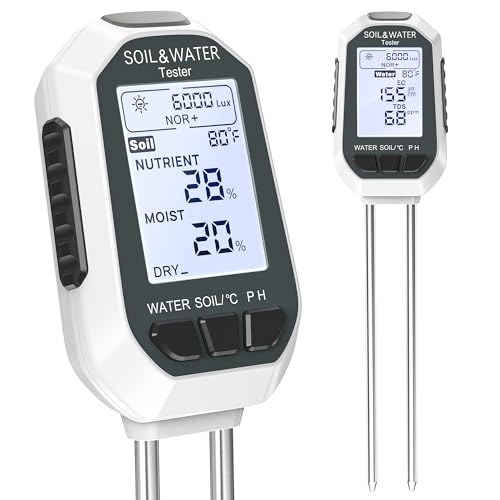
Buladeke 7-in-1 Digital Soil Tester
Buladeke
Buladeke Moisture Meter for Plants,7-in-1 Digital Soil Tester Kit | Soil pH Tester with LCD - Measures pH, EC, TDS, Fertility, Temp, Moisture & Sunlight, Garden Tools for Indoor & Outdoor
- 【7-in-1 Features】This is a 7-in-1 multi-function soil tester. Our soil tester quickly measures soil moisture, pH, temperature and…
- 【Large Screen & LCD Backlight】The Soil Moisture Meter has a large LCD display with white backlight that clearly shows the numerica…
- 【Fast and accurate measurement】With the latest 2025 probe technology, it can quickly and accurately measure soil pH, moisture, tem…
This is the most feature-dense tool in the group. The Buladeke measures soil moisture, pH, temperature, light intensity, fertility, EC, and TDS. That is seven data points from one probe. For a serious raised-bed gardener who wants to understand the full picture, this replaces several single-purpose tools. The large backlit LCD screen shows all readings clearly, even in low light. It runs on four AAA batteries and warns you when they are getting low.
The digital readout eliminates the guesswork of analog needles and color charts. You get specific numbers for pH and moisture, which makes tracking changes over time much easier. The fertility function is particularly useful in raised boxes, where nutrients deplete faster than in ground soil. The EC and TDS readings help you monitor salt buildup from repeated fertilizer applications, a common problem in container gardening. If you are managing a raised bed soil tester setup, this level of detail is genuinely helpful.
The learning curve is real. Seven functions mean seven sets of optimal ranges to remember, and the manual is not always clear about what constitutes a good reading for specific plants. The probe also requires careful handling. You cannot force it into hard, dry soil, and you should not use it to measure liquids directly. The batteries are not included, which is a small annoyance at this price point.
- Seven functions: moisture, pH, temperature, light, fertility, EC, and TDS
- Large backlit LCD screen for easy reading day or night
- Low battery warning and simple button controls
- Probe inserts about 10 cm into soil for readings
- Requires four AAA batteries (not included)
Best for: The data-driven gardener who wants comprehensive soil analysis and does not mind a small learning curve.
YAMRON 4-in-1 Soil Moisture Meter

YAMRON
4-in-1 Soil Moisture Meter Digital Plant Temperature/Soil Moisture/PH Meter/Sunlight Intensity Backlight LCD Display Soil Test Meter for Gardening, Farming and Outdoor Plants
- 【4 in 1 function】This is a 4-in-1 multifunctional soil tester.Our soil tester fastly to measure soil moisture, pH, temperature and…
- 【Large Screen & Backlight LCD Display】The Soil Tester uses a large LCD screen and white backlight to conveniently display and read…
- 【Quick Accurate measurement】The latest probe detection technology in 2026 can quickly and accurately measure the pH, moisture and…
The YAMRON sits between the simple SONKIR and the complex Buladeke. It measures four things: moisture, pH, temperature, and sunlight. The digital screen is large and backlit, with clear numbers and simple icons. The 45-degree rotating head is a small but thoughtful design choice. You can tilt the display toward you without bending over or crouching, which matters when you are checking boxes at ground level.
Setup is quick. Insert the probe about four inches into the soil, wait ten seconds, and read the values. The instructions recommend taking at least five readings from different spots and averaging them for pH and moisture. That is good advice for raised planter boxes, where soil conditions can vary from one end to the other. The temperature reading is a bonus that helps you decide when to plant warm-season crops. For a gardener who wants digital accuracy without seven different functions to manage, this hits a comfortable middle ground.
The main drawback is the same as any probe-style meter: it needs moist soil to work. Dry, hard soil can damage the probe, so you must water and wait before testing. The pH accuracy is decent but not laboratory-grade. And the batteries are not included, so plan ahead. If you are also working with sandy mixes, a dedicated sandy soil tester might give you more relevant guidance.
- Four functions: moisture, pH, temperature, and sunlight
- Large LCD screen with white backlight
- 45-degree rotating head for comfortable viewing
- Probe inserts about 4 inches into soil
- Powered by four AAA batteries (not included)
Best for: The gardener who wants digital readings for the essentials without the complexity of a full seven-function meter.
How We Chose These Products
We started by identifying what actually matters for raised planter boxes. These containers drain faster, heat up more, and hold less soil volume than in-ground beds. A tester needs to handle those conditions. We looked at five factors: measurement accuracy, ease of use, durability, battery or consumable requirements, and the range of data provided. A tool that only measures pH is fine for some gardeners but useless for others. We prioritized options that cover different needs rather than five versions of the same thing.
We also considered real-world feedback and the practical realities of gardening. A tester that takes 30 minutes per reading will not get used often. A probe that breaks after three insertions is a waste of money. We favored tools with clear instructions, reasonable durability, and a track record of working in container gardens. No single tester wins every category, so we included a mix of chemical, analog, and digital options to match different gardening styles and budgets.
Buying Guide: What Really Matters
The first question is what you actually need to measure. If your plants look healthy and you just want to avoid overwatering, a simple moisture meter is enough. If you are troubleshooting yellow leaves or poor growth, you need pH and nutrient data. Raised planter boxes are prone to nutrient depletion because the soil volume is limited. A kit that measures nitrogen, phosphorus, and potassium gives you actionable information that a pH-only tool cannot.
Consider how often you will test. Consumable kits and test strips are great for occasional diagnostics, but they run out. Digital meters and analog probes cost more upfront but work indefinitely. Battery-powered meters add convenience but require you to keep spare batteries on hand. Analog probes never need power, but they are less precise. Match the tool to your testing frequency and your tolerance for maintenance.
Do not overlook probe length and build quality. Raised boxes are often deeper than standard pots, so a longer probe reaches the root zone more accurately. Cheap probes bend or corrode quickly, especially in moist soil. A slightly higher price for a sturdier build usually pays off over a few seasons. Finally, check whether the tester comes with a plant preference list or guidance on optimal ranges. Raw numbers mean nothing if you do not know what your tomatoes or peppers actually need.
Our Top Recommendation
The Luster Leaf Rapitest Soil Test Kit is our top pick for most raised planter box gardeners. It measures the four variables that matter most for diagnosing plant problems: pH, nitrogen, phosphorus, and potassium. The capsule system is accurate enough for home gardening, and the included plant preference list helps you interpret results. It costs less than most digital meters and requires no batteries. The main downside is that it is a diagnostic tool, not a daily monitor, but that is exactly what most gardeners need.
If you want a quick moisture checker for everyday use, the SONKIR 3-in-1 is a solid runner-up. It never needs batteries and gives you instant readings. For gardeners who prefer digital precision and want a broader data set, the Buladeke 7-in-1 is the most comprehensive option. The YAMRON 4-in-1 is a good middle ground for beginners who want digital readings without the complexity. And if you only need pH strips in bulk, the Dewilde kit is the budget-friendly choice.
Frequently Asked Questions
Can I use a regular soil tester in a raised planter box?
Yes, but you need to account for the differences in container soil. Raised boxes dry out faster and have less buffering capacity than ground soil. A tester that works well in a garden bed may give different readings in a raised box. Look for tools that measure moisture accurately, since overwatering and underwatering are the most common mistakes in container gardening.
How often should I test the soil in my raised planter boxes?
Test pH and nutrients at the start of each growing season and again mid-season if plants show stress. Moisture should be checked every few days, especially during hot weather. Digital meters and analog probes make frequent testing easy. Chemical kits are better for periodic deep checks rather than weekly monitoring.
What pH range is best for vegetables in raised boxes?
Most vegetables prefer a pH between 6.0 and 7.0. Tomatoes, peppers, and lettuce all fall in that range. Blueberries and potatoes want more acidic soil, around 4.5 to 5.5. Always check the specific preferences for what you are growing. The Luster Leaf kit includes a list of over 450 plants to help with this.
Do I need a nutrient tester or just a pH meter?
It depends on your plants. If they look healthy and you fertilize regularly, a pH meter may be enough. If you see yellowing leaves, stunted growth, or poor fruit set, you need nutrient data. Nitrogen, phosphorus, and potassium deficiencies cause distinct symptoms that a pH reading alone will not explain. A kit like the Rapitest covers both bases.