I killed a $60 Anthurium once because a cheap moisture meter told me the soil was dry when it wasn’t. The probe sat in a pocket of air inside chunky bark mix, gave a false reading, and I watered a plant that was already sitting in moisture. That mistake sent me down a rabbit hole of testing gadgets, and most of what I found was built for tomato beds and lawn turf, not the soilless blends exotic plant owners actually use.
A good soil tester for exotic plants needs to handle bark, perlite, sphagnum moss, and coco coir. Standard garden probes often fail in these chunky substrates because they can’t make consistent contact. The best tools also give you pH and nutrient feedback, not just moisture, since tropicals, orchids, and carnivorous plants each have narrow pH preferences.
Below are five testers I’d actually recommend, ranked by how well they perform in real soilless conditions. You’ll find a budget analog probe, a digital 4-in-1, a 7-in-1 with fertility readings, a dual-dial hybrid, and a simple 2-in-1. Each one suits a different type of grower.
Here’s a quick spec comparison to help you spot the differences before reading the full reviews.
| Features | SONKIR MS02 | Buladeke 7-in-1 | YAMRON 4-in-1 | HSLGOVE 7-in-1 | Aenncci 2-in-1 |
|---|---|---|---|---|---|
| Functions | 3-in-1 analog | 7-in-1 digital | 4-in-1 digital | 7-in-1 dual-dial | 2-in-1 dual dial |
| Power Source | No battery | 4 AAA batteries | 4 AAA batteries | 3 batteries | No battery |
| Display Type | Analog needle | LCD backlit | LCD backlit | LCD plus dial | Dual analog dial |
| Probe Depth | Standard single probe | About 10cm | About 10cm | Over 3 inches | Over 4 inches |
| Best Use Case | Budget indoor use | Tropical indoor plants | Mixed indoor collection | Serious indoor growers | Succulents and cacti |
SONKIR Soil pH Meter, MS02

SONKIR
SONKIR Soil pH Meter, MS02 3-in-1 Soil Moisture/Light/pH Tester Gardening Tool Kits for Plant Care, Great for Garden, Lawn, Farm, Indoor & Outdoor Use (Green)
- Kindly NOTE: This soil tester can not be applied to test pH value of any other liquid. If the soil is too dry the indicator will n…
- 3 METERS IN ONE: Soil moisture level, Soil pH value and Sunlight level could be tested easily according to your need by switching…
- NO BATTERY NEEDED: Simply insert the meter into soil, wait few minutes, accurate test results will be displayed on the readout pan…
The SONKIR MS02 is the tester most people buy first. It’s a 3-in-1 analog meter covering moisture, pH, and light, and it needs no batteries. For someone with a handful of pothos, snake plants, or basic houseplants, it does the job without fuss. Exotic plant owners will find it useful as a backup tool, especially for quick moisture checks.
What stands out is the simplicity. You flip a switch to pick your function, insert the probe, and wait a few minutes. No menus, no calibration screens, no dead batteries. The build feels sturdier than the price suggests, and the single probe causes minimal root disturbance when you slide it in carefully. It’s also handy for checking light levels near a window before you place a light-hungry aroid there.
Here’s the honest part: analog meters drift, and this one is no exception. Readings get less reliable in very dry or very chunky soil. The manufacturer even warns that dry soil won’t move the needle. In bark-heavy orchid mixes, the probe often hits air pockets and reads low. You’ll want to test multiple spots and average the results. It also can’t measure temperature, EC, or nutrients.
- Measures moisture, pH, and light with a single switch
- No batteries required, works immediately out of the box
- Single probe design limits root damage on delicate plants
- Needs moist soil to give reliable readings
- Less accurate in chunky or bark-based substrates
Best for: Beginners and casual houseplant owners who want a no-fuss, battery-free tester for standard potting mixes.
Buladeke Moisture Meter for Plants
Buladeke
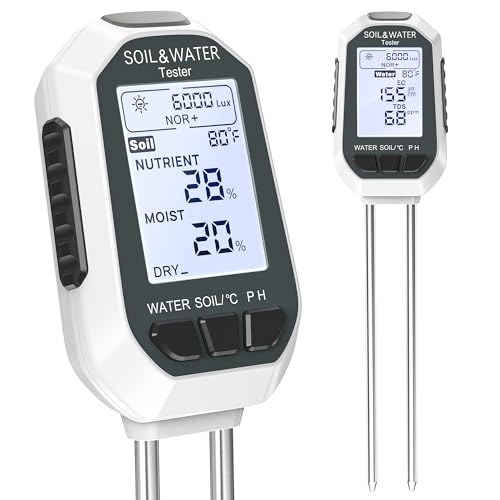
Buladeke Moisture Meter for Plants,7-in-1 Digital Soil Tester Kit | Soil pH Tester with LCD - Measures pH, EC, TDS, Fertility, Temp, Moisture & Sunlight, Garden Tools for Indoor & Outdoor
- 【7-in-1 Features】This is a 7-in-1 multi-function soil tester. Our soil tester quickly measures soil moisture, pH, temperature and…
- 【Large Screen & LCD Backlight】The Soil Moisture Meter has a large LCD display with white backlight that clearly shows the numerica…
- 【Fast and accurate measurement】With the latest 2025 probe technology, it can quickly and accurately measure soil pH, moisture, tem…
Buladeke’s 7-in-1 tester is what I’d hand to someone growing tropicals indoors. It reads moisture, pH, temperature, light, fertility, EC, and TDS. That last set is unusual at this price point and genuinely useful for anyone running a fertilizing schedule on aroids, monsteras, or philodendrons. The large backlit LCD makes night checks easy, which matters during winter when you’re watering after work.
Speed is the standout feature. Insert the probe about 10cm deep, wait 10 seconds, and you get a number. Compare that to the 3-5 minute wait on analog meters, and you’ll understand why digital wins for anyone testing multiple pots. The fertility function gives you a rough sense of when your potting mix is running out of nutrients, which is helpful between repotting cycles. For a fuller look at tools built for potted plants specifically, this potted plants guide covers similar ground.
The trade-offs are real. It needs four AAA batteries, and they aren’t included. You also can’t jam it into dry, hard soil or you’ll damage the probe. Exotic plant owners using bark mixes should water the area slightly and wait 10 minutes before testing. The EC and TDS readings are more about water quality than soil, so don’t expect lab-grade nutrient analysis.
- Seven functions including EC, TDS, and fertility
- 10-second readings versus minutes on analog meters
- Backlit LCD readable in low light
- Requires four AAA batteries, sold separately
- Probe can be damaged by forcing into dry soil
Best for: Indoor tropical plant owners who fertilize regularly and want fast digital readings plus nutrient feedback.
YAMRON 4-in-1 Soil Moisture Meter

YAMRON
4-in-1 Soil Moisture Meter Digital Plant Temperature/Soil Moisture/PH Meter/Sunlight Intensity Backlight LCD Display Soil Test Meter for Gardening, Farming and Outdoor Plants
- 【4 in 1 function】This is a 4-in-1 multifunctional soil tester.Our soil tester fastly to measure soil moisture, pH, temperature and…
- 【Large Screen & Backlight LCD Display】The Soil Tester uses a large LCD screen and white backlight to conveniently display and read…
- 【Quick Accurate measurement】The latest probe detection technology in 2026 can quickly and accurately measure the pH, moisture and…
YAMRON’s 4-in-1 covers moisture, pH, temperature, and sunlight. It sits in the middle of the pack on features but wins on ergonomics. The 45-degree rotating head lets you read the screen without crouching, which sounds minor until you’ve spent twenty minutes hunched over a shelf of plants. Anyone with a mixed indoor collection, from succulents to ferns, will appreciate the versatility.
The screen uses visual icons alongside numbers, so beginners can interpret readings without memorizing pH ranges. That’s a small but thoughtful design choice. The 2026 probe technology gives fast results, and the 10cm insertion depth works well for most medium pots. It’s also the tester I’d suggest for anyone testing multiple pots per session, since averaging five readings per plant is the manufacturer’s own recommendation for accuracy.
Batteries are again not included, and the probe has the same dry-soil limitation as the Buladeke. The pH reading is a general indicator, not a precision measurement. If you’re growing acid-loving exotics like anthuriums or certain orchids, you’ll want a dedicated pH tool for confirmation. This unit is best treated as a solid all-rounder rather than a specialist.
- Four functions with a rotating 45-degree head
- Icon-based screen helps beginners interpret data
- 10-second readings with 10cm probe depth
- Manufacturer recommends averaging five readings per plant
- Needs four AAA batteries, not included
Best for: Growers with varied indoor collections who want a comfortable, fast digital tester without paying for fertility or EC features.
HSLGOVE Soil Test Kit, 7-in-1

HSLGOVE
HSLGOVE Soil Test Kit, 7-in-One Soil Moisture Meter/Soil PH Meter/Fertility, Dual Screen Soil Tester w/Digital Soil Temp/Air Temp&Humidity for Plants Gardening,Lawn,Farm Indoor&Outdoor-Lvory White
- ✅ 1Dial & 1 LCD Screen - Replace/install all 3 batteries each time. Put button to %RH/°F to - Turn On, and put to LIGHT to - Turn…
- 7Meter-in1 Comprehensive Maintenace: Specially designed for beginners, the built-in 1.6" chips board, can meet all your needs for…
- Design Patented US & Utility Patented US: Origin Dual-Dial Design -combined with both soil meter and LCD-display soil/air temperat…
HSLGOVE’s 7-in-1 is the most feature-dense option here, and it’s built for people who want a single device to cover everything. It combines an analog dial with an LCD screen, measuring soil moisture, pH, fertility, temperature, light, plus air temperature and humidity. For serious collectors running a grow shelf or small greenhouse, that air humidity reading is a genuine bonus since many tropicals care as much about ambient moisture as soil moisture.
The dual-dial design is patented, and the probe uses three metal materials for durability. At roughly 6.8 inches, it reaches deeper into larger pots than most competitors, which helps when you’re testing a mature monstera in a 12-inch container. The single-probe design also minimizes root damage, a real concern with delicate epiphyte roots. If you’re working with acid-loving species, the fertility and pH combo gives you more to work with than a moisture-only tool.
Setup is fussier than the digital-only options. You’re managing both a dial and an LCD, and the button sequence for switching modes takes a day to get used to. Battery installation covers all three cells at once, which is convenient but means one dead battery takes the whole unit offline. It’s also the priciest-feeling option here, so casual growers may find it overkill.
- Combines analog dial and LCD screen in one unit
- Measures soil plus air temperature and humidity
- 6.8-inch probe reaches deeper into large pots
- Three-metal probe for durability and accuracy
- Button and mode switching takes time to learn
Best for: Serious indoor growers and small greenhouse owners who want comprehensive environmental data in one tool.
Aenncci Soil Test Kit, 2-in-1
Aenncci’s 2-in-1 strips things back to moisture and pH only. That’s it. For succulent and cacti owners, that’s often all you need. These plants care about two things: whether the soil is fully dry before the next watering, and whether the pH sits in a reasonable range. The large dual dial shows both readings at once, so there’s no button to press or mode to switch.
The battery-free design is the biggest selling point. You insert the probe more than four inches deep, wait a moment, and read the dial. No charging, no AAA runs to the store, no low-battery warnings. The single probe is also gentler on roots than multi-prong designs, which matters when you’re checking a shallow-rooted haworthia or a tightly packed echeveria. The manufacturer backs it with a 24-hour customer service promise, which is a nice touch at this price.
Limitations are obvious. No temperature, no light, no nutrients. If you’re growing acid-loving exotics, the pH dial is coarse and won’t give you the precision you’d want for orchids or carnivorous plants. It’s also strictly for soil, not water. For succulent owners, though, the simplicity is the point. You don’t need seven functions to know when to water a jade plant.
- Simultaneous moisture and pH readings on one dial
- No batteries, no switches, no setup
- Requires insertion deeper than four inches
- Single probe reduces root disturbance
- No temperature, light, or nutrient readings
Best for: Succulent and cacti owners who want a simple, battery-free way to check moisture and pH without extra features.
How We Chose These Products
We started with the substrate problem. Most soil testers are designed for garden dirt, which is dense and holds moisture evenly. Exotic plants sit in bark, perlite, sphagnum moss, coco coir, and other chunky blends that create air pockets. A tester that reads perfectly in a raised bed can give nonsense in an orchid pot. So we prioritized tools that either work in soilless mixes or clearly state their limitations.
Next came the feature set. Moisture alone isn’t enough for exotic plant owners. pH matters for acid-loving species like anthuriums and many orchids. Fertility and EC readings help you avoid over-fertilizing, which is a common killer of slow-growing tropicals. Temperature and humidity matter for plants that sulk below 65°F. We favored testers that covered more of these without adding gimmicks.
Finally, we weighed practicality. Battery life, probe depth, root damage risk, and reading speed all affect whether you’ll actually use the tool. A tester that takes five minutes per pot won’t get used on a collection of thirty plants. A probe that snaps in dry bark is worse than useless. Every pick here balances usefulness against real-world friction.
Buying Guide: What Really Matters
Probe depth is the first spec to check. Exotic plants often live in deeper pots than standard houseplants, and a short probe only reads the top inch or two of soil. That top layer dries out faster than the root zone, so you’ll get a false dry reading and overwater. Look for at least 4 inches of insertion, ideally closer to 6 for large containers.
Accuracy claims are tricky. Analog meters drift over time and respond slowly. Digital meters give faster numbers but can be thrown off by air gaps in chunky mixes. No consumer tester is lab-grade. The practical approach is to test multiple spots per pot and average the results, which is exactly what YAMRON recommends. For a deeper look at which kits hold up under scrutiny, this accuracy comparison of soil testing kits is worth reading.
Calibration is the elephant in the room. Cheap pH meters rarely come calibrated, and even the digital ones here use general-purpose sensors. If you’re growing acid-loving exotics, you’ll get better results cross-checking with pH strips or a dedicated pen. For general moisture and trend tracking, the built-in sensors are fine. Just don’t treat any single reading as gospel.
One more thing: consider what you’ll actually test. If you only grow succulents, a 2-in-1 is plenty. If you’re running a mixed collection with orchids, aroids, and carnivorous plants, you need pH and ideally temperature. Match the tool to your collection, not to the longest feature list. For more on this, see our guide to the best soil tester for acid-loving plants.
Our Top Recommendation
The Buladeke 7-in-1 is the best overall pick for most exotic plant owners. It’s fast, readable, and covers the features that actually matter for tropicals: moisture, pH, temperature, light, and fertility. The 10-second readings mean you’ll actually use it. The fertility function helps you time fertilizing between repotting, which is a real pain point with slow-growing aroids.
If you want a simpler, battery-free option for succulents and cacti, the Aenncci 2-in-1 is the runner-up. It does two things well and never needs charging. For serious collectors running a grow shelf or greenhouse, the HSLGOVE 7-in-1 adds air humidity and a deeper probe, which justifies the extra complexity. Budget buyers who just want a basic moisture and pH check should look at the SONKIR MS02, though it struggles in bark-heavy mixes.
Frequently Asked Questions
Can I use a garden tester on orchid bark?
You can, but expect lower accuracy. Bark creates air pockets that break contact with the probe, so readings often skew dry. Water the bark lightly and wait ten minutes before testing, then take readings from at least three spots and average them. Digital testers with thin probes handle bark better than thick analog ones.
How often should I test exotic plant soil?
Test after every repotting, after fertilizing, and whenever you change your watering routine. During active growing season, a monthly check on moisture and pH is reasonable. In winter, most tropicals slow down and need less water, so testing every two to three weeks prevents overwatering. Carnivorous plants and orchids benefit from more frequent checks since their substrates break down faster.
Why does my moisture meter read dry when the soil is wet?
This usually means the probe isn’t making full contact with the substrate. Chunky mixes, bark, and perlite create gaps. Push the probe in at a slight angle and test multiple spots. If readings stay inconsistent, your meter may be drifting and needs replacement or recalibration.
Do I need a separate pH pen for acid-loving plants?
For most growers, no. The pH readings on these testers are good enough to spot trends. But if you’re growing orchids, anthuriums, or carnivorous plants where a half-point shift matters, a dedicated pH pen gives you more precision. Use the multi-function tester for moisture and temperature, and a pen for pH confirmation.