You planted the trees, watered them on schedule, and pruned like the extension office told you. Two seasons later the leaves still look pale and the fruit set is thin. Nine times out of ten the problem sits six inches underground, in soil you have never actually measured.
A good soil tester for backyard orchards does one job well: it tells you what your trees are working with before you spend another dollar on fertilizer you may not need. The right tool depends on whether you want a quick pH reading today or a full nutrient breakdown you can act on next month.
Below are five testers that cover both ends of that spectrum, plus the middle. The LAWNFUL pH pen wins for most home growers who want fast answers, the MySoil mail-in kit is the pick for anyone serious about long-term orchard health, and the Rapitest kit sits in the middle for beginners who want to check nitrogen, phosphorus, and potassium without mailing anything off.
| Features | LAWNFUL pH Meter | Rapitest Soil Kit | MySoil Lab Kit | VT-05 pH Meter | HiHydro Soil Probe |
|---|---|---|---|---|---|
| Test Method | Digital probe, instant read | Capsule color comparison | Mail-in lab analysis | Analog probe, instant read | Manual soil extraction |
| What It Measures | pH only | pH, N, P, K | 13 nutrients plus pH | pH and moisture | Sample collection only |
| Power Source | 3 AA batteries included | None required | None required | Self-powered, no batteries | None required |
| Turnaround Time | Instant | Minutes per test | 6-8 days | Instant | Instant sample |
| Best Use Case | Quick pH checks | Beginner nutrient testing | Serious orchard management | Vineyard and orchard rows | Deep profile sampling |
LAWNFUL Digital Soil pH Meter
The LAWNFUL is what most backyard orchard owners should buy first. It’s a handheld pH pen with two stainless steel probes, a clear LCD readout, and a calibration-free design that works straight out of the box. If you manage a handful of fruit trees and just want to know whether your soil is drifting acidic or alkaline, this gets you there in under a minute per spot.
What stands out is the build quality at this price point. The double-needle probe is anticorrosive and sensitive enough to pick up small pH shifts between rows, which matters when you’re comparing soil under a plum tree versus soil near a fence line. The included AA batteries are rated for roughly five years of normal use, so you won’t be hunting for replacements every season. It’s also light at 160 grams, easy to pocket while you walk the orchard.
Here’s the honest limitation: it reads pH and nothing else. No nitrogen, no phosphorus, no potassium. If your trees are yellowing from a nutrient deficiency rather than a pH problem, this meter won’t tell you. It also needs reasonably moist soil to give a stable reading, so dry summer ground may require a quick watering first.
- Industrial-grade accuracy with embedded calibration algorithms
- Dual stainless steel probes resist corrosion over years of use
- Runs on three AA batteries with roughly a five-year lifespan
- Weighs 160 grams, pocket-sized for field use
- Backed by a one-year replacement warranty
Best for: Home orchardists who want fast, reliable pH readings without a lab bill or a steep learning curve.
Rapitest Soil Test Kit for Gardens

Luster Leaf
Rapitest Soil Test Kit for Gardens, Vegetables, Flowers and Lawns. USA designed and assembled soil tester completely, quickly and accurately measures/analyzes soil pH acidity and garden nutrients.
- Quick, at home results for Soil pH, Nitrogen, Phosphorous and Potash Innovative and inexpensive soil test kit features an easy-to-…
- Contains all components needed for 20 tests. 5 for each of pH, N, P and K
- Contains all components needed to test all variables in several spots in the yard or garden
Luster Leaf’s Rapitest kit is the classic starter option for anyone who wants to check more than pH. It uses a capsule system with color comparators to measure pH, nitrogen, phosphorus, and potash. You get five tests for each variable, twenty total, which is plenty to sample several spots around a small orchard before the season starts.
The real value here is the included pH preference list covering over 450 plants. That reference alone saves you a lot of guessing when you’re trying to figure out whether your apple trees want the same soil conditions as your blueberries. For a beginner who has never tested soil before, the step-by-step instructions make the process approachable.
Color matching is the weak point. Reading a capsule against a printed chart is subjective, and results can vary depending on lighting and how good your eyes are. It’s also a consumable product. Once the twenty tests are gone, you buy refills or a new kit. For someone managing a dozen trees across multiple seasons, that adds up.
- Tests pH, nitrogen, phosphorus, and potash in one kit
- Twenty total tests, five per variable
- Capsule system with patented color comparators
- Includes pH preference data for over 450 plants
- No batteries or electronics to maintain
Best for: Beginners and casual gardeners who want a broad nutrient snapshot without spending much.
MySoil Soil Test Kit, Unlock Your Lawn

My Soil
MySoil Soil Test Kit, Unlock Your Lawn & Garden Potential, Complete & Accurate Nutrient and pH Analysis with Recommendations Tailored to Your Soil and Plant Needs
- KNOW BEFORE YOU GROW | Grow the healthiest, sustainable lawn and garden with the most accurate and easy to use professional soil t…
- FAST & ACCURATE | Unlike at-home pH meters and test strips, our mail-in professional lab analysis accurately measures 13 plant-ava…
- FOR ANY GROWING SCENARIO | Tests any soil type and growing condition - lawn & turf, vegetable gardening, flowers, compost, trees,…
MySoil takes a completely different approach. You collect a soil sample, mail it in, and a professional lab analyzes it for thirteen plant-available nutrients including nitrogen and pH. Results come back in six to eight days with custom fertilizer recommendations, both organic and non-organic, telling you what to apply, how much, and when.
For anyone running a serious backyard orchard, this is the most accurate option on the list. Home meters and strips give you a ballpark. Lab analysis gives you actual numbers you can build a multi-year soil management plan around. The recommendations are tailored to your specific soil and plant needs, which means you stop guessing and stop over-applying products your trees don’t need.
The trade-off is obvious: you wait over a week for results, and it’s a one-time test per sample. You also can’t retest on a whim the way you can with a handheld meter. If you want to monitor pH weekly through a growing season, this isn’t the tool for that. It’s a snapshot, not a live feed.
- Lab analysis of 13 plant-available nutrient levels
- Results delivered in 6-8 days
- Works for lawns, gardens, trees, vines, and hydroponics
- Custom organic and non-organic fertilizer recommendations
- Identifies exactly what to apply and when
Best for: Committed orchard owners who want professional-grade data and a real soil management plan.
VT-05 Professional Soil pH Meter

Tangxi
VT-05 Professional Soil pH Meter Tester, Soil pH and Moisture Meter Hygrometer, Soil Tester PH Instrument Hygrometer Monitor Humidity for Vineyards, Orchards, Field Production, Lawn, Gardens
- value measurement range: 3~8 , accuracy: ±0.3 . meter can tell you the value. The best working temperature range of is at working…
- Equipped with a metal electrode, which can quickly and accurately measure the and humidity levels, as well as the and values of di…
- Very suitable for vineyards, orchards, field production, caretakers, lawn care, gardens, quick and planting humidity reference.
Tangxi built the VT-05 with vineyards and orchards in mind, and it shows. The meter reads both pH and moisture on a single analog dial, with a pH range of 3 to 8 and accuracy of plus or minus 0.3. It’s self-powered, so no batteries to replace, ever. For row-by-row orchard checks where you want to compare moisture retention alongside pH, this dual reading saves a step.
The metal electrode responds quickly to soil changes, and the working temperature range of 5 to 50 degrees Celsius covers most growing seasons in temperate climates. Field producers and caretakers who walk long rows will appreciate not carrying spare batteries. The analog display is also easy to read in bright sun, which digital screens sometimes struggle with.
Two real caveats. First, accuracy of plus or minus 0.3 pH is looser than the LAWNFUL’s digital precision, so if you need tight numbers for acid-loving crops, this may not cut it. Second, availability is spotty. This model goes in and out of stock, so check the current listing before you commit. The probe also needs cleaning between readings to avoid cross-contamination.
- Measures both pH and moisture on one dial
- pH range 3 to 8 with plus or minus 0.3 accuracy
- Self-powered, no batteries required at all
- Metal electrode for fast soil response
- Working temperature range 5 to 50 degrees Celsius
Best for: Vineyard and orchard growers who want pH and moisture in one pass without battery hassles.
HiHydro 12 Inch Stainless Steel Soil Probe
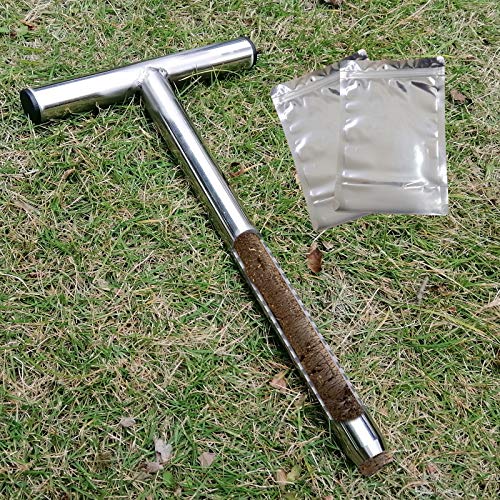
The HiHydro isn’t a tester in the electronic sense. It’s a soil sampling tool. The 12-inch stainless steel probe with a T-handle lets you pull a clean core from deeper in the profile, which matters for orchards where tree roots run well below the surface. Two reusable sample bags come included for collecting and inspecting soil from different spots.
Anyone who plans to send samples to a lab needs a tool like this. You can’t get a meaningful lab result from a handful of surface dirt. The probe is marked at 7.87-inch intervals so you know exactly how deep you sampled, and the T-handle gives enough leverage to push through moderately compacted ground. It’s also useful for visual soil profile inspection, checking moisture content by feel, and selecting the right fertilizer for root development.
Limit one: it doesn’t measure anything. No pH, no nutrients, no moisture reading. You still need a meter or a lab kit to interpret what you pull up. It also struggles in hardened or bone-dry soil, so sampling after rain or irrigation works far better. Think of it as the shovel you wish you had, not the answer itself.
- 12-inch stainless steel probe with T-handle grip
- Marked at 7.87-inch intervals for depth accuracy
- Includes two reusable sample bags
- Works for gardens, lawns, farms, and golf courses
- Best on soil that isn’t hardened or dried out
Best for: Growers who plan to mail samples to a lab and need a clean, deep core every time.
How We Chose These Products
We looked at what backyard orchard owners actually need, not what sounds impressive on a spec sheet. Accuracy mattered most, followed by durability, ease of use, and whether the tool solves a real problem for someone managing fruit trees rather than a single houseplant. Products that only read pH got judged on how well they do that one job. Products that do more got judged on whether the extra features earn their keep.
We also weighed the trade-offs honestly. A lab kit beats a handheld meter on precision every time, but it can’t give you an instant reading. A probe beats both for sample quality but measures nothing on its own. The five picks here cover the full range, so you can match the tool to how you actually work in your orchard. For growers dealing with specific soil conditions, our orchard soil health guide digs into those scenarios further.
Buying Guide: What Really Matters
Start with what you’re trying to measure. If you only care about pH, a digital pen like the LAWNFUL is faster and cheaper than anything else. If you suspect a nutrient deficiency, you need a kit that reads nitrogen, phosphorus, and potassium, or a lab analysis. Buying a pH-only tool when your problem is potassium is money wasted.
Accuracy claims deserve scrutiny. Consumer meters typically land within plus or minus 0.2 to 0.5 pH. That’s fine for most fruit trees. It’s not fine if you’re growing blueberries or citrus, which are picky about pH. For those crops, a lab test or a higher-precision meter is worth the extra cost. Our breakdown of citrus orchard testing covers that in more detail.
Think about frequency, too. A one-time lab test gives you a baseline. A handheld meter lets you check weekly and catch drift early. Many serious growers use both: lab analysis once a year for the full picture, a cheap pen for spot checks in between. And don’t overlook sample quality. A $10 probe that pulls a clean 8-inch core will give you better data than a $100 meter jammed two inches into dry topsoil.
Our Top Recommendation
For most backyard orchard owners, the LAWNFUL Digital Soil pH Meter is the right first purchase. It’s accurate, durable, calibration-free, and cheap enough that you can add a lab kit later without feeling like you wasted money. The five-year battery life and one-year warranty seal it. If you want to read more about matching testers to specific orchard conditions, our vineyard soil testing guide is a good next step.
The MySoil kit is the runner-up and the better pick if you’re managing mature trees and want a real nutrient plan. The Rapitest kit suits tight budgets and beginners. The VT-05 works well for vineyard-style row checking, and the HiHydro probe is essential if you plan to send samples to a lab. Different jobs, different tools.
Frequently Asked Questions
Can I use a pH meter on dry soil?
No, not reliably. Most probes need moisture to conduct a reading. Water the spot lightly, wait a few minutes, then insert the probe. Dry soil readings are usually inaccurate or won’t register at all.
How often should I test my orchard soil?
Twice a year works for most home orchards: once in early spring before growth starts and once in late summer. If you’re correcting a pH problem, test monthly until levels stabilize. A lab test once a year gives you the deeper nutrient picture.
Is a lab test worth it over a home meter?
Yes, if you want to know more than pH. Home meters can’t measure nitrogen, phosphorus, or potassium accurately. A lab test tells you exactly what’s available to your trees and what to add. The MySoil kit costs more per test but gives you data you can actually build a plan around.
Do cheap soil testers give accurate results?
Inexpensive digital pH pens can be accurate within plus or minus 0.2 to 0.3 pH, which is fine for most fruit trees. Cheap analog meters vary more. Capsule kits depend on your color perception. For critical decisions like correcting severe acidity, confirm with a lab test before making big amendments.