Citrus trees are picky about soil in a way most garden plants are not. A lemon planted in ground that reads 7.2 on a cheap probe will sulk for two seasons, drop blossoms, and produce fruit with thick rinds and dry pockets. The tree is not dying. It is starving, because iron and zinc lock up in alkaline soil even when those nutrients are sitting right there.
A good citrus soil tester has to do two things well: read pH with enough accuracy to trust the number, and hold that accuracy across wet winter soil and bone-dry summer beds. Analog probes are cheap and battery-free but drift. Digital meters give you numbers but vary wildly in build quality. Lab kits cost more and take a week, yet they measure nutrients no handheld probe can touch.
Below are five testers worth your money, ranging from a $10 analog stick to a professional mail-in lab kit. Each one solves a different problem, and the best choice depends on whether you grow one potted Meyer lemon on a patio or manage a small orchard of lime and orange trees.
Here is a quick side-by-side of the key specs before we get into the details.
| Features | Buladeke Moisture Meter | SONKIR Soil pH Meter | Rapitest Soil Kit | MySoil Lab Test | YAMRON 4-in-1 Meter |
|---|---|---|---|---|---|
| Measurement Type | Digital 7-in-1 | Analog 3-in-1 | Chemical capsule kit | Mail-in lab analysis | Digital 4-in-1 |
| Key Readings | pH, moisture, temp, light, EC, TDS | pH, moisture, light | pH, nitrogen, phosphorus, potassium | 13 nutrients plus pH | pH, moisture, temp, light |
| Power Source | 4 AAA batteries | None needed | None needed | None needed | 4 AAA batteries |
| Results Time | 10 seconds | Few minutes | Minutes per test | 6 to 8 days | 10 seconds |
| Best Use Case | Container citrus, quick checks | Budget in-ground testing | Nutrient profiling | Orchard-level precision | Potted lemon and lime trees |
Buladeke Moisture Meter f…
Buladeke
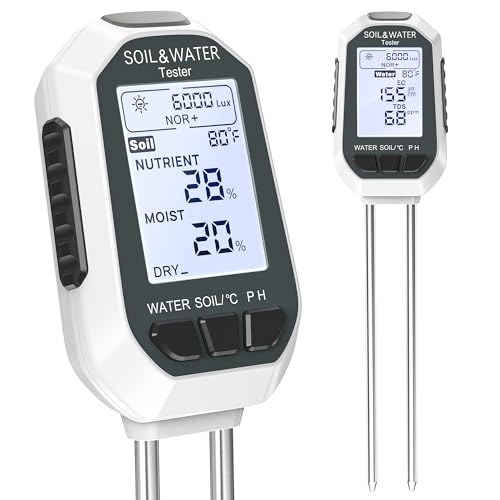
Buladeke Moisture Meter for Plants,7-in-1 Digital Soil Tester Kit | Soil pH Tester with LCD - Measures pH, EC, TDS, Fertility, Temp, Moisture & Sunlight, Garden Tools for Indoor & Outdoor
- 【7-in-1 Features】This is a 7-in-1 multi-function soil tester. Our soil tester quickly measures soil moisture, pH, temperature and…
- 【Large Screen & LCD Backlight】The Soil Moisture Meter has a large LCD display with white backlight that clearly shows the numerica…
- 【Fast and accurate measurement】With the latest 2025 probe technology, it can quickly and accurately measure soil pH, moisture, tem…
The one you buy when you want a full soil snapshot in ten seconds. Buladeke packs seven functions into a single handheld unit, and for citrus growers the useful ones are pH, moisture, temperature, and EC. That last reading matters more than most people realize, because high soluble salts in container soil burn citrus roots faster than any pH swing.
The large backlit LCD is the standout feature here. Citrus care often happens at odd hours, and reading a dim analog needle in low light is genuinely frustrating. This screen shows clear numbers with symbols, so you can compare today’s reading against last week’s without squinting. The 2026 probe design responds fast, and the unit warns you when batteries run low, which prevents the silent false readings that plague cheap digital meters.
Here is the honest catch. This meter cannot be dipped into liquid, and forcing the probe into hard, dry soil will damage it. Potted citrus in summer often has crusty surface soil, so you need to water the test spot and wait ten minutes before pushing the probe in. That extra step annoys some users. The EC and TDS functions also measure water quality rather than soil directly, so treat those readings as a bonus rather than the main event.
- Seven functions including pH, moisture, temperature, light, EC, and TDS
- Large white backlit LCD readable in daylight or darkness
- Runs on four AAA batteries with low-battery warning
- Ten-second readings from a probe inserted about 10 cm deep
- Not designed for liquid testing or hard, dry soil
Best for: Container citrus growers who want fast, readable data without guessing at analog needle positions.
SONKIR Soil pH Meter, MS0…

SONKIR
SONKIR Soil pH Meter, MS02 3-in-1 Soil Moisture/Light/pH Tester Gardening Tool Kits for Plant Care, Great for Garden, Lawn, Farm, Indoor & Outdoor Use (Green)
- Kindly NOTE: This soil tester can not be applied to test pH value of any other liquid. If the soil is too dry the indicator will n…
- 3 METERS IN ONE: Soil moisture level, Soil pH value and Sunlight level could be tested easily according to your need by switching…
- NO BATTERY NEEDED: Simply insert the meter into soil, wait few minutes, accurate test results will be displayed on the readout pan…
The no-battery workhorse for anyone testing multiple trees across a large yard. SONKIR’s 3-in-1 design covers moisture, pH, and sunlight with a simple function switch, and it never needs a battery. That last point sounds minor until you are halfway through testing eight citrus trees in a backyard orchard and your digital meter dies.
Build quality is better than the price suggests. The probe feels solid, and the analog readout responds smoothly once soil moisture is adequate. For in-ground citrus, this is often all you need: a quick pH check at root depth, a moisture reading to confirm drainage, and a light reading to verify your tree gets six-plus hours of sun. It handles all three without fuss.
The trade-off is accuracy. Analog meters drift, and this one is no exception. If your soil is too dry, the needle simply will not move, which confuses first-time users into thinking the meter is broken. You also get no temperature or nutrient data, and the pH scale on the dial is coarse enough that a reading of 6.5 could realistically be 6.0 or 7.0. Use it for trends, not precision.
- Three functions: moisture, pH, and sunlight level
- No batteries required, works indefinitely
- Simple function button switches between readings
- Compact and portable for garden, lawn, or farm use
- Cannot test liquid pH and needs moist soil to register
Best for: Budget-conscious gardeners with several in-ground citrus trees who want a reliable backup tool.
Rapitest Soil Test Kit fo…

Luster Leaf
Rapitest Soil Test Kit for Gardens, Vegetables, Flowers and Lawns. USA designed and assembled soil tester completely, quickly and accurately measures/analyzes soil pH acidity and garden nutrients.
- Quick, at home results for Soil pH, Nitrogen, Phosphorous and Potash Innovative and inexpensive soil test kit features an easy-to-…
- Contains all components needed for 20 tests. 5 for each of pH, N, P and K
- Contains all components needed to test all variables in several spots in the yard or garden
The kit you reach for when pH alone will not tell you why your orange tree has yellowing leaves between green veins. Rapitest measures pH plus nitrogen, phosphorus, and potassium using a capsule system and color comparators. For citrus, that NPK data is critical, because a tree can sit at perfect pH 6.0 and still starve if phosphorus is locked out by cold soil or potassium is depleted after a heavy fruiting season.
Each kit includes enough capsules for 20 tests, split evenly across the four measurements. That works out to five full rounds of testing, which covers a full citrus season if you test quarterly. The color comparator system is old-school but effective, and the included pH preference list covers over 450 plants, so you can cross-check your citrus variety against the recommended range without hunting online.
The downside is time and subjectivity. Each test takes several minutes, and reading color charts introduces human error, especially if you are colorblind or working in poor light. You also cannot retest the same spot without using another capsule, so a large orchard burns through the kit fast. For a single backyard tree, though, this is the most informative non-lab option available. If you want to compare this against other nutrient-focused tools, our guide to the best backyard orchard testers covers more options.
- Tests pH, nitrogen, phosphorus, and potassium
- Includes supplies for 20 total tests, five per measurement
- Patented color comparator system for reading results
- pH preference list covers over 450 plant varieties
- Detailed instructions suit beginners and experienced growers
Best for: Citrus growers who suspect nutrient deficiencies and want NPK data without paying for lab analysis.
MySoil Soil Test Kit, Unl…

My Soil
MySoil Soil Test Kit, Unlock Your Lawn & Garden Potential, Complete & Accurate Nutrient and pH Analysis with Recommendations Tailored to Your Soil and Plant Needs
- KNOW BEFORE YOU GROW | Grow the healthiest, sustainable lawn and garden with the most accurate and easy to use professional soil t…
- FAST & ACCURATE | Unlike at-home pH meters and test strips, our mail-in professional lab analysis accurately measures 13 plant-ava…
- FOR ANY GROWING SCENARIO | Tests any soil type and growing condition - lawn & turf, vegetable gardening, flowers, compost, trees,…
The professional option for anyone serious about a small citrus orchard. MySoil skips the handheld meter entirely and sends your soil sample to a lab, which measures 13 plant-available nutrient levels including nitrogen and pH. Results come back in six to eight days with recommendations tailored to your specific soil and crop.
What separates this from every other option on the list is the custom reporting. You get organic and non-organic fertilizer recommendations, plus guidance on what to apply, how much, and when. For citrus, that timing matters enormously. Applying nitrogen in late fall pushes tender growth that frost kills. A lab report tells you to wait until spring, which no handheld meter can do.
The obvious limitation is the wait. You cannot test soil today and amend tomorrow. The kit also works best when you sample correctly, which means collecting soil from multiple depths and spots around each tree. Do that poorly and the lab results mislead you. Availability can also be inconsistent, so check the current listing before planning your season around it.
- Lab analysis of 13 plant-available nutrients plus pH
- Results returned in six to eight days
- Works for lawns, gardens, trees, containers, and hydroponics
- Includes organic and non-organic fertilizer recommendations
- Custom guidance on what, how much, and when to apply
Best for: Small orchard owners and serious container growers who want lab-grade accuracy and a full amendment plan.
YAMRON 4-in-1 Soil Moistu…

YAMRON
4-in-1 Soil Moisture Meter Digital Plant Temperature/Soil Moisture/PH Meter/Sunlight Intensity Backlight LCD Display Soil Test Meter for Gardening, Farming and Outdoor Plants
- 【4 in 1 function】This is a 4-in-1 multifunctional soil tester.Our soil tester fastly to measure soil moisture, pH, temperature and…
- 【Large Screen & Backlight LCD Display】The Soil Tester uses a large LCD screen and white backlight to conveniently display and read…
- 【Quick Accurate measurement】The latest probe detection technology in 2026 can quickly and accurately measure the pH, moisture and…
The one with the rotating head, which sounds like a gimmick until you use it. YAMRON’s 4-in-1 meter measures moisture, pH, temperature, and sunlight, and the 45-degree bendable display lets you read results without kneeling in wet grass. For raised bed and container citrus, that ergonomic detail makes regular testing far less annoying.
The large backlit LCD shows clear numbers and simple graphics, so beginners can interpret readings without a manual. The 2026 probe technology responds in about ten seconds once inserted to roughly 10 cm. YAMRON also recommends averaging readings from at least five spots in the soil for pH and moisture, which is genuinely good advice that most manufacturers skip. Citrus roots spread wide, and a single probe point rarely represents the whole root zone.
Two honest caveats. The meter cannot touch liquid, and dry, hard soil will damage the probe, so you must water test spots and wait ten minutes. The five-location averaging also means each full test takes longer than the ten-second spec suggests. Budget more like two to three minutes per tree if you follow the instructions properly.
- Four functions: moisture, pH, temperature, and sunlight
- 45-degree rotating head for easier screen viewing
- Large backlit LCD with visual graphics for beginners
- Recommends averaging readings from five soil locations
- Requires four AAA batteries and moist soil for accurate results
Best for: Raised bed and patio citrus growers who test frequently and want comfortable, readable results.
How We Chose These Products
We started with the specific needs of citrus, not general gardening. That meant prioritizing pH accuracy above all else, since citrus is far more sensitive to alkaline soil than most fruit trees. Tools that only measured moisture got cut, no matter how popular they were.
From there we weighed build quality, reading speed, and whether the tool could handle both container soil and in-ground beds. We also looked at what each product does not do, because a tester’s limitations matter as much as its features. A $10 analog probe and a $40 lab kit both earn a place here, but for completely different reasons.
Buying Guide: What Really Matters
pH range is the first thing to check. Citrus generally prefers slightly acidic soil between 5.5 and 6.5, though exact targets shift by variety. Lemons tolerate a touch more alkalinity than limes, and oranges sit somewhere in between. A tester that only reads whole numbers will not help you fine-tune within that narrow band.
Probe depth comes second. Citrus feeder roots sit in the top 6 to 12 inches of soil, so a probe that only reaches 3 inches gives you surface data that dries out faster than the root zone. Look for probes that insert at least 10 cm, and ideally deeper for in-ground trees.
Finally, decide whether you need nutrients or just pH. A handheld meter tells you if soil is acidic or alkaline. Only a lab kit or capsule test tells you whether phosphorus, potassium, and nitrogen are actually available to the tree. Most citrus problems trace back to nutrient lockout caused by pH, so starting with pH makes sense. Once pH is correct, nutrient testing tells you what to feed. If your soil runs alkaline, our guide to alkaline soil testers covers tools built for that specific problem.
Our Top Recommendation
For most citrus growers, the Buladeke 7-in-1 is the best all-around pick. It reads pH, moisture, temperature, and EC in ten seconds, the backlit screen is genuinely easy to read, and the price sits comfortably in the middle of the range. Container growers will appreciate the EC function, which flags salt buildup before it burns roots.
If you manage an in-ground orchard and want lab-grade data, the MySoil kit is worth the wait. It costs more and takes a week, but the nutrient breakdown and fertilizer timing recommendations pay for themselves in healthier fruit. For a tight budget, the SONKIR analog meter does the basics without batteries and survives years of use. And if you grow citrus in pots on a balcony, the YAMRON’s rotating head makes frequent testing far more pleasant.
Frequently Asked Questions
What pH do citrus trees actually need?
Most citrus grows best between 5.5 and 6.5. Lemons handle up to 6.5 comfortably, limes prefer the lower end around 5.5 to 6.0, and oranges sit near 6.0. Above 7.0, iron and zinc become unavailable, which causes interveinal yellowing on new leaves.
Can I use the same tester for potted citrus and in-ground trees?
Yes, but clean the probe between uses. Container soil accumulates fertilizer salts that can skew readings if transferred to garden soil. Wipe the probe with a damp cloth and let it dry before moving to a new tree.
Why does my meter give different readings in the same spot?
Cheap analog probes drift, and digital meters need consistent soil moisture to read accurately. Take at least three readings from different points around the tree and average them. If readings still swing wildly, the probe may be damaged or the soil too dry.
How often should I test citrus soil?
Test pH monthly during the growing season and after any fertilizer application. Run a full nutrient test at the start of spring and again in late summer. Container citrus needs more frequent checks, since potting soil shifts faster than ground soil.