

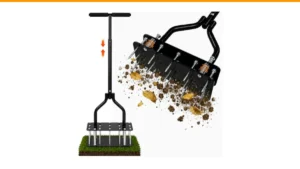
Best Residential Lawn Aerator: Top Picks, Buy vs Rent, and Timing Guide
Contents
Your lawn feels like a parking lot in July. Water pools in the same low spot every time it rains, and the grass roots stay shallow and weak. That hard, compacted layer is the problem, and an aerator is the fix.
A great residential aerator matches your lawn size, soil type, and how much work you want to do. Manual spike tools suit small yards and spot fixes. Tow-behind plug aerators handle half-acre lots behind a riding mower. The wrong pick wastes money and your Saturday.
We reviewed five models across the main categories: manual spike, manual core, and tow-behind. The Walensee is the best manual spike pick for most small yards. The Bigwish core aerator wins for compacted clay soil. The Garvee tow-behind is the choice for large lawns. Read on for the full breakdown, plus a buying guide and timing chart.
Here is a quick side-by-side of the key specs that separate these five tools.
| Features | Walensee Manual | Bigwish Core Aerator | Garvee Tow-Behind | Saker Manual | Lxuziud Roller |
|---|---|---|---|---|---|
| Material & Build | Powder-coated iron | Stainless steel | Powder-coated steel | Thickened iron | Welded steel |
| Key Specification | 15 iron spikes, 2.8 in | 3 hollow tines | 40 in width, 3 sizes | 15 spikes, 2.3 in | Pre-attached spikes |
| Main Feature | Foot pedal, T-handle | Adjustable height | Transport wheels | Double-layer spring | Add water or sand |
| Performance | Spike aeration | True core removal | Weight-supported tines | Self-cleaning ejector | Rolling spike action |
| Best Use Case | Small yards, spot fixes | Compacted clay soil | Large lawns, tractors | Small lawns, low effort | Medium lawns, budget |
Walensee Manual Lawn Aera…
1st Pick

Walensee
Walensee Aerator Lawn Tool, 15-Spike Manual Lawn Aerator Tool for Yard
- 【EFFECTIVE MANUAL LAWN AERATOR TOOL】: Walensee spike lawn aerator helps loosen soil and create small channels so air, water, and n…
- 【15 SHARP IRON SPIKES FOR BETTER COVERAGE】: Designed with 15 sturdy iron spikes, each about 2.8 inches long, this manual lawn aera…
- 【NO MORE SPIKED SHOE HASSLES】: Unlike plastic or metal lawn aerator shoes that may require strap adjustments, shoe-size matching,…
The Walensee spike aerator fits the homeowner with a quarter-acre or smaller yard who wants a simple, no-fuss tool. You step on the foot pedal, the 15 iron spikes punch into the soil, and you move on. It is built for lawn edges, bare patches, and lightly compacted spots. If you have been fighting with aerator shoes that slip off your feet, this is a welcome change.
What stands out is the three-row spike layout. Most manual spike tools have a single row or fewer spikes, so you cover less ground per step. Walensee’s 15 spikes across three rows mean fewer passes and faster work on small lawns. The 34.6-inch handle reduces bending, and the cushioned T-handle gives you something solid to push against. Assembly is straightforward, and the detachable design stores flat in a garage corner.
The trade-off is depth. Spike aerators do not remove soil plugs, so they do not relieve deep compaction the way a core aerator does. This tool also struggles in heavy sticky clay or rocky ground. For those conditions, water the lawn first or step up to a core model. And it is not built for large-scale aeration. If your lawn is bigger than a quarter acre, you will want a tow-behind unit.
- 15 iron spikes, each about 2.8 inches long
- Three-row spike layout for better coverage per step
- 34.6-inch handle with cushioned T-grip
- Foot pedal for extra leverage
- Detachable design for easy storage
Best for: Small-yard homeowners who want a sturdy manual spike aerator without the hassle of aerator shoes.
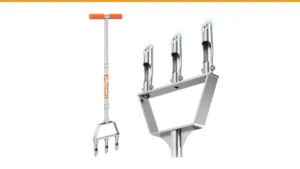
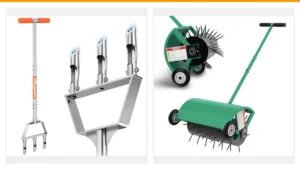
Lawn Aerator Tool, Stainl…
The Bigwish core aerator is the right call for anyone dealing with genuinely compacted soil, clay-heavy yards, or a lawn that has been abused by foot traffic for years. Core aeration removes actual plugs of soil, which creates channels for air, water, and nutrients to reach the root zone. That is a different job than spike aeration, and it produces better long-term results in tough soil.
Stainless steel construction sets this apart from most manual aerators, which use painted carbon steel that rusts after a season or two. The reinforced hollow tines and solid frame are built to survive repeated seasonal use without bending. The adjustable handle lets you set the working height for your body, which matters if you are tall or have back issues. A sturdy step bar helps drive the tines into hard ground with less effort.
Core aeration is physically harder than spike aeration. You are pulling plugs, not just poking holes. Expect to work up a sweat on a half-acre lawn, and expect to empty the tine chamber regularly. The tool also needs moist soil to work well. Water the lawn 12 to 24 hours before use, or the tines will not penetrate. It is not a fast process, but the results on compacted clay are noticeably better than any spike tool.
- True core aeration with 3 hollow tines
- Full stainless steel construction resists rust
- Adjustable handle height for better posture
- Step bar for extra driving force
- Requires moist soil for best results
Best for: Homeowners with compacted or clay-heavy soil who want real core aeration without renting a machine.
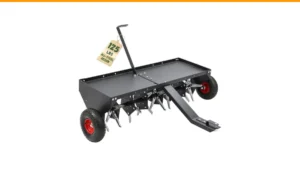
Garvee 40”Tow Behind Law…
The Garvee tow-behind aerator is built for the homeowner with a large lawn, a riding mower or ATV, and a desire to finish aeration in one afternoon. It comes in 32-inch, 40-inch, and 48-inch working widths, so you can match the deck size to your yard. The 40-inch model is the sweet spot for most residential properties between a half-acre and two acres.
Hardened steel tines punch holes into the soil as you tow, and the open-top platform accepts weight blocks to boost penetration on hard ground. That weight feature is the difference between a tool that skims the surface and one that actually reaches root depth. Transport wheels lift the tines off the ground when you move between zones, so you do not damage the lawn or dull the tines on pavement. The universal tow hitch connects to most riding tractors, ATVs, and UTVs without modification.
The catch is that you need a towing vehicle. If your only mower is a push model, this aerator is useless to you. It also requires assembly, though the pre-drilled holes and included hardware make it manageable. Storage takes up more space than a manual tool. And on very small or heavily landscaped yards, the 40-inch width can be awkward to maneuver around beds and trees. The 32-inch version solves that, but you will make more passes.
- Available in 32, 40, and 48-inch widths
- Hardened steel tines with replaceable assemblies
- Open platform accepts weight blocks
- Transport wheels for moving without damage
- Universal tow hitch fits most tractors and ATVs
Best for: Large-lawn owners with a riding mower or ATV who want to aerate acres in a single session.
Saker Manual Lawn Aerator…
4th Pick

Saker
Saker Manual Lawn Aerator Tool with 15 Iron Spikes Black
- 【Preparation Before Aeration】:Before using the Saker lawn aerator, trim the lawn and check soil moisture. Soft soil allows easier…
- 【Efficient Manual Lawn Aerator】Saker lawn aerator penetrates the soil with iron nails, making it easy to insert into the ground an…
- 【Time Saving and Labor-Saving Spike Design】The Saker lawn aerator features 15 sharp 2.3-inch iron spikes that create multiple hole…
The Saker manual aerator targets the homeowner who wants a lightweight, low-effort spike tool for a small lawn. It uses 15 sharp iron spikes, each about 2.3 inches long, to loosen compacted soil and improve drainage. The design prioritizes convenience over depth, which suits regular maintenance on lawns that are not severely compacted.
The standout feature is the double-layer spring system. It automatically ejects soil and debris during operation, so you do not have to stop and clean the spikes by hand. That is a real time-saver if you have ever used a spike aerator that clogs every few steps. The foot pedal uses high-strength screw connections instead of welds, which adds stability and reduces the chance of breakage at the stress point. The rust-resistant coating helps it survive outdoor storage.
Spike length is the main limitation. At 2.3 inches, these spikes do not reach as deep as the Walensee’s 2.8-inch tines. On hard, dry soil, you will need to water first or the tool will just bounce off the surface. It is also a spike aerator, so it does not remove plugs or relieve deep compaction. Think of it as a maintenance tool, not a renovation tool. For a small, healthy lawn, that is fine.
- 15 iron spikes, each about 2.3 inches long
- Double-layer spring auto-ejects soil and debris
- Screw-connected foot pedal for added stability
- Rust-resistant coating
- Lightweight and easy to store
Best for: Small-lawn owners who want a self-cleaning spike aerator for routine maintenance.
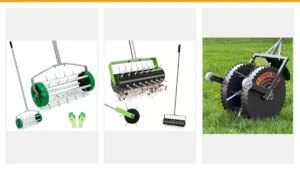
Manual Roller Lawn Aerato…
The Lxuziud roller aerator suits the homeowner with a medium-sized lawn who wants a middle ground between a hand-pushed spike tool and a tow-behind machine. It rolls across the grass with pre-attached spikes, punching holes as you go. The adjustable weight feature lets you add water or sand to the drum, which increases penetration on harder soil.
Welded construction gives it a durable feel, and the roller design is less fatiguing than stomping a foot pedal repeatedly. You walk, it rolls, and the spikes do the work. For lawns between a quarter and half acre, this is a practical compromise. The weight adjustment is the key feature. A light drum works for soft soil, and a heavy drum handles firmer ground without you pushing harder.
Roller spike aerators have the same depth limitation as any spike tool. They do not pull cores, so they will not fix severe compaction. The drum also needs to be emptied before storage if you filled it with water, or it will get heavy and may rust from the inside. On uneven ground, the roller can skip over high spots, leaving those areas unaerated. It is a budget-friendly option, but not a precision tool.
- Pre-attached spikes on a rolling drum
- Adjustable weight with water or sand
- Welded steel construction
- Less fatiguing than foot-pedal aerators
- Best for medium lawns up to half an acre
Best for: Budget-conscious homeowners with medium lawns who want a rolling spike aerator with adjustable weight.
How We Chose These Products
We evaluated each aerator on four criteria: build material, aeration method, ease of use, and suitability for specific lawn sizes. Stainless steel and powder-coated iron scored higher than bare or painted steel because they resist rust. Core aeration models scored higher for soil health benefits than spike models, but we weighed that against the physical effort required.
We also considered who each tool actually serves. A tow-behind aerator is useless without a tractor, and a manual core aerator is overkill for a postage-stamp lawn. The picks here cover the full range of residential situations, from small yards to large properties. We avoided models with vague specs or missing details about tine length, spike count, or construction material.
Buying Guide: What Really Matters
Lawn size drives the first decision. Under a quarter acre, a manual spike or core aerator is plenty. Between a quarter and half acre, a rolling aerator or a manual core tool makes sense. Over half an acre, you want a tow-behind unit. Trying to aerate an acre with a manual tool is a recipe for a wasted weekend.
Soil type determines whether you need core or spike aeration. Spike aerators poke holes and are fine for maintenance on healthy lawns. Core aerators remove plugs and are the better choice for compacted clay, heavy foot traffic, or lawns that have not been aerated in years. If your soil is rock-hard in summer, core aeration will give you better results. You can read more about the differences in this spike vs plug guide.
Tine depth and spike count matter more than most buyers realize. Longer tines reach deeper root zones. More spikes per pass mean fewer passes overall. A 15-spike tool covers more ground per step than a 6-spike model. Check the actual spike length in the specs, not just the count. And confirm the material. Stainless steel lasts longer than painted carbon steel in wet conditions.
Our Top Recommendation
The Walensee Manual Lawn Aerator is our top pick for most residential lawns. It balances build quality, spike depth, and ease of use better than any other manual tool here. The 15 spikes across three rows cover ground quickly, and the foot pedal and T-handle make it comfortable to use for extended sessions. It is the right tool for small yards, spot aeration, and routine maintenance.
For compacted clay soil, the Bigwish Core Aerator is the better choice. It costs more effort but delivers real core aeration results. If you have a large lawn and a riding mower, the Garvee Tow-Behind is the clear winner. The Saker and Lxuziud models are solid budget alternatives for small to medium lawns, though neither matches the Walensee for spike depth or the Bigwish for soil improvement.
Frequently Asked Questions
How often should I aerate my lawn?
Once a year is enough for most residential lawns. Cool-season grasses like fescue and bluegrass do best with fall aeration. Warm-season grasses like Bermuda and zoysia respond well to late spring or early summer aeration. Lawns with heavy foot traffic or clay soil may need it twice a year.
Can I aerate when the soil is dry?
No. Dry soil is hard and tines will not penetrate well. Water the lawn 12 to 24 hours before aerating so the soil is moist but not soggy. This makes the job easier and protects your tool from unnecessary strain. It also helps the tines pull cleaner plugs if you are using a core aerator.
Should I overseed after aerating?
Yes, if you are trying to thicken the lawn. Aerating opens up the soil surface, and seed that falls into those holes has better contact with soil and moisture. Spread seed right after aerating, then water lightly. Do not fertilize at the same time as overseeding. Wait until the new grass is established.
Is a liquid aerator as good as core aeration?
No. Liquid aerators are soil conditioners that may help with surface tension and water penetration, but they do not create physical channels in the soil. They cannot relieve deep compaction the way core aeration does. Think of liquid products as a supplement, not a replacement. For real compaction, you need mechanical aeration.
Final Verdict
Match the tool to your lawn, not the other way around. Small yard, manual spike aerator. Compacted clay, manual core aerator. Large property with a riding mower, tow-behind plug aerator. The Walensee is the best all-around pick for most homeowners. The Bigwish is the upgrade for tough soil. The Garvee is the time-saver for big lawns. Pick the one that fits your situation, water the lawn first, and aerate in the right season. Your grass will thank you.