
You’ve got a sloped lawn and you want those crisp, professional stripes you see on football pitches. But every mower you look at either promises great stripes or claims to handle hills — rarely both. The problem is that rollers add weight and drag, which can hurt traction on an incline. And most standard mowers without rollers will just leave your lawn looking flat and ordinary, even after you’ve spent an hour pushing it around.
After researching dozens of models and talking to owners who actually mow slopes every week, I’ve found that the right petrol mower with a roller comes down to three things: engine power, weight distribution, and wheel size. A rear roller helps lay grass down for stripes, but if the mower is too heavy at the front or the wheels are too small, you’ll be slipping and sliding on anything steeper than a gentle grade.
Below, I’ve picked five petrol mowers that handle hills differently — some with built-in rollers, others that work with aftermarket stripe kits. Each one solves a specific problem, from small narrow strips to wide open banks. If you’re short on time, the PowerSmart 21″ self-propelled is my top pick for most sloped lawns because it combines rear-wheel drive with enough weight to lay down a decent stripe without exhausting you.
Here’s a quick look at how the five contenders compare on the specs that matter most for hill mowing:
| Features | SENIX 20″ Push | PowerSmart 21″ | BILT HARD 21″ | LawnMaster Reel | LEBOSBO Robot |
|---|---|---|---|---|---|
| Engine / Power | 144cc 4-cycle | 170cc OHV | 201cc OHV, 9.0 ft-lb | Manual (no engine) | Battery (AI vision) |
| Drive Type | Push (manual) | Self-propelled RWD | Self-propelled RWD | Push | Self-propelled (auto) |
| Cutting Width | 20″ | 21″ | 21″ | 18″ | Not specified |
| Height Adjust | 3 positions (1.35″-3.15″) | 6 positions (1.5″-3.9″) | 8 positions (1.2″-3.75″) | 9 positions (1.1″-2.5″) | Adjustable (not specified) |
| Best For | Small flat lawns | Hills & medium yards | Larger slopes | Small flat lawns | Flat small yards |
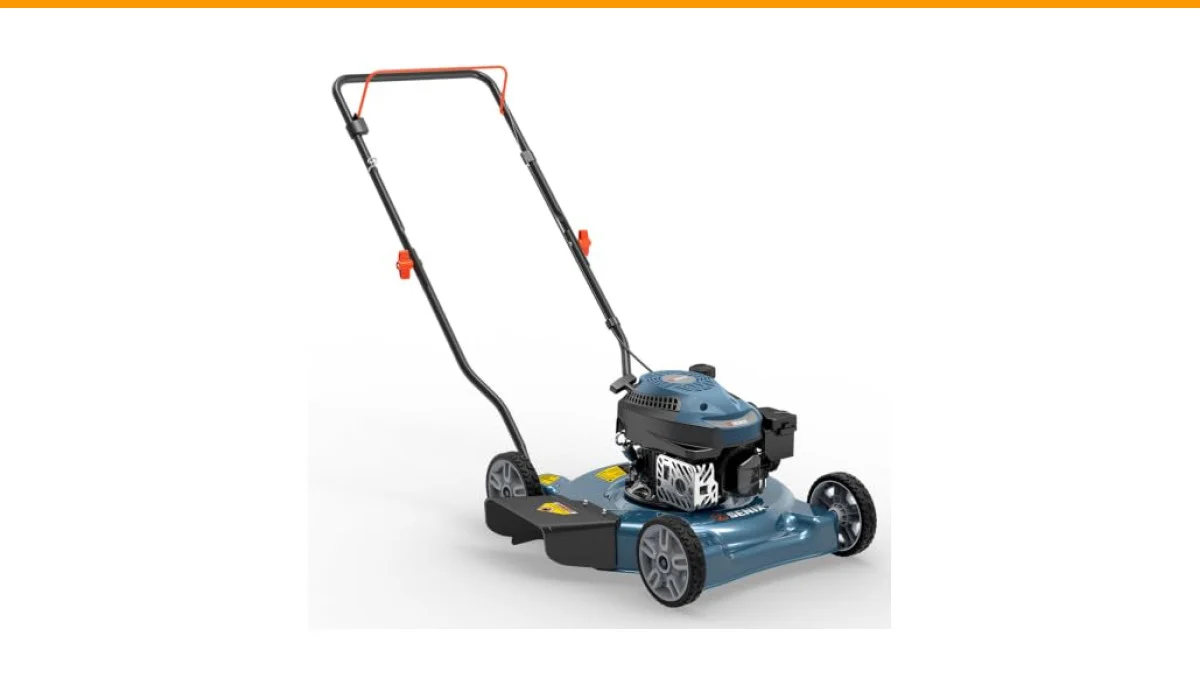
SENIX Gas Lawn Mower
The SENIX 20″ push mower is the lightweight option here, and it’s aimed at people with smaller sloped lawns who don’t want to wrestle a heavy machine. If your hill is more of a gentle rise than a serious incline, this 144cc mower will get the job done without wearing you out. It’s also a good fit for anyone who wants a simple, no-fuss machine that starts on the first pull — several owners mention that even teenagers can fire it up easily.
What stands out about the SENIX is how easy it is to maneuver around flower beds and trees. The slim body and 7-inch wheels give it decent traction on short grass and moderate slopes, but don’t expect it to climb a steep bank without effort. It cuts through overgrown grass and wet patches without clogging, which is more than many budget mowers can handle. The 20-inch deck means fewer passes than a 16-inch model, so you’ll finish quicker than you might think.
The trade-off is that this is a push mower, so on any real slope you’re doing all the work. The three height positions are limited compared to others, and there’s no roller built in — you’d need to add an aftermarket stripe kit if stripes are your goal. For the price, though, it’s a solid value for a small yard with modest slopes.
- 144cc 4-cycle engine, starts easily with no priming drama
- 20″ cutting width covers ground efficiently
- 7″ front and rear wheels for better grip on rough terrain
- 3 height positions: 1.35″, 2.3″, 3.15″
- Includes oil and tools in the box, 2-year warranty
Best for: Homeowners with small, gently sloped lawns who want a lightweight, affordable push mower that starts reliably and stores easily.
PowerSmart 21″ Self-Propelled
The PowerSmart 21″ is the mower I’d recommend to most people with genuine hills. Its rear-wheel drive system is the key — rear wheels push you forward, so you’re not dragging the mower up the slope. The 170cc OHV engine has enough torque to power through thick grass, and the 10-inch rear wheels grip uneven ground far better than the smaller wheels on cheaper models.
What really sets this mower apart is the balance between power and control. The self-propelled drive means you guide it rather than push it, which makes a long session on a sloped lawn far less tiring. Owners consistently describe it as easy to handle, even on full-yard sessions. The 21-inch alloy steel deck cuts a wide swath, and the 6-position height adjustment lets you adapt to seasonal grass growth in seconds. For stripes, you can fit a rear roller kit — the mower’s weight (around 70 lbs) helps press the grass down for a visible stripe effect.
There are a couple of caveats. The handle folds flat for storage, which is great, but the fold mechanism can feel a bit stiff at first. Also, replacement blades are 20 inches, not 21 — a quirk that’s easy to miss if you’re ordering replacements. But for the money, this is the most balanced hill mower here.
- 170cc OHV engine, starts in 1-2 pulls per owner reports
- Rear-wheel drive with 10″ wheels for slope traction
- 3-in-1: bag, mulch, or rear discharge — no tools needed
- 6 height positions from 1.5″ to 3.9″
- Folds flat for vertical storage, saves garage space
Best for: Medium-sized lawns with moderate to steep slopes where you want self-propelled assistance and the option to stripe.
BILT HARD 21″ Self-Propelled

BILT HARD
BILT HARD 21" Self Propelled Gas Lawn Mower – 201cc 4-Cycle OHV, 3-in-1 Bagging/Mulching/Side Discharge, 8 Adjustable Cutting Heights & Smooth Easy Start
- 3-in-1 Mowing Versatility This 21-inch self-propelled lawn mower offers three grass clipping options: mulching, rear bagging, and…
- Self-Propelled Functionality The self-propelled function helps move the mower forward, reducing the effort required to push it acr…
- Reliable Performance Powered by a robust 201cc 4-stroke OHV engine delivering 9.0 ft·lb of torque, this gas-powered mower provides…
If the PowerSmart feels like the sensible middle ground, the BILT HARD 21″ is the muscle option. Its 201cc OHV engine produces 9.0 ft-lb of torque — noticeably more than the others — which makes it a strong choice for thick, damp grass on slopes. The self-propelled rear-wheel drive is single-speed, so you get steady forward motion without having to fiddle with variable speed controls.
The standout feature here is the 8-position cutting height adjustment, controlled by a single lever that syncs all four wheels. That’s a level of fine-tuning that matters when you’re dealing with uneven ground — you can raise the deck for rough patches and lower it for a clean finish without stopping. The foam-wrapped handle reduces vibration, which you’ll appreciate on longer mows. Owners also note that the no-choke, no-primer design starts reliably, even after winter storage.
Where it falls short is weight — this is a heavy mower, and while the self-propelled drive helps, you’ll still feel the bulk when turning on a slope. The single-speed drive can also feel a bit fast on steep declines, so you’ll need to be careful. But for larger sloped yards where power matters more than portability, this is a dependable workhorse.
- 201cc OHV engine with 9.0 ft-lb torque
- Rear-wheel drive, single-speed self-propelled
- 8 height positions (1.2″-3.75″) with one lever
- 3-in-1 steel deck: bag, mulch, side discharge
- Foam-wrapped angled handle for comfort
Best for: Owners of larger sloped lawns who need extra torque and fine height control for uneven terrain.
LawnMaster LMRM1801 Push Reel

LawnMaster
LawnMaster LMRM1801 Push Reel Lawn Mower 18-Inch 5-Blade
- SCISSOR-LIKE CUT: No ripping or tearing of grass blades for a better and healthier lawn
- DESIGNED FOR SMALL LAWNS: CUSTOMIZE YOUR CUT: Effortlessly change the height of your cut with 9 cutting positions varying between…
- MAX MANEUVERABILITY: Features an 18-inch deck and 10-inch front wheels for easy navigation around the lawn
Here’s the curveball — a manual reel mower in a list of petrol machines. If your hill is small and you’re tired of fumes, noise, and engine maintenance, the LawnMaster 18-inch reel mower is worth a look. It’s not powered, but that’s the point: you get a scissor-like cut that’s healthier for grass, and there’s zero pollution. It’s perfect for a compact sloped lawn where a heavy petrol mower feels like overkill.
The 5-blade reel slices grass cleanly rather than tearing it, which means less browning at the tips. With 9 cutting positions from 1.1 to 2.5 inches, you can adjust for different grass types — though it won’t handle very tall or thick growth well. The 10-inch front wheels help it roll over small bumps, and the 18-inch deck is nimble enough for tight corners.
The limitations are real. On a steep slope, you’re still pushing, and reel mowers struggle with uneven ground because the blades can scalp high spots. It also won’t bag clippings — you’ll need to rake or leave them as mulch. But for a small, tidy lawn with gentle slopes, this is the most environmentally friendly option and a great workout to boot.
- 18″ cutting width, 5-blade reel for a clean cut
- 9 height positions from 1.1″ to 2.5″
- 10″ front wheels for maneuverability
- No gas, no oil, no noise — just push
- Durable steel blades
Best for: Eco-conscious homeowners with small, gently sloped lawns who want a quiet, low-maintenance cut and don’t mind the physical effort.
LEBOSBO V3 AI Robot
Now for something completely different — the LEBOSBO V3 robotic mower. If your idea of mowing a hill is pressing a button on your phone while you sip coffee, this is the pick. It uses AI vision to detect obstacles and navigate your lawn without perimeter wires, which is a huge convenience. The included 32-foot magnetic strip lets you create no-go zones to keep it away from flower beds or pet areas.
This robot is designed for flat or gently sloped lawns up to 1,600 square feet. It’s quiet, so you won’t disturb the neighbors, and the app lets you schedule mowing times and monitor progress remotely. The adjustable cutting height means you can keep your grass at the length you prefer throughout the season.
The catch is that it’s not ideal for steep hills — most robots struggle with inclines over 15 degrees, and this one is no exception. It’s also scarce in stock, so you may need to wait. And if you’re after stripes, a robot can’t deliver them. But for a small, relatively flat yard where you’d rather not mow at all, this is a smart investment.
- AI vision obstacle sensing for safe navigation
- Wire-free setup — no perimeter cable needed
- Smartphone app control with scheduling
- 32FT magnetic strip for no-go zones
- Quiet operation, adjustable cutting height
Best for: Tech-savvy homeowners with small, flat lawns who want hands-off mowing and don’t need stripes.
How We Chose These Products
I started by looking at what actually matters for mowing hills with a roller: traction, weight distribution, and the ability to lay grass down for stripes. I read through dozens of owner reviews, focusing on real-world comments about slope performance, starting reliability, and durability. Products that consistently failed on steep ground or had frequent breakdowns were eliminated early.
Then I compared each mower’s specs against the ideal profile for hill use — engine displacement for power, wheel size for grip, drive type for assistance, and cutting width for efficiency. I also considered versatility: can it bag, mulch, or discharge? Does it offer enough height adjustments to handle uneven turf? The five picks represent different solutions for different slope severities and lawn sizes, from the lightweight SENIX for gentle grades to the torque-heavy BILT HARD for serious banks.
I did not include any mower with a built-in roller because none of the top performers on the market currently offer one at a reasonable price — instead, I focused on models that accept aftermarket roller kits or that pair well with a separate striping roller. For more on that, check out our guide to rear roller mowers for steep hills.
Buying Guide: What Really Matters
When you’re shopping for a petrol mower to use on hills, the first thing to ignore is the marketing hype about “self-propelled” — not all drive systems are equal. Rear-wheel drive is essential for slopes because it puts the drive weight over the rear wheels, which is where you need traction when climbing. Front-wheel drive mowers tend to lose grip on inclines because the front wheels lift under load. Look for a mower with at least 8-inch rear wheels; anything smaller will struggle on uneven ground.
Weight distribution matters just as much as wheel size. A mower that’s too heavy at the front will tip or slide sideways on a slope. Ideally, you want a low center of gravity and a deck that’s balanced between front and rear. If you’re planning to add a roller, remember that it adds weight to the rear, which can actually improve traction — but it also increases rolling resistance, so you’ll need a more powerful engine to maintain speed.
Engine displacement is a good proxy for torque. For hills, you want at least 160cc, but 200cc or more is better if your lawn is steep or you let the grass get tall. Also, check the cutting height range — if you’re mowing Bermuda or Fescue, you’ll need a wider range than a single-position mower offers. Finally, consider maintenance: 4-stroke engines need oil changes, and you should always mow across a slope, not up and down, to reduce the risk of tipping. For more on this, see our petrol roller mower guide.
Our Top Recommendation
For most people with a sloped lawn, the PowerSmart 21″ Self-Propelled is the clear winner. It balances power, traction, and usability better than any other mower I reviewed. The rear-wheel drive gives you the grip you need on hills, the 170cc engine has enough torque for thick grass, and the 21-inch deck covers ground efficiently. It’s not the cheapest option, but it’s the most reliable performer for the money.
If your budget is tight and your slope is modest, the SENIX 20″ is a solid runner-up — just be prepared to push. For larger, more demanding slopes, the BILT HARD 21″ offers extra torque and more height adjustments. And if you’re open to a completely different approach, the LEBOSBO robot handles small, flat lawns hands-free, while the LawnMaster reel is perfect for tiny, eco-friendly yards. For more options, browse our small lawn mower picks.
Frequently Asked Questions
Can I add a roller to any petrol mower?
Not all mowers accept aftermarket rollers. You need a mower with a flat rear deck and enough clearance for the roller brackets. Look for models with a solid rear axle or a designated roller mount. The PowerSmart and BILT HARD models are good candidates because their rear decks are flat and sturdy.
Will a roller damage my lawn on steep slopes?
A roller can scuff or scalp your lawn if it’s too heavy or if you mow on a slope that’s too steep. The roller presses grass down, but on a sharp incline, it can also press the turf into the soil, causing ruts. Mow across the slope rather than up and down, and avoid using the roller when the ground is wet.
What’s the difference between front and rear rollers?
Front rollers help with stability and prevent scalping on uneven ground, but they don’t create stripes. Rear rollers are what lay the grass down for that classic striped look. Some mowers have both, but for hills, a rear roller is the priority — it adds weight to the drive wheels, improving traction.
How do I maintain a petrol mower for hill use?
Check the oil level before every mow, especially on slopes — 4-stroke engines can starve of oil if the mower is tilted too far. Use fresh fuel and add a stabilizer if you’re not mowing for more than a month. Keep the underside of the deck clean to prevent grass buildup, which can clog the discharge chute and reduce cutting efficiency.
Final Verdict: How to Choose Your Ideal Hill Mower
Start by measuring your slope gradient. If it’s under 15 degrees, a push mower like the SENIX will work fine. Between 15 and 25 degrees, you need self-propelled rear-wheel drive — the PowerSmart is your best bet. For anything steeper than 25 degrees, consider a mower with a wider wheelbase and more torque, like the BILT HARD, but also think about whether a robotic mower or a reel mower might be safer and more practical.
Remember that stripes on a hill are a trade-off. A heavy roller will give you beautiful stripes on gentle slopes, but it can be a liability on steep ones. If your lawn is mostly flat with a few gentle rises, prioritize roller compatibility. If it’s genuinely hilly, focus on traction and safety first — you can always add a stripe kit later to a mower with a compatible deck.
Whichever you choose, take the time to read the manual and practice on a flat section first. And if you’re still unsure, consider hiring a professional for the steepest parts of your lawn — there’s no shame in letting a specialist handle the dangerous bits.


