Most lawn care advice tells you to fertilize in spring. That’s only half right. The best month to fertilize your lawn depends on two things: the type of grass you have and the temperature of your soil. For cool-season grasses like fescue and bluegrass, the single most important feeding happens in early fall—usually September or October. For warm-season grasses like Bermuda and St. Augustine, the critical window is late spring to early summer, typically May through June. If you fertilize at the wrong time, you’re either feeding weeds or stressing your grass.
Here’s the good news: you don’t need a lab report to get this right. A simple soil thermometer and a few calendar anchors can tell you exactly when to act. This guide will walk you through the decision tree. You’ll learn how to check soil temperature, why the N-P-K ratio changes with the seasons, and how to use holidays like Memorial Day and Labor Day as foolproof reminders.
We’ve also included a detailed review of a trusted fertilizer option that fits most of these schedules. Scotts Turf Builder Lawn Food is a solid all-around choice for many homeowners, and we’ll explain exactly who it’s for and where it falls short.
Before we dig into the schedule, here’s a quick look at the fertilizer we’ll be referencing throughout this guide.
| Features | Scotts Turf Builder Lawn Food |
|---|---|
| Grass Type | All grass types |
| Coverage | 15,000 sq. ft. |
| Season | Spring, summer, fall |
| Main Benefit | Strong roots, deep greening |
| Best Use Case | General lawn maintenance |

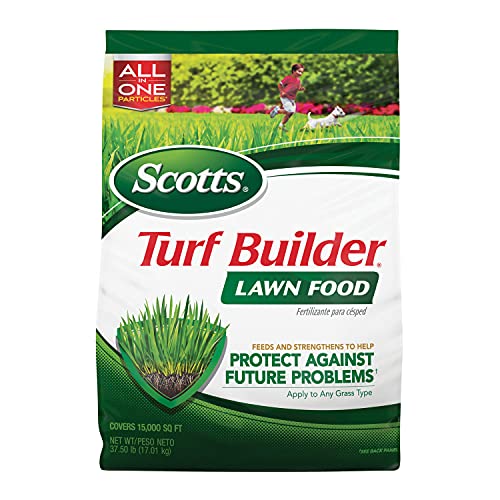
Scotts Turf Builder Lawn Food
Scotts
Scotts Turf Builder Lawn Food, 37.50 lbs. | Fertilizer for Grass, For All Grass Types, Covers 15,000 sq. ft.
- WHERE TO USE: Lawn fertilizer for grass can be used on any grass type
- GRASS FERTILIZER FOR LAWNS: Scotts Turf Builder Lawn Food feeds and strengthens your grass to help protect against future problems
- STRONG ROOTS: Our pesticide-free lawn food for grass builds strong, deep roots, improving your lawn's ability to absorb water and…
This is the bag you’ll see in garages across the country. Scotts Turf Builder Lawn Food is a general-purpose, granular fertilizer designed for homeowners who want a straightforward feeding without a lot of fuss. It’s best for someone who has an established lawn—at least a year old—and wants to keep it thick and green through the growing season. If you’re the type who wants one product that works on fescue, Bermuda, or anything in between, this fits that bill. It’s also a good pick for renters or new homeowners who just want to improve the curb appeal without becoming a turf scientist.
What stands out here is the balance. The formula feeds the grass and strengthens the root system, which helps the lawn handle heat, drought, and foot traffic better. You can apply it to a wet or dry lawn, which means you don’t have to wait for a perfect weather window. One bag covers 15,000 square feet, so for a typical quarter-acre lot (about 10,000 square feet of actual lawn), you’ll have some left over for spot treatments. The granular format is easy to spread with a standard broadcast spreader, and it doesn’t burn the grass as long as you follow the rate on the bag.
The trade-off? This is a synthetic fertilizer. It feeds fast, but it doesn’t do much for your soil’s long-term health. If you’re trying to build organic matter or you have sandy soil that leaches nutrients quickly, you’ll need to apply it more often or mix in a slow-release organic option. Also, this isn’t a weed-and-feed. It won’t kill dandelions or crabgrass. You’ll need a separate pre-emergent or post-emergent for that. And while it’s safe for most grass types, you should still avoid applying it during the hottest, driest part of summer—especially on cool-season grasses—or you’ll risk stressing the lawn.
- Feeds and strengthens grass for better drought and traffic tolerance
- Works on all grass types, including fescue, Bermuda, and ryegrass
- One 37.5 lb. bag covers 15,000 sq. ft.
- Can be applied to wet or dry lawn in spring, summer, or fall
- Pesticide-free formula builds deep roots
Best for: Homeowners with an established lawn who want a reliable, no-nonsense feeding that fits a simple spring-fall schedule.
Why Soil Temperature Beats Calendar Dates
Your grass doesn’t know what month it is. It responds to soil temperature. Cool-season grasses start growing when soil hits about 50°F. Warm-season grasses wait until the soil is consistently above 65°F. If you fertilize before those thresholds, the grass can’t use the nutrients. They sit there, and rain washes them into the storm drain or they feed the weeds instead.
Air temperature is a liar. You can have a warm week in March that tricks you into fertilizing. Then a cold snap hits, and your grass goes dormant again. The fertilizer is wasted. Soil temperature is slower and more stable. That’s why it’s the better guide.
How to Check Soil Temperature
Buy a cheap soil thermometer—the kind with a metal probe. They cost less than a fast-food lunch. Push it into the soil about 3 to 4 inches deep. Do this in a few spots around the lawn. Take a reading in the morning for three or four days in a row. The average is your number. If you don’t want to buy a thermometer, check your local extension office website. Many of them post daily soil temperature readings for your area.
Fertilizing Cool-Season Grasses (Fescue, Bluegrass, Ryegrass)
If you live in the transition zone or the North, you likely have a cool-season grass. These grasses grow best in spring and fall. They struggle in the heat of summer. Your fertilizing schedule should mirror that growth cycle.
The Critical Fall Window (August–November)
This is the single most important feeding of the year. In early fall, soil temperatures are still warm, but the air is cooling down. The grass is putting energy into root growth and storing carbohydrates for winter. A feeding in early September gives it the fuel to do that. If you only fertilize once a year, do it in September. For cool-season grasses, a second application in late October or early November helps the lawn green up faster in spring. Just make sure the grass is still green and growing. If it’s already brown and dormant, skip it.
The Light Spring Feeding (April–May)
Spring feeding is optional. If you fed in fall, your lawn probably doesn’t need a heavy dose in spring. A light application in April or early May can wake it up and fill in thin spots. But go easy. Too much nitrogen in spring pushes lush top growth at the expense of roots. That makes the lawn more vulnerable to summer drought and disease. Wait until you’ve mowed twice. That’s a good sign the grass is actively growing and ready to use the nutrients.
Fertilizing Warm-Season Grasses (Bermuda, Zoysia, St. Augustine)
Warm-season grasses love heat. They green up late and go dormant early. Your fertilizing window is narrower. Don’t feed until the grass is at least 50% green. If you fertilize too early, you’ll feed the weeds and risk cold damage to the roots.
The Summer Growth Push (May–August)
For Bermuda, Zoysia, and St. Augustine, the main feeding happens from late spring through summer. A good rule is to fertilize once you’ve mowed twice. That usually lands in May or early June. Then apply again every 6 to 8 weeks through August. Stop by early September. Late-season nitrogen on warm-season grass can cause winter kill. The grass needs to harden off before the first frost.
The Holiday Schedule: A Simple Memory Trick
You don’t need a spreadsheet. Use three holidays as your anchors. For cool-season grasses: fertilize around Memorial Day (light), Labor Day (main), and Halloween (optional second fall feeding). For warm-season grasses: fertilize around Memorial Day (first), July 4th (second), and Labor Day (last). This isn’t perfect for every climate, but it’s close enough for most homeowners. Adjust by a week or two if you’re far north or far south.
Decoding the N-P-K Ratio for Each Season
The three numbers on a fertilizer bag tell you the percentage of nitrogen (N), phosphorus (P), and potassium (K). Nitrogen pushes leaf growth. Phosphorus supports roots and blooms. Potassium helps with stress tolerance and disease resistance. The ratio you need changes with the season.
In spring, cool-season grasses want a balanced or slightly higher nitrogen blend to support new growth. Something like a 20-5-10 works. In fall, you want a formula with more potassium and less nitrogen. A 10-10-20 or similar helps the grass store energy and prepare for winter. For warm-season grasses, a high-nitrogen formula in summer is fine, but you still want some potassium for heat stress. Never use a high-phosphorus fertilizer unless a soil test tells you your soil is deficient. Most lawns have plenty of phosphorus already.
Organic vs. Synthetic: Does Timing Change?
Yes. Organic fertilizers are slower. They rely on soil microbes to break them down. That means you need to apply them earlier than synthetic options. For a fall feeding, put down organic fertilizer in late August instead of September. The microbes need a few weeks of warm soil to work. Synthetic fertilizers are fast-acting. You can apply them closer to the target date. But they also leach faster. If you have sandy soil, you’ll need to split your applications into smaller doses more often. Organic options improve soil structure over time, but they’re not a quick fix. If your lawn is starving, synthetic gives you faster results.
Special Cases: New Lawns and Drought Stress
If you seeded or sodded your lawn this year, the rules change. New grass has shallow roots. It needs frequent, light feedings. Wait until you’ve mowed the new grass three times before you fertilize. Then use a starter fertilizer with higher phosphorus to support root development. Avoid high-nitrogen products for the first few months. They’ll burn the tender seedlings.
During a drought, don’t fertilize. Fertilizer needs water to activate. If the lawn is dormant and crispy, feeding it will only stress it more. Wait until you get consistent rain or you’re watering regularly. A good soak is better than a feeding when the grass is already struggling.
Common Mistakes That Ruin Your Schedule
One mistake is fertilizing too early in spring. You see a warm day in March and you get excited. The soil is still cold. The grass can’t use the food. The weeds can. Another mistake is over-applying. More isn’t better. It burns the lawn and wastes money. Follow the bag rate. A third mistake is fertilizing before a heavy rain. The nutrients wash away. You want a light rain or you water it in yourself. Finally, don’t fertilize a dry lawn. Water first, then apply. That prevents burn and helps the granules break down.
Frequently Asked Questions
Can I fertilize my lawn in the summer?
Yes, but only if you have a warm-season grass and you’re watering regularly. Cool-season grasses should not be fertilized in the heat of summer. It stresses them and invites disease.
What if I miss the fall window?
Don’t panic. If you miss September, you can still apply a winterizer formula in late October or early November, as long as the grass is still green. If it’s already dormant, wait until spring.
Do I need a soil test before fertilizing?
A soil test is always a good idea. It tells you exactly what nutrients your lawn needs and what the pH is. Without one, you’re guessing. But if you’re not ready for a test, a balanced fertilizer is a safe starting point.
How soon after fertilizing can I mow?
Wait at least 24 to 48 hours. You want the granules to dissolve and the grass to absorb the nutrients. Mowing too soon can pick up the fertilizer and redistribute it unevenly.
Our Top Recommendation
For most homeowners, Scotts Turf Builder Lawn Food is the best starting point. It’s versatile, easy to apply, and works on any grass type. It fits a simple spring and fall schedule. If you want a more organic approach, look for a slow-release organic fertilizer with a similar N-P-K ratio. If you have a warm-season grass and need a summer boost, a high-nitrogen synthetic is fine. But for the average lawn, Scotts gets the job done without overcomplicating things.
How We Chose These Products
We looked at fertilizers that are widely available, easy to use, and backed by decades of use in real lawns. We prioritized products with clear application instructions and broad grass-type compatibility. We also considered coverage—how far one bag goes—and whether the formula is safe for most homeowners to handle without special equipment. Scotts Turf Builder stood out because it’s a proven, no-frills option that fits the schedules outlined in this guide. It’s not the cheapest per pound, but it’s reliable and predictable, which matters more when you’re trying to time your applications correctly.
Buying Guide: What Really Matters
When you’re standing in the fertilizer aisle, ignore the flashy labels. Look at the N-P-K ratio first. For general maintenance, a 3-1-2 or 4-1-2 ratio works well. That means nitrogen is the highest number, phosphorus is the lowest, and potassium is in the middle. Next, check the bag for slow-release nitrogen. It’s usually listed as a percentage of the total nitrogen. Slow-release feeds the lawn gradually and won’t burn it. Fast-release is cheaper but riskier.
Coverage matters too. A 15,000-square-foot bag is a good size for most suburban lawns. If you have a smaller yard, you can buy a smaller bag or store the leftovers in a dry place. Finally, consider the form. Granular is easier to spread evenly. Liquid fertilizers are faster-acting but require a sprayer and more frequent applications. Granular is the better choice for beginners.
Don’t overlook the importance of watering. No fertilizer works if you don’t water it in. A good soaking after application moves the nutrients down to the roots. If you skip this step, you’re wasting money.
Frequently Asked Questions
Can I use Scotts Turf Builder on a new lawn?
No. New lawns need a starter fertilizer with higher phosphorus. Scotts Turf Builder is a general-purpose food. Wait until the grass is established and you’ve mowed it at least three times.
How long does Scotts Turf Builder take to work?
You’ll see greening in about 5 to 7 days if you water it in. Full results take a couple of weeks. It’s not instant, but it’s not slow either.
Is Scotts Turf Builder safe for pets?
Once the granules have dissolved and the lawn is dry, it’s safe for pets and kids to play on. Keep them off the lawn while it’s still wet or if you can see granules.
What if it rains right after I apply it?
A light rain is fine. It helps water it in. A heavy downpour can wash it away. If that happens, you may need to reapply. Check the forecast before you start.
The Bottom Line on Timing
The best month to fertilize your lawn isn’t a single date on the calendar. It’s a window that opens when your soil hits the right temperature. For cool-season grasses, aim for September. For warm-season grasses, aim for late spring and summer. Use the holiday schedule as a memory aid. Test your soil if you can. And always water after you apply. If you get the timing right, you’ll use less fertilizer and get better results. That’s a win for your lawn and your wallet.