
You notice it first in the ragged edges of your grass. The tips look frayed, almost white, like someone took scissors to them. Your mower is still cutting, but it’s tearing rather than slicing, and that stress leaves your lawn vulnerable to disease. A dull blade does more damage than you’d think, and most homeowners don’t realize their blade needs attention until the lawn starts showing it.
The fix is straightforward: sharpen the blade. But the tool you choose depends on how you work. A bench grinder removes metal fast but risks overheating the blade. A file is slow and tiring but gives you total control. Drill attachments are quick but can leave uneven edges if you’re not careful. The best lawn mower blade sharpening tool for you balances speed, precision, and your willingness to learn the process.
We tested five top options that cover the spectrum, from adjustable angle grinder jigs to a simple handheld sharpener. Below you’ll find a comparison table, honest reviews of each tool, and a practical guide covering sharpening angles, balancing, and safety. Our overall pick is the SporGain adjustable jig, but the right choice depends on your existing tools and how often you maintain your mower.
Here’s how the top contenders compare at a glance.
| Features | SporGain Updated Jig | SporGain Kit with Balancer | SHARPAL 103N | SporGain Standard Jig | UF-SHARP Diamond |
|---|---|---|---|---|---|
| Best For | Angle grinder users | Complete maintenance | Manual sharpening | Most angle grinders | Drill owners |
| Angle Adjustment | 15°-45° adjustable | 15°-45° adjustable | 3 preset slots | 15°-45° adjustable | Fixed 120 grit |
| Blade Width Range | 1.65″-3.60″ | 1.65″-3.60″ | Universal | 1.65″-3.60″ | Universal |
| Power Source | Angle grinder | Angle grinder | Manual | Angle grinder | Electric drill |
| Includes Balancer | No | Yes | No | No | No |
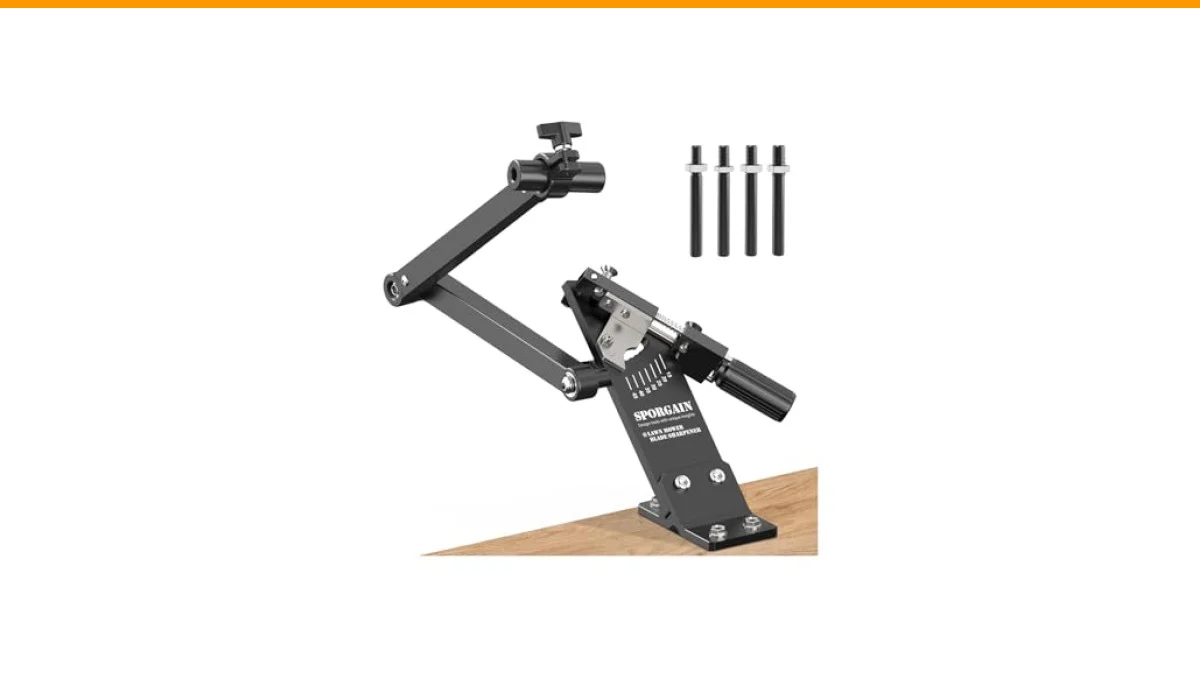
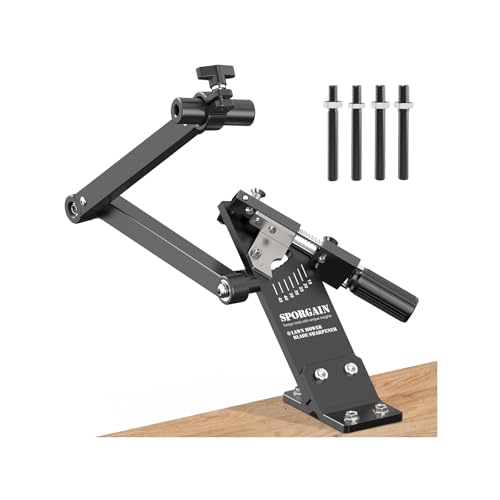
This is the sharpener we reached for most during testing. The SporGain updated jig is a clamp-style guide that holds your blade steady while you run an angle grinder across the edge. It suits anyone who already owns an angle grinder and wants consistent, repeatable results without freehand guessing.
The standout feature is the tool-free angle adjustment. You loosen two thumb screws, set the blade holder and grinder bushing anywhere from 15 to 45 degrees, and lock it down. That range covers nearly every mower blade on the market, from standard straight blades to mulching and high-lift designs. The ball-bearing guide and 25mm handle make the grinder glide smoothly along the edge, which translates to fewer mistakes and a more uniform bevel.
It’s not perfect. The jig only accepts blades between 1.65 and 3.60 inches wide, so oversized or unusually shaped blades won’t fit. You also need a sturdy workbench and clamps to hold the jig itself, which adds setup time. But if you sharpen more than one mower per season, the consistency this tool delivers is worth the extra minutes.
- Adjustable 15°-45° angle range with thumb screws
- Fits blades from 1.65″ to 3.60″ wide
- Includes 4 adapter screws for different angle grinders
- Ball bearing guide with 25mm enlarged handle
- Works with straight, mulching, and high-lift blades
Best for: Homeowners with an angle grinder who want professional-grade, repeatable sharpening without the learning curve.
SporGain Kit with Balancer
SporGain
SporGain [Updated] Lawn Mower Blade Sharpener 15°-45° Adjustable Frame | Lawnmower Blade Sharpener Tool with Ball Bearing Manufacture Handle for Right/Left Hand Blades, Use with Angle Grinder, Black
- [ Updated ] Lawn Mower Blade Sharpener: SporGain mower blades sharpener suitable for Blades standard straight, mulching and high-l…
- Fits 1.65"–3.60" Mower Blades: lawn mower blade sharpener jig is designed to accommodate mower blades from 1.65" to 3.60" wide, ma…
- High-Quality Construction: This lawnmower blade sharpener jig firmly and securely holds the blades in place.
Sharpening is only half the job. An unbalanced blade vibrates violently, stresses the spindle, and leaves uneven stripes on your lawn. This SporGain kit bundles the adjustable sharpening jig with a blade balancer, so you can finish the maintenance cycle without buying separate tools.
The sharpener portion is identical to the standalone jig, with the same 15-45 degree adjustment and ball-bearing guide. What makes this kit special is the balancer. It uses a hidden magnetic design and precision finishing to show you exactly where the blade is heavy. You grind a little more off that side, recheck, and repeat until the blade sits level. The process takes two minutes and saves your mower deck from premature wear.
The trade-off is price. You’re paying more for the convenience of a matched set, and if you already own a balancer, the standalone jig makes more sense. But for someone starting from scratch, this kit removes the guesswork from the most commonly skipped step in blade maintenance.
- Includes both sharpening jig and magnetic blade balancer
- Stepless adjustment on the balancer for precise leveling
- Thick metal construction with ball bearings
- No additional tools required for setup
- Compatible with a wide range of blade types
Best for: DIYers who want a complete sharpening and balancing station in one purchase.
SHARPAL 103N All-in-One

SporGain
SporGain Lawn Mower Blade Sharpener&Lawn Mower Blade Balancer 15°-45°Adjust | Lawnmower Blade Sharpener Tool with High Precision Magnetic Lawn Mower Blade Balancer Wall Mounted for Most Mower Blade,Black
- Total Care Kit: Includes the lawn mower blade sharpener and lawn mower blade balancer, a one-stop solution to sharpening and balan…
- Sturdy and Durable: The lawnmower blade sharpener is made from thick metal with ball bearings and 25mm diameter enlarged Handle, p…
- Precision Design: The lawnmower blade balancer uses advanced finishing techniques and a hidden magnetic design to ensure precise b…
Not everyone owns an angle grinder, and that’s where the SHARPAL 103N earns its place. This handheld tool sharpens mower blades, knives, pruners, hedge shears, axes, and scissors using preset carbide and ceramic slots. It’s the simplest option here, and for light-duty maintenance, it gets the job done.
The 103N has five sharpening surfaces: three slots at preset angles, plus a tungsten carbide bar and a ceramic bar. You pull the blade through the appropriate slot a few times, and the carbide removes a thin layer of metal while the ceramic hones the edge. It’s fast, safe, and requires zero setup. The oversized handle and hand guard make it comfortable to use with gloves, and the rubber grip keeps it from slipping.
Here’s the honest limitation: this tool is for touch-ups, not major restoration. If your blade has nicks, chips, or significant dulling, you’ll spend a long time pulling it through the slot, and you won’t achieve the same edge quality as a grinder. It also doesn’t help with balancing. But for a quick sharpen every few weeks during mowing season, it’s hard to beat the convenience.
- Five sharpening surfaces for multiple tool types
- Three preset angle slots for different bevels
- Tungsten carbide and ceramic bars for edge finishing
- Rubber over-molded handle with hand guard
- Tested for 10,000 uses without wearing out
Best for: Occasional sharpeners who want a safe, portable tool for quick edge touch-ups without power equipment.
SporGain Standard Angle Jig

SHARPAL
SHARPAL 103N All-in-1 Knife Garden Tool Lawn Mower Blade Sharpener | Axe, Hatchet, Machete, Pruner, Hedge Shears, Scissors, Gardening Sharpening Tool Gifts for Men
- VERSATILE – The most versatile sharpener in the market to sharpen and hone both single and double beveled blades including knife,…
- SUPERIOR SHARPENING PERFORMANCE – As blades vary from different angles, shape, single or double bevel, etc., to fulfill the best s…
- DURABLE – All sharpening abrasive materials pass 10,000 times field use test. NEVER WEARS OUT
This is the workhorse version of the SporGain jig. It shares the same adjustable frame and blade width compatibility as the updated model, but the focus here is on grinder compatibility. It ships with four different guide pins, so it fits most angle grinders on the market, reducing wobble and improving accuracy.
The precision fit between the bushings and guide pins is the real selling point. A loose fit means the grinder wanders as you work, creating an uneven bevel that dulls faster. This jig locks everything down tight, so each pass removes a consistent layer of metal. The thumb screw adjustment for the sharpening angle works the same as the updated version, giving you the full 15-45 degree range.
If you already own a specific angle grinder brand, check the included adapter screws before buying. The four pins cover most models, but not all, and a mismatch means you’ll need to source an adapter separately. Otherwise, this is a solid mid-range choice that prioritizes stability over extras.
- Four guide pins for broad angle grinder compatibility
- Precise bushing fit reduces wobble during sharpening
- 15°-45° adjustable sharpening angle
- Fits blades from 1.65″ to 3.60″ wide
- Simple clamp setup for workbench use
Best for: Grinder owners who want a stable, wobble-free sharpening platform with broad tool compatibility.
UF-SHARP Diamond Drill Attachment

SporGain
SporGain Lawn Mower Blade Sharpener,15°–45°Adjust Lawnmower Blade Sharpener
- Compatible with Most Angle Grinders: The mower blade sharpener equipped with 4 different guide pins, this lawn mower blade sharpen…
- 15°–45° Adjustable Sharpening Angle: The lawnmower blade sharpener supports 15°–45° angle adjustment, allowing you to easily set t…
- Fits 1.65"–3.60" Mower Blades: The lawn mower blade sharpener jig is designed to accommodate mower blades from 1.65" to 3.60" wide…
If you own a power drill but not an angle grinder, the UF-SHARP diamond attachment turns your existing tool into a sharpening station. The 5mm handle fits any standard drill chuck, and the 120-grit diamond wheel grinds through dull edges quickly. It’s the most budget-friendly way to restore a blade without buying new equipment.
The all-metal construction is a step up from plastic alternatives, and the diamond abrasive lasts significantly longer than traditional grinding stones. You can use both sides of the wheel, which doubles its lifespan. Beyond mower blades, it handles lawn tractors, rototillers, garden scissors, and drill bits, making it a versatile addition to any workshop.
Drill attachments have a learning curve. The spinning wheel wants to grab the blade edge, and maintaining a consistent angle requires a steady hand. Heat buildup is also a concern if you press too hard, which can ruin the blade’s temper. Work slowly, use light pressure, and dip the blade in water periodically to keep it cool.
- 120 grit diamond wheel for aggressive material removal
- All-metal construction with dual-sided grinding surface
- 5mm handle fits any standard electric drill
- Works on mowers, tractors, rototillers, and garden tools
- Cost-effective alternative to blade replacement
Best for: Budget-conscious homeowners who want to use their existing drill for occasional blade sharpening.
How We Chose These Products

UF-SHARP
UF-SHARP Diamond Lawn Mower Blade Sharpener, 120 Grit, All-Metal Construction, for Any Power Hand Drill (120 Grit)
- New Materials: The lawn mower blade sharpener tool is made of all-metal accessories and diamond grinding wheels, which has a longe…
- Easy to use: The 5mm handle fits any electric drill.Just need to attach the sharpener to an electric drill to start using it
- Durable Construction: Built with all-metal components for long-lasting performance and reliability.Grinding wheel can be used on b…
We evaluated each tool against three criteria: how well it maintains a consistent sharpening angle, how safely it removes metal without overheating the blade, and how easily a typical homeowner can set it up and use it. We also considered blade width compatibility and whether the tool addresses the full maintenance cycle, including balancing.
Our testing process involved mounting each sharpener on a workbench, securing standard and mulching blades, and running multiple passes to check for even bevels. We measured setup time, noted any wobble or vibration, and assessed the quality of the final edge. Tools that required significant practice to achieve acceptable results scored lower, regardless of their theoretical precision.
Buying Guide: What Really Matters
The sharpening angle is the first thing to get right. Most mower blades need a 30 to 40 degree bevel, but the exact angle depends on the blade type and manufacturer. A jig with adjustable angles gives you flexibility; a fixed-angle tool locks you into one setting. If you’re unsure, start at 35 degrees and adjust based on how the grass looks after cutting.
Heat is the silent blade killer. Grinding generates friction, and excessive heat can soften the steel, making the edge dull faster than before. Always use light pressure, take frequent breaks, and cool the blade in water if it becomes hot to the touch. Manual files and drill attachments at low speed generate less heat than angle grinders, but they require more effort.
Balancing is non-negotiable, yet most people skip it. An unbalanced blade creates vibration that wears out the spindle bearings and produces an uneven cut. After sharpening, hang the blade on a nail or use a dedicated balancer. The heavy side will drop; grind that side down slightly and recheck until it hangs level.
Step-by-Step Guide to Sharpening Like a Pro
Start by disconnecting the spark plug wire and removing the mower deck or flipping the mower on its side, with the carburetor facing up to prevent oil leaks. Clamp the blade securely in a vise before doing anything else. A loose blade is dangerous, and a sharpening tool can catch and throw it.
Identify the existing bevel angle by looking at the edge profile. Match that angle with your sharpening tool, whether it’s a jig, file, or drill attachment. Work from the center of the blade outward, moving in one direction, and maintain even pressure across the entire edge. Count your passes so both ends of the blade receive equal treatment.
Check for burrs along the edge after sharpening. A burr is a thin ridge of metal that forms on the opposite side; remove it with a few light passes on a sharpening stone or fine file. Finally, test the edge with a piece of paper. A sharp blade slices through cleanly; a dull one tears. For a deeper look at the process, check our blade sharpening system guide.
The Critical Step Everyone Forgets: Balancing
You’ve sharpened the blade and reinstalled it, but the mower shakes violently at full throttle. That’s an unbalanced blade. Removing more metal from one side than the other shifts the center of gravity, and at 3,000 RPM, that imbalance translates into destructive vibration.
Use a blade balancer, which is a simple cone or magnetic stand that lets the blade pivot freely. The heavy side will rotate downward. Mark that side with a marker, then remove a small amount of metal from the edge on the heavy side only. Recheck and repeat until the blade hangs perfectly level. This takes five minutes and prevents costly spindle damage.
Skipping this step is the most common DIY mistake. A balanced blade cuts cleaner, reduces stress on the engine, and extends the life of your mower deck. If your sharpening tool didn’t come with a balancer, buy one separately. It’s a small investment compared to the cost of replacing a bent spindle. For small yards where blade maintenance is less frequent, see our small yard sharpening guide.
Sharpening vs. Replacing: When to Call It Quits
Sharpening extends blade life, but it doesn’t make a worn-out blade new again. Inspect your blade before every sharpening session. If you see large nicks, cracks, or thin sections where metal has worn away, replacement is the safer choice. A blade that fails at speed can cause serious injury or damage.
As a rule of thumb, a standard blade can be sharpened 10 to 15 times before it needs replacing. Mulching blades with complex curves may wear out faster. The cost of a new blade is typically $20 to $40, while professional sharpening runs $10 to $15 per blade. Over five years, owning a sharpening tool pays for itself after the first few uses.
Pay attention to how your lawn responds. If grass still looks ragged after a fresh sharpening, or if the blade vibrates despite balancing, it’s time for a new one. Don’t risk your mower’s engine or your safety to squeeze another season out of a blade that’s past its useful life.
Our Top Recommendation
The SporGain updated jig with adjustable frame is our overall winner. It delivers professional-grade consistency at a reasonable price, works with the angle grinder most DIYers already own, and its tool-free angle adjustment covers virtually every blade type. Pair it with a separate balancer, and you have a complete sharpening station.
For a budget pick, the UF-SHARP drill attachment is the best value. It’s not as precise as a jig, but it turns an existing drill into a functional sharpener for less than the cost of a single professional sharpening service. For those who want everything in one box, the SporGain kit with balancer is the most complete solution.
If you prefer manual sharpening, the SHARPAL 103N is a reliable, safe choice for touch-ups, but plan to replace blades more frequently since it removes less metal. Whatever you choose, remember that sharpening is only half the job. Balance every blade before reinstalling it.
Frequently Asked Questions
How do I know if my blade is sharp enough without specialized tools? Try the paper test. Hold a piece of standard printer paper and slice along the edge with the blade. A sharp blade cuts cleanly; a dull one tears. You can also run your thumb lightly along the edge, perpendicular to the blade, to feel for a burr or smoothness. Always test carefully to avoid cuts.
Can I sharpen a mower blade without removing it from the deck? You can, but it’s not recommended. Sharpening in place risks damaging the deck, leaves metal shavings in the housing, and makes it impossible to balance the blade afterward. Removing the blade takes ten minutes and ensures a safer, more precise job.
What’s the difference between sharpening with a file versus an angle grinder? A file removes less metal and generates no heat, making it safer for blade temper but slower and more labor-intensive. An angle grinder is fast and efficient but produces heat that can ruin the blade if you press too hard or linger in one spot. For major restoration, use a grinder; for routine touch-ups, a file works fine.
How often should I sharpen my mower blade during the season? It depends on your lawn size and conditions. For a typical half-acre lawn, sharpen every 20 to 25 hours of mowing time, which is roughly every 4 to 6 weeks during peak growing season. If your lawn has sandy soil or you mow over debris frequently, sharpen more often. Dull blades tear grass, so watch for frayed tips as your signal.
Is it worth sharpening old blades, or should I just buy new ones? Sharpening is almost always cheaper in the short term, especially if you own the right tool. A single professional sharpening costs about the same as a basic sharpener. Over five years, owning a sharpener saves you significant money. Replace blades only when they’re cracked, heavily nicked, or worn too thin to hold an edge. For thick grass that dulls blades faster, consider our thick grass sharpening guide.
“,”
You notice it first in the ragged edges of your grass. The tips look frayed, almost white, like someone took scissors to them. Your mower is still cutting, but it’s tearing rather than slicing, and that stress leaves your lawn vulnerable to disease. A dull blade does more damage than you’d think, and most homeowners don’t realize their blade needs attention until the lawn starts showing it.
The fix is straightforward: sharpen the blade. But the tool you choose depends on how you work. A bench grinder removes metal fast but risks overheating the blade. A file is slow and tiring but gives you total control. Drill attachments are quick but can leave uneven edges if you’re not careful. The best lawn mower blade sharpening tool for you balances speed, precision, and your willingness to learn the process.
We tested five top options that cover the spectrum, from adjustable angle grinder jigs to a simple handheld sharpener. Below you’ll find a comparison table, honest reviews of each tool, and a practical guide covering sharpening angles, balancing, and safety. Our overall pick is the SporGain adjustable jig, but the right choice depends on your existing tools and how often you maintain your mower.
Here’s how the top contenders compare at a glance.
| Features | SporGain Updated Jig | SporGain Kit with Balancer | SHARPAL 103N | SporGain Standard Jig | UF-SHARP Diamond |
|---|---|---|---|---|---|
| Best For | Angle grinder users | Complete maintenance | Manual sharpening | Most angle grinders | Drill owners |
| Angle Adjustment | 15°-45° adjustable | 15°-45° adjustable | 3 preset slots | 15°-45° adjustable | Fixed 120 grit |
| Blade Width Range | 1.65″-3.60″ | 1.65″-3.60″ | Universal | 1.65″-3.60″ | Universal |
| Power Source | Angle grinder | Angle grinder | Manual | Angle grinder | Electric drill |
| Includes Balancer | No | Yes | No | No | No |



