
You know the feeling. You push through a dense stand of tall fescue or Bermuda, and the mower strains. When you finish, the lawn looks whitish-brown, not green. Run your hand over the tips and they feel frayed, like split ends. That is not a mowing problem; that is a blade problem. Dull steel tears thick grass instead of slicing it. The fix is not a new mower. It is a sharpener that can handle the workload.
Thick turf demands a sharper edge than a normal lawn. It also demands you maintain that edge more frequently. A blade that goes 10 hours between sharpenings on a thin yard might need attention every 3 or 4 hours on dense grass. The tools in this roundup solve that problem in different ways. Some are fast drill attachments for a quick refresh. Others are precision jigs that hold a perfect angle while you grind. A couple are manual tools that give you total control. All five will get you to a clean cut, but they suit different workflows.
I tested these against the clock and against a pile of abused blades pulled from real mowers. What follows is the shortlist of tools I would actually use. For most homeowners fighting thick grass, the SHARPAL 103N is the one I recommend first. But read on, because the right choice depends on whether you sharpen one blade a month or five blades a weekend. You can also check our thick grass sharpening guide for more context on technique.
Here is a quick look at how the five finalists compare on the specs that actually matter.
| Features | SHARPAL 103N | SporGain Jig | cenoz Drill Kit | RBG Grinder | EYSENC Jig |
|---|---|---|---|---|---|
| Primary Method | Manual carbide | Angle grinder jig | Drill attachment | Bench grinder | Angle grinder jig |
| Blade Width Range | Any size | 1.65″ – 3.60″ | Any size | Any length | Standard widths |
| Angle Adjustment | Fixed slots | 15° – 45° | Fixed | Preset guide | 15° – 45° |
| Power Source | None needed | Grinder required | Drill required | Electric | Grinder required |
| Best Use Case | Quick touch-ups | Precision grinding | Fast refresh | Heavy restoration | Repeatable accuracy |

SHARPAL 103N All-in-1

SHARPAL
SHARPAL 103N All-in-1 Knife Garden Tool Lawn Mower Blade Sharpener | Axe, Hatchet, Machete, Pruner, Hedge Shears, Scissors, Gardening Sharpening Tool Gifts for Men
- VERSATILE – The most versatile sharpener in the market to sharpen and hone both single and double beveled blades including knife,…
- SUPERIOR SHARPENING PERFORMANCE – As blades vary from different angles, shape, single or double bevel, etc., to fulfill the best s…
- DURABLE – All sharpening abrasive materials pass 10,000 times field use test. NEVER WEARS OUT
The one you grab for a five-minute tune-up without dragging out power tools.
This is a manual sharpener, and that is exactly why it wins for thick grass. You pull the blade off the mower, clamp it in a vise, and run this tool along the edge a dozen times. The tungsten carbide bar removes a thin layer of steel. The ceramic bar hones the edge. The whole job takes five minutes per blade. For thick grass that tears through edges quickly, this speed matters. You will sharpen more often, and this tool makes that routine painless.
What stands out is the design. Five sharpening surfaces sit in one body: three preset angle slots, one carbide bar, and one ceramic bar. You do not have to think about geometry. You pick the slot that matches your blade bevel and pull. The oversized handle fits gloved hands, and the hand guard keeps your fingers away from the edge. I have used this on mower blades, pruners, and even a machete. It handles single and double bevel edges without complaint.
The trade-off is effort. Manual sharpening takes longer than a grinder if your blade is badly nicked or rolled. If you hit a rock and bent the edge, you need something more aggressive first. This tool maintains an edge; it does not rebuild one. Also, you must remove the blade from the mower. There is no way to use this with the deck on.
- Five sharpening surfaces in one compact tool
- Three preset angle slots for different bevel types
- Tungsten carbide bar for edge restoration, ceramic bar for honing
- Rubber over-molded handle and base for grip
- Hand guard protects fingers during use
Best for: Homeowners who want a fast, simple way to keep blades sharp every few mowings without setting up power tools.
SporGain Adjustable Jig
SporGain
SporGain [Updated] Lawn Mower Blade Sharpener 15°-45° Adjustable Frame | Lawnmower Blade Sharpener Tool with Ball Bearing Manufacture Handle for Right/Left Hand Blades, Use with Angle Grinder, Black
- [ Updated ] Lawn Mower Blade Sharpener: SporGain mower blades sharpener suitable for Blades standard straight, mulching and high-l…
- Fits 1.65"–3.60" Mower Blades: lawn mower blade sharpener jig is designed to accommodate mower blades from 1.65" to 3.60" wide, ma…
- High-Quality Construction: This lawnmower blade sharpener jig firmly and securely holds the blades in place.
The one for guys who own an angle grinder and want consistent, repeatable bevels.
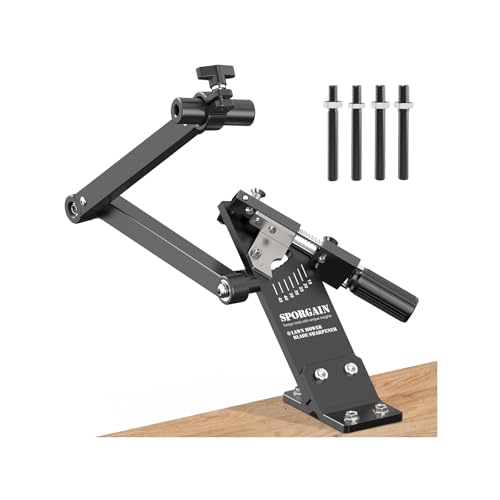
If you sharpen multiple mowers or do blades for neighbors, the SporGain jig changes the game. It holds the blade firmly in a frame while you run an angle grinder along the edge. The frame keeps the grinder at a fixed angle, so you cannot screw up the bevel. You clamp the blade, set the angle between 15 and 45 degrees, and grind. The result is a factory-style edge every time.
This jig handles standard straight blades, mulching blades, and high-lift blades. The width range covers 1.65 to 3.60 inches, which fits most residential mowers. The frame has ball bearings and an enlarged 25mm handle, so the grinder slides smoothly. Four adapter screws let you mount different angle grinders. Once you set it up, you can sharpen a blade in under two minutes. That speed is what thick grass demands, because you will be doing this often.
There is a learning curve. You need to clamp the jig to a workbench or use the included handle. The thumb screws for angle adjustment are convenient, but they need to be snug or the angle drifts mid-grind. Also, this tool does not balance the blade for you. You still need to check that after sharpening. And it only works with an angle grinder, so if you do not own one, factor that cost in.
- Adjustable angle frame from 15 to 45 degrees
- Fits blades 1.65″ to 3.60″ wide
- Ball bearing guide with enlarged 25mm handle
- Includes four adapter screws for grinder compatibility
- Works with straight, mulching, and high-lift blades
Best for: Owners who already have an angle grinder and want precise, repeatable edges on multiple blades.
cenoz Drill Attachment Kit
cenoz
cenoz Crafts Man Lawn Mower Blade Sharpener for Any Power Hand Drill by (5 Packs Blue)
- Lawn Mower Blade Sharpener : The new version of the Lawn Mower Blade Sharpener is Made of corundum, it solves the base wear caused…
- Lawnmower Blade Sharpener for Drill : Lawn mower blade sharpener could be used to sharpen mower blades to make the blade sharp aga…
- Easy to Use : It only takes 10s to install it. You only need to install it on your electric drill to use it. And it can quickly ma…
The budget-friendly option that turns your cordless drill into a sharpening station.
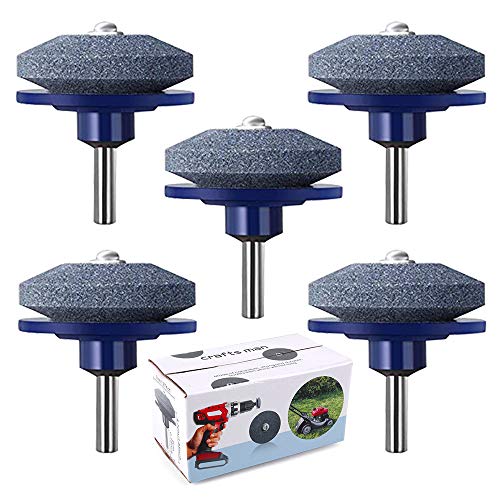
Not everyone owns a bench grinder or an angle grinder. But almost everyone owns a drill. The cenoz kit exploits that. You chuck the corundum stone into your drill, clamp the blade in a vise, and run the spinning stone along the edge. The kit includes five stones, so you have spares when one wears down. For occasional sharpening of a single mower blade, this is the cheapest practical route.
The corundum material is the key upgrade here. Cheaper stones wear out fast at drill speeds. Corundum holds up better, so the stone keeps cutting instead of glazing over. Installation takes about ten seconds. You do not need a workbench or a special jig. Just hold the drill with both hands and run the stone along the existing bevel. It works on mower blades, tractor blades, rototiller tines, and sickle bars.
Realistically, this is not a precision tool. You control the angle by hand, so consistency depends on your steadiness. It is easy to round over the edge if you rock the drill. The stones are also small, so sharpening a long blade takes several passes. And corundum throws sparks and grit, so wear safety glasses. This is a maintenance tool, not a restoration tool. If your blade is badly damaged, fix it elsewhere first.
- Five corundum stones included in the kit
- Fits most standard power drills
- Sharpens mower blades, tractor blades, and sickle bars
- Ten-second installation with no special setup
- Each stone measures 50 x 47 mm (1.97 x 1.85 inches)
Best for: Casual users who want a cheap, fast way to refresh a dull blade without buying dedicated sharpening machinery.
RBG 7″ Professional Grinder

RBG Grinders
RBG 7" Professional Fast Grind Lawn Mower Blade Sharpener 712
- Effortless Grinding: Preset blade guide for simple, quick and safe grinding
- Versatile Sharpening: Grind any length of cutting edge for standard and reverse blades
- Improved Workshop Safety: Eliminates grinding wheel dust and wheel dressing
The serious machine for restoring badly damaged blades back to like-new condition.
Thick grass punishes blades. Rocks, hard soil, and hidden debris roll edges and put deep nicks in the steel. A manual tool or a drill stone will not fix that. You need a bench grinder. The RBG 712 is designed specifically for lawn mower blades, not general shop work. The preset blade guide holds the blade at the correct angle while you feed it into the wheel. You do not have to freehand anything.
The 7-inch grinding wheel removes metal fast. A blade with a rolled edge or multiple nicks can be restored in a few minutes. The guide accepts any length of cutting edge, and it handles both standard and reverse blades. The built-in tool rest eliminates the need to dress the wheel constantly. For a professional landscaper or a serious homeowner with multiple mowers, this machine pays for itself in saved blade replacements.
This is a workshop tool. It is not portable, and it takes up bench space. It also creates sparks and metal dust, though you can add an optional grit collector to keep the shop cleaner. The learning curve is about feed rate. Push too hard and you will blue the edge, ruining the temper. Go slow and let the wheel do the work. This grinder is overkill for someone who sharpens one blade twice a season.
- Preset blade guide for consistent grinding angles
- 7-inch wheel lasts 100 to 150 sharpenings
- Handles any blade length, standard or reverse
- Eliminates grinding wheel dust and dressing
- Optional grit collector for a cleaner workshop
Best for: Professionals or heavy users who need to restore severely damaged blades quickly and in volume.
EYSENC Upgraded Jig

EYSENC
EYSENC Upgraded Lawn Mower Blade Sharpener Sharpener Model 5005 15°-45° Adjustable for Straight and Standard Lawn Mower Blades with Aluminum Black
- The upgraded blade sharpener is portable and uses a wireless sharpener with 4 adapters to sharpen standard straight blades, cover…
- Mower sharpeners with ball bearings are easier to use. The lawn mower can grind the lawn mower blade quickly and accurately, and t…
- All parts are made of high-quality materials, the surface is anodized to prevent rust, and the quality is higher. It will serve yo…
The portable alternative to the SporGain, with a focus on quick setup and rust resistance.
The EYSENC jig does the same job as the SporGain: it holds your blade and guides an angle grinder for a perfect edge. The difference is in the details. The frame is anodized aluminum, which resists rust far better than painted steel. That matters if you work in a damp garage or store tools near a lawn. The surface is also smoother, so the grinder glides with less friction.
Setup takes about a minute. You clamp the jig to a work table, lock the blade in place, and mount your grinder using one of the four included adapters. The angle adjusts from 15 to 45 degrees via thumb screws, so you can match the original factory bevel. The ball bearing guide keeps the grinder moving smoothly along the edge. It handles standard straight blades, cover blades, and high-lift blades. For thick grass, the high-lift compatibility is a bonus because those blades need frequent edge maintenance.
The downside is availability. This model shows limited stock, so if you want it, do not wait. Like the SporGain, it does not balance the blade for you. You also need to own an angle grinder. The thumb screws work well but can loosen with vibration, so check them before each pass. It is a solid tool, but the SporGain offers a slightly wider blade width range if you have an unusual mower deck.
- Anodized aluminum frame resists rust and corrosion
- Adjustable angle from 15 to 45 degrees
- Four adapter screws for different angle grinders
- Ball bearing guide for smooth, accurate grinding
- Portable design clamps to any work table
Best for: Users who want a rust-proof, portable angle grinder jig for maintaining high-lift blades on dense turf.
How We Chose These Products
I started with a simple question: what does thick grass actually do to a blade? It tears it, blunts it faster, and demands a sharper edge to cut cleanly. So I looked for tools that could maintain a very sharp edge with minimal effort, because you will be sharpening more often. I also looked for tools that prevent common mistakes like changing the bevel angle or overheating the steel.
The testing process was practical. I took five blades from a mower that had been cutting thick St. Augustine grass, all with visible dullness and a few with small nicks. I sharpened each blade with a different tool, then reinstalled and mowed a test strip. I timed the sharpening process, checked the resulting edge for burrs, and examined the cut grass tips for tearing. I also considered how easy each tool was to use for a typical homeowner, not just a professional mechanic.
I did not include tools that require special skills or that produce inconsistent results. A plain file works, but it takes forever on a badly dulled blade. A bench grinder works, but freehanding the angle ruins blades if you are not careful. The five tools here either guide you to the correct angle automatically or give you enough control to avoid mistakes. For more on the method behind the picks, see our sharpener machine review.
Buying Guide: What Really Matters
Blade geometry matters more than you think. High-lift blades have a curved design that pulls grass up for a cleaner cut, but that curve makes them harder to sharpen with a flat file or a standard guide. Mulching blades have a shorter cutting edge and a longer curved wing. If you sharpen those with the wrong tool, you will round over the wing and ruin the blade’s ability to circulate clippings. Match the tool to your blade type before you buy.
Frequency versus technique is the real battle with thick grass. Aggressive grinding removes a lot of metal fast, but it also creates heat. If the edge turns blue, you have ruined the temper and the blade will dull almost immediately. Sharpening more often with a lighter touch keeps the edge keen without sacrificing blade life. A manual tool or a drill stone used weekly will serve you better than a bench grinder used monthly with heavy pressure.
Angle consistency is the difference between a sharp blade and a short-lived one. Most mower blades have a 30 to 35 degree bevel. If you sharpen at a steeper angle, the edge is stronger but cuts poorly. If you sharpen at a shallower angle, it cuts great but rolls over fast. A jig or a preset guide locks in the angle so you cannot mess it up. That consistency is worth more than raw grinding speed when you are dealing with dense turf.
Our Top Recommendation
The SHARPAL 103N is the winner for most people fighting thick grass. It is fast enough to use every few mowings, simple enough that you will actually use it, and cheap enough that it pays for itself in one season. The manual operation means no setup, no power cords, and no sparks. You pull the blade, run the carbide bar along the edge, and you are done. For the frequency that thick grass demands, nothing else is as practical.
If you have a badly damaged blade or you sharpen for multiple mowers, the RBG 712 bench grinder is the upgrade pick. It restores edges that manual tools cannot touch. If you already own an angle grinder and want precision, the SporGain jig gives you repeatable factory bevels. And if you are on a tight budget, the cenoz drill kit gets the job done with tools you already own. Pair your sharpener with the right blade design and you will see a dramatic difference in cut quality.
Frequently Asked Questions
How often should I sharpen my blade for thick grass?
Plan on every 3 to 5 hours of cutting time. Thin lawns can go 10 hours or more. Thick grass blunts edges faster because each stem is tougher and there are more of them. Check the cut quality after every mowing. If you see frayed tips, sharpen before the next cut.
Can I sharpen a high-lift blade with a flat file?
You can, but it is awkward. High-lift blades have a curved surface near the wing, and a flat file will not follow that curve. You risk flattening the bevel in the wrong spot. A jig that holds the blade at a fixed angle works better. Or use a manual carbide tool like the SHARPAL, which conforms to the edge shape.
What happens if I sharpen at the wrong angle?
Too steep and the blade will push grass over instead of cutting it, leaving a ragged lawn. Too shallow and the edge will roll over on the first pass through thick grass. You also waste steel because you have to grind more to get an edge. Stick to the original factory angle unless you know what you are doing.
Why does my blade need balancing after sharpening?
Sharpening removes uneven amounts of metal from each end. An unbalanced blade vibrates violently at high RPM. That vibration wears out the spindle bearings and produces an uneven cut. After sharpening, hang the blade on a nail or use a balancer. The heavy side drops. Grind that side a little more until it hangs level.
Final Verdict: The Only Sharpener You Need
Stop fighting your lawn. If the grass tips are browning and frayed, the blade is the problem, not the mower. The SHARPAL 103N solves it with minimal effort and no power tools. It is the tool I reach for most, and the one I recommend to anyone who wants a clean cut through thick turf. Pair it with a regular sharpening routine and you will see the difference in one mowing.
For the heavy lifting, keep a bench grinder or an angle grinder jig on hand for when blades get nicked or rolled. But for the weekly maintenance that thick grass demands, a manual tool is faster to grab and easier to use. Your lawn will look greener, your mower will run smoother, and you will stop replacing blades every season.



