A thin lawn rarely fixes itself. You mow, you water, and still see soil between the blades. Most homeowners reach for a bag of fertilizer, spread it, and wait. Two weeks later, nothing looks different.
The problem usually isn’t the fertilizer. It’s the diagnosis. Compacted soil, shade, wrong pH, or a disease issue will stall growth no matter how much nitrogen you throw at it. The right product matters, but only after you know why the grass thinned out in the first place.
This guide covers five fertilizers that actually build density, plus how to pick the one that fits your lawn, your grass type, and your schedule. The short version: Scotts Turf Builder Thick’R Lawn Sun & Shade is the best all-around pick for most homeowners. Liquid options win if you want fast color without overseeding.
Here’s a quick spec comparison before we get into the details.
| Features | Scotts Sun & Shade | Scotts Bermudagrass | Commercial Grade Energizer | Andersons Super Juice | Extreme Grass Growth |
|---|---|---|---|---|---|
| Product Type | Granular 3-in-1 | Granular 3-in-1 | Liquid concentrate | Soluble granules | Liquid concentrate |
| Primary Nutrient | Seed, fertilizer, soil improver | Seed, fertilizer, soil improver | 6-0-0 with 5% iron | Balanced with 4% iron | Starter formula with humic |
| Coverage | 1,000 sq ft | 1,200 sq ft | 12,000 sq ft | Up to 2 acres | 12,000 sq ft |
| Best Season | Late spring, late summer | Late spring, early summer | Spring through fall | Spring through fall | Spring and summer |
| Best Use Case | Thin sun/shade lawns | Thin Bermudagrass lawns | Quick green-up | Full nutrition supplement | New sod and seeding |
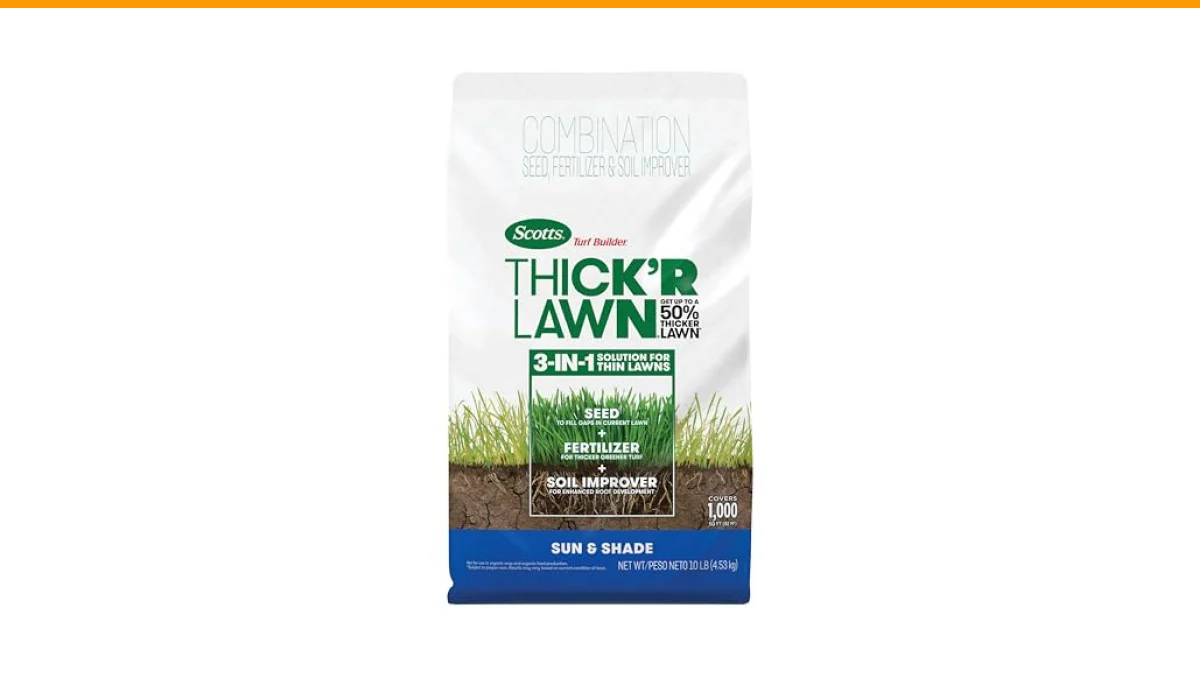
Scotts Turf Builder Thick’R Sun & Shade
This is the pick for the homeowner who stares at a patchy front yard every spring and wants one bag to handle everything. It combines grass seed, fertilizer, and a soil improver in a single granular product. You don’t need to buy seed separately or time two applications.
The seed blend is built for lawns that get a mix of sun and shade, which covers most residential yards. The fertilizer component pushes top growth while the soil improver works on root development. Scotts claims up to 50% thicker turf with proper care, and that number holds up when you water consistently for the first few weeks.
One limitation: this isn’t a pure fertilizer. If your lawn is already thick and you just want to feed it, you’re paying for seed you don’t need. The 10-pound bag also only covers 1,000 square feet, so a half-acre lawn gets expensive fast. And the seed needs consistent moisture to germinate, which means daily watering for two to three weeks.
- Three products in one bag: seed, fertilizer, soil improver
- Covers 1,000 sq ft per 10 lb bag
- Apply once in late spring and once in late summer or early fall
- Works on sun and shade mixes
- Requires regular watering for seed germination
Best for: Homeowners with thin, patchy lawns who want to overseed and feed in one pass.
Scotts Turf Builder Thick’R Bermudagrass

Scotts
Scotts Turf Builder Thick'R Lawn Bermudagrass - Covers 1,200 sq. ft., Combination Seed, Fertilizer and Soil Improver, Fill and Repair Gaps in Thin Lawns and Enhance Root Development, 12 lb.
- 3-in-1 SOLUTION: Scotts Turf Builder Thick'R Lawn Bermudagrass is a convenient and easy to use 3-in-1 solution of grass seed, fert…
- IMPROVE YOUR LAWN: Uniquely formulated solution includes high performance grass seed to fill gaps in your current lawn; fertilizer…
- 50% THICKER LAWN: Enjoy up to a 50% thicker lawn with Scott's Turf Builder Thick'R Lawn Bermudagrass (subject to proper care; resu…
Bermudagrass owners have different problems than fescue or bluegrass owners. Bermuda spreads through runners, and thin spots often mean the runners aren’t filling in. This product targets that specific situation with a 3-in-1 formula designed around warm-season grass.
The seed component fills gaps, the fertilizer thickens existing turf, and the soil improver supports root development. Coverage is slightly better than the Sun & Shade version at 1,200 square feet per 12-pound bag. Application timing matters here. Late spring or early summer is the window, which aligns with when Bermudagrass is actively growing.
Availability is the catch. This product is only sold in a specific list of states, mostly across the South, Southwest, and parts of the West. If you live outside those areas, you can’t buy it. And like the Sun & Shade version, you’re paying for seed even if your lawn just needs feeding.
- Formulated specifically for Bermudagrass
- 3-in-1 seed, fertilizer, and soil improver
- Covers up to 1,200 sq ft
- Apply in late spring or early summer
- Sold only in select states
Best for: Bermudagrass owners in warm climates dealing with thin, bare patches.
Commercial Grade Lawn Energizer
Some lawns don’t need seed. They need a jolt of nitrogen and iron to darken up and push new growth. That’s where this liquid concentrate fits. It’s a 6-0-0 formula with 5% iron and micronutrients, designed to supplement an existing fertilizer program rather than replace it.
The coverage is the headline number: one gallon treats up to 12,000 square feet. That’s a fraction of the cost per square foot compared to granular seed blends. Application is straightforward with a pump sprayer or hose-end sprayer, and you can use it in spring, summer, or fall. The iron content is what drives the deep green color, and it shows up within days rather than weeks.
Here’s the trade-off. This product has no phosphorus, which is the nutrient tied to root mass. It won’t build density on its own. Think of it as a supplement, not a standalone thickener. You’ll still need a phosphorus-containing fertilizer or an overseeding program to actually fill in thin areas.
- 6-0-0 liquid formula with 5% iron
- Covers up to 12,000 sq ft per gallon
- Works with pump-up or hose-end sprayers
- Use as a supplement, not a standalone fix
- Fast green-up, typically within days
Best for: Homeowners who already fertilize and want a fast color boost plus a nitrogen top-up.
The Andersons Super Juice

The Andersons
The Andersons Super Juice All in One Soluble Supplement Lawn Fertilizer
- Designed to be used as a supplement to a fertilizer program
- An all-in-one, complete, balanced, lawn fertilizer, available in a dry, soluble granule
- Provides fast results and deep greening
This one appeals to the homeowner who wants a complete nutrition package without mixing their own blends. Super Juice is a dry, soluble granule that dissolves in water and delivers a balanced fertilizer plus humic acid, sea kelp, and micronutrients. It’s designed as a supplement to a regular program, not a replacement.
The coverage is generous. At a half-rate application, one container treats up to two acres. That makes it a strong value for larger properties. The 4% iron content supports color, and the humic acid and sea kelp add soil-conditioning benefits you won’t find in basic NPK products. Results show up fast because the granules dissolve and the nutrients are immediately available to the roots.
Two things to know. It’s not sold in California, so residents there need an alternative. And it’s a supplement, meaning it works best alongside a granular slow-release fertilizer rather than on its own. If your lawn is severely thin, this alone won’t rebuild density.
- Dry soluble granules with balanced nutrition
- Includes humic acid, sea kelp, and micronutrients
- 4% iron for color
- Treats up to two acres at half rate
- Not available in California
Best for: Large-property owners who want a complete supplement with soil-conditioning extras.
Extreme Grass Growth Lawn Booster
New sod and fresh seedings need different nutrition than established lawns. This liquid concentrate is built for that stage. It’s a starter fertilizer with humic acid that pushes both vertical and lateral growth, which is exactly what you want when you’re trying to get a thin lawn to fill in.
The formula works on all grass types, including Bermuda, St. Augustine, Zoysia, Buffalo, Fescue, and Bluegrass. One gallon covers up to 12,000 square feet, and you can refill a Simple Lawn Solutions sprayer up to four times. It’s designed for spring and summer use, which aligns with active growth periods for most grasses.
The limitation is timing. This isn’t a fall or winter product. If you’re trying to thicken a lawn going into dormancy, you need a different approach. And like the other liquid options here, it works best as part of a program, not as a one-and-done fix.
- Liquid starter fertilizer with humic acid
- Promotes vertical and lateral growth
- Covers up to 12,000 sq ft per gallon
- Safe for all major grass types
- Designed for spring and summer use
Best for: Homeowners starting new sod or overseeding who need a growth-focused starter formula.
How We Chose These Products
We started with the diagnosis question. A fertilizer can’t thicken a lawn if the underlying problem is compaction, shade, or disease. So we looked for products that address density directly, either through seed, root-supporting nutrients, or both.
From there, we weighed coverage rates, application flexibility, and whether each product works as a standalone fix or a supplement. We also checked regional availability, because a Bermudagrass product is useless to a homeowner in Maine. Cost per 1,000 square feet mattered too, and liquid concentrates consistently beat granular seed blends on that metric.
Buying Guide: What Really Matters
Start with a soil test. You can buy a kit for under twenty dollars or send a sample to your county extension office. The results tell you your pH and which nutrients are actually missing. Without that, you’re guessing.
Next, look at the nitrogen type. Slow-release nitrogen feeds the lawn over weeks and won’t burn it. Quick-release nitrogen works fast but risks nitrogen burn if you overspread. For thickening, slow-release is the safer bet because it supports steady growth rather than a flush that fades.
Phosphorus matters for root mass, and roots are what hold a thick lawn together. If your soil test shows low phosphorus, pick a fertilizer with it. Iron drives color, not density, so don’t confuse a dark green lawn with a thick one.
Granular vs liquid comes down to your goal. Granular is easier to spread evenly and feeds slowly. Liquid gives faster uptake and better coverage per dollar, but it needs more frequent application. For overseeding, granular starter formulas pair better because they don’t wash away as easily.
If you’re dealing with a specific grass type, check our guide to the best centipede lawn fertilizer for tailored recommendations. And if you’re fertilizing after core aeration, the post-aeration fertilizer guide covers timing and product selection.
Season-by-Season Application Calendar
Spring is for wake-up feeding. Apply a balanced fertilizer once soil temps hit 55 degrees and the lawn starts greening. This is also the window for the Scotts Sun & Shade product if you’re overseeding.
Summer feeding depends on your grass type. Cool-season grasses slow down in heat and shouldn’t get heavy nitrogen. Warm-season grasses like Bermuda and St. Augustine are in peak growth and can take a feeding. Liquid products like Lawn Energizer work well here because you can dial the rate.
Fall is the most important feeding for cool-season grasses. A slow-release fertilizer applied in early fall builds root reserves before winter. This is also a good time for the second Scotts Sun & Shade application if you’re on their schedule.
Winter is for warm-season grasses in the South. A winterizer formula with potassium helps cold tolerance. Cool-season grasses should be dormant and don’t need feeding.
Pairing Fertilizer With Overseeding and Aeration
Overseeding works best when you core aerate first. Aeration pulls plugs from the soil and opens space for seed-to-soil contact. Spread a starter fertilizer at the same time, and water lightly twice a day for the first two weeks.
The fertilizer you choose for overseeding should be low in nitrogen and higher in phosphorus. Nitrogen pushes top growth, but new seedlings need root development more. Starter formulas are built for this. Once the new grass is established and you’ve mowed it three times, switch to a regular feeding schedule.
If your lawn struggles with fungus issues, pair your fertilizer program with a fungicide and check our guide to the best fertilizer for lawn fungus for product options.
Application Rates, Spreader Calibration, and Avoiding Burn
Read the bag. Every product has a recommended rate, and exceeding it doesn’t thicken the lawn faster. It burns it. Nitrogen burn shows up as brown patches with a straw-like texture, and it can take weeks to recover.
Calibrate your spreader before you start. Fill it with the product, measure out a known area like 100 square feet, and spread at your normal walking pace. Weigh how much you used. Adjust the setting until you’re applying the bag rate. This takes ten minutes and prevents a lot of damage.
For liquid products, measure the concentrate carefully. A little goes a long way with concentrates like Lawn Energizer. Over-application can burn foliage just as badly as granular over-spreading.
Water after application. Granular products need about a quarter-inch of water to activate. Liquid products should go down on dry foliage and then get watered in unless the label says otherwise.
Cost Per 1,000 Sq Ft Comparison
Liquid concentrates win on cost per area. A gallon of Lawn Energizer covers 12,000 square feet, which works out to a few cents per 1,000 square feet depending on the current price. Check the current price on Amazon to run the math for your lawn size.
Granular seed blends cost more per square foot because you’re paying for seed, fertilizer, and soil improver in one bag. The Scotts Sun & Shade covers 1,000 square feet per 10-pound bag. For a 5,000-square-foot lawn, that’s five bags per application.
Super Juice covers up to two acres at half rate, making it one of the best values for large properties. The trade-off is that it’s a supplement, so you’ll still need a base fertilizer program.
Troubleshooting: When Fertilizer Doesn’t Thicken
If you’ve fertilized correctly and the lawn still looks thin, the problem isn’t nutrition. Start checking other factors. Compacted soil prevents roots from spreading, and no fertilizer fixes that. Core aeration once a year helps.
Shade is another common culprit. Grass needs sunlight to grow dense. If a tree canopy blocks more than four hours of direct sun, you need a shade-tolerant grass variety or you need to thin the canopy.
Soil pH out of range locks up nutrients. Most lawn grasses want a pH between 6.0 and 7.0. If your soil test shows 5.0 or 8.0, the fertilizer you apply won’t be available to the roots.
Disease and grubs also thin lawns. Look for irregular brown patches, spongy turf, or moths flying over the grass at dusk. Those are signs you need a treatment, not more fertilizer.
Frequently Asked Questions
How long does it take to see thicker grass after fertilizing? Granular products show color change in one to two weeks. Actual density takes four to six weeks because new growth and tillering happen slower than greening. Seed-based products take longer, usually three to four weeks for germination plus another month for the new grass to fill in.
Can I fertilize and overseed at the same time? Yes, but use a starter fertilizer, not a regular one. Starter formulas have lower nitrogen and higher phosphorus, which supports root development instead of top growth. Regular fertilizers can burn new seedlings.
What’s the best time of year to thicken a thin lawn? Early fall for cool-season grasses and late spring for warm-season grasses. Those windows align with active root growth, which is when fertilizer does the most good. Summer feeding is riskier because heat stress compounds nitrogen burn.
Do I need a soil test before fertilizing? It’s the single best thing you can do. A soil test costs under twenty dollars and tells you exactly which nutrients are missing and whether your pH is in range. Without it, you’re guessing and possibly wasting money on nutrients your lawn already has.
Our Top Recommendation
For most homeowners, Scotts Turf Builder Thick’R Lawn Sun & Shade is the best fertilizer to thicken a lawn. It handles seeding, feeding, and soil improvement in one application, and the sun-and-shade seed blend works in a wide range of yard conditions. The 1,000-square-foot coverage means larger lawns need multiple bags, but the convenience is worth it for the average suburban yard.
If your lawn is already thick and you just want faster green-up, Commercial Grade Lawn Energizer is the better pick. It costs less per square foot and works within days. For Bermudagrass owners in the South, the Scotts Bermudagrass version is the obvious choice if it’s available in your state.
Large-property owners should look at The Andersons Super Juice for the coverage and the added humic acid and sea kelp. And if you’re starting new sod or overseeding, Extreme Grass Growth Lawn Booster gives you the starter nutrition those young roots need.