Straw bale gardening breaks the rules of normal dirt gardening. A bale is not soil. It is a dense, slow-composting block of straw held together by twine. Stick a standard trowel into a wet bale and you will bend the neck or lose the tool in a pocket of slimy, decomposing straw.

A good hand fork for this job needs sharp tines to push through matted straw, a handle long enough to reach the top of an 18 to 24 inch bale without kneeling, and steel that will not rust after constant watering and nitrogen conditioning. The fork also needs to work around twine without slicing it. That rules out cheap carbon steel and wide, blunt cultivators.
We picked five forks that handle the specific physics of straw bale gardening. The Haliaeetus is our top choice for breaking down bale centers. The DeWit Perennial Fork is the best ergonomic pick for arthritic hands. The Berry&Bird long-handle model wins for reach. Keep reading for the full breakdown.
| Features | Haliaeetus Hand Fork | DeWit Perennial Fork | Berry&Bird Long Handle | Berry&Bird Hand Fork | Garden Guru Fork |
|---|---|---|---|---|---|
| Material & Build | Thick stainless steel, wood handle | Forged boron steel, ash T-handle | Stainless steel, 12-inch ash handle | Stainless steel, ash handle | Stainless steel, ergonomic grip |
| Key Specification | 12.3 inches, 3 sharp tines | Short T-handle, compact head | 22.6 inches total length | Standard hand fork size | Rust-resistant tines, hang hole |
| Main Feature | Seamless welding, lifetime warranty | Lifetime guarantee, heirloom quality | Extra reach for raised beds | Good balance for small areas | Lifetime warranty, 90-day guarantee |
| Performance | Breaks hard soil, lifts rocks | Divides plants, loosens soil | Reaches borders without kneeling | Penetrates clay, aerates soil | Works around delicate stems |
| Best Use Case | Uprooting large weeds in bales | Perennial beds and tight spaces | Tall raised beds and borders | Pots, beds, and borders | Weeding and transplanting |
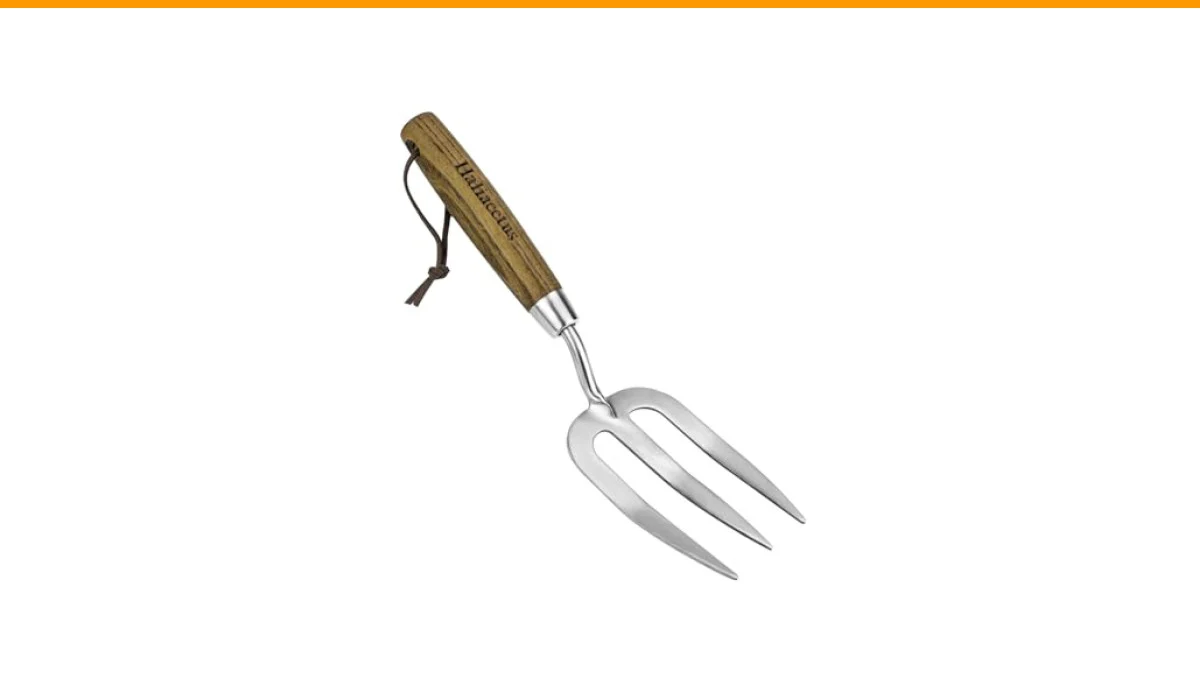
Haliaeetus Garden Hand Fork

Haliaeetus
Haliaeetus Garden Hand Fork, 12.3'' Hand Weeding Fork with Sharp Tine | for Easy Uprooting Large Weeds, Stainless Steel Garden Fork, Comfortable Wood Handle Hand Fork for Loosening Soil, Composting
- 【Great to Uproot Large Weeds】The gardening fork easily goes through the ground to digs deep under the weed and give more reach and…
- 【Loosens Soil Almost Effortlessly】With sharp and sturdy 3 prong tine that make it very easy to break through hard soil, even if yo…
- 【Comfortable Wooden Handle】Wood is a natural shock absorber and will not cause sore wrists even work for a few hours. The handle o…
This is a 12.3-inch hand fork with three sharp tines and a wooden handle. It suits gardeners who need to dig deep into a straw bale to remove established weeds or break up compacted centers. The stainless steel head is thicker than most budget forks.
The sharp tines push through matted straw without needing much force. The seamless welding at the neck is a real advantage in bales because that joint takes constant stress from prying and twisting. The wooden handle absorbs shock, which matters when you hit a hard clump of decomposed straw or a rock buried in the bale.
The trade-off is weight. This fork is heavier than a standard hand fork. If you have weak wrists, the extra heft might tire you out faster than a lighter tool. Also, the wooden handle needs occasional oiling to prevent cracking in wet bale conditions.
- Three sharp tines penetrate matted straw easily
- Thick stainless steel resists bending in heavy soil
- Seamless welding at the neck adds durability
- Wooden handle absorbs shock and reduces wrist strain
- Lifetime warranty covers defects
Best for: Gardeners who need a heavy-duty fork to uproot large weeds and break down compacted straw bale centers.
DeWit Perennial Fork with T-Handle

DeWit
DeWit Perennial Fork with Short T-Handle – Hand Garden Fork for Digging, Dividing & Separating Plants, Tempered Boron Steel with Ash Hardwood Handle
- MULTI-PURPOSE GARDEN FORK – Ideal for loosening soil, separating bulbs, dividing plants like hostas, and working in tighter spaces…
- SHORT T-HANDLE COMFORT – Ergonomic T-grip reduces hand and wrist fatigue during extended garden sessions.
- HEIRLOOM-QUALITY MATERIALS – Forged tempered boron steel head paired with sustainably grown ash hardwood handle for lasting streng…
The DeWit Perennial Fork is a compact tool with a short T-handle and a forged boron steel head. It targets gardeners with arthritis or hand fatigue who still need to divide plants and loosen soil in tight spaces. The T-grip changes how you hold the tool.
Forged boron steel is the standout feature. It is stronger than stamped stainless and holds an edge longer. The T-handle lets you push straight down with your palm instead of gripping and twisting. That motion is easier on arthritic joints. The compact head fits between plants in a raised bed without disturbing neighboring roots.
This fork is not ideal for deep digging in a straw bale. The short handle limits reach, and the head is narrow. It works best for surface cultivation and dividing perennials, not for breaking apart a whole bale. The ash hardwood handle is beautiful but requires care to avoid drying out.
- Forged boron steel head holds up to heavy use
- Short T-handle reduces wrist twisting
- Compact size fits tight perennial beds
- Ash hardwood handle from sustainable forests
- Lifetime guarantee from DeWit
Best for: Gardeners with arthritis or hand pain who need a compact, ergonomic fork for dividing plants and light soil work.
Berry&Bird Garden Hand Fork Long Handle
This is a 22.6-inch long-handle weed fork with a stainless steel head and a 12-inch ash handle. It solves the reach problem for tall raised beds and straw bales. You can stand upright and work the top of an 18 to 24 inch bale without bending.
The extra length gives you leverage. You can pry up weeds and loosen straw with less effort than a short fork. The stainless steel head resists rust, which matters in wet bale conditions. The ash handle is FSC certified and feels smooth in the hand.
The long handle makes this fork less precise for fine work around seedlings. You lose some control compared to a short-handled tool. Also, the 12-inch handle is not a full-length shaft, so it still requires some bending for ground-level beds. But for raised straw bales, it hits the sweet spot.
- 22.6-inch total length reduces bending
- 12-inch ash handle provides reach and leverage
- Stainless steel head resists rust in wet bales
- FSC certified wood from sustainable forests
- 2-year warranty and 30-day replacement
Best for: Gardeners with tall raised beds or straw bales who want to work standing up without kneeling.
Berry&Bird Gardening Hand Fork

Berry&Bird
Berry&Bird Gardening Hand Fork, Stainless Steel Hand Weed Fork | Traditional Garden Hand Fork Tool with Ergonomic Ash Wood Handle, Garden Tool for Weeding, Digging, Planting and Cultivating
- WHAT YOU GET - 1 * Stainless Steel Hand Fork. Our garden forks are made by traditional manual process and can be used for more tha…
- ERGONOMIC DESIGN- Berry&Bird hand fork has good balance and comfortable proportion, which is very suitable for planting in small a…
- STRONG AND TOUGH - Ideal for aerated soil, it will not bend under the action of force when used for harder garden work. The sharp…
This is a standard hand fork with a stainless steel head and an ash handle. It is the classic size for potting, weeding, and working in borders. It suits gardeners who want a reliable, no-frills tool for small areas.
The balance is good. The fork feels comfortable in the hand and penetrates clay soil without much effort. The stainless steel tines release soil easily, which reduces clogging. The ash handle is smooth and durable. It is a practical choice for raised beds and containers.
This fork is not designed for heavy prying. The tines are strong but not as thick as the Haliaeetus model. If you use it to lever out large rocks or thick roots, you risk bending a tine. It also lacks the reach of a long-handled fork, so you will need to kneel or bend for straw bale work.
- Standard size for pots, beds, and borders
- Stainless steel tines resist rust and soil adhesion
- Ash handle from FSC certified forests
- Good balance and comfortable grip
- 2-year warranty and 30-day replacement
Best for: Gardeners who need a dependable, standard-size hand fork for containers, raised beds, and light weeding.
Garden Guru Stainless Steel Fork

Garden Guru Lawn & Garden Tools
Garden Guru Stainless Steel Hand Weeder Fork Tool – Rust Resistant Stainless Steel – Ergonomic Handle – Great for Planting, Spreading Mulch, Weeding, Loosening & Transplanting Soil
- A must-have hand tool for every gardener. This hand rake is perfect for weeding, loosening and transplanting soil, turning, and sp…
- Stainless steel tines are rust resistant and sturdy, allowing easy penetration of soil. Fork also has the maneuverability to work…
- Ergonomic grip for comfort and control makes weeding and transplanting a breeze. Grip is designed to alleviate pressure on the pal…
The Garden Guru fork is a stainless steel hand weeder with an ergonomic handle and a large hang hole. It targets gardeners who want a rust-resistant tool for weeding, transplanting, and spreading mulch. The ergonomic grip is designed to reduce hand and wrist fatigue.
The stainless steel tines are sturdy and rust resistant. They penetrate soil easily and work around delicate stems without damaging them. The ergonomic handle alleviates pressure on the palm and fingers. The lifetime warranty and 90-day satisfaction guarantee are strong backing for a tool at this price point.
The fork is not as long as the Berry&Bird long-handle model, so it requires more bending for tall bales. The tines are also slightly narrower than some competitors, which limits how much straw you can move at once. But for the price, it is a solid choice for wet, rust-prone bale conditions.
- Stainless steel tines resist rust in wet conditions
- Ergonomic grip reduces hand and wrist fatigue
- Works around delicate stems and small plants
- Large hang hole for easy storage
- Lifetime warranty and 90-day satisfaction guarantee
Best for: Budget-conscious gardeners who need a rust-resistant fork for weeding and transplanting in wet straw bales.
How We Chose These Products
We evaluated hand forks based on how they perform in the specific conditions of straw bale gardening. That means constant moisture, decomposing straw, twine, and the need to reach 18 to 24 inches without kneeling. We looked for stainless steel or forged steel that resists rust and bending. We checked handle length and grip design for ergonomics. We also considered warranty and build quality.
We did not rank tools by popularity or price alone. A cheap fork that bends on the first rock is useless. A heavy fork that tires your hands is also a poor choice. The best fork for straw bales balances sharp tines, rust resistance, reach, and comfort. Each pick here meets that balance in a different way.
Buying Guide: What Really Matters
Tine count and spacing matter more in straw bales than in ground beds. Three or four sharp tines with moderate spacing push through matted straw without clogging. Wide, blunt tines just compress the straw. Narrow tines work better for pocketing compost around transplants.
Stainless steel is worth the extra cost for straw bale gardening. Bales stay wet, and the conditioning process uses nitrogen and water. Carbon steel rusts quickly in that environment. Stainless steel also releases soil and straw more easily, which reduces clogging and cleaning time.
Handle length depends on your bale height. A 12-inch handle works for low beds. For 18 to 24 inch bales, you want a longer handle or a T-grip that lets you push straight down. The Berry&Bird long-handle model is the best choice for tall bales. The DeWit T-handle is better for arthritic hands that need a different grip.
Using Your Hand Fork Around Bale Twine and Transplants
Straw bales are held together by twine. Your fork will hit that twine constantly. Sharp tines can slice through it, which weakens the bale structure. Work slowly around the twine lines. Use the fork to lift straw, not to chop through it. If you feel resistance, stop and reposition.
For transplanting, use the fork to create a pocket in the straw. Push the tines in, rock the handle back, and pull out a plug of straw. Drop your seedling in and firm the straw around it. The Haliaeetus fork works well for this because the sharp tines make clean pockets. The Garden Guru fork is also good for delicate seedlings because the narrower tines cause less disturbance.
Maintaining Your Fork Between Bale Seasons
Straw bales grow mold and fungi as they decompose. That saprophytic growth can leave residue on your fork. Clean the tines with a stiff brush and warm soapy water after each season. Dry the tool completely before storing it. A light coat of oil on the metal prevents rust during winter storage.
Wooden handles need care too. Wet bale conditions can dry out or crack the wood. Apply linseed oil or a wood conditioner once a year. Check the neck where the handle meets the metal. That joint takes the most stress. If it loosens, tighten or repair it before the next season.
Our Top Recommendation
The Haliaeetus Garden Hand Fork is our top pick for straw bale gardening. It has the sharpest tines, the thickest stainless steel, and a comfortable wooden handle. It handles the tough job of breaking down compacted bale centers and uprooting large weeds. The seamless welding adds durability where other forks fail.
For gardeners with arthritis or hand pain, the DeWit Perennial Fork is the better choice. The T-handle changes the grip and reduces wrist strain. For tall bales, the Berry&Bird Long Handle Fork saves your back. And for a budget-friendly rust-resistant option, the Garden Guru fork is a solid pick.
Frequently Asked Questions
Can I use a regular garden hand fork in straw bales?
You can, but most regular forks are too short and too weak for the job. Straw bales are dense and wet. A standard fork may bend or rust quickly. Look for stainless steel, sharp tines, and a handle long enough to reach the bale top.
How do I weed a straw bale without breaking it apart?
Work slowly and use a fork with sharp, narrow tines. Push the tines into the straw next to the weed, then lift and twist. Do not chop or rip. If the weed resists, loosen the straw around it first. Avoid cutting the twine.
What width fork fits a standard bale top?
A standard straw bale is about 36 inches long and 18 inches wide. A hand fork with a 3 to 4 inch wide head fits comfortably on the top surface. Wider forks are harder to maneuver around twine and transplants.
How often should I clean my fork during bale season?
Clean the tines after every few uses, especially if you see mold or sap buildup. A quick scrub with a wire brush removes most residue. At the end of the season, do a deep clean and oil the metal before storing.