Your neighbor’s lawn looks like a golf course fairway while yours has gone patchy and pale. In Texas, the difference usually isn’t luck or water. It’s feeding the right grass with the right product at the right time, and most homeowners get at least one of those three wrong.

Texas is a brutal place to grow grass. Clay soil in Dallas, sandy loam near Houston, and caliche out west all behave differently. Add 100-degree summers, occasional drought restrictions, and a mix of warm-season and cool-season grasses, and you’ve got a lawn care puzzle most generic fertilizer guides ignore.
I’ve narrowed this down to five Scotts products that actually work in Texas conditions, and I’ll tell you which one fits your grass type and region. Below you’ll find a quick comparison table, detailed reviews, a region-by-region breakdown, exact application rates, and the mistakes I see homeowners repeat every spring.
Here’s a quick side-by-side look at how these five stack up on the specs that matter most for Texas lawns.
| Features | Turf Builder Southern | Green Max Lawn Food | Turf Builder Lawn Food | Turf Builder Weed & Feed3 | WinterGuard Fall Weed & Feed3 |
|---|---|---|---|---|---|
| Primary Use | Southern grass feeding | Fast deep greening | All-purpose grass feeding | Weed kill plus feed | Fall weed control plus feed |
| Grass Types | Southern varieties only | Any grass type | Any grass type | Any grass type | Bahiia, Bermuda, Zoysia, Fescue, more |
| Coverage | 5,000 sq. ft. | Not specified | Not specified | Up to 15,000 sq. ft. | 4,000 sq. ft. |
| Iron Boost | No | Yes | No | No | No |
| Best Season | Spring, summer, fall | Growing season | Spring, summer, fall | Spring or early summer | Fall only |
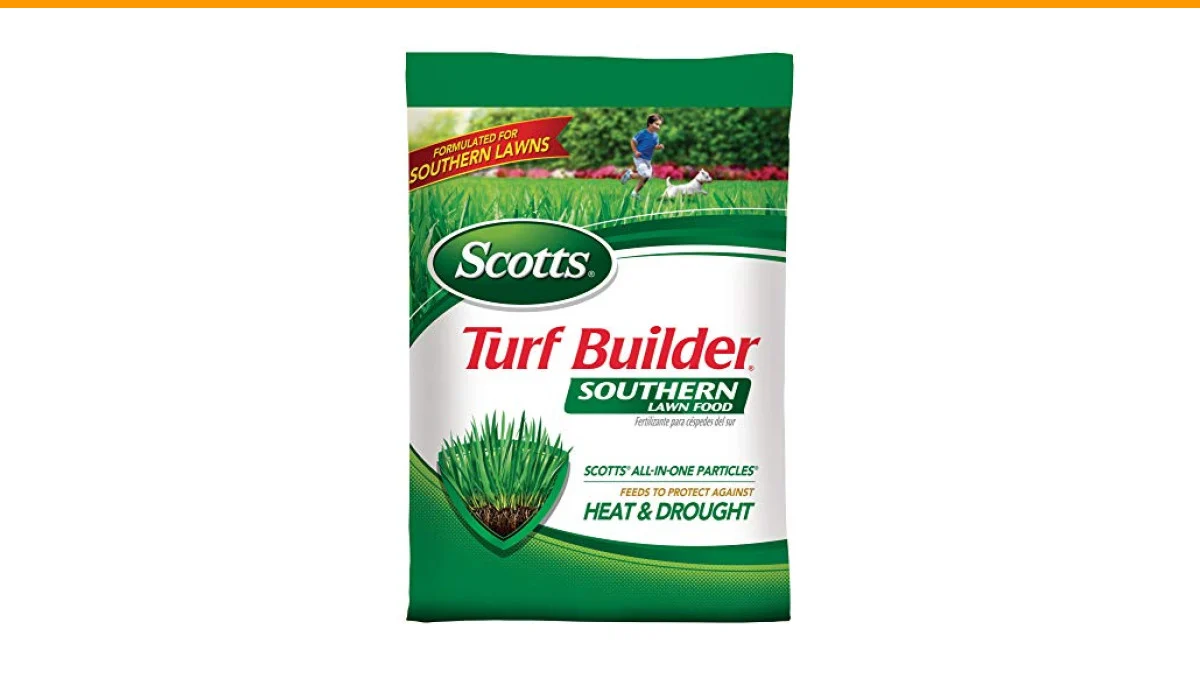
Scotts Turf Builder Southern

Scotts
Scotts Turf Builder Southern Lawn Food, 14.06 lbs. | Grass Fertilizer for Lawns with Southern Grasses, 5,000 sq. ft.
- SOUTHERN GRASS FERTILIZER: Scotts Turf Builder Southern Lawn Food is a pesticide-free lawn fertilizer specially formulated for Sou…
- WHEN TO APPLY: Apply this fertilizer for grass during the growing season in spring, summer, or fall; for fast results, lightly wat…
- WHERE TO USE: This lawn care product is formulated for Southern grass types; people and pets can re-enter the lawn after applicati…
The one you buy when your grass is St. Augustine, centipede, or carpetgrass and nothing else has worked. This is Scotts’ dedicated Southern formula, sold in a 14.06 lb. bag that covers 5,000 square feet. If you live anywhere from Houston to Corpus Christi and your lawn is a thick-bladed warm-season grass, this is the starting point.
The standout feature is the All-in-One Particles built into the blend. These aren’t just filler granules; they’re designed to push roots deeper so your grass can survive a Texas July without going dormant. Deep roots matter more in Texas than almost anywhere else, because shallow-rooted St. Augustine will fold the moment the temperature hits triple digits and watering restrictions kick in.
Here’s the trade-off: this is a straight feeder with no weed control. If your lawn is already weedy, you’ll need a separate herbicide or a weed-and-feed product. And it’s formulated only for Southern grasses, so don’t use it on a fescue lawn in the Panhandle. You’ll also want to water it in lightly after applying for the fastest response.
- Pesticide-free, safe for people and pets to re-enter immediately
- Designed specifically for warm-season Southern grasses
- All-in-One Particles target root depth and drought resilience
- One bag covers 5,000 sq. ft.
- Apply spring, summer, or fall during active growth
Best for: Gulf Coast and Central Texas homeowners with St. Augustine or centipede who want stronger roots without weed control.
Scotts Green Max Lawn Food

Scotts
Scotts Green Max Lawn Food, 16.67 lbs. | Lawn Fertilizer for Grass Plus Iron Supplement, Grass Fertilizer, Covers 5,000 sq. ft.
- Feeds for deep greening in just 3 days
- Dual-action, 2-in-1 formula feeds and supplements with iron
- Guaranteed not to stain when used as directed
The fast-fix product. If your lawn is yellowing from iron deficiency, which is common in alkaline Texas soil, Green Max delivers visible greening in about three days. That speed is the entire point of this bag, and it’s why I keep recommending it to homeowners who need their lawn presentable before a graduation party or family reunion.
The dual-action formula feeds grass and supplements with iron at the same time. Iron is what gives St. Augustine and Bermuda that deep, almost blue-green color, and Texas soil is notoriously iron-poor in many regions. This product also won’t stain concrete or driveways when you apply it as directed, which matters if you’ve ever dealt with iron stains on a sidewalk.
One real limitation: this is not sold in Florida, and it’s not a weed killer. It also doesn’t address soil pH or long-term root structure the way the Southern formula does. Think of it as a cosmetic boost with a nutritional assist, not a foundation product. Check the current price on Amazon before committing to a full-season plan.
- Deep greening visible in roughly three days
- Iron supplement corrects yellowing from deficiency
- Won’t stain hardscapes when used as directed
- Safe for any grass type
- Re-enter the lawn immediately after application
Best for: Anyone with an iron-deficient lawn who needs fast color before an event or showing.
Scotts Turf Builder Lawn Food

Scotts
Scotts Turf Builder Lawn Food, 12.5 lbs. | Fertilizer for Grass, For All Grass Types, Covers 5,000 sq. ft.
- WHERE TO USE: Lawn fertilizer for grass can be used on any grass type
- GRASS FERTILIZER FOR LAWNS: Scotts Turf Builder Lawn Food feeds and strengthens your grass to help protect against future problems
- STRONG ROOTS: Our pesticide-free lawn food for grass builds strong, deep roots, improving your lawn's ability to absorb water and…
The workhorse. This is the bag you grab when you don’t know your grass type or you’re maintaining a mixed lawn. It works on any grass type, feeds and strengthens turf, and builds deeper roots compared to an unfed lawn. The 12.5 lb. size is manageable for smaller yards and easy to store in a garage.
What I like about this formula is its flexibility. Apply it to a wet or dry lawn in spring, summer, or fall. That means you’re not waiting for a specific window or scrambling after rain. The pesticide-free blend also lets kids and pets back on the grass right away, which is a practical concern for families with dogs. If you’re building a full-season program, this fits neatly as your base feeder while you layer in weed control separately.
The honest downside: this is generic. It doesn’t have the Southern-specific root-building particles or the iron kick of Green Max. On heavy clay soil in North Texas, you may need to water it in thoroughly to get granules into the root zone. And it won’t do anything for existing weeds, so pair it with a pre-emergent if crabgrass has been a problem.
- Works on every grass type, including mixed lawns
- Builds deeper roots than an unfed lawn
- Apply wet or dry, any growing season
- Pesticide-free and pet-friendly after application
- 12.5 lb. bag suits small to mid-size yards
Best for: Homeowners with mixed grass or unknown varieties who want a reliable, no-fuss feeder.
Scotts Turf Builder Weed & Feed3

Scotts
Scotts Turf Builder Weed & Feed3, 42.87 lbs. | Weed Killer Plus Lawn Fertilizer, Controls Dandelion and Clover, Covers 15,000 sq. ft.
- Up to 2X more powerful dandelion and clover control (vs. previous formula)
- Clears out dandelions and clover—satisfaction guaranteed
- Weedgrip Technology grips the weeds you see—and the ones you don't
The heavy hitter for weedy lawns. This 42.87 lb. bag is Scotts’ most powerful weed-and-feed formula, and it’s built for the homeowner who’s tired of looking at dandelions and clover. Weedgrip Technology grabs the weeds you can see and the ones you can’t, which is the real value here. Most weed killers miss the small stuff; this one targets both.
The formula delivers up to twice the dandelion and clover control of the previous version. That’s a meaningful jump if you’ve fought clover for years in a Bermuda or St. Augustine lawn. It also feeds to thicken turf, which crowds out future weeds. Thick grass is the best long-term weed prevention there is, and this product addresses both problems in one pass.
Trade-offs exist. You can’t use this on newly seeded lawns, and it’s not a fall product. Timing matters because you need weeds actively growing for the herbicide to work. In Texas, that means spring or early summer, not August when everything is heat-stressed. The large bag also makes it awkward for small yards, so measure your square footage before ordering.
- Up to 2x more dandelion and clover control than prior formula
- Weedgrip Technology targets visible and hidden weeds
- Feeds to thicken turf and crowd out future weeds
- Large 42.87 lb. bag covers substantial square footage
- Apply when weeds are actively growing
Best for: Homeowners with established weeds who want one product to kill and feed in a single application.
Scotts Turf Builder WinterGuard Fall
The fall specialist. This 11.43 lb. bag covers 4,000 square feet and does something no other product on this list does: it prepares your lawn for winter while killing fall weeds. Apply it when temperatures sit between 60°F and 90°F and weeds are actively growing. In most of Texas, that’s October through early November.
Fall is when warm-season grasses store energy for spring green-up. Feeding at the right time in autumn gives you a thicker, faster-greening lawn next March, and it kills over 50 listed weeds including clover, plantain, morningglory, chicory, and purslane. The formula works on Bahiagrass, Bermudagrass, Bluegrass, Centipedegrass, Fescue, Ryegrass, and Zoysiagrass, though you should check the label for restrictions on your specific variety.
The catch: this is a fall-only product. Using it in spring wastes money and may stress the lawn. It’s also a smaller bag, so a half-acre yard needs multiple bags. If you’re on a tight budget, this is a supplemental purchase, not a base feeder. But skipping fall feeding is one of the most common Texas lawn mistakes, so the cost is worth it. For more on fall timing, see this fall fertilizer guide.
- Combines fall weed control with winterizing fertilizer
- Kills over 50 listed weeds including clover and dandelion
- Works on most major warm- and cool-season grasses
- Apply when temps are between 60°F and 90°F
- Covers 4,000 sq. ft. per bag
Best for: Texas homeowners who want a stronger spring green-up and fall weed cleanup in one pass.
How We Chose These Products
I focused on products that actually perform in Texas conditions, not just ones with good marketing. That meant filtering out formulas designed for cool-season Northern lawns, checking grass-type compatibility against the varieties Texans actually grow, and weighing whether each product solves a real problem: root depth, iron deficiency, weed pressure, or fall prep.
Coverage, application flexibility, and safety for families and pets also factored in. Every pick here is pesticide-free or clearly labeled for its intended use, and each one fills a distinct role in a season-long program. I didn’t include products that duplicate another pick’s job.
Buying Guide: What Really Matters
The NPK ratio on the bag tells you the percentage of nitrogen, phosphorus, and potassium. In Texas, most established lawns need a ratio close to 3-1-2 or 4-1-2. Phosphorus is usually zero because Texas soil tends to hold onto it, and runoff from excess phosphorus is a water quality issue. If your soil test says phosphorus is low, that’s the exception, not the rule.
Nitrogen type matters as much as the number. Slow-release nitrogen feeds gradually and won’t burn grass in Texas heat. Quick-release nitrogen greens faster but risks scorching during a July afternoon. For most homeowners, a blend with a good share of slow-release nitrogen is the safer bet. If you want to go deeper on this, read about nitrogen fertilizer options.
Iron and micronutrients deserve attention in Texas because alkaline soil locks up iron, and iron deficiency shows as yellow blades with green veins. A soil test from your county extension office costs a few dollars and tells you exactly what your lawn needs. Skip it and you’re guessing, and guessing gets expensive. Organic options like compost, corn gluten meal, and humic acid products work too, though they release nutrients more slowly and cost more per pound of nitrogen.
Our Top Recommendation
For most Texas homeowners with St. Augustine or centipede, Scotts Turf Builder Southern Lawn Food is the clear winner. It’s built for Southern grasses, targets root depth, and covers 5,000 square feet per bag. If your lawn is Bermuda or Zoysia and you want faster color, Scotts Green Max is the better pick. For weed-heavy lawns, Scotts Turf Builder Weed & Feed3 handles both problems at once. And no matter which base feeder you choose, add the WinterGuard Fall Weed & Feed3 in October for a stronger spring.
Frequently Asked Questions
How much fertilizer should I apply per 1,000 square feet in Texas?
Follow the bag rate, but know that Texas heat pushes you toward the lower end. Most Scotts products call for roughly 2.5 to 4 pounds per 1,000 square feet. Use a spreader calibrated to the setting on the bag, and split applications if you’re unsure. Overapplying in summer is the fastest way to burn a lawn.
Should I water in fertilizer after applying it in Texas heat?
Yes, for granular products. A light watering moves granules off the blades and into the soil where roots can use them. Skip it and you risk granules sitting on hot grass, which can cause burn spots. Water in the morning, not midday, to reduce evaporation.
Do I need a soil test before fertilizing my Texas lawn?
It’s the single best money you’ll spend. Texas soil varies wildly from sandy Gulf Coast loam to heavy black clay to alkaline caliche. A test tells you your pH, phosphorus, and potassium levels so you buy the right product instead of guessing. Your county extension office offers them cheaply.
Can I use the same fertilizer on St. Augustine and Bermuda?
Not always. St. Augustine needs more nitrogen and responds well to Southern-specific formulas. Bermuda is more aggressive and tolerates a wider range. Scotts Turf Builder Lawn Food works on both, but if you have separate lawns, match each to its grass type. For more regional comparisons, see these Texas lawn fertilizer reviews.
What about organic fertilizer for Texas lawns?
Compost, corn gluten meal, and humic acid products work, but they release nitrogen slowly and cost more per pound. They’re a good supplement on clay soil because they improve structure over time. As a standalone program, though, most organic options struggle to keep up with a Texas Bermuda lawn’s nitrogen demand in peak summer. If you’re dealing with dog spots, this dog urine fertilizer guide covers that specific problem.