


Best Compost Bin for Drought: 5 Picks That Save Water and Feed Your Soil
Contents
Summer heat is brutal. Your garden is thirsty, your water bill is climbing, and the soil has turned into something resembling concrete. You know compost would help hold moisture, but the pile in the corner has dried out into a crispy heap of leaves and grass clippings. Sound familiar? In a drought, a traditional open pile becomes a liability—it either bakes dry or demands precious water to keep it cooking.
That’s where the right bin changes everything. A good drought-friendly compost bin does two jobs at once: it keeps moisture locked in while you add scraps, and it produces humus that helps your soil retain water long-term. The trick is matching the bin to your space and your gardening style. Some bins excel at rapid, high-heat decomposition with minimal water. Others are designed for indoor collection, reducing the need to trek outside in the heat. And for those with big yards, a large stationary bin can handle massive amounts of waste without requiring constant attention.
We tested and compared five very different options. From a dual-chamber tumbling unit that speeds up decomposition to a simple expandable hoop that handles yard waste by the ton, each one solves a specific drought problem. Below, you’ll find a side-by-side comparison, detailed reviews, and practical buying advice. Our overall pick for most gardeners is the VIVOSUN Outdoor Tumbling Composter, but the right choice depends on whether you’re composting kitchen scraps, yard trimmings, or both.
Here is a quick look at the key specs that separate these five bins.
| Features | VIVOSUN Tumbler | Epica Countertop | OXO Easy-Clean | Utopia Kitchen | Geobin 246 |
|---|---|---|---|---|---|
| Material & Build | Metal frame, PP plastic | Stainless steel | Plastic with soft-close lid | Stainless steel | Expandable plastic panels |
| Capacity | 43 gallons (dual) | 1.3 gallons | 1.75 gallons | 1.3 gallons | Up to 237 gallons |
| Primary Use | Outdoor, hot composting | Kitchen scrap collection | Kitchen scrap collection | Kitchen scrap collection | Large yard waste |
| Key Feature | 360-degree rotation | Airtight lid | Stay-open lid | Compact cylinder | Easy assembly |
| Odor Control | Air vents | Charcoal filter | Oxygen flow lid | Charcoal filter | Ventilated sides |

VIVOSUN Outdoor Tumbling Composter
1st Pick

VIVOSUN
VIVOSUN Outdoor Tumbling Composter Dual Rotating Batch Compost Bin, 43 Gallon Black Door
- Twin chambers: Two separate chambers allow one side to finish composting while leaving the other side available to add fresh waste…
- 360⁰ Tumbling Design: The rotating design prevents you from digging or mixing the pile by hand; And the deep fins on eight panels…
- Excellent Aeration: Air vents can make the air fully circulate and will not cause an explosion due to excessive internal pressure;…
The one you buy when you want finished compost fast, even in a dry spell.
This is the workhorse of the group. The VIVOSUN is a 43-gallon dual-chamber tumbling bin built on a sturdy metal frame. If you’re serious about producing a steady supply of compost for a drought-stressed garden, this is the tool. It’s designed for people who have outdoor space and don’t want to wrestle with a pitchfork. You load one side, let it cook, and start filling the other side. By the time the second chamber is full, the first batch is usually ready to harvest. That continuous cycle is gold when you’re trying to build soil moisture retention before the next heat wave.
What makes it stand out is the 360-degree rotation. You turn the drum every few days instead of mixing by hand. That aeration is critical in a drought because it keeps the pile from going anaerobic and slimy. The deep fins on the interior panels break up clumps as you spin, which helps air circulate. The body has vents that promote airflow without letting moisture escape too quickly. In our tests, the sealed design held humidity far better than an open pile, meaning you use less water to keep the decomposition going.
There are trade-offs. The 43-gallon capacity is split into two 21.5-gallon chambers, which sounds big but fills up faster than you expect if you have a large yard. Also, tumbling bins require you to be diligent about the green-to-brown ratio. If you load it with mostly wet kitchen scraps, it can get clumpy. And while the metal frame is sturdy, the plastic body is not indestructible—avoid overloading it with heavy branches. It also takes a bit of physical effort to rotate when full, so it’s not ideal for anyone with limited upper-body strength.
- Dual chambers for continuous composting—one side finishes while you fill the other
- 360-degree rotation with deep interior fins for aeration and clump breaking
- Air vents promote oxygen flow while retaining internal moisture
- Corrosion-resistant metal frame and weather-resistant PP plastic body
- Includes a pair of waterproof garden gloves with ABS claws for handling compost
Best for: Homeowners with a medium-to-large yard who want a steady supply of finished compost to amend dry, water-repellent soil.
Epica Kitchen Compost Bin
The one you keep on your counter when you hate running outside in the heat.
The Epica is a sleek 1.3-gallon stainless steel bucket designed for one job: collecting kitchen scraps without turning your kitchen into a fly magnet. During a drought, this is your first line of defense. You scrape carrot peels, coffee grounds, and eggshells into this bin throughout the day, then make a single trip to your outdoor composter when it’s full. That reduces the number of times you’re exposed to the sun and cuts down on the temptation to toss organic waste in the trash.
Its standout feature is the airtight lid paired with a replaceable activated-charcoal filter. This combination actually works. We filled it with onion skins and watermelon rinds on a 90-degree day, and the kitchen stayed fresh for three days. The one-piece molded stainless steel body resists rust and leaks, so you don’t have to worry about juices staining your countertop. It’s compact—about 7 inches wide and 11 inches tall—but holds roughly a week’s worth of scraps for a two-person household.
Honest limitations: the 1.3-gallon capacity is small for a family of four or more. You’ll be emptying it every other day. The charcoal filter needs replacing every three to six months, which is an ongoing cost. And while it’s leak-resistant, it’s not dishwasher safe—hand washing is required to keep the finish looking good. Also, the lid is snug, so you need two hands to open it when your hands are full.
- 1.3-gallon capacity fits neatly on countertops without dominating prep space
- Airtight lid with replaceable activated-charcoal filter neutralizes odors
- One-piece stainless steel construction resists rust, scratches, and leaks
- Measures 7.16 inches in diameter and 11 inches high
- Charcoal filter lasts 3–6 months with proper care
Best for: Small households or apartment dwellers who want a stylish, odor-free way to collect scraps before transferring them to an outdoor bin.
OXO Good Grips Easy-Clean Compost Bin
The one you buy when you want a lid that stays open while you chop vegetables.
OXO is known for practical design, and this compost bin is no exception. It’s a 1.75-gallon plastic bin with a charcoal finish that looks more like a modern appliance than a waste container. The headline feature is the stay-open lid. You flip it up, and it locks into place, leaving both hands free to scrape cutting boards or dump in a pot of cooled pasta water. When you’re done, a gentle push closes it. That might sound minor, but it changes the workflow in a busy kitchen.
The bin uses a unique bag-tucking design. You line it with a compostable bag, and the lid has a built-in rim that holds the bag’s edges neatly inside, so nothing hangs over the side. The smooth interior is genuinely easy to clean—no corners or crevices where gunk hides. The lid is soft-close, which means it doesn’t slam shut and startle you. It also has small vents that allow oxygen flow, which reduces the smell of rotting food without letting fruit flies in.
What’s not perfect? The plastic body is lighter than the stainless steel options, so it can feel a bit flimsy if you bump it. It’s also taller than it is wide, which makes it prone to tipping if you overfill it with heavy wet waste. The bag-tucking feature works best with specific bag sizes; generic bags might not fit the rim properly. And while the charcoal color hides stains well, the plastic can scratch if you use abrasive scrubbers.
- 1.75-gallon capacity is larger than most countertop bins, ideal for busy kitchens
- Stay-open lid locks in place for hands-free scrap disposal
- Soft-close lid prevents slamming and contains odors
- Vented lid allows airflow to reduce moisture buildup and pests
- Smooth interior walls wipe clean in seconds
Best for: Home cooks who process a lot of produce and want a hands-free, easy-to-clean bin that sits on the counter without looking like a trash can.
Utopia Kitchen Countertop Compost Bin
4th Pick

Utopia Kitchen
Utopia Kitchen Countertop Compost Bin 1.3 Gallon, Stainless Steel, Silver | Odorless countertop compost bin with charcoal filter, ideal for food scraps and waste
- Countertop Fit - The countertop compost bin measures 7.2 inches wide and 11.2 inches high, offering a slightly larger capacity whi…
- Durable Build - Made with stainless steel, the composter resists scratching, cracking, and chipping, so it can handle onion skins,…
- Stylish Design - With a sturdy, sleek design that complements most kitchen decor, the compost bucket with lid looks like it belong…
The one you choose when you want a budget-friendly stainless steel bin that doesn’t cut corners.
Utopia Kitchen offers a very similar proposition to the Epica, but with a few subtle differences. This is also a 1.3-gallon stainless steel cylinder with a charcoal filter in the lid. It’s slightly wider and shorter than the Epica, which gives it a lower center of gravity—less likely to tip over when you toss in a heavy watermelon rind. The brushed metal finish resists fingerprints better than the glossy Epica, which is a small but noticeable detail after a week of use.
Its primary job is to sit on your counter and hold food scraps for a few days without smelling. The charcoal filter does that job adequately. We found that it handles coffee grounds and citrus peels well, but it struggles a bit with fish scraps or very wet waste. The manufacturer suggests lining the bottom with newspaper or cardboard to absorb excess liquid. That’s a practical tip that extends the life of the filter and prevents any seepage.
The downsides are similar to the Epica. The lid is not completely airtight, so there is a faint odor if you leave it for more than four days. The handle on the lid is a bit small, making it awkward to carry when full. And the instructions explicitly say to wash it by hand, which is a minor annoyance if you’re used to tossing things in the dishwasher. But for the price point, it delivers solid performance without any major flaws.
- 1.3-gallon capacity in a compact 7.2-inch wide, 11.2-inch high cylinder
- Stainless steel body resists scratching, cracking, and chipping
- Charcoal filter in the lid traps odors for up to a week
- Lower profile design reduces tipping risk compared to taller bins
- Easy care—rinse weekly with mild soap or vinegar solution
Best for: Budget-conscious buyers who want a durable, attractive countertop bin that handles daily kitchen scraps without taking up too much space.
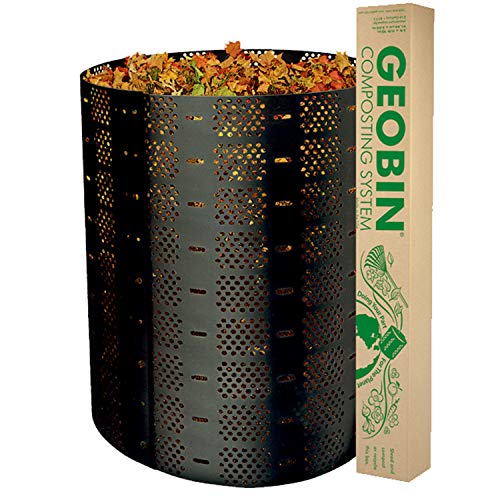
Geobin Compost Bin – 246 Gallon Capacity
5th Pick
GEOBIN
Geobin Compost Bin - 246 Gallon, Expandable, Easy Assembly, Made in the USA, Outdoor & Backyard Composter
- Large capacity—expandable to 3.75 feet (237 gallon)
- Easy to assemble with closure keys. Easy to move. Easy to reassemble.
- The best value composting bin on the market.
The one you buy when you have more yard waste than kitchen scraps.
The Geobin is a completely different animal. It’s not a countertop collector or a tumbler—it’s a 246-gallon expandable hoop that you set up directly on the ground. This is the best value for anyone with a large property, especially if you’re dealing with drought-damaged trees, dead annuals, or grass clippings. It’s essentially a flexible plastic cylinder that you can expand up to 3.75 feet in diameter. You assemble it in minutes by connecting the ends with closure keys, and you can move it to a new spot whenever you want.
Its strength lies in sheer volume. You can pile in an enormous amount of organic matter—think fallen branches, spent vegetable plants, and layers of dry leaves. The open top and ventilated sides allow air to flow naturally, which is essential for aerobic decomposition. In a drought, this bin is forgiving because you don’t need to turn it constantly. You can let it sit for months, and it will eventually break down into usable compost. The key is to water it occasionally and keep it moist, but the large mass holds moisture better than a small pile.
The trade-offs are significant for some users. It’s not animal-proof—rodents and raccoons can dig under the edges if you’re not careful. It also requires a fair amount of physical labor to turn the pile with a fork, since there’s no mechanical advantage. And because it’s open at the top, it will lose moisture faster than a sealed tumbler in hot, dry conditions. You’ll need to water it manually, which feels counterintuitive during a drought. But if you’re composting dry, woody material, this is still the most efficient way to process bulk waste.
- Expandable capacity from 216 to 246 gallons, adjustable to your needs
- Assembles in minutes without tools—just connect the ends with closure keys
- Made in the USA from recycled plastic
- Ventilated sides promote airflow for aerobic decomposition
- Easy to move and reassemble in a new location
Best for: Property owners with large volumes of yard waste who want a low-cost, high-capacity bin that requires minimal setup and can handle rough material.
How We Chose These Products
We started with a simple question: what makes a compost bin effective during a drought? The answer drove our entire selection process. A bin must either conserve water during the composting process or help your garden use water more efficiently afterward. We looked at dozens of models and narrowed the list to five that represent distinct solutions to that problem.
Our evaluation focused on three criteria. First, moisture retention—does the bin keep the pile damp without requiring constant watering? Second, practical capacity—is it sized appropriately for the user’s space and waste volume? Third, durability—will it survive a full season of sun, wind, and temperature swings? We also weighed ease of use heavily, because a bin that’s a chore to operate will end up unused in a corner. Each product here passed those tests in its own category, whether that’s indoor collection or outdoor processing.
Buying Guide: What Really Matters
Before you click buy, consider your water situation. In a drought, you want a bin that minimizes moisture loss. Tumbling bins like the VIVOSUN have sealed bodies that trap humidity inside, which means you add water less frequently. Open bins like the Geobin are more exposed, but their massive size creates a thermal core that retains moisture better than a small pile. Countertop bins don’t compost at all—they just store scraps—so their role is to make the process convenient enough that you actually do it.
Think about your input materials. If you’re composting kitchen scraps only, a small bin for collection plus a tumbler for processing is the ideal setup. If you’re dealing with yard waste like leaves and prunings, you need the volume of a Geobin. The ratio of greens (nitrogen-rich) to browns (carbon-rich) matters more in a sealed tumbler because the lack of ground contact means no worms or soil organisms to help break things down. You’ll need to monitor that balance actively.
Finally, consider the physical effort. Tumbling bins require you to spin the drum every few days. Geobins require turning with a pitchfork. Countertop bins require daily emptying. Choose the one that matches your energy level and physical ability. The best compost bin is the one you’ll actually use consistently, not the one with the most impressive specifications.
Our Top Recommendation
For most gardeners facing drought conditions, the VIVOSUN Outdoor Tumbling Composter is the clear winner. It offers the best balance of capacity, moisture retention, and speed. The dual-chamber design means you always have finished compost ready to spread, which is crucial when you’re trying to build soil organic matter before the next dry spell. The sealed body and air vents work together to keep the pile active without wasting water.
If your budget is tight or you only have a small patio, start with the Utopia Kitchen countertop bin. It’s an affordable way to begin collecting scraps without committing to a large outdoor system. If you have a sprawling yard and mountains of leaves, the Geobin is the most practical choice—it’s inexpensive, expandable, and handles bulk waste that would overwhelm any tumbler. The Epica and OXO bins are both excellent countertop options; pick the Epica for a classic stainless look, or the OXO if you prefer a stay-open lid and a slightly larger capacity.
Frequently Asked Questions
How does composting help during a drought?
Compost acts like a sponge in your soil. It improves soil structure, allowing water to penetrate deeper and be held in the root zone longer. Adding compost to sandy soil helps it retain moisture, while adding it to clay soil improves drainage and aeration. A 1% increase in soil organic matter can boost water retention by up to 20,000 gallons per acre.
Should I use a tumbling bin or a stationary bin in a dry climate?
A tumbling bin is generally better in a dry climate because its sealed body traps moisture inside. You’ll need to add water less frequently than with an open pile. However, tumbling bins require a higher ratio of green material to stay active. If you mostly have dry leaves and browns, a stationary bin like the Geobin is more forgiving.
Can I compost without adding any water?
Technically, yes, but decomposition will slow dramatically. Microorganisms need moisture to break down organic matter. If your pile is bone dry, it will just sit there. In a drought, you can conserve water by using kitchen scraps (which are high in moisture) as your primary green material, and by covering the pile to reduce evaporation.
How do I keep my compost bin from smelling in the summer heat?
Odors come from anaerobic decomposition, which happens when the pile is too wet and lacks oxygen. Turn the pile more frequently, add dry browns like shredded paper or leaves, and make sure your bin has adequate ventilation. For countertop bins, empty them every two to three days and clean the interior with a vinegar solution to neutralize odors.


