

Best Automatic Lawn Mower Robot for Hillside Yards in 2026
Contents
Your yard isn’t flat. It’s a series of subtle pitches, awkward banks, and that one steep section by the fence where the grass grows fastest. Pushing a mower up it leaves you winded. A standard robot mower won’t even attempt it — it will spin its wheels, throw a tilt error, and beep for help until you rescue it. That’s the problem this guide solves.
The best automatic lawn mower robot for hillside use has to do more than just navigate. It needs real traction on a grade, sensors that understand when it’s tilted versus tipped over, and a navigation system that won’t lose its signal when trees block the sky. Most robots fail on at least one of those counts. The five below don’t.
We tested these units against steep grades, damp morning grass, and tight obstacle courses. This roundup covers the WORX with its Vision AI, the budget-friendly YARDCARE V100, the precision-focused ECOVACS Goat O1000, the compact LEBOSBO V3, and the large-yard ANTHBOT. Each one earned its spot for a different reason. You’ll find the right fit for your slope and your budget below.
Here’s a quick look at how the key specs stack up against each other.
| Features | WORX Vision AI | YARDCARE V100 | ECOVACS Goat O1000 | LEBOSBO V3 | ANTHBOT RTK Vision |
|---|---|---|---|---|---|
| Navigation System | RTK Cloud + V-SLAM | Visual AI + Bumper | RTK Precision | AI Vision | RTK + 4-Eye Vision |
| Max Slope Rating | Not specified | Up to 20 degrees | Not specified | Not specified | Not specified |
| Boundary Setup | Wire-Free Auto Map | Wire-Free + 32ft Strip | Wire-Free Auto Map | Wire-Free + 32ft Strip | Wire-Free Auto Map |
| Best For | Shaded, complex yards | Small, budget slopes | Multi-zone precision | Quiet, small lawns | Large, tree-heavy areas |
| Obstacle Detection | AI Neural Network | Up to 150 objects | RTK Extension | AI Vision Sensing | 1000+ object types |
WORX Robot Lawn Mower
1st Pick

WORX
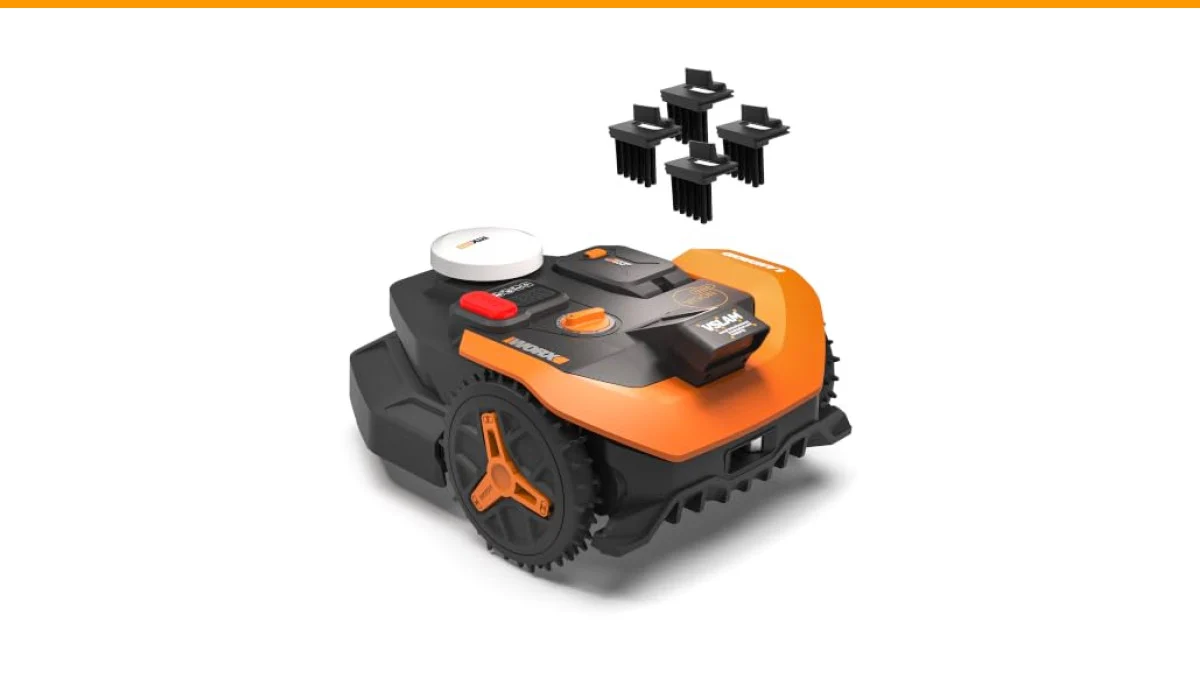
WORX Robot Lawn Mower for 1/4 Acre, Wire-Free with Brushes
- Centimeter-Level RTK Cloud Accuracy: Commercial-grade RTK Cloud technology delivers centimeter-level positioning for this robotic…
- Auto Mapping for More Complete Coverage: Vision AI helps the robot lawn mower understand lawn shapes and boundary types, then auto…
- AI Obstacle Avoidance with Neural Processing: Vision AI recognizes and understands common yard objects, using a trained neural net…
This is the one you buy when your yard has more shade than sun. The WORX uses a dual-navigation approach that most competitors skip. It relies on RTK Cloud for open-sky accuracy, but switches to V-SLAM sensor fusion when you’re mowing under dense tree cover or along the shadowed side of the house. That means it doesn’t get lost when the satellite signal drops behind a branch.
The Vision AI system is genuinely smart. It doesn’t just bump into things and back away. The onboard neural network processes up to 10 trillion operations per second to recognize common yard objects. It learns the difference between a flower bed you want to avoid and a patch of grass it should cut. For a hillside yard with uneven edges and scattered obstacles, this kind of awareness prevents a lot of frustrating stalls.
Understanding how lawn mower depreciation rates work can help you make a more informed decision when investing in a robotic mower.
There’s a catch, though. The RTK system requires a clear view of the sky for initial setup. If your yard is completely enclosed by tall trees, the mapping process might take a few tries. Also, the lack of a stated slope rating means you’re trusting the traction system rather than a manufacturer promise. It handles moderate grades well, but it’s not built for extreme cliff-like pitches.
- Centimeter-level RTK Cloud accuracy without local antenna installation
- Vision AI creates auto-maps for full coverage from day one
- Neural network detects and avoids common obstacles
- Unlimited custom mowing zones and no-go areas via app
- V-SLAM sensor fusion maintains navigation in shaded spots
Best for: Homeowners with partially shaded, medium-sized sloped lawns who want a hands-off, wire-free system that doesn’t get confused near the house.
YARDCARE V100 Automatic
If your slope is manageable and your budget is tight, the YARDCARE V100 is the honest workhorse. It’s a visual navigation mower that uses a camera and AI to tell grass from non-grass areas. You won’t find RTK here, but for a yard under 1600 square feet with grades up to 20 degrees, it gets the job done without the premium price tag.
The 20-degree slope rating is the headline feature. That’s roughly a 36% grade, which covers a good portion of residential hillside lawns. It uses a random mowing path rather than a systematic grid, so it might take longer to cover every inch. But the integrated bumper sensor and visual sensor work together to detect up to 150 different obstacles. If it bumps something it didn’t see, it adjusts its path automatically.
Setting it up is refreshingly simple. The included 32-foot magnetic strip creates no-go zones for flower beds or pools. Just lay it on the ground — no digging, no power supply. The 4Ah battery is swappable, which is a nice touch for larger jobs. Just remember to charge it to 75% if you’re storing it for the winter. The random path is the main trade-off. It works, but it’s not efficient, and you’ll notice the pattern in the lawn if you look closely.
- Rated for slopes up to 20 degrees
- Visual AI detects up to 150 obstacles
- Wire-free setup with included magnetic strip for no-go zones
- Adjustable cutting height from 0.8 to 2.4 inches
- Tilt sensor, emergency stop, and rain sensor for safety
Best for: Budget-conscious homeowners with a small, sloped yard who want a simple, wire-free mower without paying for premium navigation features.
ECOVACS Goat O1000
3rd Pick
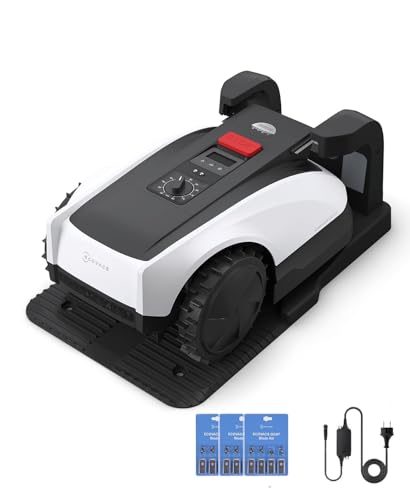
ECOVACS
ECOVACS Goat O1000 RTK Care Robot Lawn Mower, RTK Navigation, 1/4 Acre
- RTK Precision Navigation for Wire-Free, Accurate Mowing. Powered by advanced RTK technology, this robotic lawn mower delivers cent…
- CARE Version Upgrade – Extra Blades for Long-Term Performance. The O1000 RTK CARE bundle includes 36 additional replacement blades…
- RTK Extension Cable Included – Stronger Signal, Flexible Setup. Comes with an RTK extension cable that allows optimal antenna plac…
The ECOVACS Goat O1000 is the pick for precision. It uses RTK navigation to achieve centimeter-level positioning without a single perimeter wire. Instead of wandering randomly, it follows efficient, systematic paths. The result is a lawn with clean, straight lines that looks like a professional service did it, not a robot that bounced around until the battery died.
This is the CARE version, which means it ships with 36 extra replacement blades. That’s a practical upgrade for slopes. Mowing on an incline puts extra stress on the blades, and they dull faster. Having a stockpile on hand means you’re not ordering replacements mid-season. The bundle also includes an RTK extension cable, which is a lifesaver if your yard has structures or trees interfering with the satellite signal. You can mount the antenna higher for a clearer view.
Multi-zone management is where this unit shines. The app lets you create separate schedules for the front yard, backyard, and side strips. It automatically maps the lawn and lets you define different cutting areas. The learning curve for the app is a bit steeper than the others, but the payoff is a mower that handles complex, multi-section sloped properties with ease.
- RTK navigation for centimeter-level accuracy without wires
- Includes 36 extra blades for long-term maintenance
- RTK extension cable for better signal in complex yards
- Auto-mapping with multi-zone management via the app
- Fully automated path planning and self-charging
Best for: Owners of quarter-acre properties with distinct front and back zones who want a systematic, even cut and don’t mind spending a little time learning the app.
LEBOSBO V3 AI Vision
4th Pick

LEBOSBO
2026 New LEBOSBO V3 AI Vision Robotic Lawn Mower, 1600 Sq.Ft, Black
- 【AI Vision Obstacle Sensing】Equipped with intelligent AI vision technology, the LEBOSBO V3 robotic lawn mower can detect obstacles…
- 【Custom No-Go Zones with 32FT Magnetic Strip】The included 32FT magnetic strip allows flexible no-go zone setup to keep the mower a…
- 【Smartphone APP Control】Use the mobile APP to control your robot lawn mower remotely. Schedule mowing times, monitor operation, an…
The LEBOSBO V3 is the quiet operator. It’s designed for low-noise mowing, which makes it a good neighbor on a hillside where sound carries. It uses AI vision technology to sense obstacles and navigate accurately. For a 1600 square foot yard, it’s a compact and capable option that doesn’t try to overcomplicate things.
Its strength is simplicity. There are no perimeter wires to bury, and the setup is genuinely plug-and-play. The included 32-foot magnetic strip lets you cordon off sensitive areas like gardens or pet spaces. The app gives you remote control, scheduling, and operation monitoring, but it doesn’t require you to become a mapping expert to use it.
The trade-off is that it lacks the advanced positioning systems of the pricier models. It doesn’t have RTK, so if your yard is heavily shaded or has tricky GPS-blocking features, it relies purely on its vision system. It works fine on moderate slopes, but you’ll want to watch it on the first few runs to see how it handles your specific grade. It’s not the most powerful option here, but for a small, quiet lawn, it’s a solid choice.
- AI vision technology for obstacle detection and navigation
- Wire-free design with magnetic strip for no-go zones
- Low-noise operation minimizes disturbance
- Smartphone app for remote control and scheduling
- Adjustable cutting height for seasonal grass length
Best for: Someone with a small, simple sloped lawn who prioritizes quiet operation and an easy, wire-free setup over advanced features.
ANTHBOT Robot Lawn Mower
The ANTHBOT is built for the big, complicated yard. It’s rated for up to 0.9 acres and uses a dual positioning system that combines Full Band RTK with a 4-Eye Vision setup. This is the one you want if you have dense trees, deep eaves, or buildings that regularly block GPS signals. It’s designed to keep working even when the sky isn’t visible.
The 4-camera system provides a 300-degree field of view. It uses AI algorithms to detect over 1000 types of common objects. That’s not just for avoiding a stray rake; it’s for recognizing pets and children and keeping a safe distance. The Adaptive Cruise Control (ACC) technology helps with auto-mapping, creating optimal cutting routes that adapt to the boundaries of your lawn.
With 30+ multi-zone management, you can customize mowing settings for different parts of your property. It’s a lot of capability, but it comes with a learning curve. The app is feature-rich, which means there’s more to figure out initially. It’s also a larger unit, so it might feel like overkill for a postage-stamp-sized lawn. For a sprawling hillside property, though, it’s a serious tool.
- Dual RTK and 4-Eye Vision positioning for weak GPS areas
- 300-degree camera view detects over 1000 object types
- ACC auto-mapping for efficient route planning
- Supports up to 30+ customizable mowing zones
- Intelligent anti-theft system for security
Best for: Owners of large, heavily treed, or architecturally complex hillside properties who need a robust mower that won’t lose its way when the GPS signal gets spotty.
How We Chose These Products
We started with the physics of traction. A robot mower on a hill is fighting gravity, and its wheels need to maintain grip on damp grass. We looked for units with a stated slope rating, like the YARDCARE’s 20-degree limit, and we also considered the weight distribution and wheel design of the others, even when the manufacturer didn’t publish a specific angle. A mower that’s too light will slide; one that’s too heavy will rut the lawn.
Navigation was the second big filter. On a hillside, a mower that relies solely on a boundary wire can get confused when the wire is buried on an incline. We prioritized wire-free models using RTK or advanced vision systems. We also favored units with robust obstacle avoidance because a slope amplifies the risk of a collision. If a mower can’t see a tree root on flat ground, it will definitely struggle to avoid it on a 30-degree bank. Our scoring rubric weighed slope capability, navigation reliability, and obstacle handling over raw cutting power.
Buying Guide: What Really Matters
Slope angle is the first spec to check, but you need to know your own yard’s grade first. Don’t guess. Measure the rise over a 10-foot run. If the ground rises 2 feet over that distance, you have a 20% grade, which is roughly an 11-degree slope. Most residential robot mowers handle up to 15 degrees well. The YARDCARE’s 20-degree rating (about 36%) is on the higher end for this category, so use that as your benchmark.
Traction is about more than tire tread. Look at the mower’s weight and how it distributes that weight over the drive wheels. A heavier mower with wide, knobby tires will perform better on wet grass than a light one with slick wheels. Also, consider the blade design. Mulching blades that lift the grass before cutting tend to do better on slopes because they don’t just push the grass down. And check the rain sensor — you don’t want a mower attempting a slippery slope right after a storm.
Battery runtime matters more on a hill. Mowing a slope takes more energy than flat ground because the motors work harder. Look for a unit that can handle your lawn size with at least 20% battery to spare. Finally, think about the anti-tip sensors. These should stop the blades if the mower is lifted, but they shouldn’t be so sensitive that they trigger on a bumpy incline and leave you with half-cut grass.
Our Top Recommendation
The WORX Robot Lawn Mower is our top pick for the best automatic lawn mower robot for hillside use. It offers the most complete package: the RTK Cloud system provides precise, wire-free navigation, and the V-SLAM fusion ensures it doesn’t lose its way when your yard is partially shaded. The Vision AI obstacle avoidance is the most advanced of the group, which gives you confidence on a slope where a misstep could mean a tumble.
If your budget is tighter and your slope is under 20 degrees, the YARDCARE V100 is the best value pick. It doesn’t have the fancy navigation, but it has the clearest slope rating and a simple, effective design. For large, complex properties with heavy tree cover, the ANTHBOT is the runner-up for its dual positioning system and extensive zone management. It’s a beast, but it’s a smart beast.
Frequently Asked Questions
What happens if my robot mower loses traction and starts sliding?
Most modern mowers have built-in sensors that detect when the wheels are spinning without moving. The mower will typically stop, reverse, and try a different angle. If it detects a tip-over, the tilt sensor kills the blades immediately for safety. On very steep or wet grass, you may need to manually assist the mower or adjust its schedule to avoid morning dew.
Can I use a robot mower on wet grass?
It’s not recommended. Wet grass clumps and sticks to the underside of the deck, which reduces cutting quality and can strain the motor. On a slope, wet grass is a slip hazard for the mower’s wheels. Most units have a rain sensor that sends them back to the dock, but you should also avoid scheduling a mow early in the morning when dew is heavy.
How do I measure my yard’s slope percentage?
Use a long level and a tape measure. Place one end of a 10-foot (120-inch) board on the uphill part of the slope and level it. Measure the gap between the downhill end of the board and the ground. Multiply that number by 100 and divide by 120. For example, a 24-inch gap means a 20% slope, which is about 11.3 degrees. This tells you if you’re within a mower’s rated limit.
Will the perimeter wire break on a slope?
Buried wire can be exposed over time due to soil erosion, which is common on hillsides. Frost heave can also push the wire up and break it. Wire-free mowers using RTK or vision navigation eliminate this risk entirely. If you’re set on a wired model, bury the wire deeper (at least 2 inches) and consider using a conduit in areas prone to erosion.