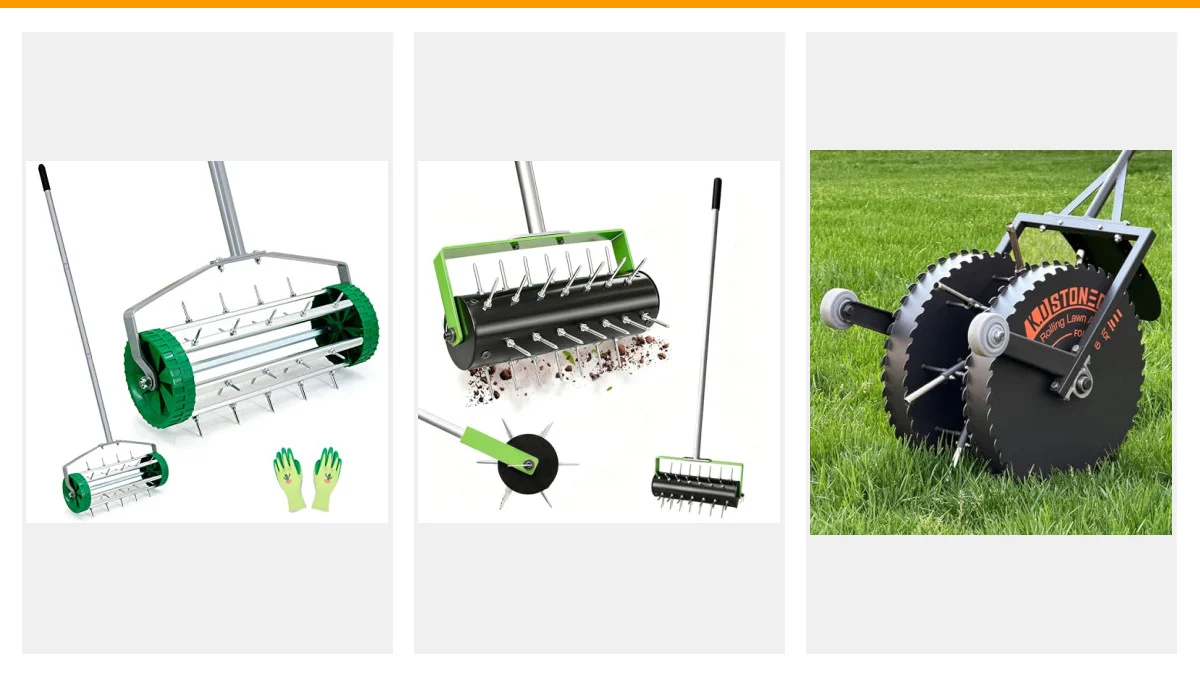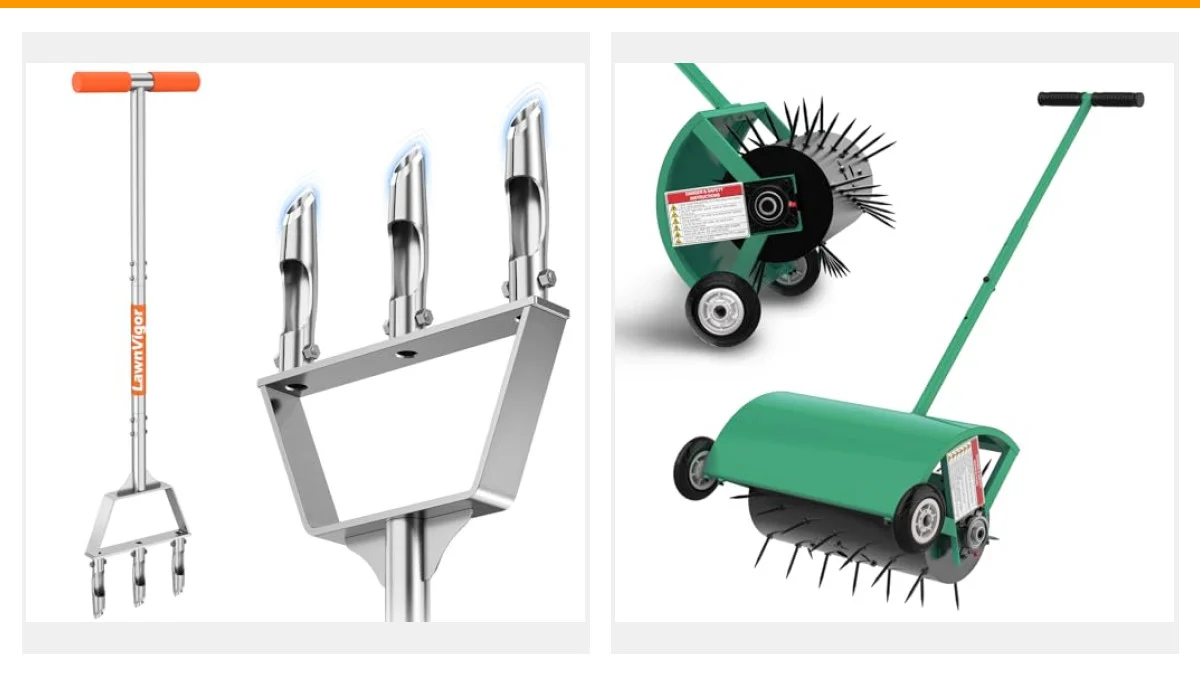

Your lawn has that tell-tale sign of compaction: hard soil, thin grass, and puddles that linger long after rain. A tow-behind aerator attachment for your tractor or riding mower breaks up that layer so water, air, and nutrients actually reach the roots. It is the difference between a lawn that merely survives and one that thrives.
Two main types dominate this category. Spike aerators punch small holes using solid tines, which works fine for mild compaction. Plug (or core) aerators pull out actual soil cores, relieving compaction more effectively for heavily trafficked yards. Your choice between them depends on your soil condition, lawn size, and how much weight you are willing to add to get good penetration.
We compared five popular models spanning both types. The lineup includes a wide plug aerator from Brinly, several spike models from VEVOR, Suchtale, and BlumeTrec, plus a versatile dethatcher from AugFir that pulls double duty. Each has strengths, and each has trade-offs. Below is a quick look at how they stack up, followed by detailed reviews.
Here is a quick comparison of the key specs that separate these five attachments.
| Features | VEVOR Spike | Suchtale Spike | BlumeTrec Spike | Brinly Plug | AugFir Dethatcher |
|---|---|---|---|---|---|
| Working Width | 32 inches | 40 inches | 40 inches | 40 inches | 48 inches |
| Tine Type | Coring spikes | 10 star tines | 10 3D tines | 24 plug spoons | 20 spring tines |
| Max Tray Weight | 100 lbs | 110 lbs | 110 lbs | 150 lbs | 150 lbs |
| Transport Mode | No | No | Yes | Yes | No |
| Best For | Small lawns | Budget buyers | Versatility | Heavy clay soil | Thatch removal |

In this article
VEVOR Tow Behind Plug Aerator

VEVOR
VEVOR Tow Behind Lawn Spike Aerator, 32 in with Universal Hitch, Heavy Duty & Rust-Resistant, Pull Behind Spike Aerator Tool with Folded Edge Tray, for Farmland & Garden Tractors
- 32-Inch Extra-Wide Working Width: This tow-behind spike aerator features an ultra-wide 32-inch coverage, allowing you to aerate la…
- Reaches the Root Zone: Equipped with high-strength coring tines that penetrate up to 2 inches deep, this tow-behind spike aerator…
- More Efficient & Even Aeration: The tow behind lawn spike aerator with weight tray supports up to 100 lbs of additional weight, he…
The VEVOR model is the compact option here. Its 32-inch working width makes it a natural fit for smaller lawns or tight spaces where a wider implement feels clumsy. It is a spike aerator, despite the product name mentioning ‘plug’, and it is best for homeowners with a standard suburban lot who want quick results without wrestling a massive frame.
This unit keeps things simple. The folded-edge weight tray holds up to 100 pounds, and the built-in strap slots are a thoughtful touch that keeps sandbags or cinder blocks from sliding off mid-pass. The fully welded steel frame feels solid, and the included socket tool and wrench mean you will not need a trip to the hardware store before your first use.
That narrower width is also its main limitation. You will make more passes to cover the same ground as a 40-inch model, which matters if your lawn is measured in acres rather than square feet. The 2-inch penetration depth is standard for spikes, but do not expect it to solve severe compaction in heavy clay without adding serious weight.
- 32-inch working width for smaller properties
- High-strength steel tines penetrate up to 2 inches
- Weight tray holds up to 100 lbs with strap slots
- Fully welded frame with reinforced hardware
- Assembly tools included in the box
Best for: Homeowners with modest lawns who want a durable, easy-to-assemble spike aerator without paying for extra width they will not use.
Suchtale 40-Inch Tow Behind

Suchtale
Suchtale 40-Inch Tow Behind Spike Aerator with Galvanized Steel Tines, Durable Lawn Aerator Soil Penetrator Spikes Tractor with Extra-Wide Tow Bar for Lawn and Farm, Black
- 10 Star-Shaped Penetrate Soil: Suchtale Spike Aerator with unique 10 steel tines star with 8” diameters, each feature 10 spike une…
- Easy to Install: 40-Inch Tow Behind Spike Aerator with detailed and completed instruction manual, includes Manual with parts break…
- Durable Construction: Designed with high-quality all -steel, and reinforced side plate and solid steel axle for extra strength. Fo…
Suchtale steps up the coverage with a 40-inch working width, making it a better match for medium to large properties. The unique selling point here is the star-shaped tines. Each of the 10 steel stars has 10 uneven tips, which means more contact points with the soil and a better chance of catching roots and thatch as they rotate.
The build quality punches above its price point. The company uses a 6 mm thick adjustment handle where many competitors use 4 mm, and the thick channel-shaped tow bar resists bending under load. Nylon spacers between each star reduce friction, which translates to smoother rolling and less wear over time. The pin-style hitch attaches to most riding mowers and ATVs without extra hardware.
There is no transport mode on this model. To move it across a driveway or sidewalk, you either lift the whole unit or drag the tines across the hard surface. It is not a dealbreaker, but it is an inconvenience you will notice every time you move between lawn sections. The powder-coat finish helps with rust, but you should still store it under cover.
- 40-inch width with 10 independent star tines
- 6 mm thick adjustment handle for durability
- Weight tray supports up to 110 lbs
- Nylon spacers reduce friction between tines
- Pin-style hitch fits most tractors and ATVs
Best for: Budget-conscious buyers with larger lawns who want a wide, durable spike aerator and do not mind lifting it to transport.
BlumeTrec 40-Inch Tow Behind

BlumeTrec
BlumeTrec 40-Inch Tow Behind Spike Aerator, Pull Behind Lawn Aerator with 10 Galvanized Steel Tines for Aerating Lawns, Soil Penetrator Spikes Tractor with Wheels, Extra-Wide Tow Bar for Garden & Farm
- Loosens & Aerates Compacted Soil: BlumeTrec 40-inch tow-behind lawn aerator features 10 galvanized 3D tines, each with 11 irregula…
- Heavy-Duty Steel Construction: This pull behind lawn aerator is built with a durable all-steel frame, reinforced side plates and a…
- Weighted Tray for Deeper Soil Penetration: The integrated steel weight tray supports up to 110 lbs of additional weight, which can…
BlumeTrec offers the most practical feature set of the spike aerators we reviewed. It matches the 40-inch width of the Suchtale model but adds a dual-mode lever that switches between working and transport positions without leaving the tractor seat. That single feature makes it noticeably more pleasant to use on properties with driveways or walkways.
The 10 galvanized 3D tines each have 11 irregular tips, giving them excellent soil contact. Metal spacers between the tines reduce friction and extend the life of the unit. The side-control lever is well-placed and easy to reach, and the two 8-inch rubber tires with bearings provide stable, smooth rolling even on uneven ground.
Assembly requires some patience. The illustrated manual helps, but the multiple parts mean it will take longer than the simpler VEVOR setup. Also, while the adjustable hitch handles different tractor heights well, the pin-style connection can rattle on rough terrain. A quick check of the hitch pin before each use is a good habit.
- 40-inch width with dual transport and working modes
- 10 galvanized tines with 11 irregular tips each
- Side-control lever for easy mode switching
- Weight tray holds up to 110 lbs
- 8-inch rubber tires with bearing-supported wheels
Best for: Owners who want a wide spike aerator with true transport capability and smooth rolling over varied terrain.
Brinly Tow Behind Plug Aerator

Brinly
Brinly Tow Behind Plug Aerator with Universal Hitch, 40" - Flat Black
- Aerate & Relieve Compacted Soil: 24 heat-treated, 16-gauge Steel plugging spoons penetrate compacted soil and remove up to 3-inch…
- Long-lasting construction: durable, all steel design with fully-enclosed weight tray holds up to 150 pounds of any type of extra w…
- Easy transport: for crossing drives, walks and rooted areas, Brinly plug Aerator includes a single transport lever to engage trans…
Brinly takes a different approach. This is a true plug aerator, not a spike model. Its 24 heat-treated steel spoons pull out actual 3-inch soil cores, which is the most effective way to relieve compaction in clay soil or heavily used lawns. The spoons are narrower with sharpened ends, so they penetrate more easily and require less added weight than blunter designs.
The fully enclosed weight tray holds up to 150 pounds, giving you serious downward force when you need it. Three independently rotating tine sections minimize turf damage during turns and maintain consistent penetration on uneven ground. The single transport lever engages 10-inch semi-pneumatic tires, making it easy to move across hard surfaces.
This is a heavier, more substantial piece of equipment. It costs more than the spike models, and the plugging action leaves small soil cores on the lawn that need to break down or be raked up. That is normal for core aeration, but it is extra cleanup work some homeowners do not expect. Availability can also be spotty, so check current stock.
- 24 heat-treated steel spoons remove 3-inch plugs
- Fully enclosed tray holds up to 150 lbs
- Three independent tine sections for turns
- Single lever engages transport mode
- 10-inch semi-pneumatic rubber tires
Best for: Lawn owners dealing with heavy clay or severe compaction who want the proven results of true core aeration.
AugFir 48-Inch Dethatcher

AugFir
AugFir 48-Inch Tow Behind Dethatcher, Pull Behind Lawn Dethatcher with 20 Spring Steel Tines, Lawn Grass Dethatcher Tractor Rake, Adjustable Hitch Riding Lawn Mower Tractor Attachment
- 【48-Inch Working Width for Faster Coverage】Cover more ground in less time with two rows of independently flexing tines spanning a…
- 【Heavy-Duty 150 lb. Capacity Tray】The tow behind lawn dethatcher rake features a robust carbon steel frame built for tough outdoor…
- 【Easy Height Adjustment】The adjustable control handle offers two height settings, making it simple to lift or lower the tines as n…
AugFir fills a different role. This is technically a dethatcher, not an aerator, but it earns a spot here because it solves a related problem. Its 20 spring steel tines in two rows aggressively pull up thatch, moss, and dead grass, which improves air and water movement just like aeration does. The 48-inch width is the widest in this roundup.
The heavy-duty carbon steel frame supports a 150-pound capacity tray, and the adjustable control handle offers two height settings. An anti-slip stopper slot prevents the handle from shifting during turns, which keeps operation predictable. The adjustable hitch adapts to different tractor heights in seconds, and the 8-inch semi-pneumatic wheels handle rough ground smoothly.
This is not a substitute for a plug aerator on compacted soil. The spring tines work the surface, removing thatch, but they do not pull cores. If your lawn needs both dethatching and core aeration, you would run this first and then follow with a plug model. Assembly requires a socket wrench or power tool, which is not included.
- 48-inch working width for large properties
- 20 spring steel tines in two rows
- Weight tray holds up to 150 lbs
- Two height settings with anti-slip stopper
- Adjustable hitch fits ATVs, UTVs, and tractors
Best for: Owners with large lawns struggling with thatch buildup who want a wide, heavy-duty attachment that also lightens the aeration workload.
How We Chose These Products
Our selection process started with the core question: what does a tractor owner actually need from an aerator attachment? We looked at working width, tine design, weight capacity, and transport convenience. Width matters because it directly determines how many passes you will make. Tine design matters because spikes and plugs solve different problems.
We also weighed build quality indicators like frame thickness, steel type, and bearing quality. A cheap unit that bends after one season is no bargain. We prioritized models with reinforced tow bars, solid axles, and rust-resistant finishes. Finally, we considered ease of use, including assembly difficulty, hitch compatibility, and whether the unit has a transport mode for crossing hard surfaces.
Buying Guide: What Really Matters
Match the tool to your soil type first. Spike aerators work well on sandy or loamy soil with mild compaction. Plug aerators are the right call for clay soil or lawns that see heavy foot traffic, because they physically remove soil rather than just pushing it aside. If you are unsure, do the screwdriver test: push a screwdriver into the ground. If it meets hard resistance within an inch, you likely need a plug aerator.
Working width should match your property size. A 32-inch unit is fine for a quarter-acre lot. For multi-acre properties, a 48-inch model like the AugFir will save you significant time. Consider your tractor’s horsepower too. Wider units with heavy weight trays require more pulling power, especially on slopes or in damp soil.
Weight capacity is the hidden variable. A weight tray that holds 150 pounds gives you flexibility to add ballast when soil is hard. Lighter trays might force you to make do with less penetration. Also look at the hitch design. A universal pin-style hitch fits most machines, but an adjustable hitch is worth the extra money if you plan to switch between different tractors or ATVs.
Our Top Recommendation
The Brinly Tow Behind Plug Aerator is our clear winner for most properties. It is the only true plug aerator in this group, and that capability matters. Pulling 3-inch cores is simply more effective at relieving compaction than poking holes, especially in clay soil. The 150-pound weight capacity, independent tine sections, and transport lever make it a complete package. It costs more, but it delivers results the spike models cannot.
If you want a spike model with modern conveniences, the BlumeTrec 40-Inch is the best runner-up. Its transport mode and smooth-rolling tires make it the easiest to live with daily. For budget buyers, the Suchtale 40-Inch offers excellent width and build quality at a lower price point, provided you can live without transport mode. And if thatch is your primary enemy rather than compaction, the AugFir 48-Inch dethatcher is the widest and most aggressive option here.
Frequently Asked Questions
Can I pull these aerators behind a standard riding mower, or do I need a garden tractor?
Most of these models work with any machine that has a hitch pin, including standard riding mowers and lawn tractors. The Brinly plug aerator is heavier and requires more pulling force, so it is better suited for a garden tractor or a mower with at least 15-20 horsepower. The spike models from VEVOR, Suchtale, and BlumeTrec are lighter and will work with most entry-level riding mowers.
How often should I aerate my lawn with a tow-behind attachment?
For most lawns, once a year is sufficient. Lawns with heavy foot traffic or clay soil may need two passes per year, ideally in the spring and fall. Aerating more frequently than that can stress the grass. Watch your lawn’s response: if water pools after rain or grass roots look shallow, it is time to aerate again.
Should I water my lawn before using a spike aerator?
Yes, but not heavily. Slightly moist soil allows tines to penetrate deeper without the soil sticking to the tines or spoons. Water the lawn a day or two before you plan to aerate. If the soil is bone dry, the tines will struggle to reach depth. If it is saturated mud, the aerator will tear up the turf instead of cleanly penetrating it.
What do I do with the soil plugs left behind by a plug aerator?
Leave them on the lawn. The plugs break down naturally within a few weeks, returning nutrients to the soil. If you find them unsightly, you can speed up the process by running a mower over them with a mulching blade. Raking them up and removing them is an option, but you lose the benefit of those nutrients cycling back into the root zone.