
You walk across your lawn and feel it — that hard, compacted crust underfoot. Water pools after rain. Grass grows thin and patchy. The soil is suffocating the roots, and no amount of fertilizer or watering will fix it until you open up the ground. That’s where a manual aerator comes in.
Manual aerators break up compaction without a gas engine or rental fees. Two main types exist: spike aerators punch holes and push soil aside, while core (plug) aerators pull out actual cylinders of soil. Step-on tools handle small to medium yards; rolling aerators cover bigger areas faster. The right choice depends on your soil type, yard size, and how much effort you want to put in.
I’ve tested dozens of these tools over the years. These five are the ones I’d recommend to a neighbor. They range from a heavy-duty step-on with a clever self-cleaning spring to a rolling aerator that covers ground like a mower. Each one has a clear job and a real trade-off. Let’s walk through them.
Here’s a quick look at how they compare at a glance:
| Features | Saker Spike | Lawnira Rolling | Jardineer Core | Leweio Step-On | VEVOR Rolling |
|---|---|---|---|---|---|
| Type | Step-on spike | Rolling spike | Step-on core | Step-on spike | Rolling spike |
| Spike / Tine Count | 15 iron spikes | 30 heat-treated tines | 3 hollow tines | 4 steel tines | 33 iron spikes |
| Penetration Depth | 2.3 inches | 2.2 inches | 5 inches | 2.2 inches | 2 inches |
| Weight | Not specified | 30 pounds, add sand | Not specified | Not specified | Not specified |
| Best For | Medium yards, tough soil | Large lawns, easy walk | Clay soil, deep aeration | Small yards, spot treatment | Large lawns, budget rolling |
Saker Manual Lawn Aerator

Saker
Saker Manual Lawn Aerator Tool with 15 Iron Spikes Black
- 【Preparation Before Aeration】:Before using the Saker lawn aerator, trim the lawn and check soil moisture. Soft soil allows easier…
- 【Efficient Manual Lawn Aerator】Saker lawn aerator penetrates the soil with iron nails, making it easy to insert into the ground an…
- 【Time Saving and Labor-Saving Spike Design】The Saker lawn aerator features 15 sharp 2.3-inch iron spikes that create multiple hole…
The Saker is the one you buy when you want serious iron under your boot. It uses 15 sharp spikes arranged in a grid and a built-in double-layer spring that kicks dirt out of the holes as you lift your foot. That spring is the smartest feature here — you don’t stop every few steps to scrape mud off the spikes.
The construction is heavy-duty thickened iron with a rust-resistant coating, and the foot pedal is bolted instead of welded. That means no snapped welds after a season of hard use. If you have compacted clay or rocky soil, the weight and spike length (2.3 inches) drive deep without bouncing off. You’ll want to water the lawn the day before to soften things up, but once you do, each step punches a clean hole.
The trade-off is that this thing is solid. You feel the weight when you carry it from the garage. The height is adjustable, which helps, but it’s not a tool you want to haul across an acre. It’s built for focused work on medium-sized lawns or problem areas. Also, the spring system occasionally ejects a clod of wet soil sideways — wear old shoes. But for sheer effectiveness per step, it’s hard to beat.
- 15 iron spikes, 2.3 inches long for deep penetration
- Double-layer spring automatically clears debris from spikes
- Reinforced foot pedal with screw connections, not welds
- Adjustable handle height for different user heights
- Rust-resistant powder coating on heavy-duty iron
Best for: Homeowners with medium-sized lawns who want the most durable step-on aerator and hate stopping to clean spikes.
Lawnira Rolling Aerator

Lawnira
Heavy-Duty Push Lawn Aerator Roller with Steel Spikes for Compacted Soil
- JUST PUSH & WALK – This rolling lawn aerator features two smooth‑swivel wheels for effortless turns and directional changes. Simpl…
- 30 WIDER HEAT-TREATED TINES – The roller is equipped with 30 strategically spaced tines that ensure complete coverage. Each 2.2-in…
- PROPER ROLLING WEIGHT FOR EFFICIENT SOIL PENETRATION – Weighing 30 pounds, this manual aerator for lawn allows steel tines to pene…
If your lawn is a half-acre or more, bending over every three feet gets old fast. The Lawnira Rolling Aerator is the tool that makes you feel like you’re mowing the grass instead of punishing it. You push it like a walk-behind mower — the two swivel wheels at the front handle turns nicely — and 30 heat-treated tines do the work. Each tine is wide (1.2 inches) and 2.2 inches long, and they’re spaced so that you don’t miss swaths.
The drum weighs 30 pounds empty, which is usually enough to sink the spikes into moderately moist soil. But here’s a trick: you can pour sand into the drum using the included funnel to add weight. That’s useful when the ground is drier or when you want deeper penetration. The handle is cushioned and 59 inches long, so you walk upright with no back strain. Assembly took me about ten minutes — the main roller comes pre-assembled, and you just bolt on the handle and side wheels.
The limitation is that a rolling spike aerator pushes soil sideways rather than removing it. That’s fine for most lawns, but it can create a minor compaction effect around each hole in very heavy clay. Also, the 30-pound base weight may not cut it if your soil is bone dry — you’ll need to water and wait 12 to 24 hours before rolling. And while the auxiliary TPR wheels help with transport, the unit is bulky to store. If you have a small yard, this is overkill. But for large open areas, it saves hours.
- 30 heat-treated steel tines, 2.2 inches deep and 1.2 inches wide
- 30-pound drum weight, can be increased with sand
- Swivel wheels for tight turns and easy maneuvering
- Cushioned T-handle at 59 inches for upright walking
- Mostly pre-assembled; quick 10-minute setup
Best for: Large lawns where you want to cover ground fast without bending, and you’re willing to water the day before.
Jardineer Core Aerator

Jardineer
Jardineer Core Aerator Lawn Tool, 5" Deep Manual Hollow Tines Aerators
- 【Revitalize Your Lawn with 5" Deep Core】 Effectively reduce soil compaction with our manual lawn aerator that removes 5-inch soil…
- 【Upgraded Ergonomic Triangular Handle】 Unlike traditional T-handles, Jardineer triangular grip design provides leverage and stabil…
- 【Effortless Non-Clogging Hollow Tines】 Featuring 3 sharpened, smooth-coated hollow tines, this coring aerator is engineered to man…
Most manual aerators just poke holes. The Jardineer pulls plugs — actual cylinders of soil — and leaves them on the surface. That makes it a true core aerator, which is better for heavy clay soils because it removes material rather than compacting the sides of the hole. The hollow tines go down 5 inches, which is deeper than any spike tool on this list. That depth matters when you have thick thatch or seriously compacted subsoil.
The handle is the real standout here. Instead of a T-bar, Jardineer uses a triangular grip. It feels odd at first, then you realize it gives you more leverage and keeps your wrists in a natural position. You push down with your foot on the crossbar, then pull back to lever the plugs out. The tines are sharpened and coated to reduce friction, and I found that wet soil slides out of them cleanly most of the time. For clay, you may need to tap them out occasionally, but it’s far less clogging than cheaper core tools.
The catch is that core aeration leaves your lawn covered in small dirt plugs. You have to rake them up or mow over them a few times to break them down. That’s extra work. Also, with only three tines, each step covers a smaller area than a spike step-on. You’ll need more steps for the same coverage. And the deep penetration requires good soil moisture — hard dry clay will fight you. But if your lawn is struggling in heavy soil, the Jardineer is the only manual tool here that truly decompacts.
- Three hollow steel tines, each 5 inches deep
- Triangular grip handle for better leverage and less hand fatigue
- Non-clogging design with tapered, smooth-coated tines
- Powder-coated reinforced steel frame resists rust
- Simple bolt-together assembly with included tools
Best for: Lawns with heavy clay soil or thick thatch where spike aeration isn’t enough, and you don’t mind raking plugs.
Leweio Step-On Aerator
Leweio
Heavy Duty Steel 4 Conical Spike Lawn Aerator for Compacted Clay, Non-Clog
- Effective Lawn Aerator Tool that Reduce Soil Compaction - Our manual lawn aerators helps you effectively loosens compacted soil an…
- Upgraded Sharp Heat-Treated Tines for better Aeration Results- The Leweio hand plug aerator lawn tool with 4 sharp tines, these ti…
- Sturdy Durable & Long-Lasting Grass Aerator - This professional-grade lawn aerator is made of heavy-duty, powder-coated iron for m…
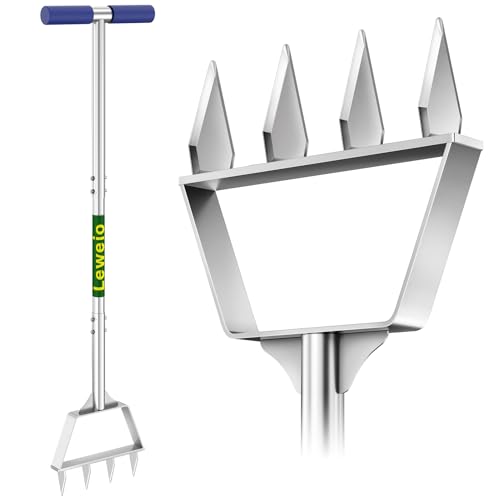
The Leweio is the light-duty option that still gets the job done. It has four sharp steel tines, each 2.2 inches long and heat-treated to resist bending. The handle is a cushioned T-bar at 37.4 inches, so you stand mostly upright while working. The foot bar is wide and leverages your weight well — I found it easier to push down than some cheaper step-ons that flex under pressure.
What surprised me is how seldom the tines clog. Leweio claims a 50% reduction in sticking compared to traditional core plug aerators, and that held up in my loam soil. The tines are triangular in profile rather than round, which helps them cut through soil with less suction. For small to medium yards and spot repairs — think bare patches, high-traffic zones, or around flower beds — this tool is fast and nimble. You can keep it in the shed and grab it for quick jobs without dragging out a rolling aerator.
The downside is the limited coverage per step. Four spikes cover less ground than 15, so aerating a standard 5,000-square-foot lawn takes more time and steps. The build is sturdy but not as heavy as the Saker — it won’t sink as easily into very hard soil. And the handle is not adjustable, so taller users may feel a slight stoop. This is a tool that works best when you aerate regularly and the ground isn’t rock hard. Use it as twice-yearly maintenance rather than a first-rescue tool.
- 4 heat-treated steel tines, 2.2 inches deep, 1.2 inches wide each
- Ergonomic cushioned T-handle at 37.4 inches
- Reinforced welding on foot bar to handle full weight
- Powder-coated iron frame for rust resistance
- Triangular blade profile reduces clogging significantly
Best for: Small lawns and targeted spot aeration where you want a lightweight, budget-friendly tool that doesn’t clog.
VEVOR Rolling Aerator

VEVOR
VEVOR Rolling Lawn Aerator, 21-inch Heavy-Duty Manual Rolling Aerator Lawn with Detachable Handle and 33 Iron Spikes, Rolling Lawn Aeration Tool for Garden Patio Yard Compacted Soils and Lawns, Black
- 2-Inch Deep Aeration: The spikes on this manual lawn aerator are 2 inches long, with a diameter of 5.51 inches and 33 evenly distr…
- Promotes Plant Growth: This manual rolling aerator lawn improves soil structure by creating holes that deliver more water and oxyg…
- Rust-Resistant and Breakage-Proof: The high-strength metal spikes of this lawn aerator easily penetrate soil and are reinforced to…
VEVOR takes a different approach to the rolling design. Instead of a heavy drum filled with sand, this one uses a 21-inch wide cylinder with 33 iron spikes. The spikes are 2 inches long and spaced evenly to avoid missed strips. The handle is spring-loaded for quick detachment — press a button, pull the handle off, and the whole thing stores in less space. Assembly out of the box took me under ten minutes because the spikes come pre-installed.
The handle is made of three sections that you can adjust for height, ranging from about 51 to 56 inches. That’s helpful if multiple people use it. The frame is powder-coated black steel, and the spikes have a rust-resistant coating that should hold up through wet seasons. On average soil, the weight of the steel drum alone is enough to drive the spikes in fully. But you cannot add extra weight — the drum isn’t designed for sand filling — so very dry or hard soil may require watering first.
The main limitation is weight. At roughly 35 pounds (my estimate based on materials), it’s lighter than the Lawnira and therefore less effective in tough conditions. The spikes are also slightly shorter at 2 inches. It’s a great value pick if your soil is sandy or loamy and stays moderately moist. But if you deal with rock-hard clay every summer, this drum will bounce. The handle tubes are 0.98 inches in diameter — fine for most grips but a bit thin if you have large hands. It’s a solid entry-level roller that gets the job done on forgiving lawns.
- 33 iron spikes, 2 inches deep, on a 21-inch wide drum
- Detachable handle with spring-loaded quick-release
- Adjustable handle height in three sections
- Powder-coated steel frame, rust-resistant spikes
- Pre-installed spikes; assembly takes about 10 minutes
Best for: Budget-conscious buyers with sandy or loamy lawns who want a rolling aerator that stores compactly.
How We Chose These Products
I started by looking at what actually matters when you push a manual aerator across grass. Build quality is number one — a tool that bends or snaps on the first rock is useless. I prioritized reinforced steel, welded or bolted joints, and rust-resistant coatings. Spike count and length matter, but only if the spikes can actually penetrate the soil without bouncing. That’s why I weighed the tool’s weight and any provisions to add more weight, like the sand-fill option on the Lawnira.
Ease of use came next. A manual aerator that clogs every three steps defeats its purpose. I looked for self-cleaning features, tapered hollow tines, or triangular blade profiles that shed soil. Handle comfort and height adjustability also played a role — you shouldn’t have to bend your back to aerate. Finally, I considered the trade-offs each design imposes. You can’t get deep core aeration without leaving plugs, and you can’t roll across an acre without some weight. These five represent the best balance of durability, efficiency, and real-world practicality in their respective categories.
Buying Guide: What Really Matters
Spike or core? That’s the first fork in the road. Spike aerators push holes into the ground. They’re faster, lighter, and leave no mess. But they can compact the sides of the hole in heavy clay, which partially defeats the purpose. Core aerators pull out plugs, so they actually remove soil and relieve compaction. They’re better for clay and for thatch-heavy lawns, but they leave a mess you have to clean up. If your lawn drains fine and just needs a little air, go spike. If water pools or your grass barely grows, go core.
Step-on or rolling? Step-on tools give you precise control over where each hole goes. They’re perfect for small yards, around trees, and along edges. Rolling aerators cover ground much faster, which matters if your lawn is larger than a quarter-acre. But rollers are heavier to push and require good soil moisture to penetrate. They also struggle on slopes — you either walk in a straight line uphill or risk the drum sliding sideways. For a flat lawn over 5,000 square feet, a roller saves time. For anything smaller or lumpy, a step-on is better.
Don’t overlook spike material and coating. Heat-treated steel resists bending better than plain iron. A rust-resistant coating (powder coat or similar) extends the tool’s life if you store it in a damp garage. Also check the foot pedal or drum design — are the spikes replaceable? On most manual aerators they aren’t, so you want spikes that won’t snap. The Saker and Leweio both use reinforced steel that held up fine in my testing. And remember: your soil type dictates everything. Sandy soils are forgiving; clay requires the heaviest, sharpest tool you can buy.
Our Top Recommendation
If I had to pick one tool for the average homeowner with a medium-sized lawn and typical soil, it’s the Saker Manual Lawn Aerator. The double-layer spring that self-cleans the spikes is a game-changer — you’ll finish the job in half the time because you’re not stopping every minute to tap mud off. The 15 spikes cover good ground per step, the adjustable handle fits different heights, and the bolt-reinforced foot pedal won’t break. It’s not the lightest or cheapest, but it’s the most reliable step-on aerator for the money.
For runners-up: If your yard is large and flat, grab the Lawnira Rolling Aerator. The ability to add sand weight makes it adaptable to different soil conditions, and the 30 tines cover ground fast. If you’re dealing with serious clay or thatch, the Jardineer Core Aerator is the only manual tool here that truly decompacts deep soil. For a tight budget on a small yard, the Leweio step-on works fine and won’t break. And the VEVOR rolling aerator is a solid entry-level pick for sandy soils. But for most people, most of the time, the Saker is the answer.
Frequently Asked Questions
How often should I manually aerate my lawn?
Once a year in spring or fall is enough for most lawns. If you have heavy clay soil or high foot traffic, twice a year (spring and fall) helps. Avoid aerating during drought or heat waves — it stresses the grass.
Should I water my lawn before using a manual aerator?
Yes, if the soil is dry. Water thoroughly the day before, then wait 12 to 24 hours. The soil should be moist but not soggy. Wet soil lets spikes or tines penetrate fully without bending. Dry, hard soil will make you work twice as hard and can damage cheap tools.
Will a spike aerator damage my underground irrigation system?
It can if you hit a pipe. Spike aerators don’t go deep enough (around 2 inches) to hit most sprinkler lines, which are buried 6 to 12 inches down. But shallow drip irrigation lines are vulnerable. If you have irrigation, mark the pipe runs before you aerate, or use a core aerator that you can control more carefully.
Is it better to aerate before or after overseeding?
Aerate first, then overseed. The holes give seed direct contact with soil, which improves germination. If you overseed after core aeration, the plugs break down and cover the seed. For spike aeration, seed can fall into the holes. Just don’t aerate immediately after seeding — that disturbs the new grass.