Best Lawn Fertilizer for Utah: A Regional Guide for Wasatch Front and Southern Utah Lawns
Contents
Your Utah lawn looks fine in May, then turns pale and patchy by July. Maybe the edges yellow out no matter how much you water. That is not bad luck. It is chemistry, climate, and the wrong bag of fertilizer.
| 1st Pick | 2nd Pick | 3rd Pick | 4th Pick | 5th Pick |
|

|
|

|

|
| Scotts Scotts Turf Builder WinterGuard Fall Lawn Food, 10 lbs. | Scotts Scotts Turf Builder Lawn Food, 12.5 lbs. | Scotts Scotts Turf Builder WinterGuard Fall Lawn Food, 32.3 lbs. | Scotts Scotts Turf Builder Starter Fertilizer for New Grass, 15 lbs. | Scotts Scotts Green Max Lawn Food, 16.67 lbs. |
| Buy on Amazon | Buy on Amazon | Buy on Amazon | Buy on Amazon | Buy on Amazon |
Picking the best lawn fertilizer for Utah comes down to three things: your region, your grass type, and your soil pH. Northern Utah grows cool-season grass on alkaline, calcium-heavy soil. Southern Utah grows warm-season grass in a hotter, drier zone. One product will not serve both well.
This guide breaks down five Scotts fertilizers by real Utah use case. You will see which one fits fall feeding, which handles new sod, which greens up fast, and where each one falls short. The top pick is the WinterGuard 32.3 lb. bag for most Wasatch Front lawns.
| Features | WinterGuard Fall 10 lb. | Turf Builder Lawn Food | WinterGuard Fall 32.3 lb. | Starter Fertilizer | Green Max Lawn Food |
|---|---|---|---|---|---|
| Primary Use | Fall root building | Year-round feeding | Fall root building | New grass establishment | Fast color correction |
| Coverage | 4,000 sq. ft. | Not listed | 12,000 sq. ft. | 5,000 sq. ft. | Not listed |
| Grass Types | All types | All types | All types | All types | All types |
| Application Season | Fall only | Spring, summer, fall | Fall only | At planting | Growing season |
| Standout Feature | Small-yard size | Pesticide-free formula | Best value per sq. ft. | 70% thicker growth | Greens in 3 days |

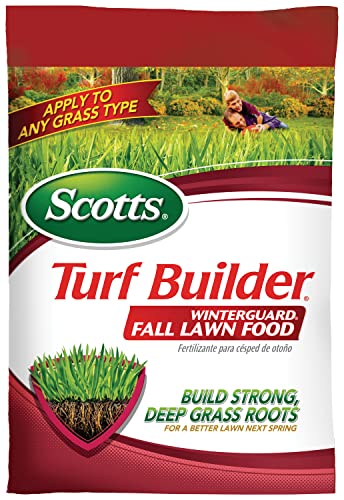
Scotts Turf Builder WinterGuard 10 lb.
1st Pick
Scotts
Scotts Turf Builder WinterGuard Fall Lawn Food, 10 lbs.
- FALL LAWN FERTILIZER: Scotts Turf Builder WinterGuard Fall Lawn Food is a fertilizer that builds strong, deep grass roots for a be…
- SUMMER LAWN RECOVERY: Our fertilizer provides nutrients lawns need to help recover from summer heat, drought, and regular activity…
- APPLY IN FALL TO PREPARE YOUR LAWN FOR WINTER: Apply this grass fertilizer to a wet or dry lawn in the fall
This is the small-yard version of Scotts’ fall fertilizer. It covers 4,000 square feet, which fits a typical Salt Lake City or Provo suburban lot without leaving half a bag to go stale in the garage. Apply it in fall and the roots keep building through winter.
Utah’s short growing season makes fall feeding more important here than in milder states. Grass stores carbohydrates before the ground freezes, and that reserve drives spring green-up. This formula targets exactly that window.
The catch is timing. This is a fall-only product. Buy it in September, not April. If you want one bag for the whole year, this is not it.
- 10 lb. bag covers 4,000 sq. ft.
- Designed for fall application only
- Works on Kentucky bluegrass, tall fescue, and other Utah grass types
- Helps lawns recover from summer heat and drought stress
- Safe on wet or dry lawns
Best for: Small Wasatch Front yards that need one solid fall feeding before winter.
Scotts Turf Builder Lawn Food 12.5 lb.
2nd Pick
Scotts
Scotts Turf Builder Lawn Food, 12.5 lbs.
- WHERE TO USE: Lawn fertilizer for grass can be used on any grass type
- GRASS FERTILIZER FOR LAWNS: Scotts Turf Builder Lawn Food feeds and strengthens your grass to help protect against future problems
- STRONG ROOTS: Our pesticide-free lawn food for grass builds strong, deep roots, improving your lawn's ability to absorb water and…
Think of this as the general-purpose bag. It feeds in spring, summer, or fall, and it works on any grass type. If you want one product to cover most of the year, this is the simplest pick.
The formula builds deeper roots and improves water absorption compared to an unfed lawn. That matters in Utah, where irrigation restrictions and dry summers punish shallow-rooted grass. Deeper roots mean less water wasted.
Here is the honest part: it does not fix yellow grass caused by iron chlorosis. Utah’s high-pH soil locks up iron, and no standard NPK fertilizer solves that. You need a chelated iron product for chlorosis, not this bag.
- Pesticide-free formula
- Feeds in spring, summer, or fall
- Builds deeper roots for better water uptake
- Safe on all grass types
- Good middle-ground choice for mixed schedules
Best for: Utah homeowners who want one flexible fertilizer instead of a seasonal lineup.
Scotts Turf Builder WinterGuard 32.3 lb.
3rd Pick
Scotts
Scotts Turf Builder WinterGuard Fall Lawn Food, 32.3 lbs.
- FALL LAWN FERTILIZER: Scotts Turf Builder WinterGuard Fall Lawn Food is a fertilizer that builds strong, deep grass roots for a be…
- SUMMER LAWN RECOVERY: Our fertilizer provides the plant food nutrients lawns need to help recover from summer heat, drought, and r…
- APPLY IN FALL TO PREPARE YOUR LAWN FOR WINTER: Apply this grass fertilizer to a wet or dry lawn in the fall
This is the same WinterGuard formula in a bigger bag. It covers 12,000 square feet, which suits larger lots in Ogden, Layton, or the south end of the Salt Lake Valley. The per-square-foot cost drops noticeably compared to the 10 lb. version.
Fall is the single most valuable feeding window for cool-season Utah grass. Kentucky bluegrass and tall fescue both respond well to late-season nitrogen. The roots thicken, and the lawn comes back stronger in March and April.
The downside is storage. A 32.3 lb. bag is heavy and awkward to haul, and it must stay dry. If your garage gets damp, keep it sealed in a bin.
- 32.3 lb. bag covers 12,000 sq. ft.
- Best cost-per-square-foot of the WinterGuard options
- Fall application for winter root preparation
- Works on all grass types
- Helps lawns bounce back from summer stress
Best for: Larger northern Utah lawns that need an economical fall feeding.
Scotts Turf Builder Starter Fertilizer
4th Pick
Scotts
Scotts Turf Builder Starter Fertilizer for New Grass, 15 lbs.
- FERTILIZER FOR NEW LAWNS: Scotts Turf Builder Starter Food for New Grass is a specially formulated starter fertilizer for grass se…
- SAFE FOR ALL GRASS TYPES: This 24-25-4 NPK lawn care product is safe to use on any grass type
- WHEN TO USE: Apply this lawn food anytime you're planting new grass, whether it's starting a new lawn, reseeding an existing one,…
New grass needs different food than established grass. This 24-25-4 starter formula is built for seeding, overseeding, sod, sprigs, and plugs. The high phosphorus supports root development right when seedlings need it most.
Utah’s alkaline soil actually helps here. Phosphorus locks up in high-pH conditions, but a starter fertilizer places concentrated phosphorus right at the root zone during establishment. The timing works in your favor.
One limitation: this is not a maintenance fertilizer. Once the new grass matures, switch to a regular feeding schedule. Using starter food on an established lawn wastes phosphorus and does little for color.
- 24-25-4 NPK ratio for root establishment
- Grows new grass 70% thicker and 35% quicker on average
- 15 lb. bag covers 5,000 sq. ft.
- Safe for all grass types
- Use for seeding, sod, sprigs, and plugs
Best for: Utah homeowners overseeding in fall or laying new sod in spring.
Scotts Green Max Lawn Food
5th Pick
Scotts
Scotts Green Max Lawn Food, 16.67 lbs.
- Feeds for deep greening in just 3 days
- Dual-action, 2-in-1 formula feeds and supplements with iron
- Guaranteed not to stain when used as directed
Green Max is the quick-fix bag. It feeds and supplements with iron in a dual-action formula, and Scotts says it greens grass in about three days. For a Utah lawn coming out of a rough summer, that speed is real.
The iron content is the key detail. Utah’s calcareous, high-pH soil causes iron chlorosis, which shows up as yellow blades with green veins. Green Max adds iron directly, so it addresses mild yellowing that plain nitrogen fertilizer cannot touch.
It will not fix severe chlorosis. If your soil pH is above 7.5 and the yellowing is deep, you need chelated iron and possibly elemental sulfur to lower pH over time. Green Max is a supplement, not a cure.
- Greens grass in roughly 3 days
- Dual-action formula with added iron
- Guaranteed not to stain when used as directed
- Safe to re-enter the lawn immediately after applying
- Not sold in Florida
Best for: Utah lawns that need fast color and mild iron support during the growing season.
How We Chose These Products
We evaluated each fertilizer against Utah’s actual growing conditions, not a national average. That means region, grass type, soil pH, and water restrictions all factored into the ranking. A product that works in Ohio may fail in St. George.
Coverage, application timing, and cost per square foot were weighed alongside formula. We also considered how each product fits a realistic seasonal schedule for cool-season and warm-season lawns. Products that only solve one problem ranked lower than flexible options.
Buying Guide: What Really Matters
Start with a soil test. Utah State University Extension offers affordable testing, and the results tell you your pH, phosphorus, and potassium levels. Most Utah soil runs alkaline, often between 7.5 and 8.2, with high calcium carbonate. That chemistry changes everything about fertilizer choice.
Nitrogen timing matters more than nitrogen amount. Cool-season grass along the Wasatch Front needs most of its nitrogen in fall and a lighter dose in spring. Warm-season grass in southern Utah wants feeding in late spring and summer. Get the timing wrong and you feed weeds instead of grass.
Phosphorus is usually already high in Utah soil. Skip starter formulas unless you are planting new grass. Potassium and iron are the nutrients Utah lawns most often lack. If you want a deeper look at matching fertilizer to soil type, this fertilizer for sandy soil guide covers similar ground.
Our Top Recommendation
The Scotts Turf Builder WinterGuard 32.3 lb. bag wins for most Utah lawns. It targets the single most important feeding window for cool-season grass, covers 12,000 square feet, and delivers the best value per square foot of the fall formulas.
For small yards, the 10 lb. WinterGuard is the same formula in a manageable size. If you want one bag for the whole year, Turf Builder Lawn Food is the flexible runner-up. Southern Utah readers with warm-season grass should lean on the general-purpose formula and skip the fall-only products.
New sod or overseeding projects should start with the Starter Fertilizer, then transition to a maintenance schedule. Yellow, iron-deficient lawns benefit from Green Max as a supplement. For more context on regional fertilizer choices, see this Utah fertilizer review.
Frequently Asked Questions
How often should I fertilize in Utah?
Cool-season lawns along the Wasatch Front do best with three to four feedings per year: one in late spring, one in early fall, and one heavier feeding in late fall. Warm-season lawns in southern Utah need two to three feedings between late spring and midsummer. More is not better here. Overfeeding in Utah’s short season causes flushes of top growth that weaken roots.
Why is my lawn yellow after fertilizing?
Yellowing after feeding usually points to one of three things. Too much nitrogen in hot weather can burn blades. Dry soil under the fertilizer stops uptake. And iron chlorosis, common in Utah’s alkaline soil, does not respond to plain NPK fertilizer at all. Water the lawn before and after applying, and check your soil pH if yellowing persists.
Is weed and feed safe for Utah lawns?
It depends on timing and grass type. Weed and feed works when broadleaf weeds are actively growing and the grass is not stressed. Applying it in the middle of a Utah summer heat wave can damage cool-season grass. Many Utah gardeners get better results by spot-treating weeds separately and using a straight fertilizer for feeding.
Do I need to water in fertilizer in Utah?
Yes, most granular fertilizers need about a quarter inch of water after application to move nutrients into the root zone. Utah’s drought restrictions sometimes limit how much you can water, so plan applications around your allowed irrigation days. Liquid fertilizers absorb faster and need less water, which helps during tight restrictions.