Best Lawn Aerators for Every Yard Size
Contents
Your lawn sends signals when it’s struggling. Puddles linger after rain, water runs straight off the grass, and the turf feels spongy underfoot. Maybe you’ve noticed bare patches spreading or roots that look shallow when you peel back a section of sod. These are classic symptoms of soil compaction, and no amount of fertilizer or watering will fix it until you break up that dense layer.
| 1st Pick | 2nd Pick | 3rd Pick | 4th Pick | 5th Pick | |
| Preview |
|
![Hubiiett 24 Inch Rolling Lawn Aerator, Heavy Duty Manual Aerator Tool, Up to 70 lbs, Push Spike Aeration Tool with 42 Spikes, Suitable for Lawns, Garden, and Yard Grass Aeration [Green]](https://m.media-amazon.com/images/I/41gdK0C75GL._SL500_.jpg "Best Lawn Aerators for Every Yard Size 2")
|

|

|

|
| Title | LawnVigor Manual Lawn Core Aerator for Compacted Soil with Non-Clogging Hollow Tines | Hubiiett Hubiiett 24 Inch Rolling Lawn Aerator, Heavy Duty Manual Aerator Tool, Up to 70 lbs, Push Spike Aeration Tool with 42 Spikes, Suitable for Lawns, Garden, and Yard Grass Aeration [Green] | Saker Saker Manual Lawn Aerator Tool with 15 Iron Spikes Black | SENVERT SENVERT Rolling Lawn Aerator, Heavy Duty Push Spike Aeration Tool Up to 55 lbs, Manual Rotary Grass Aerator for Garden and Yard Use | K.D STONEDGE Patented Rolling Lawn Aerator Manual Coring Tool Compacted Soil Loosening |
| Aeration Type | Core plug | Spike | Spike | Spike | Core plug |
| Number of Tines or Spikes | 3 | 42 | 15 | 42 | — |
| Weight | — | 32 lbs | — | 32 lbs | — |
| Max Weight Capacity | — | 70 lbs | — | 55 lbs | — |
| Tine or Spike Length | — | 3 in | 2.3 in | — | — |
| Rolling or Step Design | Step | Rolling | Step | Rolling | Rolling |
| More information | Buy on Amazon | Buy on Amazon | Buy on Amazon | Buy on Amazon | Buy on Amazon |
Aerators solve this by punching holes into the ground so air, water, and nutrients can actually reach the root zone. The right tool depends on your lawn size, soil type, and how much effort you want to put in. Manual corers pull plugs from small yards. Rolling spike aerators cover more ground quickly. Tow-behind models handle acreage, and liquid aerators offer a no-equipment alternative for mild cases.
We tested five manual aerators on real grass and compacted dirt to see which ones deliver results without wrecking your back. Below you’ll find our picks for the best lawn aerator across different needs, plus a buying guide that covers the questions most people get wrong.
Here’s how the main specs compare at a glance:
| Features | LawnVigor Corer | Hubiiett Roller | Saker Step Aerator | SENVERT Roller | K.D STONEDGE Roller |
|---|---|---|---|---|---|
| Method | Core/plug aeration | Spike aeration | Spike aeration | Spike aeration | Core/plug aeration |
| Weight Capacity | N/A (manual) | Up to 70 lbs | N/A (step-on) | Up to 55 lbs | N/A (manual) |
| Key Feature | 3 hollow tines | 42 spikes, 24″ drum | 15 spikes, spring eject | Auxiliary wheels | Patented rotary coring |
| Best For | Small lawns | Medium lawns | Tight spots | Medium lawns | Small-medium lawns |
LawnVigor Manual Core Aerator
1st Pick
LawnVigor
Manual Lawn Core Aerator for Compacted Soil with Non-Clogging Hollow Tines
- LAWN AERATOR FOR HEALTHIER LAWN GROWTH: Our manual lawn aerators promotes lush, green lawns by delivering essential air, water and…
- BUILT-TO-LAST HOLLOW TINE AERATOR: Made of sturdy metal and heat-treated hollow tines, our plug aerator lawn tool is built to with…
- NON-CLOGGING YARD AERATOR: Designed with 3 hollow tines, this lawn core aerator efficiently removes soil plugs while preventing cl…
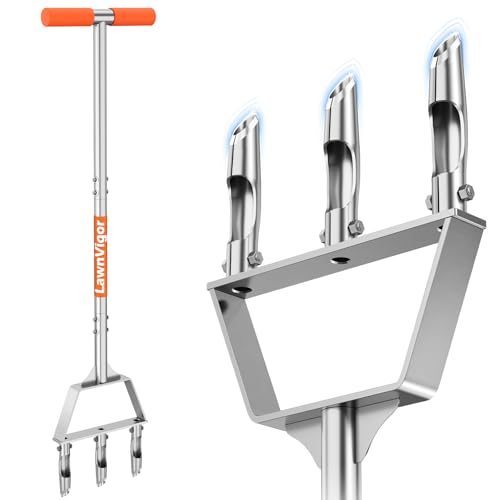
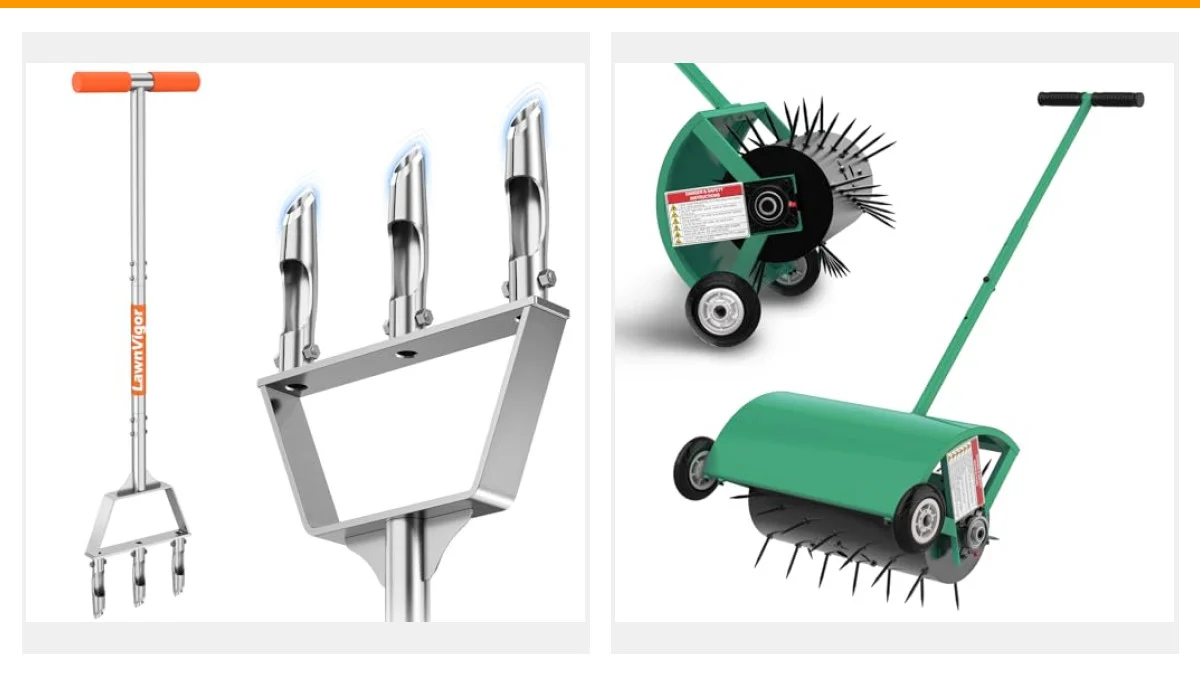
The LawnVigor is a straightforward plug aerator built for small yards where a rolling machine makes no sense. It suits homeowners with compacted patches, new lawns being prepped for seeding, or garden beds that need better drainage. If you’ve got a 1,000-square-foot lawn and want to do the job properly without renting equipment, this is the tool.
Three hollow tines pull actual soil cores out of the ground, which is the main advantage over spike tools that just poke holes. The heat-treated steel stays sharp, and the white plastic inserts inside the tines help release the plugs so you’re not constantly prying clay out with a screwdriver. The ergonomic handle sits at a height that reduces bending, and assembly takes minutes with the included wrench.
It’s not a fast tool. Covering a large lawn with this would take hours, and the instructions warn against rocking or twisting the tines once they’re in the ground — which means you need decent upper body strength to press straight down. Dry, hard soil will fight you, so water the lawn a day before use. The tines are replaceable when they eventually wear down.
- Three hollow tines pull cores, not just poke holes
- Heat-treated steel construction resists bending
- Plastic inserts prevent soil plugs from jamming
- Ergonomic handle reduces back strain
- Replaceable tines extend the tool’s lifespan
Best for: Homeowners with small lawns who want genuine core aeration without renting a machine.
Hubiiett 24 Inch Roller
2nd Pick
Hubiiett
Hubiiett 24 Inch Rolling Lawn Aerator, Heavy Duty Manual Aerator Tool, Up to 70 lbs, Push Spike Aeration Tool with 42 Spikes, Suitable for Lawns, Garden, and Yard Grass Aeration [Green]
- Efficient Lawn Aeration: Compared to step-on aerators, this 24-inch roller-style tool provides more effortless and effective aerat…
- Adjustable Weight Design: Weighing 32 lbs on its own, it penetrates most common soils with ease. The built-in weight chamber allow…
- Durable Alloy Steel Construction: The lawn aerator is made with thickened high-density alloy steel and finished with anti-rust coa…
The Hubiiett rolling aerator targets medium-sized lawns where a step-on tool takes too long but a gas-powered unit is overkill. It’s a push aerator with a 24-inch drum and 42 spikes arranged in a spiral pattern that keeps the roller moving smoothly instead of catching and stalling. The design covers more ground per pass than any manual step tool.
What sets this apart is the adjustable weight system. The drum weighs 32 pounds empty, which handles normal soil, but you can fill the chamber with sand to push it up to 70 pounds for hard, compacted ground. The three-height adjustable T-grip handle connects through a tripod frame that doesn’t wobble, and the silicone pads keep your hands comfortable during longer sessions.
The trade-off is that it’s a spike aerator, not a plug aerator. Spike holes can actually increase compaction around the hole edges in heavy clay soil, so this works best on loamy ground that just needs occasional loosening. At 70 pounds fully loaded, pulling it uphill gets strenuous, and the manufacturer recommends pulling rather than pushing once you add weight.
- 24-inch drum with 42 heat-treated spikes
- Weight chamber allows adjustment from 32 to 70 lbs
- Spiral spike arrangement prevents jerky rolling
- Tripod handle with three height adjustments
- Anti-rust alloy steel construction
Best for: Owners of medium lawns with loamy soil who want fast coverage without engine noise.
Saker Manual Step Aerator
3rd Pick
Saker
Saker Manual Lawn Aerator Tool with 15 Iron Spikes Black
- 【Preparation Before Aeration】:Before using the Saker lawn aerator, trim the lawn and check soil moisture. Soft soil allows easier…
- 【Efficient Manual Lawn Aerator】Saker lawn aerator penetrates the soil with iron nails, making it easy to insert into the ground an…
- 【Time Saving and Labor-Saving Spike Design】The Saker lawn aerator features 15 sharp 2.3-inch iron spikes that create multiple hole…
The Saker is a step-on spike aerator designed for people who need to aerate awkward spots — narrow side yards, around trees, or patches between garden beds where a roller can’t fit. It’s also a solid choice for small lawns where you don’t mind spending 20 minutes stepping across the grass. The 15 iron spikes penetrate with your body weight, so it requires less arm strength than a pull-behind corer.
The double-layer spring system automatically pushes soil and debris out of the spikes as you lift your foot, which sounds minor until you’ve used a tool that clogs every third step. The foot pedal uses high-strength screws instead of welds, a detail that makes it more likely to survive years of stomping without cracking. The rust-resistant coating adds durability for damp spring and fall use.
Spike aeration has limits, though. On dense clay soil, stepping down hard enough to get full depth is tiring, and the holes can seal shut quickly if you aerate before heavy rain. The 2.3-inch spikes are shorter than what some roller models offer, so you won’t reach deep root zones on established lawns. It’s a maintenance tool, not a renovation tool.
- 15 sharp spikes create multiple holes per step
- Spring system ejects soil automatically to prevent clogging
- Reinforced screw connections replace weaker welds
- Thickened iron with rust-resistant coating
- Compact footprint for tight spaces
Best for: Gardeners tackling small lawns or hard-to-reach areas that need quick spike aeration.
SENVERT Rolling Aerator
4th Pick
SENVERT
SENVERT Rolling Lawn Aerator, Heavy Duty Push Spike Aeration Tool Up to 55 lbs, Manual Rotary Grass Aerator for Garden and Yard Use
- EFFECTIVE LAWN REVITALIZER : Achieve optimal turf health with our rolling lawn aerator. Its effective design promotes better air c…
- EFFICIENT LAWN AERATION : Compared to aerator shoes and step-style aerators, the rolling aerator offers higher efficiency, making…
- HEAVY DUTY PERFORMANCE : The aerator weighs 32 pounds, allowing the spikes to penetrate most soils effectively. You can also add e…
The SENVERT rolling aerator is a direct competitor to the Hubiiett, aimed at the same small-to-medium lawn market. It weighs 32 pounds empty and accepts up to 55 pounds of added weight through a covered opening in the drum. The spiral-spiked tread pattern keeps the roller tracking straight, which matters more than you’d think once you’re pushing across a slope.
What makes this model stand out is the pair of auxiliary wheels. When you’re done aerating, you tip the drum up onto these wheels and roll it back to the shed without dragging spikes across your driveway or patio. That’s a small feature that saves your concrete from scratch marks and makes storage much less annoying. The wheels use quiet TPR material, so moving the tool around doesn’t sound like a shopping cart with a broken wheel.
The main body arrives fully assembled — you only attach the handle, which takes a few minutes. The 55-pound maximum weight is lower than the Hubiiett’s 70-pound capacity, so if you have extremely hard soil, the other roller might penetrate deeper. Like all spike aerators, it’s not ideal for clay-heavy soil where core aeration is the better approach.
- 32-pound drum with capacity up to 55 lbs
- Auxiliary wheels protect driveways during transport
- Spiral spike pattern for straighter rolling
- Main body pre-assembled, handle attaches quickly
- TPR wheels provide quiet movement
Best for: Homeowners who want a rolling spike aerator with convenient storage and transport features.
K.D STONEDGE Rolling Corer
5th Pick
K.D STONEDGE
Patented Rolling Lawn Aerator Manual Coring Tool Compacted Soil Loosening
- Boosts Lawn Condition: Punches holes and extracts soil plugs to improve air, water, and nutrient absorption
- Promotes Root Growth: Helps loosen compacted soil, encouraging deeper and stronger root systems for healthier grass
- Manual Push Operation: Scientifically balanced weight design ensures efficient plug pulling in small to medium lawns, delivering e…
The K.D STONEDGE takes a different approach than the other rollers on this list. Instead of spikes that poke holes, it uses a patented rotary coring design that pulls actual soil plugs as you push. That makes it a genuine plug aerator in a manual rolling format, which is rare — most manual corers are step tools, and most rollers are spike tools.
This matters for lawns with heavy clay soil or thick thatch buildup. Core aeration removes material from the ground, creating channels that stay open longer and actually relieve compaction rather than just piercing it. The weight distribution is balanced so the coring action doesn’t require excessive pushing force, though the manufacturer is honest that it delivers a workout. For small to medium lawns, you get plug aeration results without renting a tow-behind machine.
The downsides are worth noting. This tool costs more than spike rollers, and the coring mechanism has moving parts that could require maintenance over time. It’s also slower than a spike roller because pulling plugs takes more effort than poking holes. If your soil is sandy or loamy and compaction isn’t severe, a cheaper spike aerator might serve you just as well.
- Patented rotary coring design pulls soil plugs
- Effective for clay soil and thatched lawns
- Balanced weight for reasonable pushing effort
- Heavy-duty construction for regular seasonal use
- Provides genuine core aeration without a motor
Best for: Lawn owners with clay soil who want manual plug aeration benefits across a small or medium yard.
How We Chose These Products
We evaluated each aerator on four criteria: aeration method, build quality, real-world usability, and suitability for different lawn conditions. Core aerators scored higher for clay soil and severe compaction, while spike aerators earned points for speed and simplicity on healthier lawns. We considered weight capacity, spike or tine quality, and whether the design included features that reduce strain during use.
We also looked at the practical details that don’t show up in product photos. Does the handle wobble under pressure? Will the spikes bend on rocky ground? How long does assembly actually take? These factors separate tools that get used every season from those that sit in the garage after one frustrating afternoon.
Buying Guide: What Really Matters
Start with your soil type. Clay soil compacts easily and responds best to core aeration, which removes plugs and creates lasting channels. Sandy soil drains well and rarely needs aeration at all. Loamy soil sits in between and does fine with spike aeration in most cases. Test your soil by squeezing a handful — if it forms a tight ball that won’t crumble, you’ve got clay.
Lawn size determines the tool category. Manual step aerators work for patches under 500 square feet. Rolling aerators cover small to medium lawns up to about 5,000 square feet efficiently. Beyond that, consider a tow-behind plug aerator for large areas of lawn. Renting a gas-powered machine makes sense for a one-time renovation, but owning a manual tool pays off if you aerate every year.
Budget matters, but don’t let it drive the decision alone. A $40 step aerator that fights you on hard soil isn’t a bargain. Think about how often you’ll use the tool and whether your lawn actually needs core or spike aeration. For most homeowners, a quality rolling spike aerator strikes the right balance of cost and coverage, while those with clay soil should invest in a coring option.
Our Top Recommendation
The K.D STONEDGE rolling corer takes the top spot because it solves the biggest problem most lawn owners face: clay soil that spike aerators can’t truly fix. Pulling plugs manually without renting equipment is a game-changer for small and medium yards. It’s not the cheapest option, and it requires more effort than a spike roller, but the results justify the trade-off for anyone dealing with compacted, heavy soil.
For a budget pick, the Saker step aerator delivers solid spike aeration for under what most rollers cost. It’s ideal for small lawns and spot treatments. If you have a medium lawn with decent soil and want the fastest manual coverage, the Hubiiett roller with its 70-pound weight capacity is the strongest spike option. For those considering other approaches, check out our guide to rolling lawn aerators for small gardens or explore manual aerators for larger properties if your needs differ.
Frequently Asked Questions
Should I spike or plug aerate my lawn?
Plug aeration (core aeration) removes soil cores and is the right choice for clay soil, heavy compaction, or lawns with thick thatch. Spike aeration pokes holes but compresses soil around each hole, which can worsen compaction in dense ground. For sandy or loamy soil with mild compaction, spiking is sufficient and faster.
How often should I aerate my lawn?
Most lawns benefit from aeration once per year. Lawns on clay soil or with heavy foot traffic may need it twice annually — once in spring and once in fall. Sandy soil rarely needs aeration more than every two to three years. Watch for signs like water pooling or grass that doesn’t respond to fertilizer.
What is the best time of year to aerate?
Cool-season grasses should be aerated in early fall or early spring when the grass is actively growing. Warm-season grasses prefer late spring through early summer. Avoid aerating during drought or extreme heat, as the stress can damage the lawn. Aerate when the soil is slightly moist — not soaking wet or bone dry.
Can I aerate my lawn by hand?
Yes, but only for small areas. Manual step aerators and handheld coring tools work fine for patches under a few hundred square feet. For a full lawn, hand aeration becomes impractical — a rolling aerator or rental machine covers ground far more efficiently. Liquid aerators offer an easier alternative but work more slowly and are less effective on severe compaction.