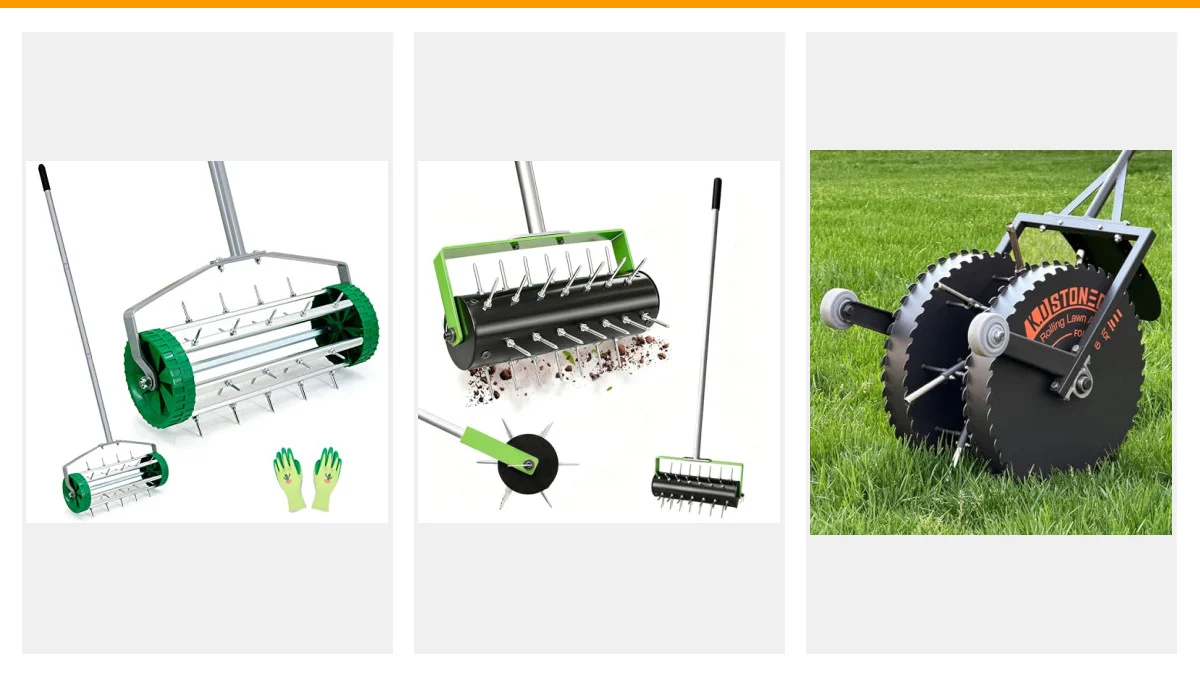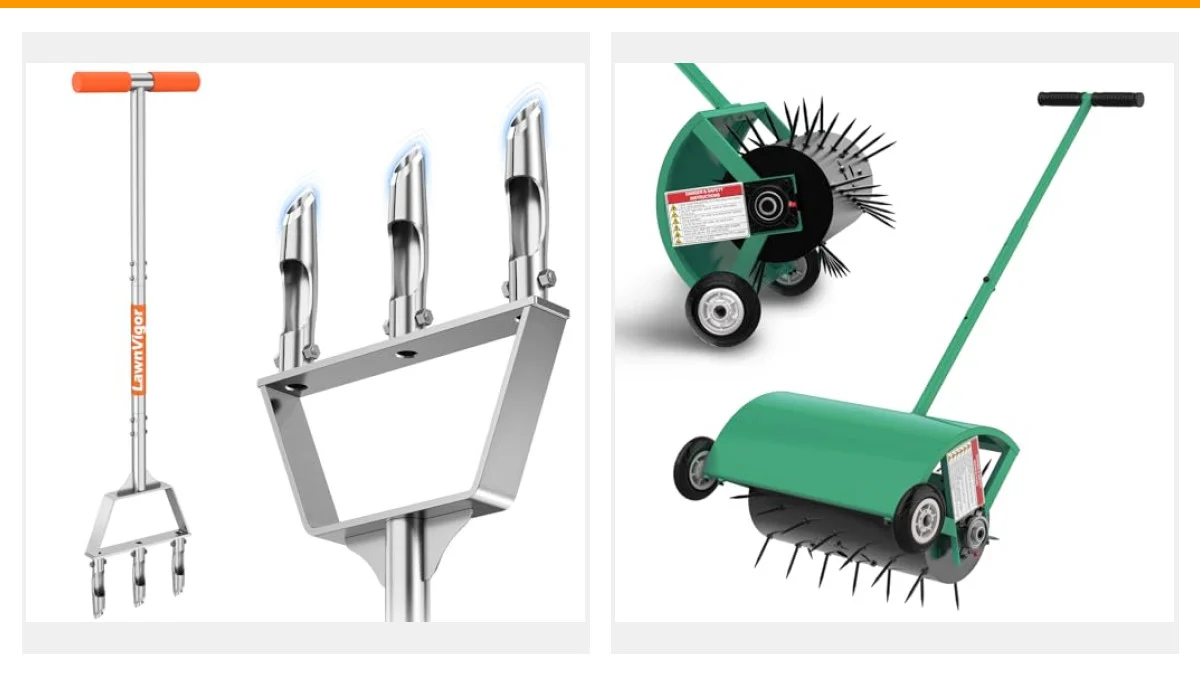
A lawn that puddles after rain, feels hard underfoot, and thins out every summer usually has the same problem. The soil underneath has packed tight, and grass roots can’t push through it. Water runs off instead of soaking in, fertilizer sits on the surface, and you end up watering more for worse results.
Core aeration fixes this by pulling small plugs of soil out and leaving holes behind. A tow behind plug aerator does the job from your tractor seat, so a half-acre yard takes an afternoon instead of a weekend with a hand tool. The right model comes down to working width, tine quality, how much weight the tray holds, and whether it fits your hitch without a trip to the hardware store.
Below are five models worth a look, ranked by how well they handle real yards rather than spec sheets. The Agri-Fab 48-inch takes the top spot for most homeowners, with the Garvee and Doniks offering solid alternatives at different widths and price points. Each pick lists who it suits and where it falls short.
Here’s a quick side-by-side of the key differences before the detailed reviews.
| Features | Agri-Fab 48-Inch | Garvee 40-Inch | Doniks 48-Inch | Suchtale 40-Inch | JFHID 40-Inch |
|---|---|---|---|---|---|
| Working Width | 48 inches | 40 inches (32/48 available) | 48 inches | 40 inches | 40 inches |
| Tine Count & Type | 32 galvanized self-sharpening knives | Hardened steel replaceable tines | 30 galvanized steel tines | 24 heat-treated coring plugs | Aeration spikes |
| Weight Tray Capacity | 175 lbs | Open platform, add blocks | 125 lbs | 125 lbs | 200 lbs |
| Wheels | Flat-free tires | Transport wheels | 10-inch pneumatic tires | Bearing wheels | 8-inch smooth-rolling tires |
| Best Use Case | Large lawns, heavy compaction | Flexible sizes for any yard | Mid-size yards on a budget | Smaller lawns, light compaction | Big lawns, deep penetration |
Agri-Fab 48 In Tow Behind
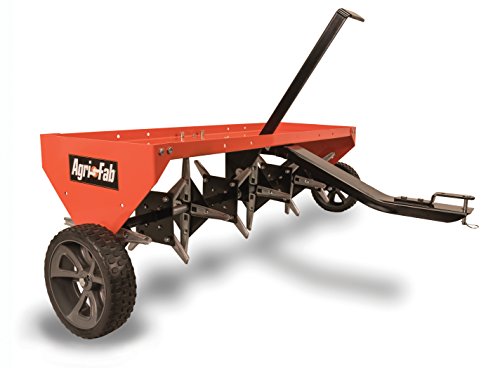
Agri-Fab
Agri-Fab 48 In Tow Behind Lawn Plug Aerator with 32 Galvanized Knives and Universal Hitch
- DEEP SOIL AERATION PERFORMANCE: Pulls plugs up to 3 in deep to improve airflow, water absorption, and nutrient penetration for str…
- IMPROVES LAWN ROOT DEVELOPMENT: Helps loosen compacted soil to encourage deeper root growth and support a thicker more professiona…
- SMOOTH EASY OPERATION: Flat free tires provide reliable transport while the cantilever transport handle allows convenient raising…
Agri-Fab has built tow behind lawn equipment for decades, and the 48-inch plug aerator is their flagship model for homeowners with larger properties. It suits anyone running a riding mower or garden tractor across a half-acre or more who wants one pass to cover serious ground. The 48-inch width means fewer laps, which matters when you’re aerating an acre in a single afternoon.
The standout feature is the weight tray capacity of 175 pounds, the highest among the coring models here. That extra weight drives the 32 galvanized knives deeper into hard soil, and the self-sharpening design keeps them cutting season after season. Flat-free tires eliminate the flat-tire annoyance that plagues pneumatic wheels on rough terrain. The cantilever transport handle lets you raise and lower the tines from the tractor seat, so you don’t climb down every time you cross a driveway.
Here’s the honest part: 175 pounds of weight capacity is only useful if you actually load it. On soft spring soil, the aerator works fine empty, but on baked summer clay you’ll want concrete blocks or sandbags on the tray. The universal hitch fits most tractors, though a few owners of older or off-brand mowers report needing an adapter pin. It’s also heavy to move by hand when disconnected, so plan where you store it.
- 48-inch swath covers large lawns in fewer passes
- 32 galvanized self-sharpening knives pull plugs up to 3 inches deep
- 175-pound weight tray for stubborn compacted soil
- Flat-free tires and seat-level transport handle
- Universal hitch fits most lawn and garden tractors
Best for: Homeowners with half an acre or more who want maximum coverage and deep penetration without stopping to adjust equipment.
Garvee 40”Tow Behind Law

Garvee
Garvee 40''Tow Behind Lawn Plug Aerator with Transport Wheels,for Tractors
- 【Multiple Size Variants】 Available in 32‑inch, 40‑inch and 48‑inch working widths to match different yard sizes. Wider coverage cu…
- 【Sharp Steel Aeration Tines】 Hardened steel tines punch holes into soil to relieve compaction. Tines penetrate ground for better w…
- 【Universal Tow Hitch & Wide Compatibility】 Universal extra‑wide tow bar connects to most riding lawn tractors, ATVs and UTVs. Simp…
Garvee takes a different approach by offering the same aerator in 32, 40, and 48-inch widths. That flexibility matters if you’re not sure which size fits your yard. A 32-inch model handles tight suburban lots where a 48-inch unit won’t clear fences and flower beds. The 40-inch version here is the middle ground for most residential lawns.
Replaceable tine assemblies set this model apart from cheaper alternatives. When tines dull or bend, you swap the assembly instead of the whole unit. The powder-coated frame resists rust, and the extra-wide tow bar connects to riding mowers, ATVs, and UTVs without modification. Transport wheels lift the tines off the ground for moving between zones, which protects both the tines and your driveway surface.
The open weight platform accepts blocks, but Garvee doesn’t specify a maximum capacity. That’s a real gap if you plan to load heavy. Assembly takes longer than the instructions suggest, and a few buyers mention the pre-drilled holes needing minor alignment work. The tines penetrate well in average soil, though extremely rocky ground will challenge them.
- Available in 32, 40, and 48-inch working widths
- Hardened steel tines with replaceable assemblies
- Extra-wide tow bar fits tractors, ATVs, and UTVs
- Transport wheels protect tines during moves
- Powder-coated frame for weather resistance
Best for: Buyers who want size options and long-term tine replacement rather than a one-size-fits-all unit.
Doniks 48-Inch Tow Behind

Doniks
Doniks 48-Inch Tow Behind Lawn Plug Aerator with Universal Hitch, Lawn Aerator Tow Behind with 30 Galvanised Steel Tines,Tray and Inflatable Wheels for Gardens, Lawns, Farms
- 【Durable Design】-This tow behind aerator is made of high quality and durable all-steel design, equipped with 30 galvanised steel p…
- 【Powerful Features】-Our plug aerator tow behind is equipped with 6 steel tines star, ,each plug can penetrate compacted soil up to…
- 【Weighted Tray】-Featuring a sturdy weighted tray,side panels and solid steel shafts with an all-steel design, that can hold up to…
Doniks built this 48-inch aerator for gardeners who want a middle-ground price without dropping to a flimsy frame. The all-steel construction and 6mm thick adjustable bracket resist bending, a common failure point on budget aerators. It suits homeowners with medium to large lawns who aerate once or twice a year and want the tool to last.
Thirty galvanized steel tines on six star-shaped spools punch holes up to 2 inches deep. That’s shallower than the Agri-Fab, but adequate for most residential soil. The 125-pound weight tray accepts cement blocks when you need extra penetration. Two 10-inch pneumatic tires roll smoothly, and the cantilevered transport handle raises the tines for crossing pavement. The control lever makes that transition quick.
Two inches of depth is the limiting factor here. If your soil is severely compacted or you’re on heavy clay, you may want more penetration than this unit delivers even with weight added. The pneumatic tires also need occasional air checks, unlike flat-free designs. Assembly follows the manual, but the instructions could be clearer on the spool orientation.
- 48-inch width with 30 galvanized steel tines
- 6mm thick bracket resists bending under load
- 125-pound weight tray for added penetration
- 10-inch pneumatic tires and cantilevered transport handle
- All-steel frame with solid steel shafts
Best for: Budget-conscious homeowners with medium lawns who want durable steel construction and don’t need maximum depth.
Suchtale 40-Inch Tow Behind

Suchtale
Suchtale 40-Inch Tow Behind Plug Aerator with Universal Hitch, Tow Plug Aerator with Extra-Wide Tow Bar, Durable Lawn Aerator Soil Penetrator Tractor with 24 Coring Plugs for Lawn, Farm and Garden
- Durable Structure with 6 spools of integral aerator knives: Suchtale Tow Behind Plug Aerator with 24 Heat-Treated Plugs, each plug…
- Easy to Use and Effort Saving: The unique 2-piece steel draw bar complete with a universal hitch pin, conveniently connects to you…
- Durable Construction & Easy to Install: Designed with high-quality all-steel, and reinforced side plate and solid steel axle for e…
Suchtale’s 40-inch plug aerator targets smaller yards and lighter compaction. The 24 heat-treated plugs on six spools penetrate up to 2 inches, which handles typical suburban soil that’s been aerated before. It connects to lawn tractors and ATVs with a pin-style hitch and two-piece steel draw bar.
The reinforced side plate and solid steel axle add strength where cheaper units flex. Suchtale uses a 6mm thick adjust handle instead of the usual 4mm, a small detail that prevents bending over time. Wheel bearings increase load capacity, and the 125-pound weight tray accepts blocks for extra depth. The transport handle raises and lowers plugs for crossing walkways without leaving marks.
Availability is spotty, so check stock before committing. The 2-inch maximum depth won’t satisfy anyone dealing with rock-hard clay or years of neglect. And while the build quality is solid for the price, it’s not in the same class as the Agri-Fab for heavy-duty use. The satisfaction guarantee is a nice safety net, though.
- 40-inch width with 24 heat-treated coring plugs
- 2-inch maximum penetration depth
- 6mm adjust handle resists bending
- 125-pound weight tray capacity
- Pin-style hitch for tractors and ATVs
Best for: Homeowners with smaller lawns and already-managed soil who want a reliable, affordable coring aerator.
JFHID 40” Tow Behind Law

JFHID
JFHID 40'' Tow Behind Lawn Plug Aerator, Heavy Duty Rolling Spike Aerator
- Effortless Stable Plowing: Durable aeration spikes and 8" smooth-rolling tires enable seamless soil penetration for this tow behin…
- Universal Hitch Compatibility: Featuring a universal hitch design, this tow behind aerator securely fits most riding mowers, lawn…
- 40" Working Coverage: Featured with a 40-inch wide working width, this tow behind plug aerator covers more ground in fewer passes,…
JFHID’s 40-inch model leans on spike aeration rather than coring plugs. Spikes push soil aside instead of removing plugs, which some lawn experts consider less effective for long-term compaction relief. Still, it covers ground fast and handles large lawns with a 200-pound weight capacity, the highest in this roundup.
The adjustable height and secure lock let you match tine depth to soil conditions, and the lock prevents shifting during operation. Rust-resistant, waterproof construction keeps maintenance low. The 8-inch smooth-rolling tires and universal hitch fit most riding mowers, tractors, ATVs, and UTVs. For someone who wants quick surface aeration without the cleanup of soil plugs, this works.
Here’s the trade-off: spike aerators can actually worsen compaction over time by pushing soil particles together rather than removing them. If your goal is genuine compaction relief, a coring model does more. This one suits overseeding prep or light annual maintenance, not rescue work on hard-packed ground. Stock is also limited.
- 40-inch working width for efficient coverage
- 200-pound weighted capacity for deep spike penetration
- Adjustable height with secure lock
- 8-inch smooth-rolling tires
- Universal hitch fits mowers, tractors, ATVs, UTVs
Best for: Large-lawn owners who want fast spike aeration before overseeding and don’t need plug removal.
How We Chose These Products
We started with the specs that actually affect results: tine count and material, working width, weight tray capacity, and hitch compatibility. A 48-inch aerator with dull tines loses to a 40-inch model with sharp, replaceable ones. We weighted tine quality and penetration depth heavily because those determine whether aeration works at all.
Then we looked at real-world usability. Flat-free versus pneumatic tires, transport handles, assembly difficulty, and replacement part availability all matter after the first season. We also considered who each model suits, since a 32-inch unit for a small yard makes more sense than a 48-inch unit that won’t fit through a gate. Every pick here has a clear use case and an honest limitation.
Buying Guide: What Really Matters
Working width is the first decision. Measure your lawn and your gate openings. A 48-inch aerator covers more ground per pass but needs clearance and a tractor with enough power to pull it when weighted. For lawns under a quarter acre, a 40-inch model is plenty. For an acre or more, wider saves real time.
Tine type separates coring aerators from spike aerators. Coring models remove plugs and genuinely relieve compaction. Spike models push holes into the soil and work for overseeding prep, but they can compact soil further over time. If your lawn has never been aerated or feels rock-hard, go with coring. Weight tray capacity matters too. More capacity means deeper penetration in tough soil, but only if you actually add weight.
Check your hitch before buying. Most models claim universal fit, but older tractors sometimes need an adapter. Transport handles and wheel type affect daily usability more than most buyers expect. Flat-free tires save hassle. Pneumatic tires roll smoother but need air. And consider replacement parts: tines wear out, and a model with replaceable assemblies lasts longer than one you throw away.
Our Top Recommendation
The Agri-Fab 48-inch plug aerator wins for most homeowners. The combination of 32 galvanized self-sharpening knives, 175-pound weight capacity, and flat-free tires handles real compaction without constant fiddling. The seat-level transport handle is a small feature that makes a big difference on a full afternoon of work. It costs more than the budget options, but it’s built to last.
If you want size flexibility, the Garvee 40-inch offers three widths and replaceable tines. For a tighter budget, the Doniks 48-inch delivers solid steel construction at a lower price, though with shallower penetration. The Suchtale works for smaller, already-managed lawns. The JFHID suits spike aeration before overseeding, not heavy compaction relief. Match the tool to your soil and lawn size, and you’ll get better results than buying on price alone.
Frequently Asked Questions
How often should I aerate my lawn?
Once a year for most lawns, ideally in early fall when grass is growing but temperatures are cooling. Lawns with heavy foot traffic or clay soil may need twice a year, in spring and fall. Aerating during drought or extreme heat stresses grass, so time it around rainfall.
Do I need to add weight to the aerator tray?
Only if the tines aren’t penetrating. Start without weight on soft spring soil. If the plugs come up shallow or the tines barely scratch the surface, add 50 to 100 pounds and test again. More weight means deeper holes but also more strain on your tractor.
Will a plug aerator work on a lawn with sprinkler heads?
It can, but mark sprinkler heads first. Tines can damage plastic heads and irrigation lines. Many homeowners flag head locations and aerate around them, or use a spike aerator at shallow depth near irrigation zones.
What’s the difference between core and spike aeration?
Core aeration removes small plugs of soil, which relieves compaction and lets water and nutrients reach roots. Spike aeration pushes holes into the soil without removing anything. Core aeration is more effective for compaction, while spike aeration works for quick overseeding prep. For hard, compacted lawns, core aeration is the better choice.