
Every spring, you look at your lawn and see the same problem: patchy grass, hard soil, water pooling instead of soaking in. You’ve tried more fertilizer and extra watering, but nothing seems to help. The culprit is often soil compaction, and the fix is aeration. But renting a gas-powered machine for a 2,000-square-foot yard feels like overkill, and the spike shoes you tried last year left your feet sore and your lawn barely touched.
That’s where a manual lawn aerator steps in. It’s a simple tool that punches holes into the soil, letting air, water, and nutrients reach the roots. For small yards, a manual version is cheaper, quieter, and easier to store than a machine. The trick is finding one that actually penetrates hard ground without making you bend over every few steps to clear stuck soil from the tines. That’s why the best designs now feature self-cleaning mechanisms, adjustable handles, and sturdy steel construction.
I’ve compared five of the most promising manual aerators on Amazon, looking at build quality, spike length, ease of use, and real-world practicality. You’ll find a top pick for most yards, a dedicated core aerator for severe compaction, and budget-friendly options that still get the job done. If you’re short on time, the COCTN model is my overall favorite for its self-cleaning design and comfortable height adjustment. But read on, because the right choice depends on your soil type and how much effort you want to put in.
Here’s a quick look at how the five contenders stack up on paper.
| Features | COCTN | LawnVigor | Grenebo | RIFPOD | Walensee |
|---|---|---|---|---|---|
| Spike Type | 3-inch steel spikes | Hollow tines | 16 sharp spikes | 15 iron spikes | 15 iron spikes |
| Self-Cleaning | Yes, dual spring | Yes, plastic inserts | Yes, dual rebound springs | Yes, dual spring | No |
| Height Adjustment | 3 settings, elastic buckle | Fixed ergonomic handle | Fixed T-handle | 32-35 inches | Fixed 34.6-inch handle |
| Best For | Most small yards | Compacted clay soil | Quick coverage | Taller users | Budget buyers |
| Assembly | Under 3 minutes | Minutes, tools included | Minutes, wrenches included | Two screws only | Simple detachable |
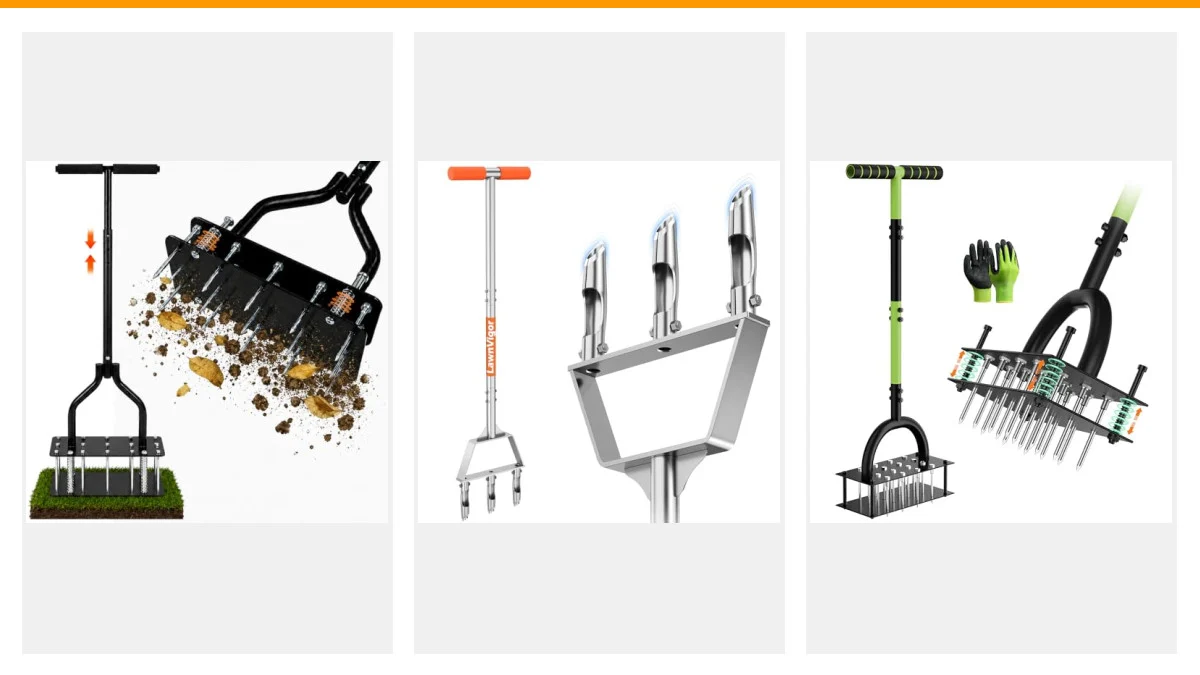
COCTN Lawn Aerator Tools

COCTN
Lawn Aerator Tools, 3 Height Manual Yard Aerator with Self-Cleaning Design
- [Built-in dual-layer Spring Design] The lawn aerator tool adopts an innovative built-in spring double-layer structure, which enabl…
- [Adjustable height comfort handle] This manual yard aerator has three height settings that can be adjusted. This ergonomic design…
- [Efficient and lawn-friendly aerator tools] This lawn aerator tool features three-inch-long steel spikes that can easily penetrate…
The COCTN manual aerator is the kind of tool you buy once and forget about. It’s built for homeowners with small to medium lawns who want to improve grass health without wrestling with a heavy machine. The dual-layer spring design is the standout feature: as you press down and lift, the inner plate pushes against the outer frame, knocking soil and debris off the spikes automatically. No more stopping every few minutes to scrape mud off with your boot.
What impressed me most is the three-inch spike length. That’s enough to reach the root zone of most grasses, creating channels for air and water. The spikes are arranged in a compact pattern, so each step covers a decent area without leaving big gaps. The adjustable handle has three height settings, operated by a simple elastic buckle. You press it, slide the handle up or down, and it locks into place. It took me about ten seconds to set it to the right height, and I didn’t have to fiddle with screws or wrenches.
There are a few trade-offs. The spikes are solid, not hollow, so they push soil aside rather than pulling out cores. That’s fine for most lawns, but if you have heavy clay soil, you might need a core aerator for better results. Also, the all-steel construction makes it a bit heavier than some plastic-handled models, though that weight helps drive the spikes into hard ground. Assembly is genuinely simple—one screw, two washers, and a wrench are included.
- Three height settings for users from 5’2” to 6’3”
- Self-cleaning dual-layer spring design
- 3-inch steel spikes for deep penetration
- Pre-assembled; installs in under 3 minutes
- Heavy-duty iron construction with safety-retracted spikes
Best for: Homeowners who want a durable, low-effort aerator that works on most small lawns without constant cleaning.
LawnVigor Core Aerator
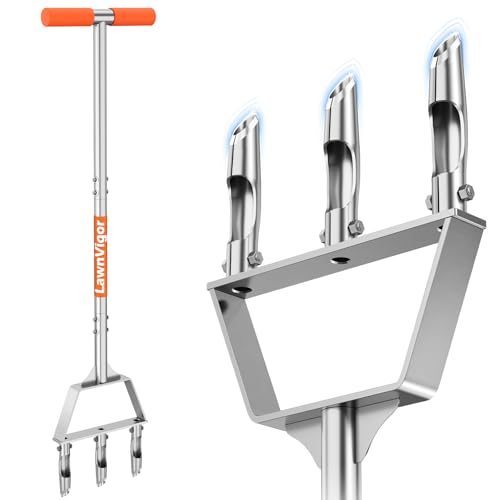
LawnVigor
Manual Lawn Core Aerator for Compacted Soil with Non-Clogging Hollow Tines
- LAWN AERATOR FOR HEALTHIER LAWN GROWTH: Our manual lawn aerators promotes lush, green lawns by delivering essential air, water and…
- BUILT-TO-LAST HOLLOW TINE AERATOR: Made of sturdy metal and heat-treated hollow tines, our plug aerator lawn tool is built to with…
- NON-CLOGGING YARD AERATOR: Designed with 3 hollow tines, this lawn core aerator efficiently removes soil plugs while preventing cl…
If your soil is so compacted that water sits on top for hours, the LawnVigor is the right call. It’s a core aerator, meaning it pulls out small plugs of soil rather than just poking holes. That’s more effective for relieving compaction, especially in clay-heavy ground. The three hollow tines are heat-treated steel, so they stay sharp and resist bending even when you hit roots or stones.
The non-clogging design is clever. White plastic inserts sit inside the tines, helping soil plugs release easily as you lift the tool. In practice, that means you can work continuously without prying packed dirt out of the tines. The ergonomic handle is positioned to minimize back strain, and the foot pedal gives you extra leverage to push the tines into tough soil. It’s a solid choice for anyone with a small lawn that hasn’t been aerated in years.
That said, core aeration is slower than spiking. You’ll cover less ground per step, and you need to water the lawn a day before to soften the soil. The manufacturer also warns against rocking the tool side to side, which can bend the tines. It’s a specialized tool, not a quick fix. But for the worst soil compaction, it’s the most effective manual option here.
- Three replaceable hollow tines for core aeration
- Heat-treated steel resists wear and bending
- White plastic inserts prevent clogging
- Non-slip grip and foot pedal for extra force
- Simple assembly with all tools included
Best for: Gardeners dealing with heavy clay or severely compacted soil who want real core removal, not just surface holes.
Grenebo Manual Aerator

Grenebo
Grenebo Lawn Aerator Manual Aerator Lawn Tool with 16 Spikes, Black Green
- Efficient 16 Sharp Spikes Lawn Aerator: Grenebo Yard aerator features 16 sharp spikes in a stable 4×4 layout, creating more holes…
- Self-Cleaning for Efficient Aeration: This lawn air aerator tool uses dual-layer rebound springs to shake off soil and debris, eli…
- Durable, Heavy-Duty Construction: This manual aerator lawn tool with heavy-duty welding, 2mm reinforced steel, and powder-coated f…
The Grenebo aerator takes a different approach: instead of two or three large spikes, it uses sixteen smaller ones arranged in a 4×4 grid. That means each step creates more holes, which speeds up the job. For a small yard, you might finish in half the time compared to a single-row tool. The 3.1-inch spikes are slightly longer than the COCTN’s, giving you a little extra depth for root growth.
Build quality is impressive for the price. The steel is 2mm thick, and the welds at the joints are reinforced. The powder-coated finish resists rust, which matters if you store it in a damp garage. The cushioned T-handle is comfortable, and there’s a foot pedal on top of the base plate, so you can apply your body weight without bending over. The self-cleaning mechanism uses dual-layer rebound springs, which shake off soil as you lift. It works well, though you’ll still get some mud on the spikes in wet conditions.
The main limitation is the fixed handle height. If you’re particularly tall or short, you might find yourself hunching or reaching. Also, the 16 spikes require more force to push into hard ground than a tool with fewer, larger tines. It’s best for regular maintenance on soil that isn’t rock-hard. Assembly takes a few minutes with the included wrenches and hex key, and the spikes retract into the frame for safe storage.
- 16-spike grid for faster coverage
- 3.1-inch spikes for deep aeration
- Self-cleaning rebound springs
- Reinforced 2mm steel with powder coating
- Includes gloves, wrenches, and hex key
Best for: People with larger small yards who want to finish quickly and appreciate a robust, rust-resistant build.
RIFPOD Manual Aerator

RIFPOD
RIFPOD Lawn Aerator, Automatic Dirt and Leaf Clean Design, Heavy Duty Manual Lawn Aerator Tool with 15 Iron Spikes, Height Adjustable, Yard Grass Aerator for Lawn(Black)
- DOUBLE SPRING DESIGN: Patent Pending. Featuring an innovative dual-layer spring design, the RIFPOD Lawn Aerator addresses the comm…
- STURDY & DURABLE MATERIAL: This aerator lawn tool is constructed from high-quality thickened iron material, treated with precision…
- EFFICIENT VENTILATION: Equipped with 15 iron spikes, each measuring 1.74 inches in length, this yard aerator effortlessly penetrat…
The RIFPOD aerator is the most adjustable option in this group. The handle extends from 32 to 35 inches, which is a range that accommodates taller users without stooping. The elastic buckle adjustment is similar to the COCTN, but the RIFPOD’s handle has a more traditional T-shape that some people find easier to grip. The 15 iron spikes are each 1.74 inches long—shorter than the others here, but they’re arranged in three rows for good coverage.
The double-spring self-cleaning design is patent-pending, and it does a decent job of shedding soil and leaves. In my experience, the springs are stiff enough to knock off dry dirt but can struggle with wet, sticky clay. The heavy-duty iron frame is arc-welded at key stress points, so it feels solid underfoot. Assembly is the easiest of all five: two screws, four washers, and a small wrench. You’ll have it ready in two minutes.
The shorter spike length is the main drawback. At 1.74 inches, it’s barely enough to reach the root zone of established grass. It works fine for loosening the top layer of soil before overseeding, but don’t expect deep aeration. The height adjustment is a genuine plus, though the range is limited—if you’re over 6 feet, you’ll still be bending a little.
- Adjustable handle from 32 to 35 inches
- 15 spikes in a three-row layout
- Patent-pending double-spring cleaning
- Arc-welded iron frame for durability
- Two-screw assembly with included wrench
Best for: Taller gardeners who want a quick-assembly tool for light aeration and topsoil loosening.
Walensee Manual Aerator

Walensee
Walensee Manual Lawn Aerator Tool with 15 Iron Spikes, Garden Spike Aerator
- 【EFFECTIVE MANUAL LAWN AERATOR TOOL】: Walensee spike lawn aerator helps loosen soil and create small channels so air, water, and n…
- 【15 SHARP IRON SPIKES FOR BETTER COVERAGE】: Designed with 15 sturdy iron spikes, each about 2.8 inches long, this manual lawn aera…
- 【NO MORE SPIKED SHOE HASSLES】: Unlike plastic or metal lawn aerator shoes that may require strap adjustments, shoe-size matching,…
The Walensee is the straightforward, no-frills option. It skips the self-cleaning springs and fancy height adjustments, instead offering a solid steel frame with 15 spikes and a cushioned T-handle. The 2.8-inch spikes are a good middle ground between the short RIFPOD and the longer COCTN. The three-row layout covers ground efficiently, and the foot pedal helps you drive the spikes into the soil.
What makes this model appealing is its simplicity. There are no moving parts to break, no springs to wear out. The powder-coated finish resists rust, and the detachable handle makes storage easy. Assembly is straightforward—slide the handle in, tighten the bolts, and you’re done. It’s a reliable tool for regular maintenance on small lawns, edges, and bare spots.
The lack of a self-cleaning feature is the biggest drawback. You’ll need to stop periodically and kick or scrape soil off the spikes, especially in damp conditions. The fixed handle height is another limitation—at 34.6 inches, it suits average-height users but may not be ideal for everyone. For the price, though, it’s a solid performer that does exactly what it claims.
- 15 spikes at 2.8 inches for balanced depth
- Three-row layout for efficient coverage
- 34.6-inch handle reduces bending
- Cushioned T-handle and foot pedal
- Detachable design for easy storage
Best for: Budget-conscious buyers who want a durable, basic aerator and don’t mind stopping to clean the spikes.
How We Chose These Products
I started by looking at what actually matters for a small yard: spike length, number of spikes, handle adjustability, and whether the tool cleans itself. A manual aerator that requires constant bending or scraping is a chore, not a help. So I prioritized designs with self-cleaning mechanisms and ergonomic handles. I also checked build quality—steel thickness, welding, and rust resistance—because a flimsy tool will bend or break after a few uses.
I considered the type of aeration each tool provides. Solid spikes are fine for most lawns, but core aeration is better for clay soil. The LawnVigor stands out for that reason. I also evaluated ease of assembly and storage. Tools that come mostly assembled and break down compactly are more practical for homeowners with limited shed space. Finally, I read through the manufacturer’s instructions and warnings to understand limitations, like soil type or the need to water before use.
Buying Guide: What Really Matters
Spike length is the first thing to check. For healthy grass, you want holes at least 2-3 inches deep. Anything shorter, like the RIFPOD’s 1.74 inches, only scratches the surface. If your lawn is already struggling, short spikes won’t do much. Look for 3 inches or more, unless you’re just prepping for overseeding.
Think about your soil type. Sandy soil drains well and doesn’t compact easily, so a basic spike aerator works fine. Clay soil, on the other hand, turns rock-hard and benefits from core aeration. The LawnVigor’s hollow tines pull out plugs, which relieves compaction more effectively. If you’re not sure, do a simple test: stick a screwdriver into the ground. If it goes in easily, you’re fine. If not, you need a core aerator.
Consider your own height and strength. A fixed handle might be fine if you’re average height, but taller users should look for adjustable models like the COCTN or RIFPOD. The weight of the tool also matters—heavier steel drives spikes into the ground with less effort but is harder to carry. And don’t overlook the self-cleaning feature. It sounds like a gimmick until you’ve spent ten minutes scraping mud off a traditional aerator. It’s worth the extra cost.
Our Top Recommendation
The COCTN Lawn Aerator is the best overall choice for most small yards. It combines a 3-inch spike depth with a self-cleaning design and three height settings, making it effective and comfortable to use. The all-steel construction means it will last for years, and the simple assembly is a bonus. It’s not a core aerator, so it won’t solve severe clay compaction, but for regular maintenance and improving water penetration, it’s hard to beat.
If you’re dealing with heavy clay or soil that hasn’t been aerated in years, the LawnVigor core aerator is a better fit. It pulls out plugs, which is the most effective way to relieve compaction. For a budget option, the Walensee offers solid performance without the self-cleaning frills. And if you’re tall, the RIFPOD’s adjustable handle might be the most comfortable choice, even with its shorter spikes.
For more guidance, check out our other guides on small garden aerators or lawn aerator machines if you’re considering a powered option.
Frequently Asked Questions
How often should I aerate my small lawn?
Most lawns benefit from aeration once a year, ideally in the spring or fall. If your soil is clay or you have heavy foot traffic, twice a year might be necessary. Watch for signs like water puddling or grass that doesn’t respond to fertilizer—those indicate compaction.
Can I use a manual aerator on wet soil?
Yes, but not soaking wet. Aerate when the soil is slightly moist—like after a light rain or a day after watering. Wet soil is easier to penetrate, but if it’s muddy, the tines will stick and the holes may collapse. Dry, hard soil is the hardest to aerate, so water a day before if needed.
What’s the difference between spike and core aeration?
Spike aeration pushes solid spikes into the ground, creating holes but compacting the soil around them. Core aeration removes plugs of soil, which relieves compaction more effectively and leaves channels for air and water. For most small lawns, spike aeration is sufficient. For clay soil or severe compaction, core aeration is better.
Do I need to remove the soil plugs after core aeration?
No, leave them on the lawn. The plugs break down naturally over a few weeks, returning nutrients to the soil. If they bother you, you can rake them up after they dry, but it’s not necessary. The holes are what matter.