The Best Way to Remove Thatch from Your Lawn: Top 4 Tools Reviewed
Contents
That spongy, brown layer hiding between your grass blades is doing more harm than you think. Thatch blocks water, nutrients, and air from reaching the soil. You might notice your lawn feels soft and bouncy when you walk on it, or that it dries out faster than it should. When thatch builds up past half an inch, it’s time to act.
A great dethatching tool makes a tough job manageable. The right choice depends on your lawn size, your physical limits, and how much elbow grease you’re willing to put in. Manual rakes work fine for small yards. Powered or tow-behind units save hours on larger properties. You also need to think about tine design, handle comfort, and how you’ll dispose of all that dead grass.
We tested four tools that cover the full spectrum, from a dual-sided manual rake to a 40-inch tow-behind unit for big lawns. The EUIJOIP Thatch Rake takes our top spot for its smart two-sided blade design. The Tolia 2-in-1 is a close runner-up with its carbon steel build and included accessories. Read on to find the one that fits your lawn and your back.
Here’s a quick comparison of the key specs that separate these four tools.
| Features | EUIJOIP 51-Inch Rake | Tolia 2-in-1 Rake | Spear & Jackson Knife | Ningering 40-Inch Dethatcher |
|---|---|---|---|---|
| Material & Build | Metal with dual center support | Powder-coated carbon steel | Mirror-polished stainless steel | Heat-treated spring steel tines |
| Key Specification | 15-inch wide head | 16 sharp + 16 rounded tines | 12.4 x 3.3 inches | 40-inch working width |
| Main Feature | Double-sided sharp blades | Dual-action tine design | Tanged blade for knuckle clearance | Combined dethatcher and sweeper |
| Performance | Adjustable head angle | Rust-resistant, stays strong | Minimal soil adhesion | Collects debris in hopper |
| Best Use Case | Sloped lawns, rugged terrain | Medium yards, seedbed prep | Patios, crevices, rockeries | Large lawns, riding mower owners |
EUIJOIP 51-Inch Thatch Rake
1st Pick
EUIJOIP
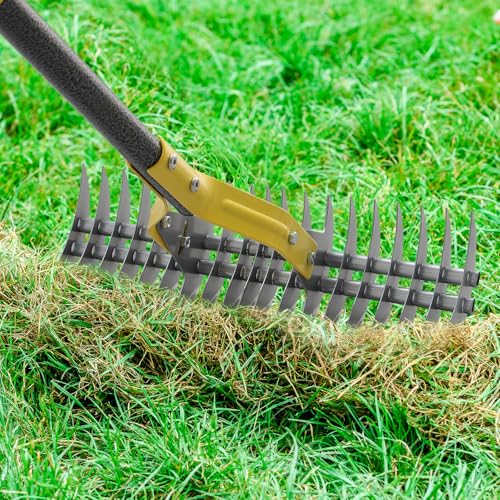
Thatch Rake, 51" Heavy Duty Metal Dethatcher Rake with 15" Wide Double-Edged Sharp Tines Thatch Rakes for Lawns,Dead Grass Removal,Soil Loosening,Lawn Care, Dethatching,Yard,Garden
- ✅ Multi-Purpose Double-Sided Sharp Blades: Side A's long tines penetrate soil to clear leaves, pine needles, grass clippings, and…
- ✅ Time-Saving Garden Rake: The 15" wide rake head, combined with an adjustable rake head angle, enables efficient, labor-saving wo…
- ✅ Dual Center Support: This weed rake features reinforced dual center support rods for superior structural stability and even tine…
This is the tool you want if your lawn has slopes, bumps, or a mix of thatch and surface debris. The EUIJOIP rake handles everything from deep soil loosening to surface cleanup. Homeowners with irregular terrain will appreciate the adjustable head angle. It’s also a solid pick for seniors or anyone who needs to protect their lower back.
The double-sided blade design is the standout feature here. One side has long tines for penetrating soil and pulling up moss or pine needles. Flip it over and the serrated side cuts through dense thatch and stubborn weeds like crabgrass. That versatility means you don’t need to swap tools mid-job. The dual center support rods keep the head stable, so it doesn’t wobble when you hit a tough patch. The 15-inch head covers decent ground per pass without being unwieldy.
One honest drawback: the sharp tines require some care. You can’t leave this rake lying around where kids or pets might step on it. And while the adjustable angle helps on slopes, the mechanism adds a small learning curve. It took us a few passes to find the right setting for different tasks. The handle adjusts to your height, but the assembly instructions could be clearer.
- Double-sided head with long tines on one side and serrated blades on the other
- Adjustable rake head angle for deep weeding or gentle leaf removal
- Dual center support rods prevent wobbling and bending
- Ergonomic 1.1-inch diameter handle adjusts for height
- 15-inch wide head balances coverage and maneuverability
Best for: Homeowners with sloped or uneven lawns who want one tool for both deep dethatching and surface cleanup.
Tolia 2-in-1 Thatch Rake
2nd Pick

Tolia
Tolia 2-in-1 Thatch Rake with Dual Different Tines - Dethatcher Rake for Lawns, Versatile Lawn Rake for Thatch Removal and Soil Care, Heavy Duty Garden Rake Includes Reusable Waste Bag & Gloves
- Innovative Dual-Action Tine Design: Unlike standard rakes with identical tines on both sides, our thatch rake features two distinc…
- Built to Last with Carbon Steel & Functional Accessories: Engineered for heavy-duty use. This rake features a thick, powder-coated…
- Easy Assembly & Compact Storage: Get set up in minutes. The 57” handle consists of 4 easily joined sections. Its detachable design…
The Tolia rake is a smart choice for medium-sized yards and anyone who wants a complete kit right out of the box. It comes with a reusable waste bag and gardening gloves, which saves you a trip to the store. The dual-action tine design sets it apart from standard rakes. You get 16 sharp tines for cutting through dense thatch and 16 rounded tines for gently scooping leaves and clippings.
Carbon steel construction gives this rake a sturdy feel. The powder coating resists rust, and the tines hold up even in hard, compacted soil. We like that the handle breaks into four sections for storage. That’s a real benefit if your garage or shed is tight on space. The included waste bag is genuinely useful for collecting debris as you work, though it’s not huge. You’ll still make multiple trips on a big job.
The trade-off is assembly. The four-piece handle needs to be joined and tightened properly. Tolia even includes a pro tip about standing on the rake head and twisting the handle to secure the connection. Skip that step and the handle will loosen while you work. Also, the 57-inch handle is a good length for most adults, but taller users might find it a bit short. The rounded tines are gentle on grass, but they won’t cut through thick, matted thatch as aggressively as the sharp side.
- Dual-action design with 16 sharp and 16 rounded tines
- Powder-coated carbon steel head resists rust and bending
- Includes reusable waste bag and gardening gloves
- Four-piece handle disassembles for compact storage
- 57-inch total handle length when fully assembled
Best for: Medium-lawn owners who want a complete dethatching kit with storage-friendly design and included accessories.
Spear & Jackson Select Stainless Patio Knife
3rd Pick

Spear & Jackson
Spear & Jackson Select Stainless Patio Knife, Comfortable Grip Garden Tool for Weeding and Moss Removal
- Ergonomic Design: Features a bi-material contoured handle for a comfortable grip, reducing hand fatigue during extended use
- Durable Construction: Crafted with a mirror-polished stainless steel head that ensures corrosion resistance and minimal soil adhes…
- Knuckle Clearance: Designed with a tanged blade to provide ample knuckle clearance, enhancing user comfort and control
This isn’t a rake, and it’s not meant for whole-lawn dethatching. The Spear & Jackson Patio Knife is a precision tool for tight spots. Think patio crevices, rockeries, and the narrow gaps between paving stones where thatch and moss love to hide. It’s also handy for edging along walkways or cleaning out flower bed borders. If your thatch problem is concentrated in small, hard-to-reach areas, this knife earns its place in your shed.
Stainless steel construction is the highlight. The mirror-polished head resists corrosion and sheds soil easily, so it stays clean with a quick wipe. The tanged blade design gives your knuckles plenty of clearance, which matters when you’re scraping along rough stone. The bi-material contoured handle feels comfortable during extended use. At just 5.8 ounces, it’s light enough to carry around the yard without fatigue.
Here’s the limitation: this tool won’t help you dethatch a large lawn. It’s simply not designed for that. You’d be on your hands and knees for hours. The 12.4-inch length is compact, which is great for control but means more bending. And the stainless steel head, while durable, isn’t meant for prying up rocks or heavy roots. Use it for what it’s built for and it’ll last for years.
- Mirror-polished stainless steel head resists corrosion and soil adhesion
- Tanged blade provides ample knuckle clearance
- Bi-material contoured handle reduces hand fatigue
- Compact 12.4-inch length for precise control in tight spaces
- Weighs just 5.8 ounces for easy handling
Best for: Gardeners who need to remove moss and thatch from patio crevices, rockeries, and narrow spaces between stones.
Ningering 40-Inch Tow-Behind Dethatcher
4th Pick

Ningering
Ningering 40inch Tow Behind Dethatcher,Lawn Sweeper Garden Grass Tractor Rake Removes Thatch from Large Lawns, Riding Lawn Mower Attachments for Outdoor Yard Tools Lawn Care (Black)
- Efficient Dual Functionality - This lawn dethatcher implement combines a dethatcher and lawn sweeper in one unit. Spring steel tin…
- Optimal Working Width - Yard rake pull behind cover substantial ground with each pass thanks to the 40 inch working width. This at…
- Durable Construction - Lawn thatcher rake features heat treated spring loaded tines that resist rust and withstand regular use. Th…
Own a riding mower and a lawn that takes more than an hour to walk? The Ningering Tow-Behind Dethatcher is built for you. This attachment connects to most riding mowers and lawn tractors with a hitch system that requires no tools. It combines a dethatcher and a lawn sweeper in one unit. The spring steel tines pull up thatch while the sweeping system collects debris in a hopper. That means fewer passes and less raking afterward.
The 40-inch working width covers serious ground. You’ll finish a large lawn in a fraction of the time it would take with a manual rake. Heat-treated spring-loaded tines resist rust and stand up to regular use. They’re also replaceable when they eventually wear out. The hopper holds a good amount of debris, so you’re not stopping every five minutes to empty it. For anyone with an acre or more, this is a back-saver.
Two things to consider before buying. First, this unit requires a riding mower or tractor. If you push-mow, it’s useless to you. Second, the hopper fills up faster than you might expect in heavy thatch. You’ll still make regular stops to dump it. The tines are durable but not indestructible. Hitting a rock or root at speed can bend them. And the assembly, while tool-free for the hitch, takes some time to set up initially.
- Combines dethatching and sweeping in one tow-behind unit
- 40-inch working width for efficient coverage on large lawns
- Heat-treated spring-loaded tines resist rust and are replaceable
- Integrated hopper collects debris to minimize cleanup
- Tool-free hitch system connects to most riding mowers and tractors
Best for: Owners of large lawns and riding mowers who want to dethatch and collect debris in a single pass.
How We Chose These Products
We focused on tools that solve real dethatching problems, not just products with impressive spec sheets. Each pick had to earn its place by offering a clear advantage for a specific lawn size or user need. We looked at build quality, tine design, handle comfort, and whether the tool actually saves time or effort compared to a basic leaf rake.
We also considered the full job, not just the dethatching part. Debris collection matters. So does storage. Tools that came with practical accessories or smart design features got extra attention. We avoided anything that promised universal perfection. Every tool has a trade-off, and we’ve called those out honestly.
Buying Guide: What Really Matters
Lawn size is your first decision point. Under a quarter acre, a manual rake works fine. Between a quarter and half an acre, you’ll want a wide manual rake or consider a powered option. Over half an acre, a tow-behind unit saves your back and your weekend. Don’t buy more tool than you need, but don’t underestimate the time a manual rake takes on a big lawn.
Tine design drives performance. Sharp, serrated tines cut through thatch. Rounded tines scoop debris without tearing grass. Some tools offer both, which adds versatility. Spring steel tines last longer than rigid ones and flex over obstacles instead of snapping. Check whether tines are replaceable. That extends the tool’s life significantly.
Handle comfort is not a minor detail. Dethatching involves repetitive pulling motions. A handle that’s too short forces you to bend. One that’s too thick strains your grip. Adjustable handles help, but they add a failure point. Look for dual support rods or reinforced connections if you plan to use the rake often. And think about storage before you buy. A four-piece handle that breaks down is a blessing in a small shed.
Our Top Recommendation
The EUIJOIP 51-Inch Thatch Rake is our top pick for most homeowners. The double-sided blade design handles both deep dethatching and surface cleanup without swapping tools. The adjustable head angle works well on slopes, and the dual center support keeps the head stable. It’s the most versatile manual rake in this group.
If you prefer a complete kit with storage-friendly design, the Tolia 2-in-1 is a strong runner-up. It includes a waste bag and gloves, and the carbon steel build feels solid. For small, precise jobs around patios and rockeries, the Spear & Jackson Patio Knife is the right tool. And if you have a large lawn and a riding mower, the Ningering Tow-Behind Dethatcher will save you hours.
Frequently Asked Questions
How do I know if my lawn actually needs dethatching?
Push a finger into the grass. If you can’t feel the soil because of a spongy layer, you have too much thatch. Another test: cut a small plug of grass and measure the brown layer between the green blades and the soil. More than half an inch means it’s time to dethatch.
Can I dethatch my lawn without killing the grass?
Yes, if you do it at the right time. Dethatch when grass is actively growing, usually in early fall or late spring. Don’t dethatch during a drought or extreme heat. Water the lawn a day or two before to soften the soil. Go over the lawn in one direction, then perpendicular if needed. Don’t overdo it.
What’s the difference between dethatching and aerating?
Dethatching removes the layer of dead grass and roots sitting on top of the soil. Aerating pulls plugs of soil from below the surface to relieve compaction. They solve different problems. Some lawns need both, but not at the same time. Aerate after dethatching if your soil is compacted.
Do I need to bag the thatch after removing it?
Yes, remove the debris. Leaving it on the lawn can smother the grass and defeat the purpose. A tool with a collection hopper, like the Ningering unit, makes this easier. With manual rakes, you’ll need to rake the thatch into piles and bag it yourself. Some gardeners compost it, but only if it’s free of weeds and disease.