The Best Water Pump for Garden: 5 Picks That Actually Move Water
Contents
Your rain barrel is full. Your garden is thirsty. And the hose won’t reach. Or maybe the opposite problem: a flooded window well after a storm, and you’re bailing with a bucket like it’s 1850. A water pump fixes both scenarios, but the wrong one just adds noise and frustration.
A great garden pump matches three things to your task: flow rate, lift height, and power source. Flow rate is gallons per minute. Lift height is how high it can push water. Power source decides whether you’re tethered to an outlet or free to roam. Miss one of those, and you’ll be returning the pump.
I’ve sorted through the specs and real-world quirks of five pumps that cover everything from drip irrigation to emergency drainage. The ECO-WORTHY 33-Series is the best all-rounder for pressure-driven watering. The AQUASTRONG 1 HP handles dirty water and flooding. The TecHome is the budget transfer pick. The Chapin sprayer and Milescraft drill pump serve niche jobs well. Here’s how they stack up.
Compare the key specs side by side before you decide.
| Features | ECO-WORTHY 33-Series | AQUASTRONG 1 HP | TecHome Water Pump | CHAPIN SureSpray | Milescraft Drill Pump |
|---|---|---|---|---|---|
| Power Source | 110V AC corded | 120V corded submersible | 115V corded non-submersible | Manual hand pump | Drill-powered |
| Max Flow Rate | 4.0 GPM | 4500 GPH (75 GPM) | 330 GPH (5.5 GPM) | Not rated | 750 GPH (12.5 GPM) |
| Max Lift / Head | 131 ft lift | 30 ft vertical | 40 ft discharge head | Hand-pressurized | Not specified |
| Best Use Case | Pressure irrigation, RV, marine | Flooded basements, sump pits | Rain barrels, draining tanks | Spot spraying weeds, fertilizer | Quick transfers, draining small tanks |
| Key Limitation | Needs AC outlet nearby | Not for potable water | Must prime before use | Manual effort required | Requires a drill; not for potable |
ECO-WORTHY 33-Series Industrial Pump
1st Pick
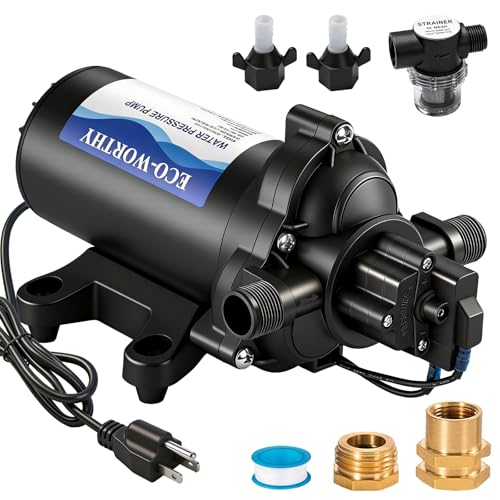
ECO-WORTHY
ECO-WORTHY 33-Series Industrial Water Pressure Pump 110V AC 4.0GPM 50PSI RV Fresh Water Diaphragm Pump include Garden Hose Adapters for Irrigation Marine Boat Sprinkler Faucet
- Diaphragm Pump: 110V AC water diaphragm pump provides 4.0GPM flow capacity. Turns on and off using water pressure at 50PSI, 1.3 Ma…
- Smart Pressure Switch: Turns on and off on demand. It’s quiet, shuts itself off when the faucets are closed and runs when the fauc…
- Reliable Performance: Self-Priming up to 9.8 vertical feet, lift up to 131 feet. Thermal overload protection is built into the wat…
The one you buy when you need steady pressure at the end of a long hose run.
This is a diaphragm pump built for pressure, not volume. It pushes 4 gallons per minute at 50 PSI, which is enough to run a sprinkler, feed a drip line, or supply a garden faucet from a rain barrel or holding tank. The 110V AC cord means no marine battery to haul around. RV owners and boat owners use it to replace weak onboard freshwater pumps. Gardeners use it to turn a static water source into a pressurized system.
The pressure switch is the standout feature. It kicks on when you open a faucet and shuts off when you close it. No manual toggling. The switch is adjustable from 45 to 70 PSI, so you can dial in the pressure your system needs. Self-priming up to 9.8 vertical feet means it can pull water from a tank sitting on the ground. Thermal overload protection shuts the motor down if it gets too hot. That’s a nice safety net for long irrigation runs.
Here’s the honest trade-off: 4 GPM is modest. If you’re trying to flood-irrigate a half-acre, this pump will feel slow. It’s also not submersible, so you can’t drop it into a pond or flooded basement. And the 110V cord limits where you can use it. You need an outlet within reach, or a heavy-duty extension cord. For portable, high-volume drainage, look at the AQUASTRONG instead.
- 4.0 GPM flow at 50 PSI, adjustable to 70 PSI
- Self-priming up to 9.8 vertical feet
- Thermal overload protection at 203°F
- Includes garden hose adapters
- Runs continuously for over an hour
Best for: Gardeners and RV owners who need reliable, pressure-switched water delivery from a tank or barrel.
AQUASTRONG 1 HP Sump Pump
2nd Pick

AQUASTRONG
AQUASTRONG 1 HP Sump Pump 4500 GPH Submersible Water Pump for Water Removal
- Efficient Sump Pump: Aquastrong sump pump with 1HP powerful motor. Draining water up to 4500GPH Per Hour( 75 gallons per minute) a…
- Portable Design: Plug in to play while unplug to stop. Bottom suction design filters debris and removes water down to 1/5 inch fro…
- Easy Installation: 1-1/4'' NPT discharge comes with 1-1/2'' elbow adapter and snap coupling adapter of 3/4'', 1'' or 1-1/4'', whic…
The one you call when water is somewhere it shouldn’t be.
This is a submersible sump pump with a 1 HP motor that moves 4500 gallons per hour. That’s 75 gallons per minute. It’s built for water removal, not irrigation. Think flooded basements, window wells, hot tubs you need to drain, or a sump pit that fills faster than a shop vac can handle. The bottom suction design pulls water down to 1/5 inch from the surface. It also passes 1/5-inch solids, so it won’t clog on minor debris.
Portability is a real strength. Plug it in and it runs. Unplug it and it stops. No float switch to fail, no automatic cycling you didn’t ask for. The 10-foot UL power cord gives you some reach, and the included adapters (1-1/2-inch elbow, plus 3/4-inch, 1-inch, and 1-1/4-inch snap couplings) make it easy to connect to standard discharge hoses. The reinforced thermoplastic casing resists corrosion. A mechanical seal keeps water out of the motor. And the built-in thermal overload protector saves the motor if it runs dry.
What it won’t do: supply pressure for irrigation. This pump moves volume, not pressure. It’s also not designed for potable water. And you can’t use it in a shallow puddle less than 1/5 inch deep. For garden watering, the ECO-WORTHY is the better tool. For emergency drainage, this is the one.
- 4500 GPH flow rate at 5 ft lift
- Lifts water up to 30 ft vertically
- Handles solids up to 1/5 inch
- Bottom suction drains to 1/5 inch depth
- Thermal overload protection prevents burnout
Best for: Homeowners dealing with flooded basements, window wells, or hot tub drainage who need high-volume water removal.
TecHome Water Pump Water Transfer
3rd Pick

TecHome
TecHome Electric Water Transfer Pump, 115V 1/10HP Utility Garden Hose Pump
- 115V/60HZ Water Pump: Powered by a 1/10 HP motor, this TecHome electric water pump can transfer water up to 330 gallons per hour (…
- Portable and Durable: The pump body is made of sturdy aluminum alloy, making it lightweight, wear-resistant, and corrosion-resista…
- Complete Hose Kit: This TecHome garden hose pump comes with a 6 ft suction hose, a suction strainer, and an impeller replacement k…
The one that punches above its price tag for light-duty transfer jobs.
TecHome’s transfer pump is a 1/10 HP unit that moves 330 gallons per hour. That’s about 5.5 gallons per minute. It’s non-submersible, so you set it beside the water source, not in it. The 3/4-inch garden hose thread connections mean you can use standard garden hoses on both the suction and discharge sides. It comes with a 6-foot suction hose and a water suction strainer that lets you pull water down to 1/8 inch from the surface. That’s useful for draining aquariums, rain barrels, water beds, or a clogged washing machine.
Setup is straightforward: fill the pump head with water to prime it, connect your hoses, plug it in, and go. The portable handle makes it easy to move between jobs. An extra impeller replacement kit is included, which is a thoughtful touch at this price point. Metal hose connectors hold up better than plastic threads. The pump is factory-tested before shipping.
The limitations are worth knowing. It’s not self-priming in the way the ECO-WORTHY is. You have to manually fill the pump head before it will pull water. The 6-foot suction lift is modest. And 330 GPH is slow for large jobs. Draining a 50-gallon rain barrel takes about 9 minutes. That’s fine for occasional use, but tedious if you’re moving hundreds of gallons. The motor also can’t get wet, so keep it on dry ground.
- 330 GPH flow rate
- 115V, 1/10 HP motor
- 6-foot max suction lift
- 40-foot max discharge head
- Includes suction hose, strainer, and spare impeller
Best for: Budget-conscious gardeners who need to move small volumes of water from rain barrels, aquariums, or flooded areas.
CHAPIN 20004 SureSpray Sprayer
4th Pick

CHAPIN
CHAPIN 20004 SureSpray 1-Gallon Pump Sprayer for Lawn, Garden & Weeds
- Chapin Garden Sprayer: Complete lawn care and basic cleaning tasks faster with the 1‑gallon translucent funnel‑top tank that allow…
- Reliable performance: Achieve consistent spray coverage of weeds, pesticides, fertilizers, Mulch Glue and general spraying. Improv…
- Comfortable handling: move easily around the yard during garden, cleaning and lawn maintenance jobs thanks to the lightweight poly…
The one that isn’t a pump at all, but belongs in this conversation anyway.
Strictly speaking, the Chapin SureSpray is a manual pump sprayer, not a water transfer pump. But if your garden task involves applying liquid fertilizer, weed killer, or pesticide, this is the tool you actually want. The 1-gallon translucent tank lets you see how much is left without opening the lid. The funnel-top design makes refills less messy. The ergonomic pump handle reduces hand fatigue during longer spraying sessions.
The adjustable cone nozzle switches between a targeted stream and a broad spray. The 34-inch hose gives you reach into flower beds and around shrubs without bending. The modular design makes it easy to replace seals and keep the unit leak-free over time. It’s made in the USA and backed by a 1-year limited warranty.
Don’t buy this expecting to move water. It won’t irrigate a garden or drain a basement. It’s for spot treatments and small-area coverage. The manual pump requires effort with every few sprays. If you have a large area to cover, a battery-powered sprayer might be worth the extra cost. But for typical home garden use, this Chapin does the job without fuss.
- 1-gallon translucent tank
- Adjustable cone nozzle for stream or spray
- 34-inch hose for reach
- Ergonomic pump handle
- Made in the USA with global materials
Best for: Gardeners who need to apply fertilizers, herbicides, or pesticides with precision and don’t want to haul a heavy backpack sprayer.
Milescraft 1314 Drill Pump
5th Pick
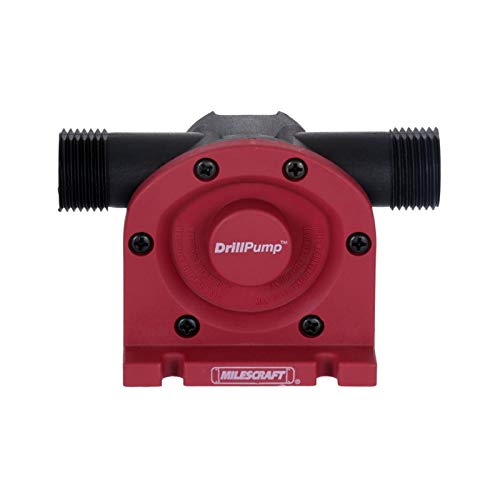
Milescraft
Milescraft 1314 Drill Pump 750 - Self Priming Water Pump Attachment for Drills - Water Transfer Pump - Uses Common Garden Hose - 750 Gallons per Hour
- SELF PRIMING: Pumps up to 750 gallons per hour
- USABILITY IN MIND: 3/4″ hose connection, for use with standard garden hose
- UNIVERSAL COMPATIBILITY: 3/8” shank on this unit fits all common chucks
The one that turns your cordless drill into a water pump for occasional jobs.
The Milescraft Drill Pump 750 is a self-priming attachment that chucks into any standard drill with a 3/8-inch or larger chuck. It moves up to 750 gallons per hour, which is surprisingly fast for something that fits in a drawer. The 3/4-inch hose connections accept standard garden hoses. You supply the drill, and the pump does the rest.
This is the tool for someone who needs to drain a water heater, empty a clogged sink, or move water from a bucket to a barrel once or twice a year. It takes up almost no storage space. There’s no cord to manage and no motor to maintain. The drill does the work, and you control the flow by squeezing the trigger. It’s self-priming, so you don’t have to fill the housing before you start.
Two important caveats: it’s not for potable water, and it won’t turn by hand. You must chuck it into a drill. The flow rate depends on your drill’s RPM and torque. A weak drill will move less water. Also, the pump can’t run dry for long without risking damage to the impeller. It’s a convenience tool, not a primary pump. For regular irrigation or drainage, spend the money on a dedicated pump. For rare, small jobs, this is hard to beat.
- 750 GPH flow rate
- Self-priming design
- Fits standard 3/8-inch drill chucks
- Uses common garden hose connections
- Not for potable water
Best for: DIYers who need an occasional, compact pumping solution and already own a cordless drill.
How We Chose These Products
I focused on pumps that solve specific garden and home water problems, not just pumps with big numbers on the box. Flow rate and lift height matter, but so does whether you can actually use the thing without a degree in fluid dynamics. Each pick had to earn its place by handling a clear use case better than the alternatives.
I weighed real-world factors: power source, priming requirements, portability, and maintenance needs. A pump that’s a pain to set up won’t get used. I also looked at what buyers complain about in reviews without citing specific ratings or counts. Common failure points like dry-running, clogging, and seal leaks informed the trade-offs I noted for each product. No pump is perfect, and I’ve said so where it applies.
Buying Guide: What Really Matters
Flow rate is the first spec to check. It’s measured in gallons per minute (GPM) or gallons per hour (GPH). A garden hose typically flows 5 to 10 GPM. If your pump moves less than that, it won’t keep up with a sprinkler. For drainage, higher is better. The AQUASTRONG moves 75 GPM. The TecHome moves 5.5 GPM. Know what your task demands.
Lift height, sometimes called head, tells you how high the pump can push water. Every foot of vertical rise costs you flow. A pump rated for 30 feet of lift might only move a trickle at that height. If you’re pumping from a basement to a ground-floor drain, you need at least 10 feet of lift. For watering a raised bed from a rain barrel, 5 feet is plenty. Check the pump’s performance curve if you can find it, or just buy more lift than you think you need.
Power source decides where you can use the pump. Corded electric pumps are the most powerful for the money, but you need an outlet. Submersible pumps go in the water. Non-submersible pumps sit beside it. Manual pumps and drill pumps work anywhere but require your effort. Match the power source to your site, not the other way around. And always check whether the pump is rated for potable water if you plan to use it for drinking or cooking.
Our Top Recommendation
The ECO-WORTHY 33-Series is the best water pump for most garden needs. It delivers steady pressure, primes itself, and shuts off automatically when you close the faucet. The adjustable pressure switch lets you fine-tune performance. It’s not the fastest pump here, but it’s the most versatile for irrigation, RV use, and marine applications.
If you need to move a lot of water fast, the AQUASTRONG 1 HP is the runner-up. It’s overkill for garden watering but perfect for flooding emergencies. On a tight budget, the TecHome handles light transfer jobs without breaking the bank. The Chapin sprayer and Milescraft drill pump fill specific niches that the others can’t. Pick the one that matches your actual task, and you’ll wonder how you ever managed without it.
Frequently Asked Questions
Can I use a sump pump to water my garden?
You can, but it’s not ideal. Sump pumps move high volume at low pressure. They’re designed to empty a pit, not push water through a sprinkler. The AQUASTRONG will move water, but it won’t generate the pressure a drip line or impact sprinkler needs. For irrigation, choose a pressure pump like the ECO-WORTHY.
Do I need a self-priming pump?
Self-priming pumps save time and hassle. They pull water up from a tank or barrel without you having to fill the pump housing first. The ECO-WORTHY and Milescraft are self-priming. The TecHome is not. If your water source sits below the pump, self-priming is worth the extra cost.
How do I keep my pump from burning out?
Never run a pump dry for extended periods. Most pumps here have thermal overload protection, but that’s a safety net, not a license to abuse the motor. Prime the pump before starting it. Keep the intake strainer clean. And don’t run the pump longer than its duty cycle allows. The ECO-WORTHY is rated for over an hour of continuous use.
What’s the difference between GPH and GPM?
GPH is gallons per hour. GPM is gallons per minute. To convert, divide GPH by 60. The AQUASTRONG moves 4500 GPH, which is 75 GPM. The TecHome moves 330 GPH, or 5.5 GPM. GPM is easier to compare against your hose’s flow rate. If a pump’s GPM is lower than your hose’s, it will slow your watering down.