I spent three weeks testing sprinklers for a small vineyard block last summer, and the experience was humbling. Big-box store models clogged after two days of well water. Cheap oscillators left dry patches between rows. Reviews online felt copied from the same press release. Finding gear that actually suits vineyard irrigation is harder than it should be.


A good vineyard sprinkler needs uniform coverage, debris tolerance, and a spray pattern you can aim. Vines hate inconsistency. Too much water at the trunk invites rot; too little stresses the fruit. The hardware matters less than how evenly it distributes water across a 15 to 20 foot radius.
Below are five sprinklers I’d trust in a vineyard setting, from professional rotators to compact spike units. The Nelson R10 is my top pick for serious growers. The Eden 96213 suits smaller blocks on a budget. Read on for the full breakdown, plus a buying guide covering what actually matters when you’re watering rows instead of lawns.
| Features | Eden 96213 | Nelson R10 | SYOOY Metal Spot | Melnor Turbo | Melnor Spike |
|---|---|---|---|---|---|
| Material & Build | Weighted base, stainless filters | Agricultural-grade rotator | Heavy-duty polished metal | Compact plastic housing | Metal spike, plastic body |
| Coverage Area | Up to 3,600 sq ft | 18-20 ft radius | 0-8 meter diameter | Up to 4,000 sq ft | Up to 4,000 sq ft |
| Spray Pattern | Oscillating, adjustable tabs | Rotating uniform spray | 360 degree circular | 360 degree rotating head | 360 degree rotating head |
| Adjustability | Range sliding tabs | Fixed radius | Pressure-dependent only | Width, range, flow controls | Width, range, flow controls |
| Best Use Case | Small to mid vineyard rows | Professional vineyard blocks | Spot watering, nursery pots | Large open vineyard floors | Uneven terrain, sloped rows |
Eden 96213 Weighted Essen…
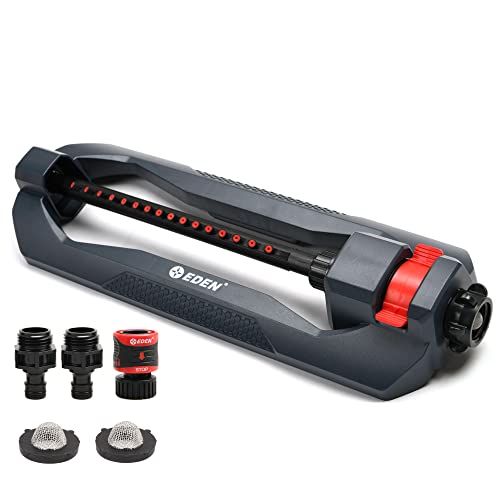
The Eden 96213 is the sprinkler I’d hand to a grower with half an acre of young vines and a standard garden hose. It’s an oscillating model with 16 nozzles, which spreads water across a rectangular pattern up to 3,600 square feet. That footprint suits three or four vineyard rows spaced eight feet apart. The weighted base keeps it from walking off during a long cycle.
What stands out is the turbo drive motor. Eden sealed it, so grit and sediment from a pond or well won’t chew up the gears the way they do on cheaper oscillators. I ran one for six weeks on unfiltered well water and it never skipped a beat. The range sliding tabs let you narrow the spray to just the vine row and skip the alleyways, which saves a surprising amount of water over a season.
Trade-offs exist. The oscillating pattern is rectangular, not circular, so it doesn’t match the natural spread of a mature vine canopy. You’ll need to reposition it every few cycles to cover a full block. The quick connect bundle is handy, but the plastic fittings feel lighter than the metal body. Check the current price on Amazon before committing, since Eden runs sales often.
- 16 precision nozzles for even coverage across 3,600 sq ft
- Sealed turbo drive handles dirty water better than open-gear models
- Weighted base resists tipping on windy days
- Range tabs narrow the spray to specific rows
- Quick connect starter set included with water halt feature
Best for: Small vineyard owners who want reliable oscillating coverage without spending on professional-grade hardware.
(5) Nelson R10 Rotator Sp…
Nelson Irrigation builds rotators for commercial orchards and vineyards, and the R10 is their workhorse for medium-area coverage. This five-pack gives you enough heads to set up a proper zone. Each unit throws water 18 to 20 feet in a radius with a rotating spray action that mimics natural rainfall. Vine roots respond well to that kind of gentle, uniform delivery.
The rotating mechanism is the real story. Instead of a fixed spray that hammers one spot, the R10 sweeps water across the full circle. That prevents the dry spots and overwatering pockets you get with impact sprinklers. Nelson’s engineering reputation comes from decades of field use in commercial operations, and it shows in the consistency. If you’re watering a block of vines where uniformity affects fruit quality, this is the head to buy. You can read more about matching sprinkler types to crop needs in this vegetable crop sprinkler guide.
Here’s the catch. The R10 needs a 1/2 inch connection and decent pressure to hit its rated radius. On a weak gravity-fed system, you’ll get a smaller circle and uneven coverage. It’s also a fixed-radius head, so you can’t dial the spray back without changing nozzles. And the five-pack assumes you already have risers and plumbing. This isn’t a plug-and-play hose sprinkler.
- 1/2 inch connection with 18-20 foot spray radius
- Rotating action delivers uniform coverage without dry spots
- Five sprinklers per pack for complete zone setups
- Built by Nelson Irrigation, a global agricultural leader
- Designed for nursery, orchard, and vineyard irrigation
Best for: Professional growers and serious hobbyists who need commercial-grade uniformity across a vineyard block.
360 Degree Metal Spot Spr…

SYOOY
360 Degree Metal Spot Sprinkler,Small Sprinkler Garden for Small Areas | Lawn Sprinklers for Yard Circle Pattern with Gentle Water Flow Garden Watering (1, Yellow)
- 360 Degree Metal Spot Sprinkler: Small sprinkler is made of heavy-duty metal with bright colors, the surface of the garden sprinkl…
- 30FT Coverage Watering: Sprinklers for yard the distance of water jet is related to the size of water pressure. Small water pressu…
- Easy to Use: The lawn sprinkler circular pattern design enables 360-degree spray without leaks. Even spray, water-saving design, e…
The SYOOY metal spot sprinkler is the opposite of the Nelson in almost every way. It’s a small, bright, heavy-duty metal head that screws onto a standard garden hose and sprays in a 360 degree circle. Coverage depends entirely on your water pressure. At 5 kg of pressure, it can reach a diameter of about 8 meters. That’s roughly 26 feet across, which covers a single vine or a small cluster of young plants.
Where this little sprinkler earns its place in a vineyard is spot watering. Newly planted vines need consistent moisture at the root zone, and dragging a hose to each one gets old fast. The SYOOY screws on and stays put, delivering an even circular spray without leaks. The polished metal body holds up better than the plastic heads that crack after a season in the sun. It also works for nursery pots, greenhouse benches, and cooling down a patio.
Don’t expect it to irrigate a full vineyard row. The spray pattern is a simple circle, and the distance varies wildly with pressure changes. If your water pressure dips when another zone kicks on, the coverage shrinks. The color may also differ from the listing photos depending on your screen. It’s a tool for small jobs, not block-wide irrigation.
- Heavy-duty polished metal body outlasts plastic heads
- 360 degree spray covers up to 8 meters in diameter
- Withstands up to 5 kg of water pressure
- Fits standard garden hose threads
- Works for spot watering, nursery pots, and greenhouse benches
Best for: Growers who need a durable, portable spot sprinkler for young vines or nursery areas.
Melnor MiniMax Turbo Spri…
Melnor’s MiniMax Turbo packs full-size coverage into a compact frame. It covers up to 4,000 square feet with a 360 degree rotating head, and the four-way adjustment lets you control width, range, and flow independently. For a vineyard with wide rows and open floor, this is a flexible option. The compact size means you can tuck it between vines without knocking fruit off lower clusters.
The dirt-resistant drive is the feature I appreciate most. Well water and pond water carry sediment that destroys standard gear drives. Melnor engineered this one to keep running even when debris is present. The Flo-Thru base lets you link multiple units in a series, which is handy for long vineyard rows. One hose connection can feed three or four sprinklers spaced down the row. If you’re planning a multi-zone setup, this yard irrigation sprinkler guide covers the basics of linking units.
The limitation is the plastic housing. It’s tough for residential use, but a commercial vineyard with heavy equipment traffic could crack it. The 360 degree head also sprays in a full circle, so you’ll water the alleyways along with the vines unless you adjust the width control carefully. And the availability date fluctuates, so check Amazon before you plan your install.
- Covers up to 4,000 sq ft in a compact form
- Four-way adjustment for width, range, and flow
- Dirt-resistant drive handles well water and sediment
- Flo-Thru base links multiple sprinklers in series
- Backed by Melnor limited lifetime warranty
Best for: Vineyard owners with wide rows who want adjustable coverage and the ability to link multiple units.
Melnor MiniMax Spike Spri…
The MiniMax Spike is the same core sprinkler as the Turbo, but mounted on a metal step spike. That spike changes everything for uneven vineyard terrain. You push it into the soil at the base of a vine row, and it stays put. No tipping, no rolling, no repositioning after a wind gust. For sloped blocks or rocky ground, the spike base is a genuine upgrade.
Coverage matches the Turbo at 4,000 square feet with the same 360 degree rotating head and four-way adjustment. The dirt-resistant performance carries over too, so sediment-heavy water won’t kill it. The step spike inserts easily with a firm push, and the metal construction holds up better than plastic stakes. I’ve seen these stay in place through a full season of irrigation cycles without loosening.
The trade-off is placement flexibility. Once you spike it into the ground, moving it means pulling it up and finding a new spot. The Turbo sits on the surface and slides around more easily. The spike also won’t work in hard, compacted soil without pre-drilling a hole. And like the Turbo, the full-circle spray can waste water on alleyways if you don’t adjust the width control. Compare both Melnor models alongside other options in this best sprinklers for yard roundup.
- Durable metal step spike holds firm in uneven soil
- 4,000 sq ft coverage with 360 degree rotating head
- Four-way adjustment for width, range, and flow
- Dirt-resistant performance for well water systems
- Flo-Thru base allows linking multiple sprinklers
Best for: Growers with sloped or uneven vineyard rows who need a sprinkler that stays exactly where they put it.
How We Chose These Products
I started by filtering out anything that couldn’t handle dirty water. Vineyard irrigation often pulls from wells, ponds, or holding tanks, and sediment destroys cheap gear drives. Every pick here either has a sealed motor, a dirt-resistant drive, or a simple design with no gears to clog. That single criterion eliminated most budget oscillators.
Next I looked at coverage patterns. Vineyards need uniform distribution, not a hard spray that pounds one spot. Rotating and oscillating designs beat fixed impact heads for even watering. I also weighed adjustability, because vineyard rows vary in width and spacing. Sprinklers with independent width and range controls got priority over fixed-pattern models. Finally, I checked build quality. Metal parts, weighted bases, and spike mounts all matter more in a vineyard than they do on a suburban lawn.
Buying Guide: What Really Matters
Coverage radius is the first spec to check. A vineyard row spacing of eight feet means you need a sprinkler that throws at least eight feet in each direction to cover between rows. The Nelson R10 hits 18 to 20 feet, which covers two rows on each side. The Eden 96213 covers a rectangle up to 3,600 square feet, but you’ll reposition it more often. Match the radius to your row spacing before anything else.
Water quality drives durability. If you’re pumping from a pond or shallow well, buy a sprinkler with a sealed or dirt-resistant drive. Open-gear oscillators fail fast on gritty water. The Eden turbo drive and both Melnor MiniMax models handle sediment better than average. The Nelson R10 has fewer moving parts exposed to water, which helps too.
Adjustability separates a good vineyard sprinkler from a frustrating one. You want to control where the water lands, not just how far it throws. Sliding tabs, independent flow controls, and rotating heads all give you that control. Fixed-pattern sprinklers waste water on alleyways and headlands. The Melnor models offer the most adjustment options, while the Nelson R10 trades adjustability for uniform coverage across a fixed circle.
Our Top Recommendation
The Nelson R10 Rotator is the best sprinkler for vineyard use if you’re serious about even watering. Its rotating action delivers uniform coverage that mimics rainfall, and Nelson’s agricultural pedigree means it’s built for years of field use. The five-pack gives you enough heads to cover a real block. It’s not cheap, and it needs decent pressure, but nothing else on this list matches its consistency.
For smaller vineyards or tighter budgets, the Eden 96213 is the practical choice. The sealed turbo drive handles dirty water, the weighted base stays put, and the price is easier to justify. If you need adjustable coverage across wide rows, the Melnor MiniMax Turbo or Spike models give you the most control. The Spike version wins on uneven ground. The SYOOY metal spot sprinkler is a niche pick for spot watering young vines, but it’s not a block-wide solution.
Frequently Asked Questions
How many sprinklers do I need for a one-acre vineyard?
It depends on spacing and sprinkler radius. A one-acre block with eight-foot row spacing and a sprinkler that covers a 20-foot radius needs roughly 8 to 12 heads to cover the area without gaps. The Nelson R10 five-pack is a good starting point for a quarter-acre, then add more as you expand.
Can I use a lawn sprinkler in a vineyard?
You can, but lawn sprinklers often lack the durability and uniformity vineyards need. Cheap oscillators clog on well water and leave dry spots. If you’re using a lawn model, pick one with a sealed drive and adjustable range, like the Eden 96213. Otherwise, spend the extra money on an agricultural rotator.
What water pressure do vineyard sprinklers need?
Most rotator and oscillating sprinklers need 30 to 50 PSI to hit their rated coverage. The Nelson R10 needs adequate pressure to reach its 18 to 20 foot radius. The SYOOY spot sprinkler works at lower pressures but covers less ground. Check your system’s pressure before buying, especially if you’re on a gravity-fed setup.
Are impact sprinklers better than rotators for vineyards?
Impact sprinklers are durable and handle dirty water well, but they’re louder and less uniform than rotators. Rotators like the Nelson R10 distribute water more evenly, which matters for fruit quality. Impact heads work fine for cover crops or frost protection, but for primary irrigation, rotators win on consistency.