
You’ve got a patch of lawn you want to turn into a vegetable garden. Or maybe the family plot hasn’t been touched in three seasons, and the soil feels like concrete. A front tine tiller will bounce across that crust and leave you exhausted. A rear tine tiller digs in, pulls itself forward, and leaves a seedbed you can actually plant in.


A great walk-behind rear tine tiller needs three things: enough engine torque to churn virgin sod, a transmission that won’t slip under load, and tines that can spin both directions. Counter-rotating tines break new ground. Standard rotation maintains existing beds. The best models give you both, plus instant reverse for tight turns near fences and raised beds.
We looked at five rear tine tillers built for serious gardeners. The Earthquake Victory 39381 leads the pack for raw breaking power. The Novus 18-Inch and Poulan Pro offer dual-direction versatility with gear-driven reliability. The Earthquake Pioneer 46059 wins on weight and maneuverability. And the SuperHandy is a budget-friendly workhorse for smaller plots. Here’s how they compare.
Compare the key specs side by side before you decide.
| Features | Earthquake Victory | Novus 18-Inch | Poulan Pro Dual | Earthquake Pioneer | SuperHandy Tiller |
|---|---|---|---|---|---|
| Engine Size | 209cc Viper | 212cc 4-cycle | 212cc 4-cycle | 127cc Briggs | 209cc OHV |
| Transmission | Cast-iron bronze gear | Full gear | Full gear-driven | Patented efficient transmission | Centrifugal friction clutch |
| Tilling Width | 16 inches | 18 inches | 18 inches | 17 inches | Adjustable |
| Tilling Depth | Up to 10 inches | Up to 10 inches | Up to 10 inches | Up to 11 inches | Adjustable |
| Tire Type | Pneumatic | Airless | Airless | Airless rubber | Not specified |
EARTHQUAKE Victory Rear T…
This is the tiller for the gardener who’s tired of fighting clay. The Earthquake Victory 39381 pairs a 209cc Viper engine with counter-rotating tines that spin opposite the wheels. That action lifts and fractures compacted soil instead of riding over it. If you’re breaking new ground or dealing with heavy clay, this machine does the work.
The cast-iron transmission with bronze gears is the standout feature. Most tillers in this class use aluminum or belt drives. Bronze gears handle shock loads better when tines hit rocks or roots. The instant reverse handle lets you back out of corners without shifting gears, which matters when you’re working near fences or raised beds. The 3-position handlebar adjusts for height, and you can operate it one-handed to keep your feet out of the seedbed.
It’s heavy. The bronze gear transmission and cast-iron housing add weight, which helps traction but makes transport harder. You won’t want to lift this into a truck bed alone. The 16-inch tilling width is narrower than the 18-inch competitors, so you’ll make more passes on large plots. And the pneumatic tires can go flat if you don’t maintain them. Check the current price on Amazon before you commit.
- 209cc Viper engine with cast-iron bronze gear transmission
- Counter-rotating tines for breaking tough soil
- Instant reverse handle for tight maneuvering
- 16-inch width, 10-inch depth, adjustable drag stake
- 3-position handlebar with one- or two-hand operation
Best for: The gardener breaking new ground or tilling heavy clay who wants a transmission that will outlast the engine.
NOVUS 18-Inch Dual Direct…
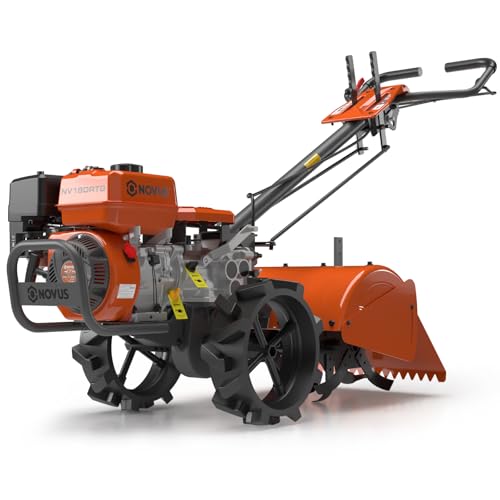
The Novus 18-Inch is for the gardener who wants one machine to do everything. You get a 212cc engine, full gear transmission, and the ability to switch between standard and counter-rotating tines. That means you can bust sod in the spring and switch to standard rotation for working compost into existing beds. The 18-inch width covers more ground per pass than the Earthquake Victory.
Sixteen steel tines and an 8-position depth adjustment give you fine control over how deep you go. The full gear transmission eliminates the belt that would eventually slip or need replacement on cheaper tillers. Two forward speeds and one reverse let you match the pace to the job. The airless tires never go flat, which is a genuine convenience if you’ve ever spent a morning fixing a punctured tire on a tiller.
Availability is scarce. This model sells out fast, so if you see it in stock, don’t wait. The airless tires ride stiffer than pneumatic ones, which can make the tiller feel bouncy on hard ground. And the 212cc engine is powerful, but it’s not a diesel. You’ll still need to make multiple passes in untouched clay. For most gardeners, though, this is the sweet spot of power and versatility.
- 212cc 4-cycle engine with full gear transmission
- Dual-direction tines: standard and counter-rotating
- 18-inch tilling width, up to 10-inch depth
- 8-position depth adjustment, 2 forward speeds plus reverse
- Airless tires, 1- or 2-hand operation
Best for: The gardener who wants a single tiller for both breaking new ground and maintaining existing beds, with the convenience of airless tires.
Poulan Pro Dual Direction…
Poulan Pro built this tiller for the homeowner who wants commercial-grade durability without the commercial price. The 212cc engine and full gear-driven transmission match the Novus on paper, but the Poulan Pro adds aggressive tread lugs on the airless tires. Those lugs bite into loose soil and pull the tiller forward with less wheel slip. If you’ve ever fought a tiller that just spins its tires, you’ll appreciate the difference.
The dual-grip handlebar lets you control the tiller from either side. That’s a small feature that makes a big difference when you’re working along a fence line or turning at the end of a row. You can pivot with one hand and keep your body out of the tilled path. The 16 steel tines cover an 18-inch width and go up to 10 inches deep. Two forward speeds and one reverse give you control for both tilling and transport.
The Poulan Pro is scarce right now, so availability fluctuates. The airless tires, while durable, don’t absorb vibration as well as pneumatic ones. On rocky ground, you’ll feel every bump through the handlebars. And the engine, while reliable, isn’t quite as refined as the Viper in the Earthquake Victory. It’s a workhorse, not a luxury machine. Check the current price on Amazon to see if it fits your budget.
- 212cc 4-cycle engine with full gear-driven transmission
- Dual-direction tines, 18-inch width, 10-inch depth
- Airless tires with aggressive tread lugs
- Dual-grip handlebar for one-hand pivoting
- 2 forward speeds plus 1 reverse
Best for: The practical gardener who wants gear-driven reliability and aggressive traction for both new ground and existing beds.
Earthquake® 46059 Pionee…
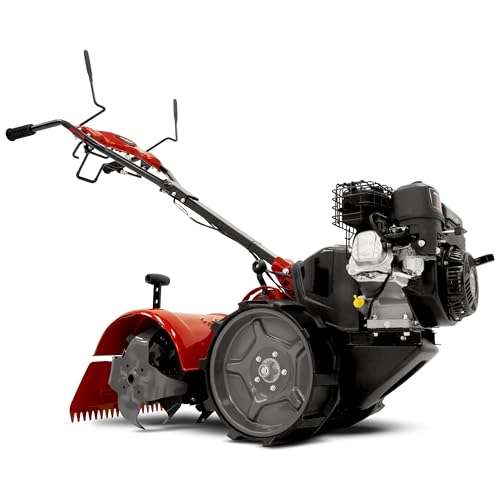
The Earthquake Pioneer 46059 is for the gardener who values maneuverability over raw displacement. At 143 pounds, it’s significantly lighter than the 200-pound tillers in this roundup. The lower, wider body and forward-facing engine keep the weight balanced, so it doesn’t feel top-heavy. If you’ve struggled with a tiller that wants to tip or fight you on turns, the Pioneer is a relief.
The 127cc Briggs & Stratton engine is smaller than the others, but the patented transmission makes the most of it. Earthquake claims the powertrain delivers the same sod-busting performance as larger tillers in a more user-friendly package. The dual-direction tines switch between counter-rotating for new ground and standard rotation for weeding and maintaining existing beds. Instant reverse works with a handle pull, no gear shifting. The airless rubber tires with steel rims never go flat and have extra-wide tread blocks for traction.
The smaller engine means you’ll work slower in heavy clay. This isn’t the tiller for breaking a half-acre of virgin sod in a weekend. It’s for the gardener with a manageable plot who wants a machine that’s easy to handle and store. The 17-inch tilling width and 11-inch depth are respectable for the class. If you have raised beds and a few rows, the Pioneer is easier on your body than the heavier alternatives.
- 127cc Briggs & Stratton engine with patented transmission
- 143 pounds, lower center of gravity for stability
- Dual-direction tines: CRT for new ground, SRT for maintenance
- 17-inch width, 11-inch depth, instant reverse
- Airless rubber tires with steel rims
Best for: The gardener with a smaller plot or raised beds who wants a light, maneuverable tiller that’s easy to turn and store.
SuperHandy Tiller Cultiva…

SuperHandy
SuperHandy Tiller Cultivator – 7HP 209cc Engine, Adjustable Tilling Width & Depth, Heavy-Duty Steel Tines for Garden Soil Prep, Landscaping & Weed Removal (Rear Tine Tiller)
- Powerful 7HP 209cc Gas Engine: High-performance OHV 4-stroke engine delivers strong torque and efficiency, making soil preparation…
- Customizable Tilling Depth & Width: Adjustable tilling width (varies by model) ensures coverage for both large plots and compact g…
- Heavy-Duty Steel Tines: Engineered for durability and performance, the hardened steel tines efficiently break through tough soil,…
The SuperHandy Tiller Cultivator is for the budget-conscious gardener who still wants a 209cc engine. It’s a rear tine tiller with a 7HP OHV 4-stroke engine and a centrifugal friction clutch for smooth engagement. The adjustable tilling width and depth let you customize the pass to your garden size. If you’re prepping a few beds or maintaining a large vegetable patch, this tiller covers the basics without the premium price of the Earthquake or Poulan Pro.
Heavy-duty steel tines handle tough soil, and the engine delivers strong torque for a machine in this price range. The centrifugal clutch is a nice touch. It engages smoothly and reduces the shock on the transmission when you start tilling. The tiller works for digging, cultivation, aeration, and weed removal. It’s not a one-trick pony. For a gardener who wants one machine for multiple soil tasks, the SuperHandy is a practical choice.
The trade-off is refinement. The SuperHandy doesn’t have the bronze gear transmission of the Earthquake Victory or the dual-direction tines of the Novus and Poulan Pro. It’s a straightforward rear tine tiller. The adjustable width and depth are less precise than the 8-position depth adjustment on the Novus. And availability is scarce. If you’re on a tight budget and need a tiller for basic soil prep, this one gets the job done. Just don’t expect the same longevity or resale value as the premium brands.
- 209cc OHV 4-stroke engine with centrifugal friction clutch
- Adjustable tilling width and depth
- Heavy-duty steel tines for tough soil
- Works for digging, cultivation, aeration, and weed removal
- Requires 87 octane gasoline and SAE 30 oil
Best for: The budget-conscious gardener who wants a powerful 209cc engine for basic soil prep and cultivation without paying for premium features.
How We Chose These Products
We started with the engine and transmission. A rear tine tiller lives or dies by its drivetrain. Belt-driven models slip under load and need constant tension adjustment. Every tiller on this list uses a gear-driven or direct-drive system. The Earthquake Victory stands out with its cast-iron bronze gear transmission, which is a step above the aluminum gears found in most consumer tillers.
We also weighed maneuverability against power. A 200-pound tiller with a 212cc engine will break any soil, but it’s a bear to turn and store. The Earthquake Pioneer sacrifices displacement for a lighter frame and a lower center of gravity. That trade-off matters for gardeners with raised beds or small plots. We looked for models with instant reverse, adjustable handlebars, and airless tires because those features reduce frustration in real-world use.
Finally, we considered availability and value. The Novus and Poulan Pro are scarce, which tells you they’re in demand. The SuperHandy offers a 209cc engine at a lower price point but lacks the dual-direction tines and premium transmission. There’s no single best tiller for everyone. The right choice depends on your soil, your plot size, and how much you’re willing to spend.
Buying Guide: What Really Matters
Engine size is the first spec most buyers check, but it’s not the whole story. A 209cc engine with a bad transmission will underperform a 127cc engine with a well-designed drivetrain. The Earthquake Pioneer proves this. Its 127cc Briggs engine uses a patented transmission to deliver sod-busting performance without the weight of a larger engine. Look for gear-driven transmissions over belt-driven ones. They cost more upfront but last longer and need less maintenance.
Tine direction is the second critical factor. Counter-rotating tines spin opposite the wheels, which lifts and fractures soil. That’s what you want for breaking new ground or tilling clay. Standard rotation tines spin with the wheels, which is better for maintaining existing beds and mixing in compost. Dual-direction tillers give you both options. If you’re only maintaining a garden you’ve already established, a standard rotation tiller is fine. If you’re starting from scratch, counter-rotating is worth the extra cost.
Don’t overlook tires and handlebars. Pneumatic tires absorb vibration and ride smoother, but they can go flat. Airless tires never go flat but ride stiffer. For rocky or uneven ground, pneumatic is more comfortable. For convenience, airless wins. Adjustable handlebars matter more than you’d think. A handlebar that’s too low will tire your back. One that’s too high reduces control. Look for at least three height positions. And if you have fences or raised beds, instant reverse is a feature you’ll use every time you till.
Our Top Recommendation
The Earthquake Victory 39381 is our top pick for most gardeners. The 209cc Viper engine and cast-iron bronze gear transmission are built to last. Counter-rotating tines break tough soil, and instant reverse makes maneuvering easy. It’s heavier than the Pioneer and narrower than the Novus, but the drivetrain quality sets it apart. If you’re serious about breaking new ground, this is the tiller to buy.
For a lighter, more maneuverable option, the Earthquake Pioneer 46059 is the runner-up. It’s ideal for raised beds and smaller plots. If you want dual-direction tines and an 18-inch width, the Novus 18-Inch is the best alternative, though it sells out quickly. The Poulan Pro is a close second to the Novus with better traction. And if budget is your main concern, the SuperHandy delivers a 209cc engine for basic soil prep at a lower price. For more options, see our guide to the best rear tine tiller for breaking new ground.
Frequently Asked Questions
Do I really need counter-rotating tines?
Only if you’re breaking new ground or dealing with heavy clay. For maintaining an existing garden, standard rotation tines work fine and leave a smoother seedbed. Dual-direction tillers give you both options, which is why they’re popular.
How often do I need to change the oil?
Check your owner’s manual, but most 4-cycle tiller engines need an oil change after the first 5 hours of use, then every 50 hours or once a season. The SuperHandy requires SAE 30 or 10W-30 API-certified oil.
Are airless tires better than pneumatic?
Airless tires never go flat, which is a real convenience. But they ride stiffer and don’t absorb vibration as well. If you till rocky ground, pneumatic tires are more comfortable. If you want zero maintenance, go airless.
Can I use a rear tine tiller on a slope?
Rear tine tillers are heavy and can be tricky on slopes. Work across the slope, not up and down, and use the drag stake to control the pace. If your slope is steep, consider a lighter model like the Earthquake Pioneer. For more heavy-duty options, see our review of the best heavy-duty rear tine tiller.


