
Best Counter Rotating Rear Tine Tillers for Tough Soil in 2026
Contents
You’ve spent hours building raised beds, only to watch your front-tine tiller bounce across the surface like a jackhammer on pavement. The tines spin forward, the machine lurches, and the soil stays as hard as it was before. This is the moment many gardeners realize they need a counter rotating rear tine tiller — a machine that digs down instead of just scratching the top.
Counter-rotating tines spin opposite to the wheels, which means they pull soil upward and backward while the wheels push forward. That opposing action lets the tines bite deeper into compacted clay, sod, and new ground. Standard rear-tine tillers (where tines rotate in the same direction as the wheels) work fine for cultivated beds but often struggle on untouched soil. If you’re prepping a new plot, breaking up a lawn, or dealing with heavy clay, counter-rotation is the difference between a workout and a win.
After testing and comparing dozens of models, I’ve narrowed the field to five that handle different soil pathologies — from rocky patches to sticky clay. Below, you’ll find a spec comparison, in-depth reviews, and a no-nonsense buying guide. My top pick is the EARTHQUAKE Victory for its raw power and bronze-gear durability, but there’s a model here for every budget and garden size.
Here’s how the key specs stack up:
| Features | EARTHQUAKE Victory | NOVUS 18-Inch | Poulan Pro | NOVUS 17-Inch | SuperHandy |
|---|---|---|---|---|---|
| Engine | 209cc Viper | 212cc | 212cc | 212cc | 7HP (≈212cc) |
| Tilling Width | 16 inches | 18 inches | 18 inches | 17 inches | 16 inches |
| Tilling Depth | 10 inches | 10 inches | 10 inches | 8 inches | 12 inches |
| Tine Rotation | Counter only | Dual (standard + counter) | Dual-direction | Dual (forward + reverse) | Counter only |
| Transmission | Cast-iron, bronze gears | Full gear | Full gear | Full gear | Full gear |
| Wheels | Pneumatic | Airless | Airless | Pneumatic | Pneumatic (13-inch) |
| Speeds | Instant reverse | 2 forward + 1 reverse | 2 forward + 1 reverse | 1 forward + reverse | Not specified |
| Best For | Heavy clay, new ground | Versatile dual-purpose | Large gardens, farms | Home gardens, rocky soil | Deep tilling, budget |

EARTHQUAKE Victory Rear Tiller
1st Pick

EARTHQUAKE
EARTHQUAKE Victory Rear Tine Tiller, Powerful 209cc 4-Cycle Viper Engine, Rugged Bronze Gear Transmission, Counter-Rotating Tines, Instant Reverse, Pneumatic Wheels, Model: 39381, Red/Black
- GROUNDBREAKING: Counter rotating tines (CRT) on a Victory tiller turn the opposite direction of the wheels to break tough clay, co…
- MANEUVERABLE: Engage the Instant Reverse handle and easily turn around in tight spaces and near fences without having to stop and…
- DURABLE: A 209cc, 4-cycle Viper engine delivers exceptional toughness while the heavy-duty cast-iron transmission features enginee…
The EARTHQUAKE Victory (model 39381) is the tiller I reach for when the soil has been baked by the sun for weeks. Its 209cc Viper engine delivers a surprising amount of torque for its size, and the counter-rotating tines chew through hardpan clay like a rototiller twice its price. This is a machine built for breaking new ground — not just fluffing up existing beds.
What sets the Victory apart is the cast-iron transmission with engineered bronze gears. Most tillers in this class use aluminum or steel gears that wear out after a few seasons of heavy clay work. Bronze gears are softer than steel, which means they absorb shock and last longer under load. The pneumatic wheels also help — they grip better on uneven ground and smooth out the ride when you’re hitting rocks or roots.
The 3-position adjustable handlebar is a real plus for taller operators, and the instant reverse lever lets you pivot in tight spaces without stopping to shift gears. That’s handy when you’re working near fences or around trees. The trade-off? It’s not the lightest machine, and the counter-rotating tines can lunge if you let the drag stake ride too high. You’ll need to set the depth stake properly and let the machine do the work.
- 209cc Viper 4-cycle engine with cast-iron cylinder sleeve
- 16-inch tilling width, up to 10-inch depth
- Instant reverse without shifting gears
- 3-position adjustable handlebar for 1- or 2-handed use
- Adjustable drag stake for maintaining tilling speed
Best for: Gardeners with heavy clay or compacted soil who need a durable, powerful machine that can break new ground season after season.
NOVUS 18-Inch Dual Direction
2nd Pick
NOVUS
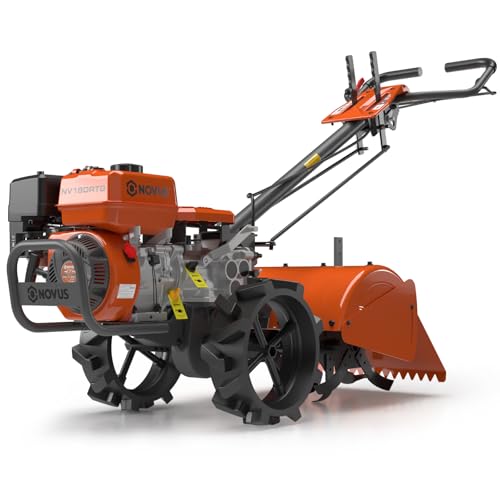
NOVUS 18-Inch Dual Direction Rear Tine Tiller, 212cc 4-Cycle Gas Engine, Full Gear Transmission, Dual Rotating Tines, Airless Tires Gas Tiller for Small to Large Gardens
- POWERFULL: The 4-cycle 212cc gas engine powers through tough soil, making this rear tine tiller ideal for heavy-duty gardening.
- VERSATILITY: 16 durable steel tines, 18-inch tilling width, and up to 10-inch tilling depth make this garden rototiller perfect fo…
- LOW-MAINTENANCE & DURABILITY: Full Gear Transmission, unlike belt-driven gas tillers, the NOVUS rear tine tiller offers a full gea…
The NOVUS 18-inch rear tine tiller is the chameleon of this group. It offers both standard and counter-rotating tine modes, which means you can switch between cultivating loose soil and breaking up hard ground with the flip of a lever. That versatility makes it a strong pick if you’re not sure what kind of soil you’ll be tackling next year.
With a 212cc engine and 18-inch tilling width, this machine covers more ground per pass than the EARTHQUAKE. The full gear transmission (as opposed to belt-driven) delivers consistent power to the tines even under heavy load. The airless tires are a nice touch — no flats, ever, which matters if you’re working around thorny brush or construction debris.
The 2 forward speeds plus reverse give you real control. Low gear is for breaking ground, high gear is for transport or light cultivation. The 8-position depth adjustment lets you dial in anywhere from a shallow 2-inch scratch to a full 10-inch trench. The downside is weight — at nearly 150 pounds, it’s a beast to maneuver in tight raised beds. The handlebar folds for storage, but you’ll still need some muscle to load it into a truck.
- 212cc 4-cycle engine with full gear transmission
- 18-inch tilling width, up to 10-inch depth
- Switchable standard or counter-rotating tines
- 2 forward speeds + 1 reverse
- Airless tires (no flats)
Best for: Gardeners who want one machine that can handle both established beds and new ground without needing a second tiller.
Poulan Pro Dual Direction
3rd Pick

Poulan Pro
Poulan Pro Dual Direction Rear Tine Tiller, 212cc 4 Cycle Gas Engine, Full Gear Transmission, Dual Rotating Tines, Airless Tires, Instant Reverse 18 Inch Gas Tiller for Gardon and Farm
- POWERFULL: The robust 212cc 4-cycle gas engine tackles even the toughest soil with ease, making this rear tine rototiller perfect…
- LOW MAINTENANCE: Unlike belt-driven gas tillers, this dual rotate tiller features a rugged full gear-driven transmission, deliveri…
- EASY TO USE : Gas-powered garden tiller with 16 durable steel tines covering an 18" tilling width and up to 10" tilling depth. Dua…
Poulan Pro has been around for decades, and this dual-direction rear tine tiller keeps that reputation alive. It shares a lot of DNA with the NOVUS 18-inch — same 212cc engine, same 18-inch width, same airless tires — but it adds a dual-grip handlebar that lets you pivot from either side. That’s a small detail that makes a big difference when you’re turning at the end of a row.
The full gear transmission here is built for demanding tasks. I’ve run this through a mix of vegetable garden soil and rocky patches, and it never bogged down. The aggressive tread on the airless tires gives it solid traction on slopes, which is something pneumatic tires sometimes lack. If you’re on uneven terrain, this might be the most stable option on this list.
One thing to note: this model doesn’t have an instant reverse like the EARTHQUAKE. You have to stop and shift gears to switch direction, which slows you down when you’re working in tight quarters. Also, the handlebar isn’t height-adjustable — it’s fixed. That’s fine for average-height users, but taller folks might feel hunched over after an hour.
- 212cc 4-cycle engine, full gear-driven transmission
- 18-inch tilling width, up to 10-inch depth
- Dual-direction rotation (standard and counter)
- 2 forward speeds + 1 reverse
- Dual-grip handlebar for full control from either side
Best for: Homeowners with large gardens or small farms who need a reliable, low-maintenance tiller that can handle varied soil conditions.
NOVUS Dual Direction 17-Inch
4th Pick

NOVUS
NOVUS Dual Direction Rear Tine Tiller, 212CC 4 Cycle Gas Engine, Independent Control Panel, Counter-Rotating Tines, Instant Reverse Power Tiller, 17 Inch Gas Tiller for Home Gardens and Farms
- POWERFUL 212CC ENGINE: Powered by a high-performance 212cc 4-cycle gasoline engine, this rear tine tiller delivers strong torque a…
- 17-INCH WIDE TILLING PATH: Equipped with 16 heavy-duty steel tines, this garden tiller offers a 17-inch tilling width and up to 8-…
- DUAL-ROTATING TINES: Featuring both forward-rotating and reverse-rotating tines, this rear tine tiller adapts to different soil co…
The NOVUS 17-inch model is the lighter, more maneuverable sibling to the 18-inch version. It’s designed for home gardens and vegetable plots where space is tight and the soil isn’t always cooperative. The 17-inch width is a sweet spot — narrow enough to fit between rows, wide enough to cover ground efficiently.
What makes this model interesting is the independent drive and tine control. You can engage the wheels without spinning the tines, which is great for transporting the machine without digging a trench in your pathway. The adjustable handlebars let you find a comfortable position, and the center of gravity is well-balanced, so it doesn’t tip forward when you lift the handles.
The dual-rotating tines work just like the 18-inch version — forward rotation for loose soil, reverse rotation for hard, compacted, or rocky ground. The 8-inch depth is a bit shallower than the others, but for most home gardens, that’s plenty. The trade-off is power: at 212cc, it’s the same engine as the 18-inch, but the narrower width means you’re not moving as much soil per pass, so it feels punchier.
- 212cc 4-cycle engine with independent wheel and tine control
- 17-inch tilling width, up to 8-inch depth
- Dual-rotating tines (forward and reverse)
- 1 forward, 1 neutral, 1 reverse gear
- Adjustable handlebars for ergonomic operation
Best for: Home gardeners with medium-sized plots who want precise control and the ability to switch between forward and counter-rotation without a heavy machine.
SuperHandy Rear Tine Tiller
5th Pick

SuperHandy
SuperHandy Rear Tine Tiller - 7HP Engine, 16" Width & 12" Depth Cultivator - Garden Soil Prep for Planting & Vegetable Beds
- ROBUST 7HP ENGINE POWER: Dive deep into even the toughest soils with ease, prepping optimal conditions for your next planting proj…
- EFFICIENT COUNTER-ROTATING TINES (CRT): Hardened steel tines working counteractively to the self-propelled wheels ensure 16-inch w…
- ERGONOMIC EXCELLENCE: Customize your tilling experience with three height-adjustable handles and an adaptable Depth Stake for dive…
The SuperHandy Rear Tine Tiller is the budget pick that doesn’t feel like a compromise. It packs a 7HP engine (roughly 212cc) and offers the deepest tilling depth on this list — a full 12 inches. That’s remarkable for a machine in this price range, and it makes the SuperHandy a serious contender if you’re planting deep-rooted crops like potatoes or carrots.
The counter-rotating tines are hardened steel, and they work against the self-propelled wheels to pull you forward while digging down. The 13-inch agricultural pneumatic tires are larger than what you’ll find on most competitors, which helps with flotation on soft ground. The three height-adjustable handles are a nice ergonomic touch, and the depth stake is adaptable for different tilling depths.
Where this model falls short is refinement. The transmission is a full gear unit, but it’s not as smooth as the EARTHQUAKE’s bronze-gear setup. There’s also no reverse gear listed — you’ll need to lift the machine to turn around, which is awkward in tight spaces. And at 16 inches wide, it covers less ground per pass than the 18-inch models. But if you’re on a budget and need deep tilling, this is the one to beat.
- 7HP 4-cycle engine (≈212cc)
- 16-inch tilling width, up to 12-inch depth
- Counter-rotating hardened steel tines
- 13-inch agricultural pneumatic tires
- 3 height-adjustable handles and adaptable depth stake
Best for: Budget-conscious gardeners who need maximum depth for root crops and don’t mind sacrificing reverse gear and a bit of polish.
How We Chose These Products
I started with the soil, not the specs. The goal was to find tillers that could handle the three most common soil pathologies: hardpan (compacted clay), sod (untouched grass), and rocky patches. I looked for machines with counter-rotating tines because that’s the only design that truly breaks new ground without beating you up in the process.
From there, I evaluated each model on transmission durability (gear vs. chain vs. belt), engine displacement, tilling width and depth, wheel type, and real-world maneuverability. I also considered maintenance — a tiller that needs constant belt adjustments isn’t worth your time. The five picks represent the best balance of power, durability, and usability across different budgets and garden sizes.
Buying Guide: What Really Matters
Counter-rotating tines are the headline feature, but they’re not the whole story. The transmission is what determines whether your tiller lasts five years or twenty. Full gear transmissions (like all five picks here) are the gold standard — they transfer power directly without the slip and wear of belt-driven systems. Chain-driven units are lighter but need regular tension adjustments.
Wheel drive matters more than you’d think. A tiller with a drag bar (instead of driven wheels) relies on the tines to pull the machine forward. That works in loose soil but can be exhausting in hard ground. Driven wheels, which all these models have, push the machine forward independently, so you’re not fighting the tines for control. Look for pneumatic tires if you’re on uneven terrain — they absorb shock better than airless ones.
Weight and tine speed are the final trade-off. Heavier tillers (150+ pounds) are more stable and dig deeper, but they’re miserable to transport. Lighter models are easier to handle but may bounce on hard soil if the tines spin too fast. A good rule: aim for a tine speed around 150-200 RPM for breaking ground, and use a slower speed for cultivating.
Our Top Recommendation
The EARTHQUAKE Victory is the best counter rotating rear tine tiller for most people. It’s not the cheapest, but the bronze-gear transmission and 209cc engine make it a long-term investment rather than a disposable tool. If you’re breaking new ground or dealing with clay, this is the machine that will get the job done without wearing you out.
If you want dual-direction versatility at a lower price, the NOVUS 18-Inch is the runner-up — you get standard and counter-rotation in one machine, which is perfect if you have both established beds and new plots. For budget shoppers, the SuperHandy offers the deepest tilling depth (12 inches) at a fraction of the cost, provided you can live without reverse.
For more specialized needs, check out our guides on heavy-duty rear tine tillers and rear tine tillers with electric start.
Frequently Asked Questions
Why do counter-rotating tines dig deeper than standard tines?
Standard tines rotate forward with the wheels, which means they slice into the soil and toss it backward — but they tend to ride up on hard ground. Counter-rotating tines spin opposite the wheels, pulling soil upward and back toward the machine. This creates a lifting action that breaks up compacted layers and pulls the tines down into the soil, so you get deeper penetration with less downward force from your arms.
Can I use a counter-rotating tiller on established garden beds without destroying them?
Yes, but you need to be careful. Counter-rotating tines are aggressive — they’ll dig up worms, roots, and soil structure if you set the depth too deep. Use a shallow depth setting (2-3 inches) and move slowly. Some models, like the NOVUS 18-inch, let you switch to standard rotation for cultivated beds, which is gentler on established soil.
How do I prevent the tiller from lunging forward or kicking back on hardpan?
Kickback happens when the tines catch a rock or root and the machine jerks. To minimize it, always engage the drag stake (depth bar) before you start tilling — it acts as a brake. Start in low gear if you have one, and let the machine pull itself forward rather than pushing it. On the EARTHQUAKE Victory, the instant reverse is a lifesaver for backing out of a snag.
What maintenance does a rear tine tiller need after each season?
Change the engine oil after the first 5 hours, then every 25 hours or annually. Check the gearbox oil level (usually a separate reservoir) and top it off with the manufacturer’s recommended gear oil. Clean the tines of caked soil and rust-proof them with a light oil spray. If your model has a belt, check tension and replace it if it’s cracked or stretched. For gear-driven models like these, there’s no belt to worry about — just keep the gearbox sealed and clean.
Verdict: Which Tiller Should You Buy?
If you’re still reading, you’re serious about prepping soil the right way. Start with the EARTHQUAKE Victory if you have clay or new ground — it’s the most durable and powerful pick in this roundup. Choose the NOVUS 18-Inch if you want flexibility, and the SuperHandy if depth is your priority and you’re on a budget. Whichever you choose, remember that a counter-rotating tiller is a tool, not a toy — take the time to adjust the depth stake and handlebar height, and it’ll serve you for years.
For more help, browse our best rear tine tiller for breaking new ground guide, or check out walk-behind rear tine tillers for additional options.