
That slope at the side of your house has become a genuine problem. Push mowers slide sideways. Gas engines bog down halfway up. You have probably tried mowing it at an angle and felt the machine start to drift. It is not a fun afternoon.
A mower built for hills solves this with three things: enough drive to climb without stalling, wheels that grip instead of spin, and a weight balance you can control on a sideways lean. Self-propelled drive, wheel diameter, tread pattern, and engine torque matter more than deck width or brand name for this job. A hydrostatic transmission is the gold standard, but a well-geared rear-wheel-drive mower gets most homeowners up the same slope for a lot less money.
Below are five mowers that genuinely work on sloped ground, each matched to a different type of buyer. You will also find a slope-grade guide, a traction breakdown, a safety checklist, and maintenance tips so the mower keeps climbing season after season. If you want a wider comparison of slope-rated machines, see our best walk behind mowers overview.
Here is a quick spec comparison to help you scan the differences before reading the full reviews.
| Features | PowerSmart EasyCut | Shulemin Self-Propelled | Casince Cordless 17-Inch | SENIX 21-Inch Push | LawnMaster Electric Corded |
|---|---|---|---|---|---|
| Drive Type | Push, no drive | Rear-wheel self-propelled | Push, battery powered | Push, no drive | Push, corded electric |
| Power Source | 144cc gas 4-cycle | Gas, self-propelled | Dual 20V 4.0Ah batteries | 144cc gas 4-cycle | 11-amp corded electric |
| Cutting Width | 18 inches | Not specified | 17 inches | 21 inches | 14 to 15 inches |
| Wheel Setup | 7-inch front, 8-inch rear | Big wheels, wide stance | Standard walk-behind | 8-inch front, 11-inch rear | 7.75-inch rear |
| Best Use Case | Small flat-ish yards | Slopes and rough terrain | Small to medium lawns | Large yards, gentle slopes | Flat small yards only |
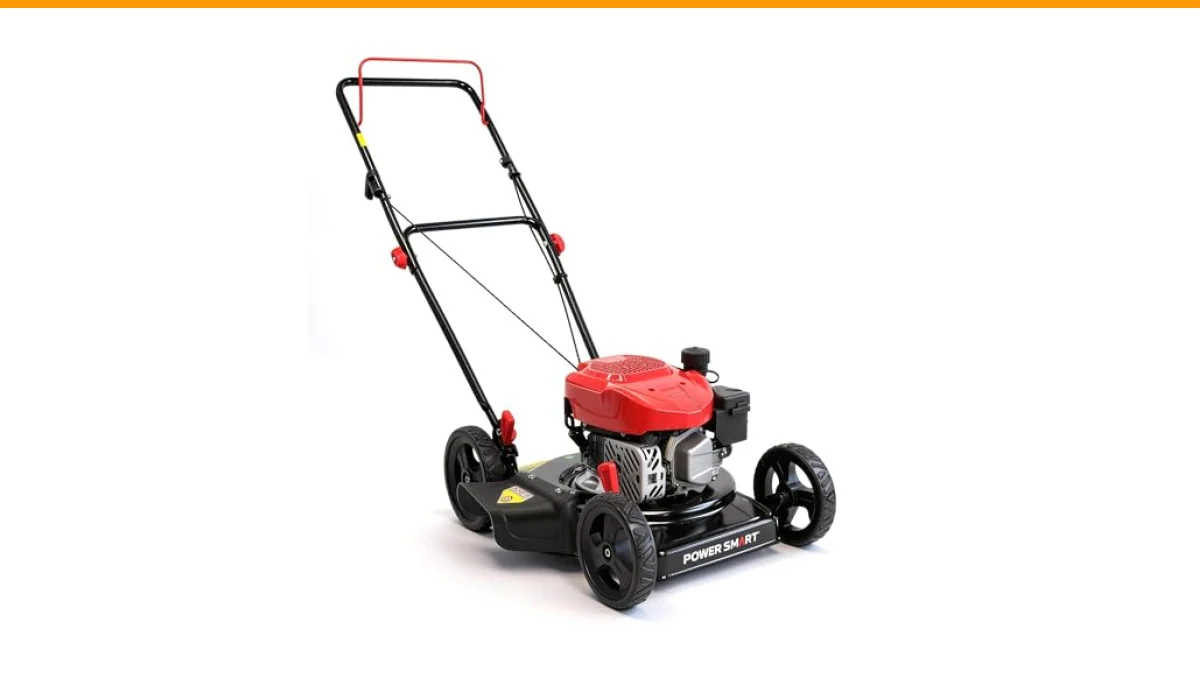
PowerSmart EasyCut 18-Inch

PowerSmart
PowerSmart EasyCut 18-Inch Gas Lawn Mower, 144cc 4-Cycle Engine, Walk-Behind Push Lawn Mower, Side Discharge, 5-Position Height Adjustment, Ideal for Small Yards
- Easy Start Engine: The144cc 4-stroke OHV engine delivers a reliable balance of high performance and ease. Equipped with auto choke…
- Side Discharge: Efficiently discharges grass clippings to keep you mowing through tall, thick grass with ease.
- 18-inch Steel Deck: The durable steel deck is built for long-lasting use, and the specialized blade delivers a clean, even cut for…
The PowerSmart EasyCut is for the homeowner with a small yard that has one or two gentle swells but nothing you would call a real hill. It starts easily, cuts clean, and does not ask much of you. Think of it as the reliable small-yard machine for someone who does not want to fight a pull cord every Saturday morning.
What stands out here is the auto choke and primer setup. Cold starts on a 144cc engine usually mean three or four pulls. This one fires up faster. The 18-inch steel deck is also a nice middle ground. It is wide enough to cover ground efficiently but narrow enough to squeeze between flower beds and fence lines without scraping. The 5-position height range from 1.5 to 3.9 inches covers everything from a summer buzz cut to a slightly taller fall trim.
Here is the honest part. This is a push mower with no drive system. On a real slope, you are the engine. The 7-inch front and 8-inch rear wheels roll fine on flat ground, but they will not save you on a 20-degree incline. If your yard is mostly flat with a slight rise, you will be fine. If you have a genuine hill, look at the Shulemin or the SENIX instead. Also, the side discharge only setup means no bagging and no mulching option, which is a real limitation if you want clippings contained.
- 144cc 4-cycle engine with auto choke for easier cold starts
- 18-inch steel deck balances coverage and maneuverability
- 5 cutting heights from 1.5 to 3.9 inches
- Side discharge only, no bag or mulch mode
- Light enough for one person to lift into a truck bed
Best for: Homeowners with small, mostly flat yards who want a simple gas mower that starts without a fight.
Lawn Mower Gas Powered, G…
Shulemin
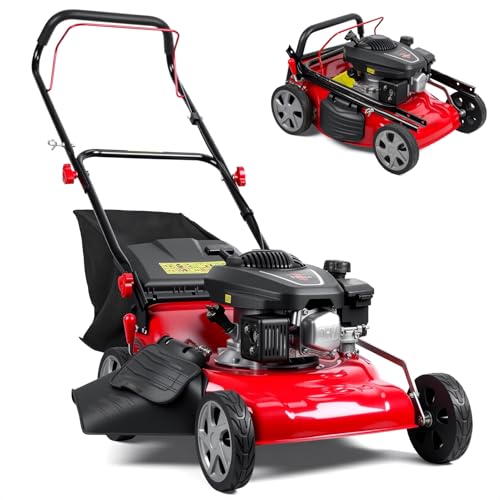
Lawn Mower Gas Powered, Gas Mower with 50l Grass Bag Big Wheels
- ⛰️✔️【𝐒𝐞𝐥𝐟-𝐏𝐫𝐨𝐩𝐞𝐥𝐥𝐞𝐝 𝐑𝐞𝐚𝐫 𝐖𝐡𝐞𝐞𝐥 𝐒𝐲𝐬𝐭𝐞𝐦 𝐟𝐨𝐫 𝐄𝐧𝐡𝐚𝐧𝐜𝐞𝐝 𝐓𝐫𝐚𝐜𝐭𝐢𝐨𝐧】Featuring a robust rear-wheel-drive system, this self-propelled gas la…
- 🌿✔️【𝐔𝐬𝐞𝐫-𝐅𝐫𝐢𝐞𝐧𝐝𝐥𝐲 𝐃𝐞𝐬𝐢𝐠𝐧 𝐟𝐨𝐫 𝐌𝐚𝐱𝐢𝐦𝐮𝐦 𝐂𝐨𝐧𝐯𝐞𝐧𝐢𝐞𝐧𝐜𝐞】Equipped with a spacious 50L grass tank, this self-propelled lawn mower effortles…
- ✅✅【𝟑-𝐢𝐧-𝟏 𝐕𝐞𝐫𝐬𝐚𝐭𝐢𝐥𝐢𝐭𝐲 𝐟𝐨𝐫 𝐂𝐮𝐬𝐭𝐨𝐦𝐢𝐳𝐞𝐝 𝐋𝐚𝐰𝐧 𝐂𝐚𝐫𝐞】This lawn mower gas powered offers three cutting options: mulch, side discharge, an…
The Shulemin self-propelled gas mower is built for the person who looks at their backyard slope and feels tired before they even start. Rear-wheel drive does the pushing. You walk behind and steer. That is the whole point of this machine, and on inclines it changes everything about how your legs feel at the end.
Rear-wheel drive is the key detail here. Front-wheel-drive mowers lose grip when the deck lifts on a slope because the drive wheels are the ones leaving the ground. Rear-wheel drive keeps the powered wheels planted, which is exactly what you want when the ground tilts. The big wheel design adds another layer of stability, and the 50L grass bag means fewer trips to the compost pile. The 3-in-1 system lets you mulch, bag, or side discharge depending on conditions, and the brush cutter attachment is a genuine bonus for anyone with overgrown edges or bramble patches along a fence line.
Two things to know before buying. First, self-propelled mowers are heavier than push mowers, so turning at the top of a slope takes a bit more effort. Second, the wide 50L bag fills fast in tall grass, so you will empty it more often than you expect during spring growth. Neither is a dealbreaker, but they are worth planning around. If you want a broader look at how self-propelled mowers compare on slopes, our walk behind mower guide covers the drive-type differences in more detail.
- Rear-wheel-drive self-propelled system for slope traction
- 50L grass bag with wide mouth for quick emptying
- 3-in-1 mulch, bag, and side discharge options
- Includes a heavy-duty brush cutter attachment
- Foam-wrapped handle reduces vibration fatigue
Best for: Homeowners with moderate to steep slopes who want the mower to do the climbing for them.
Cordless Lawn Mower, 17 i…

Casince
Cordless Lawn Mower, 17 in Walk Behind Lawn Mower for Yard & Garden | 2×4.0Ah Batteries, Up to 40-Min Runtime, 6-Position Height, 50L Grass Bag, 1200W Max Brushless Power
- WIDER MORE EVEN CUTTING: The 17-inch cutting deck and 6 height settings from 1 to 3 inches (25–75 mm) help this cordless lawn mowe…
- DUAL BATTERY EXTENDED RUNTIME: Powered by two 20V 4.0Ah batteries, this walk behind lawn mower runs for up to 40 minutes and cover…
- LARGE CAPACITY GRASS COLLECTION: The 50L collection bag holds more clippings between emptying cycles, while regular cleaning aroun…
The Casince cordless mower suits the buyer who has a small to medium lawn with a mild slope and wants zero gas, zero cords, and zero pull starts. You press a button, pull the bar, and go. For someone who mows once a week and does not want to store a gas can in the garage, this is a clean solution.
Dual 20V 4.0Ah batteries give you up to 40 minutes of runtime and roughly 5,380 square feet of coverage per charge. That is real-world useful for a typical suburban lot. The 17-inch deck with six height settings from 1 to 3 inches gives you fine control over cut length, and the 50L bag holds a decent amount of clippings between empties. The brushless motor runs at 3,000 RPM with up to 1,200W max output, which is enough for routine residential grass. At 14 kg, it is light enough that one person can carry it up a set of stairs or reposition it without strain.
The trade-off is slope capability. This is a push mower with no drive system, so on anything steeper than a gentle grade, you are pushing the full weight yourself. Battery runtime also drops in tall, wet grass because the motor works harder. And while 40 minutes sounds generous, it assumes moderate conditions. If your lawn is thick and damp, expect less. It is a great mower for the right yard, but a steep hill is not the right yard for it.
- Dual 20V 4.0Ah batteries, up to 40 minutes runtime
- 17-inch deck with 6 cutting heights from 1 to 3 inches
- 3000 RPM brushless motor, 1200W max output
- 50L collection bag with wide opening
- 14 kg body for easy carrying and storage
Best for: Homeowners with small to medium lawns and mild slopes who want a quiet, gas-free mower with push-button start.
SENIX 21-Inch Gas Push La…
SENIX
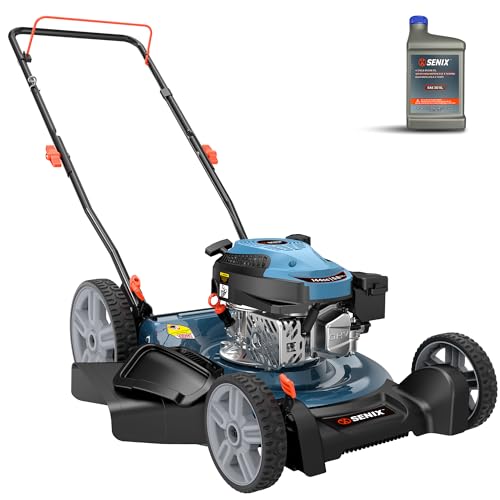
SENIX 21-Inch Gas Push Lawn Mower, 144cc, 2-in-1 Mulching | 4-Cycle Engine, Side Discharge, 6-Position Height Adjustment, Ideal for Residential Yard & Garden
- 【POWERFUL 144cc 4-CYCLE ENGINE FOR TOUGH LAWNS】 Tackle thick grass, weeds, and gentle slopes with confidence using our high-torque…
- 【EASY PUSHING WITH 11” HIGH-REAR WHEELS】 Navigate bumpy lawns, garden beds, and uneven terrain effortlessly thanks to oversized 8”…
- 【VERSATILE 2-IN-1 SYSTEM & 21-INCH CUTTING DECK】 Maximize your efficiency with a wide 21-inch cutting path that covers more ground…
The SENIX 21-inch gas push mower is aimed at the homeowner with a large yard, up to half an acre, that includes gentle slopes and uneven ground. It is a push mower, not self-propelled, but the oversized rear wheels do a surprising amount of work to reduce rolling resistance. Think of it as the mower for someone who wants big-deck coverage and does not mind providing the forward push.
The 144cc engine holds steady RPMs under load, which matters when you hit thick grass on an incline. Cheaper engines bog down and stall. This one keeps cutting. The 21-inch deck covers more ground per pass than a 20-inch mower, which adds up over a half-acre. The dual-lever 6-height adjustment runs from 1.25 to 3.75 inches, and you can change it without tools. The 11-inch rear wheels are the standout feature for slope work. They roll over roots, rocks, and uneven turf with noticeably less resistance than standard 7-inch wheels. SENIX claims a 30% reduction in rolling resistance compared to standard wheels, and in practice, that translates to less strain on your back and arms.
What you give up is drive. This is a push mower, so on a steep slope, you are still the engine. The big wheels help, but they do not replace self-propulsion. If your slope is more than about 15 degrees, you will feel it. Also, the 2-in-1 system offers mulching and side discharge but no bagging option, so if you want clippings collected, this is not the mower for you. The 2-year warranty covering engine, deck, and wheels is a solid confidence signal for the price point.
- 144cc 4-cycle engine with high torque for thick grass
- 21-inch cutting deck for fewer passes on large lawns
- 11-inch rear wheels reduce rolling resistance on uneven ground
- 6 cutting heights from 1.25 to 3.75 inches, dual-lever adjustment
- 2-year warranty on engine, deck, and wheels
Best for: Homeowners with large yards and gentle slopes who want big-deck coverage and easy rolling over rough ground.
LawnMaster MEB1114K Elect…

LawnMaster
LawnMaster MEB1114K Electric Corded Lawn Mower 15-Inch 11AMP
- POWERFUL PERFORMANCE: Tackle your yard with 3,300 RPM of power and a 14-inch cutting width
- ENVIRONMENTALLY FRIENDLY: No gas or batteries needed to power the mower
- CUSTOMIZE YOUR CUT: Effortlessly change the height of your cut with 5 cutting positions varying between 1.4-inches and 3-inches
The LawnMaster corded electric mower is for the homeowner with a small, flat yard who wants the simplest possible setup. Plug it in, press the button, mow. No gas, no oil changes, no battery charging cycles. It is the least complicated machine on this list, and for the right yard, that simplicity is the whole appeal.
The 11-amp motor runs at 3,300 RPM and cuts a 14-inch swath. That is narrower than the other mowers here, which means more passes, but it also means the mower stays light and easy to maneuver around tight landscaping. The 7-gallon collection bag holds a reasonable amount of clippings for a small yard. Five cutting positions from 1.4 to 3 inches cover the basics. The 7.75-inch rear wheels roll smoothly on flat ground. If your yard is a simple rectangle with no slope, this mower does the job with minimal fuss and no maintenance beyond blade sharpening.
The cord is the obvious limitation. You are tethered to an outlet, which means you need an outdoor extension cord long enough to reach every corner of your yard. On a slope, the cord becomes a genuine hazard because it can trail behind you and create a tripping risk. The 14-inch deck also means more passes, which is fine for a small yard but tedious for anything larger. This is not a hill mower. It is a flat-yard mower for someone who values low maintenance over everything else.
- 11-amp motor, 3,300 RPM, 14-inch cutting width
- 5 cutting positions from 1.4 to 3 inches
- 7-gallon collection bag for clippings
- 7.75-inch rear wheels for maneuverability
- No gas, no batteries, no engine maintenance
Best for: Homeowners with small, flat yards who want the lowest-maintenance mower possible and do not mind managing a cord.
How We Chose These Products
We evaluated each mower against the specific demands of sloped ground, not just general lawn care. Drive type was the first filter. Self-propelled and rear-wheel-drive machines got priority because they solve the core problem of climbing. Wheel diameter and tread came next, since bigger wheels roll over uneven ground with less resistance and better grip. Engine torque and motor output mattered for maintaining blade speed under load on an incline.
We also weighed practical factors like weight, cutting height range, bag capacity, and maintenance requirements. A mower that climbs well but weighs 90 pounds and needs constant tuning is not actually helpful. The picks here represent a range of budgets and yard types, from small flat lawns to genuine slopes. We avoided recommending any mower for hill use that lacks the traction or power to handle it safely, even if it performs well on flat ground.
Buying Guide: What Really Matters
Slope grade is the number one spec nobody talks about. A 10% grade is a gentle rise. A 20% grade is a noticeable hill. A 30% grade is steep enough that most walk-behind mowers struggle and you should consider a different approach entirely. Measure your slope by placing a 4-foot level on the ground and checking how many inches the low end drops. Four inches of drop over four feet is roughly an 8% grade. Twelve inches is 25%. Know your number before you buy.
Traction comes down to three things: drive type, wheel size, and tread. Rear-wheel drive beats front-wheel drive on slopes because the powered wheels stay planted when the deck lifts. Hydrostatic transmission is the smoothest and most controllable drive system, but a geared self-propelled system works fine for most residential slopes. Bigger wheels roll over obstacles and resist sinking into soft turf. Aggressive tread grips loose or damp ground. Smooth tread slips. If your slope is anything more than a gentle rise, you want rear-wheel drive and wheels at least 8 inches in diameter.
Weight versus power is the trade-off you will feel every time you mow. Heavier mowers have more traction and stability, but they are harder to push and turn. Lighter mowers are easier to maneuver but can slide on steep ground. Self-propelled mowers solve this by adding drive, which lets you have a heavier machine without the pushing effort. For steep slopes, self-propelled is almost always the right answer. For flat yards, a lighter push mower is easier on your body. Match the machine to your actual terrain, not to a spec sheet.
Our Top Recommendation
The Shulemin self-propelled gas mower is our top pick for hills because rear-wheel drive directly solves the traction problem that makes slope mowing miserable. It climbs, it grips, and it lets you focus on steering instead of straining. The 3-in-1 cutting system and brush cutter attachment add versatility that most mowers at this level do not offer. If your yard has a real slope, this is the mower that will make the biggest difference in how the job feels.
For a tighter budget, the SENIX 21-inch push mower is the runner-up. The 11-inch rear wheels reduce rolling resistance enough to make gentle slopes manageable, and the 144cc engine holds power under load. It is not self-propelled, so steep hills will still be work, but for moderate slopes and large yards, it is a strong value. If you have a small yard and want to skip gas entirely, the Casince cordless mower is the best electric option for mild slopes. And if your yard is flat and you just want simplicity, the LawnMaster corded electric mower is the easiest machine to live with.
Frequently Asked Questions
Can a push mower handle steep hills?
A push mower can handle gentle slopes up to about 10 to 15 degrees if you have the strength to push it and the wheels have decent grip. Beyond that, the effort becomes unsafe and exhausting. The mower can slide, you can lose footing, and the cut quality drops because you cannot maintain a steady pace. For anything steeper, a self-propelled mower with rear-wheel drive is the safer and more practical choice.
What slope grade is too steep to mow?
Most mower manufacturers recommend not exceeding 15 to 20 degrees, which is roughly a 27% to 36% grade. Beyond 20 degrees, the risk of the mower tipping or sliding sideways increases significantly. If your slope is steeper than that, consider a reel mower for light trimming, a string trimmer for the steepest sections, or a professional service. No walk-behind mower is designed for extreme slopes, and pushing one there is a genuine safety risk.
Is electric or gas better for hills?
Gas mowers generally have more torque for climbing and maintain power better under sustained load, which makes them the better choice for steep or long slopes. Electric mowers work fine on mild slopes if they are self-propelled, but battery runtime drops in tall grass and the motor can overheat under continuous heavy load. Corded electric mowers are not suitable for slopes because the cord creates a tripping hazard. For serious hill work, gas self-propelled is the safer bet.
Should I mow across a slope or up and down?
Mow across the slope, not up and down. Mowing up and down increases the risk of the mower rolling back on you if you lose footing or the engine stalls. Mowing across keeps you on a more stable path and lets you step away from the mower if needed. On very gentle slopes, either direction works, but across is always the safer habit. If the slope feels too steep to mow across comfortably, it is too steep to mow safely. For more slope-specific mower comparisons, see this hillside mowing guide.


