
Half an acre of grass sounds manageable until you actually try to cut it. A 16-inch electric mower turns that job into a three-hour slog with two extension cords, a tripped breaker, and a lawn that still looks uneven. That’s the moment most homeowners start shopping for a petrol mower.


A good petrol mower for a large yard needs three things: enough engine displacement to keep the blade spinning through thick grass, a cutting deck wide enough to reduce your pass count, and a build that survives five or six seasons without falling apart. Everything else is preference.
The five mowers below cover the realistic range of large-yard budgets. Two SENIX 20-inch models, a compact PowerSmart 18-inch, a BILT HARD 20-inch with the widest height range, and a 21-inch PowerSmart running a Briggs and Stratton engine. The first SENIX is the overall value winner, but the right pick depends on your acreage, your slope, and how much you care about self-propel.
Here’s a quick spec comparison before we break down each mower in detail.
| Features | SENIX 20-inch 144cc | PowerSmart 18-inch 144cc | BILT HARD 20-inch 144cc | PowerSmart 21-inch B&S | SENIX 20-inch 4QL |
|---|---|---|---|---|---|
| Cutting Width | 20 inches | 18 inches | 20 inches | 21 inches | 20 inches |
| Engine | 144cc 4-cycle | 144cc OHV auto choke | 144cc OHV auto choke | 125cc Briggs & Stratton | 144cc 4QL |
| Cut Heights | 3 positions | 5 positions | 8 positions | 6 positions | 3 positions |
| Deck Material | Not specified | Steel | Not specified | 15-gauge steel | Not specified |
| Best Use Case | Value all-rounder | Smaller large yards | Precise cut control | Widest passes | Light push work |
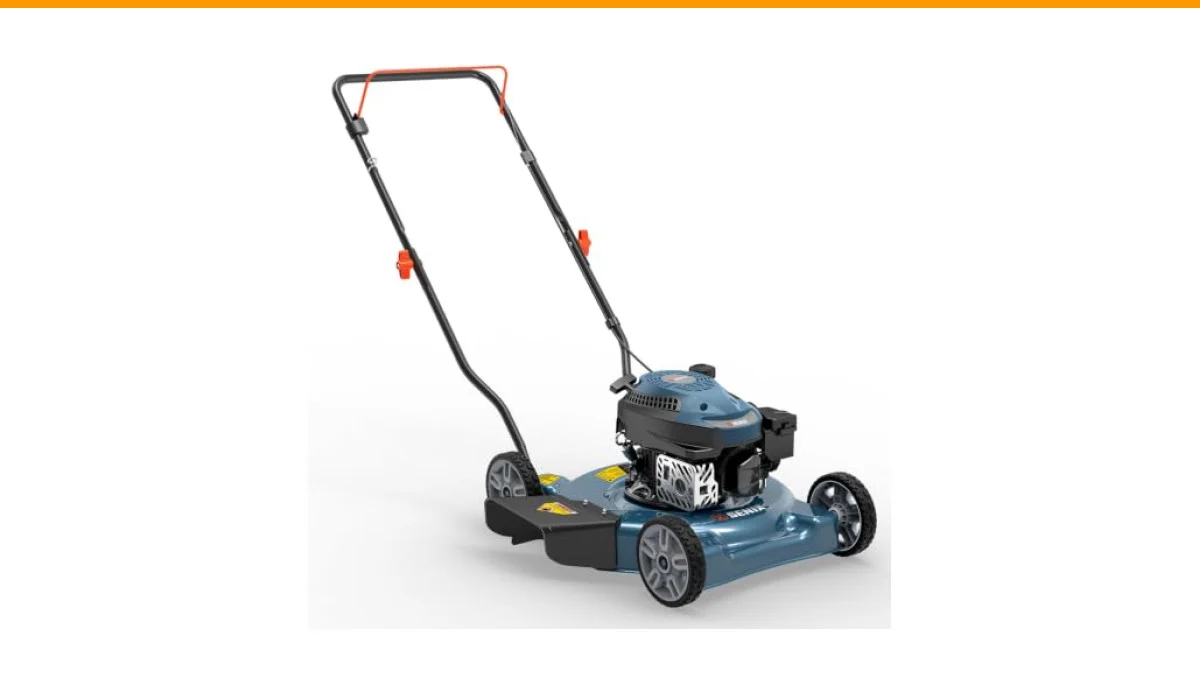
SENIX Gas Lawn Mower, 20-inch
The SENIX 20-inch 144cc push mower is the best all-round value in this lineup. It suits homeowners with a quarter-acre to roughly half an acre of flat or gently sloped grass who want a gas mower that starts easily and doesn’t demand a workout to move around.
What stands out is the combination of a 20-inch deck and a genuinely light chassis. The 7-inch front and rear wheels roll over rough patches without digging in, and the 144cc engine handles overgrown grass and wet clippings without clogging. SENIX includes oil and tools in the box, so you don’t need a separate trip to the store before your first cut. The 2-year warranty is decent for the price band.
The honest drawback: only three cutting heights (1.35, 2.3, and 3.15 inches). If you like a very short scalp cut or a tall finish, you’ll feel the gap. It’s also a push mower, so on a full acre you’ll notice the lack of self-propel by the third pass.
- 20-inch cutting width reduces pass count versus 16-inch models
- Lightweight build makes it easy to maneuver around beds and fences
- Starts on the first pull for most owners, per customer feedback
- Handles wet grass and leaves without clogging
- Oil and assembly tools included
Best for: The homeowner with a quarter to half acre who wants reliable gas power without paying for features they won’t use.
PowerSmart 18-inch 144cc Push Mower

PowerSmart
PowerSmart 18-inch 144cc Gas Lawn Mower, Push Mower with Side-Discharge | 144cc 4-stroke OHV engine, 5-Position Height Adjustment
- 【Starts with Less Effort】 The dependable 144cc 4-stroke OHV engine features an auto choke and primer bulb for quick, reliable star…
- 【Cuts Through Thick Grass】 The 18-inch heavy-duty blade delivers clean, even cuts while handling tall grass and overgrown areas wi…
- 【Built for Season After Season】 The durable steel deck is built for lasting durability, helping withstand regular mowing season af…
PowerSmart’s 18-inch model is the smallest mower here, and that’s deliberate. It fits yards that are large but cluttered, with trees, garden beds, and narrow gaps between fences and sheds that a 21-inch deck can’t reach.
The auto choke and primer bulb make cold starts simple. You press the bulb, pull the cord, and the 144cc OHV engine fires up. The steel deck should hold up through several seasons of regular use, and the 8-inch rear wheels give it decent stability on uneven ground. Five cutting heights from 1.5 to 3.9 inches cover most grass conditions.
The trade-off is obvious. An 18-inch deck means more passes than a 20 or 21-inch mower, and on anything over half an acre that extra time adds up fast. There’s also no mulching or bagging option listed, just side discharge, which limits how you handle clippings.
- 18-inch steel deck for tight spaces and obstacle-heavy lawns
- Auto choke and primer bulb for quick cold starts
- 5 cutting heights from 1.5 to 3.9 inches
- 8-inch rear and 7-inch front wheels for uneven terrain
- Side-discharge only
Best for: Yards with lots of obstacles where maneuverability matters more than cutting width.
BILT HARD Gas Lawn Mower, 20-inch
BILT HARD’s 20-inch mower targets a specific buyer: someone who wants precise control over cutting height without fiddling with four separate levers. The single-lever, four-wheel synchronized adjustment is the standout feature here.
Eight cutting positions from 0.7 to 3.2 inches is the widest range in this group. That matters if you alternate between a short summer cut and a taller spring cut, or if you’re managing different grass types across one property. The 144cc OHV engine uses an auto choke with no primer, which simplifies starts. Foam-wrapped angled grips reduce hand fatigue on longer mowing sessions, and the double ball-bearing wheels roll smoothly.
One real limitation: the cutting height tops out at 3.2 inches. If your grass gets long between cuts, you’ll need to mow twice or accept a rougher finish. BILT HARD also warns against tipping the mower over, which makes oil changes and blade maintenance more awkward than on some competitors.
- 8-position single-lever height adjustment from 0.7 to 3.2 inches
- 144cc OHV engine with auto choke, no primer needed
- 20-inch deck with specialized blade for even cuts
- Double ball-bearing wheels for smooth rolling
- Foam-wrapped angled grip reduces hand fatigue
Best for: Detail-oriented owners who adjust cut height often and want the widest range available.
PowerSmart 21-inch Gas Mower

PowerSmart
PowerSmart 21 in. Gas Lawn Mower with 125cc Briggs and Stratton E300 Engine, 2-in-1 Push Mower with Mulching & Side-Discharge, 6-Point Height of Cut
- Briggs and Stratton Engine: The 125cc Briggs and Stratton E300 engine made in the USA, delivers reliable power and is equipped wit…
- 21-Inch Blade: The heavy-duty blade with 21" cutting path that allows you to cut a wide area of lawn with each pass and delivering…
- 2-in-1 Steel Deck: This durable 15-gauge stamped steel deck is built to last, combine mulching and side-discharging capabilities i…
The PowerSmart 21-inch model is the widest mower in this roundup and the only one running a Briggs and Stratton engine. That combination makes it the strongest pick for larger properties where every inch of cutting width saves real time.
Briggs and Stratton’s E300 engine is built in the USA and uses Prime ‘N Pull starting, which is about as simple as gas mower starting gets. The 21-inch blade covers more ground per pass, and the 15-gauge stamped steel deck is the heaviest-duty build here. Mulching and side-discharge give you two ways to handle clippings, and the mower arrives fully assembled. You unfold the handle and go.
The 125cc engine is smaller than the 144cc units on the other mowers. That’s fine for regular cutting, but if you let grass get seriously overgrown, you’ll feel the difference. Six cutting heights from 1.5 to 3.9 inches cover the basics, though there’s no rear bag option.
- 21-inch cutting path, widest in this lineup
- 125cc Briggs and Stratton E300 engine, made in the USA
- 15-gauge stamped steel deck for durability
- 2-in-1 mulching and side-discharge
- Arrives fully assembled, no tools needed
Best for: Homeowners with half an acre or more who want the widest cut and a proven engine brand.
SENIX 20-inch Gas Lawn Mower, 4QL
The second SENIX 20-inch model is the entry point in this group. It’s built for straightforward push mowing on flat or gently sloped grass, and it keeps things simple with a 144cc 4QL engine and a lightweight frame.
Two features earn it a spot here: the 7-inch front and rear wheels that glide over bumpy ground, and the 20-inch cutting width that matches the first SENIX pick at a lower feature tier. The 4QL engine runs smoothly and starts without fuss. Assembly is quick, and the 2-year warranty matches the other SENIX model.
The three cutting heights (1.35, 2.3, 3.15 inches) are the same limited range as the other SENIX, and there’s no self-propel. On a half-acre or more, that means pushing the whole way. It’s the least feature-rich mower here, and that’s reflected in where it sits in the lineup.
- 144cc 4QL engine for steady power on thick grass
- 20-inch cutting width for fewer passes
- 7-inch front and rear wheels for uneven ground
- 3 cutting heights from 1.35 to 3.15 inches
- 2-year warranty
Best for: Budget-focused buyers with a flat quarter to half acre who just want a reliable push mower.
How We Chose These Products
We started with engine displacement, deck width, and cutting height range, because those three specs determine how a mower actually performs on a large yard. Anything under 125cc got filtered out for properties over a quarter acre. Deck width had to be at least 18 inches to justify the petrol switch.
From there, we weighed build quality, starting ease, and warranty coverage. Customer feedback on first-pull starts and clogging carried real weight, since those are the two complaints that ruin a mowing season. We also favored mowers that include oil and assembly tools, because hidden setup costs add up.
Finally, we compared each mower against the others in this list, not against marketing claims. A mower only made the cut if it filled a specific niche: best value, best for tight spaces, best height control, widest cut, or lowest entry price.
Buying Guide: What Really Matters
Engine displacement is the first number to check. A 144cc engine handles thick grass and light slopes without bogging down. A 125cc engine works fine for regular cutting but struggles in overgrown conditions. For anything over half an acre with tall grass, lean toward 140cc or higher.
Cutting width directly affects your mowing time. A 21-inch deck covers about 30 percent more ground per pass than an 18-inch deck. On an acre, that difference can mean 20 to 30 minutes saved per mow. But wider decks are harder to maneuver around trees and beds, so match the width to your lawn’s layout.
Cutting height range matters more than most buyers realize. Three positions is the minimum. Five to eight positions give you flexibility for seasonal growth and different grass types. If you skip mowing for two weeks, a mower with a 3.9-inch top height handles the catch-up cut better than one capped at 3.15 inches.
Self-propel is worth considering for anything over half an acre. None of the mowers here are self-propelled, so if your property is an acre or more, you may want to look at rear-wheel drive mowers instead. For flat quarter-acre lots, push mowers are fine and cost less.
You can also compare these picks against other large petrol mower reviews if you want a second opinion on engine and deck specs.
Our Top Recommendation
The SENIX 20-inch 144cc push mower is the best value pick for most large-yard owners. It balances a 20-inch deck, a strong 144cc engine, and a lightweight frame at a price that undercuts the competition. The included oil and tools seal the deal.
If you have over half an acre and want the widest cut, the PowerSmart 21-inch with the Briggs and Stratton engine is the better choice. The 15-gauge steel deck and 21-inch path justify the step up. For tight, obstacle-heavy yards, the PowerSmart 18-inch is the practical pick. And if cutting height precision is your priority, the BILT HARD’s 8-position adjustment wins.
For a broader look at mowers suited to bigger properties, see this guide to the best lawn mowers across categories.
Frequently Asked Questions
How large is a large yard in practical terms?
A quarter acre is the starting point where petrol makes sense over electric. Half an acre to one acre is the sweet spot for the push mowers in this list. Beyond one acre, consider self-propelled or a riding mower.
How much does it cost to run a petrol mower for five years?
Fuel, oil changes, spark plugs, and an annual service typically add up to a few hundred dollars over five years. That’s still less than replacing a worn-out electric mower twice, but it’s more than most buyers budget for.
How long does it take to mow an acre with a 20-inch push mower?
Expect 60 to 90 minutes for an acre with a 20-inch deck, depending on grass thickness and obstacles. A 21-inch deck shaves off 10 to 15 minutes. Self-propel cuts fatigue but not necessarily time.
Do I need self-propel for a large yard?
For anything over half an acre, yes, especially on slopes. Push mowers work fine on flat quarter-acre lots, but pushing a 60-pound mower for 90 minutes gets old fast.
Can I mulch instead of bagging on a large lawn?
Mulching returns nutrients to the soil and saves time, but it works best when you mow regularly and don’t leave thick clumps. On overgrown grass, side discharge or bagging is the safer choice.
If you’re still weighing petrol against battery power, this breakdown of petrol mowers for thick grass covers the trade-offs in more detail.


