You’ve got an acre or more of lawn, and the thatch layer has turned into a spongy mat that chokes out water and fertilizer. Raking it by hand is out of the question. A tow behind dethatcher turns your riding mower or ATV into a lawn renovation tool, but only if you pick one that matches your property size and soil conditions.
A good tow behind dethatcher for large yards needs three things: a wide working width to cut down on passes, spring steel tines that flex without snapping, and enough weight capacity to drive those tines into compacted soil. Hitch compatibility matters too, since not every unit plays nice with every tractor or UTV.
We looked at five models that cover the spectrum from budget-friendly to heavy-duty. The BlumeTrec 48-inch and Agri-Fab 48-inch are the strongest all-around picks for most large properties. The AugFir stands out for its 150-pound ballast tray. The Suchtale and the smaller BlumeTrec 40-inch offer solid alternatives depending on your mower deck size and budget.
Here’s a quick side-by-side of the key specs before we get into the details.
| Features | BlumeTrec 48-Inch | BlumeTrec 40-Inch | Agri-Fab 48-Inch | Suchtale 48-Inch | AugFir 48-Inch |
|---|---|---|---|---|---|
| Working Width | 48 inches | 40 inches | 48 inches | 48 inches | 48 inches |
| Tine Count | 24 spring tines | 20 spring tines | 24 spring tines | 24 spring tines | 20 spring tines |
| Ballast Capacity | 100 lbs | 100 lbs | 70 lbs | 70 lbs | 150 lbs |
| Wheel Type | Bearing wheels | Bearing wheels | 7-inch flat-free | Bearing wheels | 8-inch semi-pneumatic |
| Best Use Case | All-around large lawns | Mid-size yards | Proven reliability | Budget large lawns | Heavy compacted soil |
In this article
BlumeTrec Tow Behind Deth…
BlumeTrec
BlumeTrec Tow Behind Dethatcher, Pull Behind Lawn Dethatcher with Spring Steel Tines, Grass Dethatcher, Removes Thatch, Riding Lawn Tractor for Large Lawns, Yard and Garden Care, 48 Inch
- Durable Structure with 24 Spring Tines: BlumeTrec tow behind lawn rake is built with a heavy-duty carbon steel frame and 24 heat-t…
- Easy to Use & Effort Saving: Equipped with a universal pin-style hitch, this lawn thatcher rake easily attaches to riding lawn mow…
- Maximum Thatch & Debris Removal: Featuring two rows of independently flexing tines across a 48-inch working width, this pull behin…
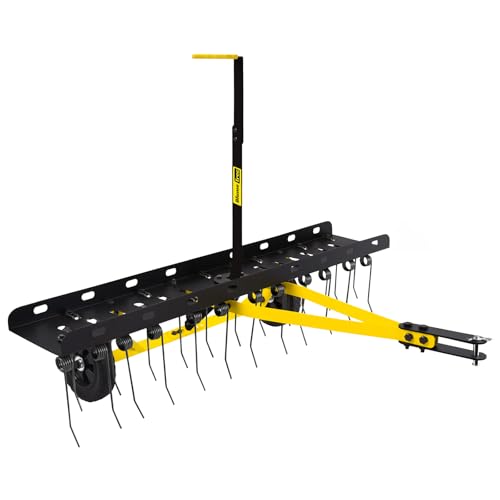
The BlumeTrec 48-inch is the one you buy when you want maximum coverage without overthinking it. It’s aimed at homeowners with half an acre to two acres who tow with a riding mower or small tractor. The 48-inch working width means fewer passes across a big lawn, and the 24 spring tines are arranged in two rows so they flex independently over uneven ground.
What separates this from cheaper units is the 100-pound ballast tray combined with bearing-supported wheels. You can load it with sandbags or concrete blocks to push the tines deeper into compacted soil, and the bearings keep the wheels rolling smoothly even with that extra weight. The adjustable handle lets you raise the tines for transport across driveways or gravel without scraping. Assembly is straightforward, and BlumeTrec includes both written instructions and a video.
The main trade-off is the universal pin-style hitch. It fits most riding mowers and ATVs, but a few owners of older tractors with non-standard hitches may need an adapter. Also, reversing while the tines are down can damage them, so you need to remember to lift the handle before backing up. It’s not a dealbreaker, just something to keep in mind.
- 48-inch width covers ground fast on large lawns
- 24 heat-treated, rust-proof spring tines are replaceable
- 100-pound ballast tray for adjustable tine depth
- Bearing wheels handle extra weight without binding
- Works with riding mowers, tractors, ATVs, and UTVs
Best for: Homeowners with large lawns who want a reliable, wide-coverage dethatcher that handles moderate thatch without constant fiddling.
BlumeTrec Tow Behind Deth…

BlumeTrec
BlumeTrec Tow Behind Dethatcher, Pull Behind Lawn Dethatcher with Spring Steel Tines, Grass Dethatcher, Removes Thatch, Riding Lawn Tractor for Large Lawns, Yard and Garden Care, 40 Inch
- Durable Structure with 20 Spring Tines: BlumeTrec tow behind lawn rake is built with a heavy-duty carbon steel frame and 20 heat-t…
- Easy to Use & Effort Saving: Equipped with a universal pin-style hitch, this lawn thatcher rake easily attaches to riding lawn mow…
- Maximum Thatch & Debris Removal: Featuring two rows of independently flexing tines across a 40-inch working width, this pull behin…
The 40-inch version of the BlumeTrec is for properties where a 48-inch unit feels like overkill. If your lawn has tight corners, garden beds, or a lot of obstacles, the narrower width gives you more maneuverability. It’s also a better match for smaller riding mowers that don’t have the horsepower to pull a fully loaded 48-inch dethatcher through thick thatch.
You still get the same build quality as the larger model: a carbon steel frame, heat-treated spring tines, and a 100-pound ballast tray. The tine count drops to 20, but they’re spaced across the 40-inch width, so coverage per pass is consistent. The bearing wheels and adjustable handle carry over, which means transport and depth control work the same way. For lawns in the half-acre range with a few trees and flower beds, this size hits a sweet spot.
The obvious limitation is coverage. On a wide-open two-acre lawn, you’ll make more passes than you would with the 48-inch model. That’s extra seat time. The 40-inch also has slightly less stability on very uneven ground because the narrower frame has less span to bridge dips. Neither issue is severe, but they’re worth knowing before you buy.
- 40-inch width fits tighter spaces and smaller mowers
- 20 spring tines in two rows for consistent flex
- 100-pound ballast tray for deeper penetration
- Same bearing wheels and adjustable handle as larger model
- Quick assembly with included video
Best for: Homeowners with mid-size lawns or obstacle-heavy yards who need maneuverability more than maximum width.
Agri-Fab 48 In Tow Behind…
Agri-Fab
Agri-Fab 48 In Tow Behind Lawn Dethatcher with 24 Durable Spring Steel Tines and Universal Hitch
- EFFECTIVE THATCH REMOVAL: 48 in tine dethatcher loosens and lifts dead matted grass while helping dislodge compacted soil for heal…
- CONVENIENT HEIGHT ADJUSTMENT: Cantilever transport handle allows easier raising and lowering of the tines for smoother operation a…
- WIDE LAWN GROOMING COVERAGE: 48 in working width helps cover larger lawn areas efficiently while improving water, nutrient, and ai…
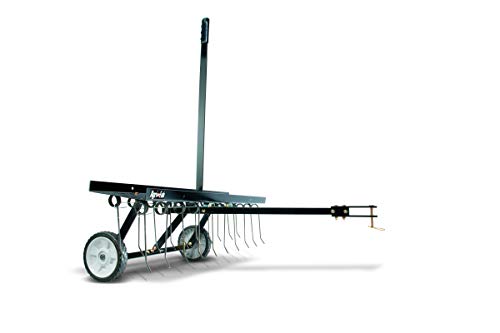
Agri-Fab has been making tow behind lawn equipment for decades, and the 48-inch dethatcher is their flagship model for large yards. It’s the pick for someone who values a proven design over flashy features. The cantilever transport handle is a standout detail: it lets you raise and lower the tines from the driver’s seat with one hand, which sounds minor until you’ve wrestled with a stiff lever on a competitor’s unit.
The 24 heat-treated spring tines are rust-proof and replaceable, same as the BlumeTrec. Where Agri-Fab differs is the 7-inch flat-free wheels. They never go flat, which matters if you’re towing across rough ground or near thorny brush. The 70-pound weight tray is smaller than some competitors, but Agri-Fab designed the tine angle to work well without excessive ballast. For routine seasonal dethatching on a lawn with moderate thatch, it performs reliably.
The trade-off is the smaller ballast capacity. If your soil is heavily compacted or the thatch layer is thick, you may find yourself wanting more weight than 70 pounds provides. You can add aftermarket weights, but that’s extra cost and effort. Also, the flat-free wheels are durable but heavier than pneumatic ones, which slightly increases rolling resistance on soft ground.
- 48-inch width for efficient large-lawn coverage
- Cantilever handle raises and lowers tines easily
- 24 replaceable heat-treated spring tines
- 7-inch flat-free wheels never go flat
- 70-pound weight tray for moderate ballast
Best for: Buyers who want a proven, no-nonsense dethatcher from a legacy brand and don’t need maximum ballast capacity.
Suchtale 48 Inch Tow Behi…

Suchtale
Suchtale 48 Inch Tow Behind Lawn Dethatcher with 24 Spring Tines | 48 Inch working width with 24 spring steel tines and a 70 lb ballast platform for efficient thatch removal on large lawns.
- WIDE THATCH REMOVAL: The 48 inch working width loosens and lifts matted grass, dead thatch and surface debris across a wide area,…
- 24 FLEXIBLE SPRING TINES: Equipped with 24 heat-treated spring steel tines that flex over lawn surfaces. Rust-resistant and replac…
- HEAVY-DUTY STEEL CONSTRUCTION: The full steel frame is designed for stable towing, while bearing-supported wheels help the dethatc…
Suchtale’s 48-inch dethatcher is the budget-conscious pick that still covers a wide swath. It’s aimed at homeowners who want 48-inch coverage without paying premium prices. The full steel frame feels solid, and the 24 heat-treated spring tines are rust-resistant and replaceable. For seasonal dethatching on a lawn with average thatch buildup, it does the job.
The bearing-supported wheels help it track smoothly behind a riding mower or ATV, and the 70-pound ballast platform adds tine contact when you need it. The pin-style hitch connects to most compatible mowers and tractors. A transport handle lets you raise the tines for moving across pavement or storing the unit. Assembly instructions are detailed enough for a first-timer to follow without much frustration.
Where this model shows its budget roots is in the smaller ballast tray and the lack of premium touches like a cantilever handle or flat-free wheels. The 70-pound capacity is fine for light to moderate thatch, but heavy compacted soil may need more weight than the tray can hold. The wheels are bearing-supported, which is good, but they’re not pneumatic, so they ride a bit firmer on rough ground. It’s a capable unit for the money, just not the most refined.
- 48-inch working width at a budget-friendly price point
- 24 rust-resistant, replaceable spring tines
- Bearing-supported wheels for smooth towing
- 70-pound ballast platform for moderate depth control
- Transport handle for easy raising and lowering
Best for: Budget-minded homeowners with large lawns who need wide coverage and don’t mind a few missing premium features.
AugFir 48-Inch Tow Behind…

AugFir
AugFir 48-Inch Tow Behind Dethatcher, Pull Behind Lawn Dethatcher with 20 Spring Steel Tines, Lawn Grass Dethatcher Tractor Rake, Adjustable Hitch Riding Lawn Mower Tractor Attachment
- 【48-Inch Working Width for Faster Coverage】Cover more ground in less time with two rows of independently flexing tines spanning a…
- 【Heavy-Duty 150 lb. Capacity Tray】The tow behind lawn dethatcher rake features a robust carbon steel frame built for tough outdoor…
- 【Easy Height Adjustment】The adjustable control handle offers two height settings, making it simple to lift or lower the tines as n…
The AugFir 48-inch is the heavy-duty option for lawns with serious thatch or compacted soil. Its headline feature is the 150-pound ballast tray, which is more than double what most competitors offer. That extra weight drives the 20 spring tines deeper into the ground, making it the best choice for reviving a neglected lawn or breaking up hard, clay-heavy soil.
The adjustable hitch is another practical detail. It moves up and down in seconds to match the height of your mower or ATV, so you don’t need to swap hitches or rig adapters. The 8-inch semi-pneumatic wheels roll smoothly over uneven terrain and provide decent shock absorption. An anti-slip stopper slot on the height adjustment handle prevents accidental shifts during turns, which is a small but thoughtful touch. The two-row tine design flexes independently over bumps.
The trade-off is weight. A fully loaded 150-pound tray plus the unit’s own heft makes for a heavy pull. Smaller riding mowers with less horsepower may struggle, especially on slopes or in wet conditions. The 20 tines are slightly fewer than some competitors’ 24, though the wider spacing and heavier ballast compensate in most situations. If your mower is on the smaller side, consider the BlumeTrec 40-inch instead.
- 150-pound ballast tray for aggressive dethatching
- Adjustable hitch fits ATVs, UTVs, tractors, and mowers
- 8-inch semi-pneumatic wheels for smooth rolling
- Anti-slip stopper prevents height shifts during turns
- 20 spring tines in two independently flexing rows
Best for: Homeowners with heavily compacted soil or thick thatch who have a capable tow vehicle and want maximum penetration.
How We Chose These Products
We started by filtering out dethatchers that couldn’t handle large yards. That meant requiring a working width of at least 40 inches and a frame built from steel, not plastic. We also eliminated units with fixed tine heights, since adjustable depth is essential for everything from light seasonal cleanup to aggressive soil breaking.
From there, we compared ballast capacity, tine count and material, wheel type, and hitch compatibility. We prioritized models with replaceable tines, because tines wear out and a dethatcher with non-replaceable tines is a disposable purchase. We also looked at real-world usability details like transport handles, assembly instructions, and whether the hitch works with common tow vehicles. The five models here represent the best balance of coverage, durability, and value for large properties.
Buying Guide: What Really Matters
Working width is the first spec to check. A 48-inch dethatcher covers four feet per pass. On a one-acre lawn, that’s roughly 10,890 square feet. You’ll still make multiple passes, but wider is faster. If your lawn has lots of trees, beds, or tight turns, a 40-inch unit may actually save time because you spend less effort maneuvering.
Ballast capacity determines how aggressive you can get. Light thatch needs 50 to 70 pounds. Moderate thatch responds well to 100 pounds. Heavy, compacted soil or years of neglect may require 150 pounds or more. Check your tow vehicle’s towing capacity and traction before loading up a heavy tray. A small riding mower on wet grass will spin its wheels before it pulls a 150-pound dethatcher through thick thatch.
Tine material and replacement matter more than tine count. Heat-treated spring steel flexes without snapping and resists rust. Replaceable tines extend the life of the unit for years. Also look at wheel type: flat-free wheels never go flat, pneumatic wheels absorb bumps better, and bearing-supported wheels roll easier under load. Finally, confirm the hitch fits your mower or ATV. Most use a universal pin-style hitch, but a few older tractors need an adapter.
Our Top Recommendation
The BlumeTrec 48-inch tow behind dethatcher is our top pick for most large yards. It balances a wide 48-inch working width, 24 replaceable spring tines, a 100-pound ballast tray, and bearing wheels at a price that’s reasonable for the build quality. It handles moderate thatch without constant adjustments and works with the most common tow vehicles.
If your soil is heavily compacted, the AugFir 48-inch with its 150-pound tray is the better choice. For budget-focused buyers, the Suchtale 48-inch covers the same width for less money, though you give up some ballast capacity. And if you have a smaller mower or a lawn with tight spaces, the BlumeTrec 40-inch is the maneuverable alternative. The Agri-Fab remains a solid pick for anyone who trusts a legacy brand and wants a proven design.
Frequently Asked Questions
How often should I dethatch my lawn?
Most lawns benefit from dethatching once a year, either in early spring or early fall. If your lawn has a thick thatch layer over half an inch, you may need to dethatch twice a year until it’s under control. After that, annual maintenance keeps it in check.
Can I use a tow behind dethatcher on a lawn with sprinkler heads?
Yes, but you need to mark sprinkler heads clearly and raise the tines when passing over them. The tines can damage plastic sprinkler components if they hit them directly. Most dethatchers have a transport handle that lets you lift the tines quickly.
What’s the difference between dethatching and aerating?
Dethatching removes the layer of dead grass and organic matter sitting on top of the soil. Aerating pulls plugs of soil out to relieve compaction deeper down. They solve different problems. Many homeowners dethatch first, then aerate a few weeks later for best results.
Will a tow behind dethatcher work with an ATV or UTV?
Most models with a universal pin-style hitch work with ATVs and UTVs, provided the hitch height matches. Check the product specs for hitch compatibility. Some units, like the AugFir, have adjustable hitches that make matching height easier.