You planted tomatoes, peppers, and a row of lettuce. Now the real work starts: keeping them watered without soaking the leaves or drowning the roots. A hose and a thumb only go so far, and hand watering gets old fast in July.
A good vegetable garden sprinkler solves three problems at once. It covers ground evenly, it works with the water pressure you actually have at the spigot, and it doesn’t waste half its output on the driveway. The right pick depends on your crop mix, your garden shape, and whether you want to automate the whole thing.
We looked at five systems that cover the full spectrum: two overhead sprinklers, one gear-drive unit, and two drip kits. The Eden 96213 is our top pick for most vegetable plots. The CARPATHEN drip kit wins for disease-prone crops like tomatoes. Read on for the full breakdown, plus a pressure and watering schedule guide you won’t find in most roundups.
Here’s a quick look at how the five picks compare on the specs that matter most.
| Features | Eden 96213 | Acostop 4-Pack | CARPATHEN Drip Kit | Orbit H2O-Six | 120Ft Drip Kit |
|---|---|---|---|---|---|
| Type | Oscillating sprinkler | Spike sprinklers | Drip irrigation kit | Gear-drive spike | Drip irrigation kit |
| Coverage | Up to 3,600 sq ft | Up to 2,800 sq ft | Up to 3 raised beds | Large-area adjustable | 120 ft with 26 nozzles |
| Build | Weighted base, steel filters | Aluminum alloy spike | UV-resistant tubing, stakes | Metal T-spike | Copper nozzles, PE tubing |
| Spray Style | 16 nozzles, adjustable range | 360° twist nozzle | Vortex and spray emitters | Six patterns, 360° | Spray, drip, mist modes |
| Best Use | Rectangular veg plots | Odd shapes, daisy chain | Tomatoes, raised beds | Mixed lawn and garden | Large gardens, potted plants |
In this article
- Eden 96213 Weighted Oscillating Sprinkler
- Acostop 4pcs 360° Spray Sprinklers
- CARPATHEN Drip Irrigation Kit
- Orbit H2O-Six Gear-Drive Sprinkler
- 120Ft 1/4″ Drip Irrigation System
- How We Chose These Products
- Buying Guide: What Really Matters
- Watering Schedule by Vegetable Type and Growth Stage
- Our Top Recommendation
- Frequently Asked Questions
Eden 96213 Weighted Oscillating Sprinkler
Eden
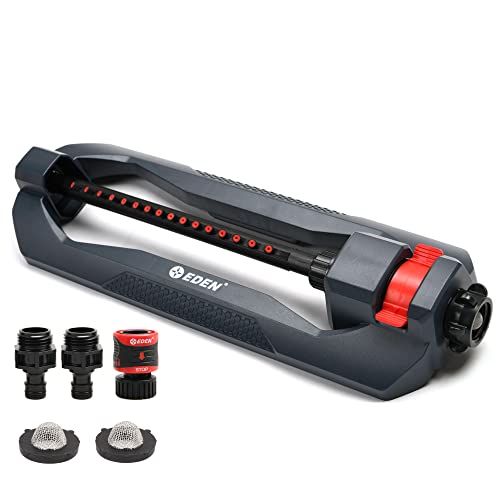
Eden 96213 Weighted Essential Oscillating Sprinkler | Covers Up to 3,600 sq. ft., 16 Precision Nozzles, Adjustable Range, Turbo Drive Motor, Quick Connect Bundle, Stainless Steel Filters, Black
- 16 PRECISION NOZZLES- Provides even, consistent watering coverage for lawns and gardens up to 3,600 sq. ft..
- ADJUSTABLE WATERING RANGE- Range sliding tabs allow easy customization of the watering area for precise coverage.
- SEALED TURBO DRIVE MOTOR- Patented turbo drive design delivers smooth operation, quiet performance, and extended gear life.
The one you buy when you want even, hands-off coverage for a rectangular vegetable plot. The Eden 96213 is an oscillating sprinkler with 16 nozzles and a weighted base, and it’s built for gardeners who water a block of rows rather than a scattered patch. If your beds sit in a tidy grid, this is the natural first choice.
What stands out is the sealed turbo drive motor. Most oscillating sprinklers use a plastic gear train that strips out after a season or two. Eden’s patented design runs quieter and lasts longer, which matters when you’re running it every other morning from June through August. The 16 nozzles deliver even coverage across up to 3,600 square feet, and the sliding range tabs let you narrow the spray to fit a smaller bed without soaking the fence line. The weighted base keeps the unit from creeping across the lawn when pressure spikes. And the included quick-connect set has a water-halt feature, so you can swap tools without walking back to the spigot.
It’s not perfect. The oscillating pattern is a rectangle, so L-shaped or curved beds get uneven coverage. You’ll also want to check your water pressure before buying. Below 40 PSI, the throw distance drops and the coverage area shrinks. And like any overhead sprinkler, it wets the foliage, which is a real problem for tomatoes and peppers. Use it for leafy greens, root crops, and seedlings instead.
- 16 precision nozzles cover up to 3,600 sq ft
- Sealed turbo drive motor for quiet, long-life operation
- Sliding range tabs customize the watering width
- Weighted base resists movement under pressure
- Quick-connect starter set with water-halt feature included
Best for: Gardeners with rectangular vegetable plots who want even overhead coverage and a sprinkler that lasts more than one season.
Acostop 4pcs 360° Spray Sprinklers

Acostop
Acostop 4pcs 360° Spray Sturdy Metal Sprinklers for Yard Lawn Medium Garden | Adjustable Brass Nozzle Water Sprinkler, with Aluminum Alloy Spike Base, Up to 2800 sq. ft Coverage, for Backyard Flower Bed
- Daisy Chain to Expand the Coverage Area: Connect the 4 sprinklers in a series to the same water source to expand its coverage area…
- Adjustable Twist Irrigation Nozzle: Under normal 50-60psi water pressure, the twisting barrel on the brass nozzle adjusts water fr…
- Aluminum Alloy Spike Base: Different from ordinary plastic and zinc alloy spike bases, our sprinklers for the yard are made of a s…
The one you buy when your garden isn’t a neat rectangle. The Acostop 4-pack gives you four individual spike sprinklers you can place wherever you need water. Daisy-chain them from one hose to cover up to 2,800 square feet, or split them across separate beds. For odd-shaped plots, narrow rows, or a mix of raised beds and in-ground plantings, this flexibility beats a single fixed sprinkler every time.
Each unit has a brass twist nozzle that adjusts from a fan spray to a cone to a straight stream. That range matters in a vegetable garden. You can dial in a gentle mist for newly sown carrots, then switch to a stronger stream for established squash. The aluminum alloy spike base is the real standout. Most budget spike sprinklers use plastic or zinc alloy, which snaps or corrodes within a season or two. Aluminum handles pressure and weather far better. Setup is simple: push the spike into soil or turf, connect a standard 3/4-inch hose, and twist the nozzle to set your pattern.
The trade-off is coverage overlap. Four sprinklers daisy-chained can leave dry patches between them if you space them too far apart. You’ll need to experiment with placement, and for very large gardens, four units won’t be enough. The 50-60 PSI sweet spot also means low-pressure setups will see shorter throw distances. It’s a placement puzzle, not a plug-and-play system.
- Four spike sprinklers daisy-chain from one hose
- Expands to roughly 2,800 sq ft without overlap
- Brass twist nozzle adjusts from fan to cone to stream
- Aluminum alloy spike base outlasts plastic and zinc
- Works with any standard 3/4-inch garden hose
Best for: Gardeners with irregular bed layouts or multiple separate plots who want flexible placement over a single fixed coverage zone.
CARPATHEN Drip Irrigation Kit

CARPATHEN
CARPATHEN Drip Irrigation System Kit for Garden Watering, Sprinkler, 100 ft | For Garden, Yard, Raised Beds, Plants, Lawn, with Barbed 5/16 Mainline + 1/4 Tubing + 30 Emitters, 20-45 PSI and up to 40 GPH
- Be a Gardening Master with the help of our superior and complete Drip Irrigation Kit: 50ft flexible & durable PVC 5/16" Irrigation…
- Make your own garden irrigation system kit easier than ever: run a 3/4 connection from your water source to the watering area. Use…
- Enjoy taking care of your garden with high quality adjustable spray emitters and forget about broken irrigation sprayer stakes and…
The one you buy when leaf disease has burned you before. The CARPATHEN drip irrigation kit delivers water straight to the root zone, keeping foliage dry. For tomatoes, peppers, zucchini, and anything else prone to blight or mildew, that’s the single biggest advantage you can buy. This kit is designed for up to three raised beds and comes with everything you need to build a full system: 50 feet of 5/16-inch mainline tubing, 50 feet of 1/4-inch distribution tubing, 10 vortex emitters, 20 spray emitters, couplers, tees, end plugs, and a water connector.
The emitters are the strong point. Each one is detachable and cleanable, so clogging doesn’t end your season. The 7.5-inch stakes have sharp bottoms that push into loose soil and stay put. You can rotate the cap on each emitter to fine-tune flow, which lets you give more water to heavy feeders and less to herbs. The kit runs on 20-45 PSI and puts out up to 60 gallons per hour per emitter. Carpathen also throws in a printed instruction guide and two digital grow-your-own guides, which helps first-timers avoid the usual layout mistakes.
Here’s the honest part: this is a project, not a plug-in. You’ll spend an afternoon cutting tubing, placing emitters, and testing flow. The 1/4-inch tubing can kink if you bend it sharply around corners. And the kit tops out at 30 emitters, so a large garden will need a second kit or a different mainline setup. If you want zero assembly, this isn’t it.
- Complete kit for up to three raised beds
- 10 vortex and 20 spray emitters, all adjustable
- 100 ft of combined 5/16-inch and 1/4-inch tubing
- Detachable, cleanable emitter heads resist clogging
- Runs on 20-45 PSI, up to 60 gallons per hour per emitter
Best for: Vegetable growers with raised beds or disease-prone crops who want root-zone watering and are willing to spend an afternoon on setup.
Orbit H2O-Six Gear-Drive Sprinkler

Orbit
Orbit H2O-Six Gear-Drive Sprinkler on Metal T-Spike - Customizable Lawn Watering Coverage - Multi-Pattern Rotating Head with Adjustable Spray Range - Durable Outdoor Yard Irrigation Sprinkler - 58573
- Lush Lawn Coverage: The Orbit H2O-Six Gear Drive Sprinkler delivers efficient watering for lawns and gardens with six spray patter…
- Effortless Spray Adjustments: Customize watering angles and spray distance with rotating head controls and adjustable collar tabs,…
- Precise Water Distribution: Built with a four-position spray control system that helps fine-tune watering flow for consistent cove…
The one you buy when the garden and the lawn share a water source. The Orbit H2O-Six is a gear-drive sprinkler on a metal T-spike with six spray patterns and a 360-degree rotating head. It covers large areas and adjusts in more ways than most vegetable gardeners need, which is exactly why it works for mixed yards. One afternoon it waters the tomatoes, the next it handles the front lawn.
Gear-drive sprinklers are known for smooth, consistent rotation, and this one lives up to that. The rotating head controls let you set the arc and distance, while the adjustable collar tabs fine-tune the spray. A four-position spray control system lets you dial in flow for different zones. The metal T-spike pushes into turf or soil and holds the unit steady. For gardeners who want one sprinkler to handle everything, this is a strong pick.
The downside for pure vegetable use is overlap. Gear-drive sprinklers throw a circular pattern, so rectangular beds get corners that stay dry. You’ll need to reposition it or accept some waste. It also wets foliage like any overhead sprinkler, so it’s a poor fit for tomatoes and peppers during humid stretches. And the six patterns are more than most veggie gardeners will ever use.
- Gear-drive rotating head with six spray patterns
- 360-degree coverage with adjustable arc and distance
- Four-position spray control for flow tuning
- Metal T-spike holds steady in turf and soil
- Limited warranty against material and workmanship defects
Best for: Gardeners who water both lawn and vegetables and want a single durable sprinkler that handles both jobs.
120Ft 1/4″ Drip Irrigation System

BUIGNDG
120Ft 1/4" Drip Irrigation System for Garden – 26 Adjustable Copper Nozzles, Automatic Atomizing Sprinkler System for Outdoor Plants Raised Bed, Yard, Potted Plants & Lawn
- 1 case of 25 Packs, 25 Count Total
- The 4-way connector and emitter connect directly to 1/4" irrigation tubing easily, making installation a breeze.
- Drip irrigation system is perfect for lawn irrigation, gardens, patios, vegetables, plant greenhouses, flower beds, agriculture an…
The one you buy when you want drip coverage without building it from scratch. The BUIGNDG kit ships with 120 feet of 1/4-inch tubing and 26 adjustable copper nozzles, plus every connector, stake, and clip you need. It’s the most complete kit on this list, and it’s aimed at gardeners who want to water a large area, potted plants, and raised beds from one system.
Three irrigation modes set this apart: spray, drip, and mist. You can run misters for seedlings, switch to drip for established plants, and use spray for a patio container collection. The copper nozzles are adjustable, detachable, and washable, which addresses the clogging problem that plagues cheap drip systems. The tubing is UV-resistant and bends to lock at any angle, so you can route it around corners and up stakes without kinking. Installation is tool-free thanks to a pneumatic 3-way quick-connect system with a leak-proof rubber ring. If you connect something wrong, you can pull it apart and redo it without cutting new tubing.
Coverage claims deserve scrutiny. The 26 nozzles spread across 120 feet means spacing is generous, and in a dense vegetable bed you may want more emitters than the kit provides. The 1/4-inch tubing also limits total flow, so long runs at the end of the line may see reduced pressure. It saves up to 70% water compared to overhead watering, but only if you place the nozzles correctly.
- 120 ft of 1/4-inch tubing with 26 copper nozzles
- Three modes: spray, drip, and mist
- Tool-free quick-connect with leak-proof rubber rings
- UV-resistant, anti-clogging, detachable nozzles
- Includes 50 stakes, 26 three-way connectors, and 40 clips
Best for: Gardeners with large or mixed plantings who want a complete drip kit with flexible spray, drip, and mist options.
How We Chose These Products
We started with the crops. Vegetables have different watering needs than lawns, and the wrong sprinkler can spread disease or waste water. Overhead sprinklers got evaluated on coverage evenness and droplet size, since heavy droplets compact soil and damage seedlings. Drip systems got judged on emitter quality, clog resistance, and how easy the kit is to assemble. Pressure compatibility mattered for every pick, because a sprinkler rated for 60 PSI performs poorly on a 35 PSI spigot.
Build quality separated the field. Plastic spike bases and thin tubing fail within a season or two, so we favored aluminum spikes, weighted bases, and UV-resistant tubing. We also weighed setup effort honestly. A drip kit that takes three hours to install isn’t for everyone, and a roundup that ignores that fact isn’t useful. Every pick here solves a specific problem, and none of them pretend to be universal.
Buying Guide: What Really Matters
Coverage math trips up most buyers. A sprinkler rated for 3,600 square feet covers a 60 by 60 foot square, but only at full pressure. If your garden is 20 by 30 feet, you’re paying for coverage you won’t use, and the outer edges may still get less water than the center. Measure your beds first, then match the sprinkler’s throw pattern to your garden’s shape. Rectangular beds suit oscillating sprinklers. Odd shapes and multiple plots suit spike sprinklers you can place individually.
Water pressure decides everything. Most garden spigots deliver 40 to 60 PSI, but long hose runs and elevation drop cut that number fast. A sprinkler rated for 3,600 square feet at 60 PSI might only reach 2,000 square feet at 40 PSI. Check your pressure with an inexpensive gauge before buying, and size your sprinkler to the pressure you actually have. Drip systems are more forgiving, since they run on 20 to 45 PSI and don’t rely on throw distance.
Spray pattern and seedling safety go together. Overhead sprinklers with large droplets can flatten newly sprouted carrots and beat down young lettuce. Look for adjustable nozzles that produce a fine mist or gentle fan. Drip systems avoid the problem entirely because water goes straight to the soil. For disease-prone crops like tomatoes, peppers, and zucchini, drip is the safer choice. For leafy greens and root vegetables, overhead watering works fine as long as you water in the morning so foliage dries before evening.
Durability and clogging prevention round out the list. Metal spike bases outlast plastic by years. Copper or brass nozzles resist mineral buildup better than plastic. Detachable, cleanable emitters save you from replacing an entire system when one head clogs. And if you plan to automate, check that the sprinkler or drip kit works with a standard hose timer, since some quick-connect systems don’t seal properly under timer pressure.
Watering Schedule by Vegetable Type and Growth Stage
Most vegetable gardens need about 1 inch of water per week, including rainfall. That translates to roughly 60 gallons per 100 square feet. But the schedule shifts by crop and stage. Seedlings need shallow, frequent watering, often twice a day in hot weather, because their roots sit near the surface. Established plants want deeper, less frequent soakings that push roots downward.
Leafy greens like lettuce and spinach prefer consistent moisture and shallow roots. Water them every two to three days in summer, and don’t let the soil dry out completely. Root crops like carrots and beets want even moisture to avoid splitting, so a steady drip or overhead schedule works well. Fruiting crops are the exception. Tomatoes, peppers, and zucchini produce best with deep watering once or twice a week, and they strongly prefer drip over overhead because wet foliage invites blight and mildew. For a deeper look at crop-specific options, see this vegetable sprinkler guide.
Timing matters as much as volume. Water in the early morning so foliage dries before evening humidity sets in. Evening watering leaves leaves wet overnight, which is the fastest path to fungal disease. If you use a timer, set it for 5 to 7 AM and run it long enough to soak the root zone, not just the surface. For drip systems, 30 to 60 minutes per zone is typical, depending on emitter count and soil type. Sandy soil drains fast and needs shorter, more frequent cycles. Clay soil holds water and needs longer, less frequent runs.
Our Top Recommendation
The Eden 96213 is the best all-around sprinkler for most vegetable gardens. It covers a large area evenly, the sealed turbo motor outlasts cheaper gear drives, and the quick-connect set makes tool changes painless. For rectangular plots of leafy greens, root crops, and seedlings, it’s the simplest path to consistent watering. Check the current price on Amazon before you commit.
If disease is your biggest worry, the CARPATHEN drip kit is the better choice. It keeps foliage dry, delivers water to the roots, and comes with everything needed for up to three raised beds. For odd-shaped gardens or multiple plots, the Acostop 4-pack offers flexibility no fixed sprinkler can match. And if you water both lawn and vegetables, the Orbit H2O-Six handles both with a durable gear-drive head.
Frequently Asked Questions
Can I use an overhead sprinkler on tomatoes without causing disease?
You can, but timing is critical. Water before 8 AM so leaves dry within a few hours. Avoid evening watering entirely during humid stretches. Even with perfect timing, drip irrigation remains the safer choice for tomatoes, peppers, and zucchini, because it never wets the foliage in the first place.
How do I know if my water pressure is high enough for a sprinkler?
Buy an inexpensive pressure gauge that attaches to your spigot. Most oscillating and gear-drive sprinklers need at least 40 PSI to hit their rated coverage. Drip systems run fine on 20 to 45 PSI. If your pressure is below 40, choose a drip kit or a spike sprinkler you can place close to the spigot.
How many sprinklers do I need for a 20 by 30 foot vegetable garden?
That’s 600 square feet. A single oscillating sprinkler like the Eden 96213 covers it easily at full pressure. If you use spike sprinklers, two Acostop units placed at opposite corners will do the job. For drip, one CARPATHEN kit handles up to three raised beds in that footprint.
Can I connect a sprinkler or drip kit to a hose timer?
Yes, but check the connection type first. Standard threaded fittings work with most timers. Quick-connect systems sometimes leak under timer pressure, so test the seal before relying on it. For drip kits, a timer with a minimum flow rate of 1 gallon per minute works best. See this drip irrigation comparison for more on timer-compatible setups.
How often should I run a drip irrigation system in summer?
Most vegetable gardens need 1 inch of water per week. With drip, that’s typically 30 to 60 minutes per zone, two to three times per week, depending on emitter count and soil. Sandy soil needs shorter, more frequent cycles. Clay soil needs longer runs with more time between them. Adjust based on rainfall and check soil moisture by hand for the first few weeks.