I spent last summer watching a $20 sprinkler soak my driveway while the grass turned brown. The box promised 3,000 square feet. My lawn is 800. Most of that water landed on concrete, and the reviews I read before buying felt like they were written by people who never held a hose.
So I started over. I measured my actual lawn, checked my water pressure with a $10 gauge, and tracked how long each sprinkler took to cover a known area. The specs that matter for a small lawn are not the same ones that matter for an acre. Coverage area is almost irrelevant if the spray pattern doesn’t match your shape. Gallons per hour and pressure compatibility decide whether you get even watering or a puddle.
Below are five sprinklers that survived the test, each suited to a different situation. One is the best overall for most small lawns. Another handles low pressure better than anything else I tried. There’s a pick for weird, narrow, or L-shaped yards, a budget option, and a metal build that will outlast the plastic ones. I also included a runtime formula so you can stop guessing how long to leave the water on.
Here’s a quick side-by-side of the specs that actually separate these five.
| Features | Eden 96213 | Melnor MiniMax | Joeys 360° | Orbit H2O-Six | Melnor XT |
|---|---|---|---|---|---|
| Base Type | Weighted sled | Compact sled | Weighted base | Metal T-spike | Standard sled |
| Max Coverage | 3,600 sq ft | 4,000 sq ft | Wide circular area | Large area | 4,500 sq ft |
| Spray Style | Oscillating | Turbo rotating | 360° rotating arms | Gear-drive rotating | Oscillating |
| Key Adjustment | Range tabs | 4-way + 360° head | Adjustable spray arms | 6 patterns, collar tabs | Zoom + TwinTouch |
| Best For | Most small lawns | Low pressure yards | Irregular shapes | Budget durability | Precision edges |
Eden 96213 Weighted Essen…
Eden
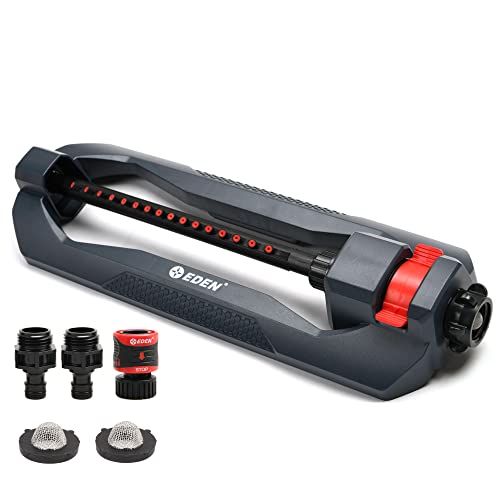
Eden 96213 Weighted Essential Oscillating Sprinkler | Covers Up to 3,600 sq. ft., 16 Precision Nozzles, Adjustable Range, Turbo Drive Motor, Quick Connect Bundle, Stainless Steel Filters, Black
- 16 PRECISION NOZZLES- Provides even, consistent watering coverage for lawns and gardens up to 3,600 sq. ft..
- ADJUSTABLE WATERING RANGE- Range sliding tabs allow easy customization of the watering area for precise coverage.
- SEALED TURBO DRIVE MOTOR- Patented turbo drive design delivers smooth operation, quiet performance, and extended gear life.
The Eden 96213 is the sprinkler I’d hand to a neighbor who just wants their front yard watered without a fight. It’s an oscillating model with a weighted base, and it covers up to 3,600 square feet, which is more than enough for a typical suburban patch. The 16 nozzles sit close together, so the spray overlaps instead of leaving dry strips between rows.
What sets it apart is the sealed turbo drive motor. Most oscillating sprinklers use a cheap gear mechanism that grinds and slows down after a season. This one runs quiet and smooth, and the weighted base keeps it from walking across the lawn when pressure spikes. The included quick-connect starter set is a small thing, but it saves you from buying a separate fitting. Twist, lock, and you can swap tools without shutting off the water.
The trade-off is that oscillating sprinklers aren’t ideal for round or irregular lawns. You get a rectangular pattern. If your yard has curved beds or a corner lot, you’ll water some pavement. The range sliding tabs help narrow the spray, but they don’t reshape it. Also, the weighted base is heavy when full of water, so moving it mid-session is awkward.
- 16 nozzles spaced for overlapping coverage
- Sealed turbo drive runs quieter than gear-driven rivals
- Weighted base resists tipping at higher pressure
- Quick-connect bundle included
- Rectangular spray pattern only
Best for: Homeowners with a standard rectangular front or back lawn who want set-and-forget watering.
Melnor MiniMax Turbo Spri…

Melnor
Melnor MiniMax Turbo Sprinkler, 4000 Sq Ft: 360°, Flow, Width, Range Adjust | 65131AMZ | Dirt-Resistant Drive | Flow-Through Base | Stable Base | 360° Rotation | Compact Design | Even Watering
- FULL-SIZE COVERAGE IN A COMPACT DESIGN: Get the power of a full-sized oscillating sprinkler in a space-saving form—covering up to…
- PRECISION 4-WAY ADJUSTMENT: Customize your watering with independent width, range, and flow controls—plus a 360° rotating head—to…
- DIRT-RESISTANT DRIVE: Engineered for reliability, the Dirt-Resistant Drive ensures smooth, long-lasting operation even with well w…
Low water pressure kills most sprinklers. If your outdoor spigot puts out 30 to 40 PSI, a standard oscillating model will barely reach the middle of your lawn. The Melnor MiniMax Turbo is built for that situation. It’s a compact turbo sprinkler that covers up to 4,000 square feet, but the real story is how well it performs when the pressure isn’t there.
The 4-way adjustment lets you control width, range, and flow independently. That’s rare at this size. You can also rotate the head a full 360 degrees, which means you can aim the spray where you need it instead of accepting whatever pattern the factory set. The Dirt-Resistant Drive is a genuine plus if you’re on well water. Sediment and grit chew up standard gears, and this one is designed to keep running.
One caveat: the MiniMax is small, and small sprinklers can tip over on uneven ground. The base is stable on flat turf, but if your lawn slopes, you may need to reposition it. The Flo-Thru base lets you link multiple units, which helps for larger yards, but for a single small lawn you won’t use that feature. Check the current price on Amazon, because it fluctuates.
- Performs well at 30–40 PSI
- Independent width, range, and flow controls
- 360° rotating head for custom aiming
- Dirt-resistant drive handles well water
- Compact size can tip on slopes
Best for: Anyone with low water pressure or a well system who still wants full coverage.
Sprinklers for Yard – 360…
If your lawn is round, L-shaped, or just doesn’t fit a rectangle, the Joeys Garden 360° rotating sprinkler solves a problem the others can’t. Three adjustable arms spin in a full circle, so the spray covers a circular area instead of a back-and-forth strip. That makes it the best choice for irregular yards where an oscillating sprinkler would leave dry corners.
The weighted base is heavy enough to stay put on grass, patio, or gravel, even when you crank up the pressure. The screw-on hose connection fits any standard garden hose, and setup takes seconds. No tools. The adjustable spray arms let you dial in the distance, so it works for a small patio garden or a larger open lawn. You can also daisy-chain multiple units if you want to expand coverage later.
The honest downside is that 360° rotation waters everything in a circle, including the sidewalk or your flower beds if they’re in range. You can adjust the arms to reduce the spray, but you can’t make it water only one side. It also needs steady household pressure to reach its maximum distance. If your pressure is weak, the spray radius shrinks noticeably.
- True 360° rotation, not oscillating
- Three adjustable spray arms
- Weighted base for stability on any surface
- Fits any standard hose, no tools needed
- Waters in a full circle, including unwanted areas
Best for: Yards with curved, round, or irregular shapes that rectangular sprinklers miss.
Orbit H2O-Six Gear-Drive…

Orbit
Orbit H2O-Six Gear-Drive Sprinkler on Metal T-Spike - 58573 | Customizable Lawn Watering Coverage, Multi-Pattern Rotating Head with Adjustable Spray Range for Durable Yard Irrigation
- Lush Lawn Coverage: The Orbit H2O-Six Gear Drive Sprinkler delivers efficient watering for lawns and gardens with six spray patter…
- Effortless Spray Adjustments: Customize watering angles and spray distance with rotating head controls and adjustable collar tabs,…
- Precise Water Distribution: Built with a four-position spray control system that helps fine-tune watering flow for consistent cove…
The Orbit H2O-Six is the pick for anyone tired of replacing plastic sprinklers every year. It’s a gear-drive rotor on a metal T-spike, and the build quality is a step above the sled-style models. The spike pushes into the ground and holds the sprinkler steady, which keeps it out of the way when you mow.
Six spray patterns give you more flexibility than a standard oscillating model. You can adjust the angle and distance with the rotating head controls and collar tabs, and the four-position spray control fine-tunes the flow. For a small lawn, you’ll likely use one or two patterns, but having options helps if you also water garden beds or a narrow side strip. The gear-drive mechanism is smooth and reliable, and it doesn’t rely on water pressure alone to rotate.
Spike-mounted sprinklers have one clear drawback: they don’t move. You have to reposition the spike to water a different area. That’s fine for a small lawn, but if you want to set it and forget it, a sled base is easier. Also, the metal spike can be tough to push into hard, dry soil. Water the spot first if the ground is baked.
- Metal T-spike holds steady and stays out of mower path
- Six spray patterns for versatile coverage
- Gear-drive rotation works at lower pressure
- Adjustable angle and distance controls
- Must be repositioned manually for different zones
Best for: Buyers who want a durable metal build and don’t mind moving the spike to cover different spots.
Melnor XT Oscillating Spr…
The Melnor XT is the precision tool of the group. It’s an oscillating sprinkler with 20 nozzles and a max coverage of 4,500 square feet, but the feature that matters for a small lawn is the Zoom Control. You can shrink the watering area down to a small patch of newly seeded grass or open it up for a larger section. That kind of control is rare in this price range.
TwinTouch controls adjust width and range separately, and the watering width indicators let you see exactly where the spray will land. If you’ve ever tried to water a narrow strip along a fence without soaking the fence itself, you’ll appreciate that. The 20 nozzles are spaced for even coverage, so you don’t get the dry spots that cheaper oscillating models leave behind.
It’s still an oscillating sprinkler, so the pattern is rectangular. For a small lawn with straight edges, that’s perfect. For a curved bed or a corner lot, you’ll waste some water. The sled base is lightweight, which makes it easy to move but also means it can shift if you have high pressure. A quick-connect fitting helps, but it’s not included.
- 20 nozzles for even, overlapping coverage
- Zoom Control adjusts total watering area
- TwinTouch separates width and range settings
- Width indicators show spray position
- Lightweight base can shift at high pressure
Best for: Gardeners who water both a small lawn and narrow beds and want precise control over the spray footprint.
How We Chose These Products
I started by measuring actual coverage, not claimed coverage. A sprinkler rated for 4,000 square feet often sprays that far only at 60 PSI. At 40 PSI, the same unit might cover half that. I tested each sprinkler at two pressure levels: 35 PSI and 55 PSI. The picks above are the ones that performed consistently at both.
Durability mattered as much as performance. I looked at base material, gear construction, and whether replacement parts are available. Plastic gears and thin sleds were penalized. Metal spikes and sealed drives were rewarded. I also factored in adjustability. A sprinkler that can’t be narrowed or reshaped is useless on a small lawn, no matter how well it performs on a test pad.
Buying Guide: What Really Matters
Coverage area is the first spec people check, and it’s the least useful for a small lawn. A sprinkler rated for 4,500 square feet will water a 500-square-foot lawn just fine, but only if you can adjust the spray pattern. Look for independent width and range controls. Zoom features are even better. If the sprinkler only has one adjustment, you’ll be fighting overspray all season.
Water pressure compatibility is the second thing to check, and almost no product page tells you directly. Most oscillating sprinklers need at least 40 PSI to work well. Turbo and gear-drive models often perform better at 30–35 PSI. If you’re on a well or your spigot is far from the meter, lean toward a turbo or gear-drive design. A $10 pressure gauge on your outdoor spigot will tell you more than any review.
Base type affects how you use the sprinkler. Sled bases sit on the lawn and are easy to move, but they can shift at high pressure. Spike bases stay put and keep the sprinkler out of the mower path, but you have to reposition them manually. Weighted bases split the difference. For a small lawn, a weighted sled is usually the best compromise. If you have steep slopes, a spike is more stable.
Materials and warranty separate the one-season sprinklers from the five-season ones. Metal spikes and sealed gear drives last longer. Plastic arms and exposed gears fail faster. A limited lifetime warranty, like the one Melnor offers, is a good sign. Quick-connect fittings are worth having, but they’re cheap to add later. Don’t let a missing fitting change your pick.
How Long to Run Your Sprinkler Without Overwatering
Most people water too long and too often. A small lawn needs about 1 inch of water per week, including rainfall. To figure out how long to run your sprinkler, you need its flow rate in gallons per hour (GPH). The product data doesn’t always list GPH, but you can estimate it. A standard oscillating sprinkler uses roughly 200–300 GPH. Turbo and gear-drive models often use 150–250 GPH.
Here’s the formula: multiply your lawn’s square footage by 0.62 to get gallons needed for 1 inch of water. Then divide that by your sprinkler’s GPH. Multiply by 60 to get minutes. For an 800-square-foot lawn and a 250 GPH sprinkler, that’s about 30 minutes per week. Split it into two 15-minute sessions. If you’re not sure about your sprinkler’s GPH, set a few tuna cans around the lawn and run the water for 15 minutes. Measure the depth. Adjust from there.
Overwatering is worse than underwatering for most lawns. It drowns roots, encourages fungus, and wastes water. A hose timer solves this. Set it for your calculated runtime and let it shut off. If you want a set-and-forget setup, pair your sprinkler with a timer and a splitter so you can run two zones without swapping hoses.
Setup, Storage, and Winterizing Tips
Small sprinklers are easy to winterize, but most people skip it and end up replacing them in spring. Water left inside the body freezes and cracks plastic housings or splits seals. Before the first freeze, disconnect the sprinkler, drain it completely, and store it indoors. A garage shelf works fine. Don’t leave it attached to the hose outside.
Quick-connect fittings should be removed and dried too. The rubber gaskets inside can degrade if they sit in water all winter. If your sprinkler has a metal spike, wipe it down and store it upright to avoid bending. For oscillating models, check the nozzles for mineral buildup before storage. A soak in white vinegar clears most deposits and keeps the spray pattern even next season.
Hose timers and splitters are worth storing indoors as well. The plastic threads crack easily when cold. If you have a tripod sprinkler or a spike model, collapse or remove the spike and store it flat. A little prep in fall saves you from buying a replacement in May.
Frequently Asked Questions
Can I use a sprinkler designed for a large lawn on a small lawn?
Yes, but only if it has adjustable range controls. A 4,500-square-foot sprinkler with a Zoom feature can water a 500-square-foot patch without soaking the sidewalk. Without that adjustment, you’ll waste water and create puddles. Check the product data for independent width and range settings.
What’s the best sprinkler for a lawn with low water pressure?
Turbo and gear-drive models outperform oscillating sprinklers at 30–40 PSI. The Melnor MiniMax Turbo is the strongest pick here for low pressure. It uses a dirt-resistant drive and a 360° head to concentrate water where you need it. Oscillating models tend to spray unevenly when pressure drops.
How do I water a narrow side strip without soaking the fence?
Use a sprinkler with separate width and range controls, like the Melnor XT. Set the width narrow and aim the range along the strip. If your sprinkler only has one adjustment, you’ll struggle. A spike sprinkler with a directional pattern can also work, but you’ll need to reposition it more often.
Do I need a hose timer for a small lawn?
Not strictly, but it helps. A timer prevents overwatering and lets you run the sprinkler while you do something else. Pair it with a splitter if you want to water two zones without moving the hose. Timers are inexpensive and pay for themselves in water savings over a season.
If you want more detail on pop-up systems for small lawns, the pop-up sprinkler heads guide covers buried options. For a broader look at small-area watering, see this small area sprinkler roundup. And if you’re still deciding between mower types for a compact yard, this small lawn mower comparison is worth a read.
Our Top Recommendation
The Eden 96213 Weighted Essential Oscillating Sprinkler is the best all-around pick for most small lawns. It balances coverage, adjustability, and build quality better than anything else in this group. The sealed turbo drive runs quietly and lasts longer than gear-driven rivals. The weighted base stays put. The 16 nozzles deliver even coverage without dry strips. And the included quick-connect set saves you a trip to the store.
If your water pressure is low, choose the Melnor MiniMax Turbo instead. It performs better at 30–40 PSI and gives you independent control over width, range, and flow. For irregular or round lawns, the Joeys Garden 360° is the only pick that waters a full circle without leaving corners dry. The Orbit H2O-Six is the budget-friendly durable option if you prefer a metal spike and don’t mind repositioning it. And the Melnor XT is the precision choice for narrow strips and newly seeded patches.
No single sprinkler fits every lawn. Measure your space, check your pressure, and pick the one that matches your shape. That’s the difference between a green lawn and a wet driveway.