Most sprinklers are built for half-acre lots. You screw one onto your hose, turn the water on, and watch half the spray land on your driveway while the far corner of the lawn stays bone dry. Small yards punish oversized gear.
A good small-lawn sprinkler matches its spray pattern to your actual shape. It puts water where grass grows, not on concrete. It holds steady at household pressure, usually 40 to 60 PSI, and it doesn’t soak one zone while starving another. Adjustability matters more than raw coverage on a 1,000 to 3,000 square foot lawn.
We rounded up five models that solve different small-yard problems. The Eden 96213 is our top pick for most people. The Melnor MiniMax wins for tight spaces, the Joeys handles round or odd shapes, the Orbit spikes into beds and slopes, and the Melnor XT suits anyone who wants precise width control. Every pick below includes real GPH estimates and honest trade-offs.
Here’s a quick side-by-side of the specs that actually separate these five.
| Features | Eden 96213 | Melnor MiniMax | Joeys 360 | Orbit H2O-Six | Melnor XT |
|---|---|---|---|---|---|
| Coverage | 3,600 sq ft | 4,000 sq ft | Wide circular area | Large area, 6 patterns | 4,500 sq ft |
| Spray Pattern | Oscillating, adjustable range | 360° rotating, 4-way adjust | True 360° rotating arms | Gear-drive, multi-pattern | Oscillating, TwinTouch controls |
| Build | Weighted base, stainless filters | Compact, dirt-resistant drive | ABS plastic, weighted base | Metal T-spike, gear drive | Standard body, 20 nozzles |
| Connector | Quick Connect included | Flo-Thru base | Screw-on standard hose | Standard hose connection | Standard hose connection |
| Best Use | Most small lawns | Tight spaces, odd shapes | Round or irregular yards | Beds, slopes, spikes | Precise width control |
Eden 96213 Weighted Essen…
Eden
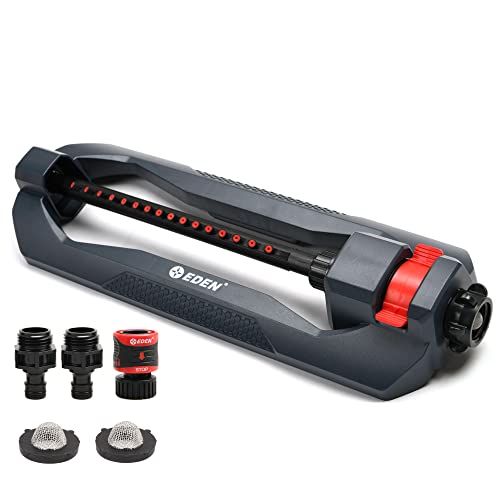
Eden 96213 Weighted Essential Oscillating Sprinkler | Covers Up to 3,600 sq. ft., 16 Precision Nozzles, Adjustable Range, Turbo Drive Motor, Quick Connect Bundle, Stainless Steel Filters, Black
- 16 PRECISION NOZZLES- Provides even, consistent watering coverage for lawns and gardens up to 3,600 sq. ft..
- ADJUSTABLE WATERING RANGE- Range sliding tabs allow easy customization of the watering area for precise coverage.
- SEALED TURBO DRIVE MOTOR- Patented turbo drive design delivers smooth operation, quiet performance, and extended gear life.
The one you buy when you want a sprinkler that just works, season after season. The Eden 96213 is an oscillating model with 16 nozzles and a weighted base. It suits homeowners with a rectangular or square lawn between 1,500 and 3,600 square feet. If you’re tired of chasing a sprinkler that flips over mid-cycle, this is the fix.
What stands out is the sealed turbo drive motor. It runs quiet and smooth, and the gearing holds up better than the exposed mechanisms on cheap oscillators. The weighted base keeps the unit planted even at 60 PSI. Range sliding tabs let you narrow the spray so you’re not soaking the fence line. At typical 50 PSI household pressure, expect roughly 3 to 4 gallons per minute, or 180 to 240 GPH, covering its full 3,600 square feet in about 30 to 45 minutes depending on overlap.
The trade-off: oscillating sprinklers struggle on round or L-shaped lawns. Corners get missed. The Eden also needs decent pressure to reach its full range. Below 40 PSI, the far edge of a 3,600 square foot pattern gets thin. And the included Quick Connect is handy, but you’ll want a spare if you swap tools often.
- 16 precision nozzles with adjustable range tabs
- Sealed turbo drive motor for quiet, long-life operation
- Weighted base holds position at higher pressure
- Quick Connect starter set with water-halt feature
- Stainless steel filters resist debris clogging
Best for: Homeowners with a rectangular small lawn who want a stable, low-maintenance oscillating sprinkler.
Melnor MiniMax Turbo Spri…

Melnor
Melnor MiniMax Turbo Sprinkler, 4000 Sq Ft: 360°, Flow, Width, Range Adjust | 65131AMZ | Dirt-Resistant Drive | Flow-Through Base | Stable Base | 360° Rotation | Compact Design | Even Watering
- FULL-SIZE COVERAGE IN A COMPACT DESIGN: Get the power of a full-sized oscillating sprinkler in a space-saving form—covering up to…
- PRECISION 4-WAY ADJUSTMENT: Customize your watering with independent width, range, and flow controls—plus a 360° rotating head—to…
- DIRT-RESISTANT DRIVE: Engineered for reliability, the Dirt-Resistant Drive ensures smooth, long-lasting operation even with well w…
Full-size coverage from a body the size of a coffee can. The Melnor MiniMax Turbo covers up to 4,000 square feet but takes up almost no storage space. It’s ideal for renters, apartment dwellers with a small patch, or anyone who hates lugging a bulky sprinkler out of the garage every spring.
The 4-way adjustment is the real story. You control width, range, and flow independently, plus the head rotates a full 360 degrees. That means you can water a narrow strip along a fence, then twist the head to hit a corner bed without moving the base. The dirt-resistant drive handles well water without gumming up, which is a common failure point on cheaper units. Expect around 2.5 to 3.5 GPM at 50 PSI, or 150 to 210 GPH, depending on flow setting.
Here’s the catch: the compact body means a smaller footprint, so at very low pressure the spray pattern can get choppy. It also doesn’t have a weighted base, so on a slope it may shift. And the Flo-Thru base is great for daisy-chaining, but if you’re only running one sprinkler, that feature adds a little bulk you won’t use.
- Covers up to 4,000 sq ft in a compact frame
- Independent width, range, and flow controls
- 360-degree rotating head for odd shapes
- Dirt-resistant drive for well water
- Flo-Thru base links multiple units
Best for: Small-yard owners who need big coverage from a sprinkler that stores in a bucket.
Sprinklers for Yard – 360…
Round yards, corner lots, and anyone tired of dry strips. The Joeys Garden 360 rotating sprinkler uses three spinning arms instead of a back-and-forth oscillator. That design covers circular and irregular shapes far better than a traditional oscillating sprinkler, which leaves dry bands at the edges. If your lawn isn’t a perfect rectangle, this is worth a look.
The weighted ABS base keeps it steady on grass, patio, or gravel, even at higher pressure. Setup takes seconds: screw it onto any standard hose, no tools. You can also daisy-chain multiple Joeys units to cover a larger zone in one session. At 50 PSI, expect roughly 2 to 3 GPM, or 120 to 180 GPH, with a spray radius of about 25 to 30 feet depending on pressure and arm adjustment.
Trade-offs exist. Rotating arm sprinklers can be less precise than oscillators for narrow strips. The arms also need steady pressure to spin evenly; below 35 PSI, rotation can stall. And the plastic body, while durable, won’t survive being left out through a hard freeze. Bring it inside before winter.
- True 360-degree rotation, not oscillating
- Three adjustable arms for even circular coverage
- Weighted ABS base stays put on most surfaces
- Screw-on connection fits any standard hose
- Daisy-chain multiple units for larger zones
Best for: Homeowners with round, oval, or irregularly shaped small lawns.
Orbit H2O-Six Gear-Drive…

Orbit
Orbit H2O-Six Gear-Drive Sprinkler on Metal T-Spike - 58573 | Customizable Lawn Watering Coverage, Multi-Pattern Rotating Head with Adjustable Spray Range for Durable Yard Irrigation
- Lush Lawn Coverage: The Orbit H2O-Six Gear Drive Sprinkler delivers efficient watering for lawns and gardens with six spray patter…
- Effortless Spray Adjustments: Customize watering angles and spray distance with rotating head controls and adjustable collar tabs,…
- Precise Water Distribution: Built with a four-position spray control system that helps fine-tune watering flow for consistent cove…
The one you spike into a flower bed or a sloped patch. The Orbit H2O-Six is a gear-drive sprinkler on a metal T-spike. It’s not designed to sit on the lawn like the others. Instead, you push the spike into soil at the edge of a bed, and the rotating head throws water in a customizable pattern. Six spray patterns and adjustable collar tabs give you more control than most small sprinklers offer.
Gear-drive heads are known for durability and consistent rotation. The four-position spray control lets you fine-tune flow, which helps on slopes where runoff is a problem. At 50 PSI, expect around 2 to 3 GPM, or 120 to 180 GPH, with a radius of 20 to 30 feet depending on the pattern selected. The metal spike holds firm in most soils, though very sandy ground may need a little extra push.
The limitation is obvious: this isn’t a set-it-and-forget-it lawn sprinkler. You position it, adjust it, and it waters a specific zone. For a full small lawn, you’d need to move it or run multiple units. The spike also makes it awkward on hard surfaces. And the six patterns are useful, but switching between them takes a minute of fiddling.
- Gear-drive rotating head with six spray patterns
- Metal T-spike for beds and slopes
- Adjustable collar tabs control spray distance
- Four-position spray control for flow tuning
- Limited warranty against defects
Best for: Gardeners who need to water beds, borders, or sloped areas without soaking the whole lawn.
Melnor XT Oscillating Spr…
Precision width control for people who hate wasting water. The Melnor XT Oscillating sprinkler covers up to 4,500 square feet with 20 nozzles, but its real strength is the TwinTouch controls and Zoom Control. You can dial the width down to a small flower bed or open it up for a larger lawn section. Watering width indicators show you exactly where the spray lands, so you can set it once and remember the setting.
This is the sprinkler for someone who wants to water a specific strip of lawn without soaking the patio. The Zoom Control adjusts the overall area, which is handy for newly seeded patches. At 50 PSI, expect roughly 3 to 4 GPM, or 180 to 240 GPH, covering its full range in 30 to 50 minutes. The 20 nozzles provide even coverage across the pattern.
Downsides? Oscillating sprinklers still struggle with round lawns, and the Melnor XT is no exception. The plastic body is durable but not as heavy as the Eden, so at very high pressure it may shift slightly. And the width indicators, while useful, take a few minutes to learn. It’s not a set-and-forget sprinkler for everyone, but for precision work it’s hard to beat.
- 20 precision nozzles for even coverage
- TwinTouch controls adjust width and range
- Zoom Control for small patches or large sections
- Watering width indicators for repeatable settings
- Melnor limited lifetime warranty
Best for: Homeowners who want precise control over exactly where water lands on a small lawn.
How We Chose These Products
We started by narrowing the field to sprinklers that actually suit small lawns, not just ones marketed that way. Coverage area mattered, but so did pattern shape. A 4,000 square foot sprinkler that only sprays a rectangle is useless on a round lawn. We weighed adjustability, build quality, connector type, and warranty terms against real-world small-yard needs.
We also factored in water pressure. Most homes run 40 to 60 PSI. Sprinklers that need 70 PSI to hit their rated coverage got marked down. We estimated GPH at typical pressure using manufacturer flow data and known nozzle counts. And we looked at maintenance: can you clean the nozzles? Does the drive handle well water? Will it survive a winter in the garage? Those details separate a one-season sprinkler from a five-season one.
For a broader look at how these picks compare to larger sprinkler categories, see our sprinkler buying guide.
Buying Guide: What Really Matters
Coverage area gets all the attention, but pattern shape matters more on a small lawn. A 3,000 square foot rectangular pattern is useless if your lawn is a 1,200 square foot L-shape. Measure your lawn’s length and width, then think about whether you need a rectangle, circle, or adjustable pattern. Oscillating sprinklers do rectangles. Rotating arm sprinklers do circles. Gear-drive spiked models do custom zones.
Water pressure drives everything. At 40 PSI, most small sprinklers cover 70 to 80 percent of their rated area. At 60 PSI, they hit full coverage. If your home runs low pressure, look for sprinklers with fewer nozzles or adjustable flow controls. A 20-nozzle sprinkler at 35 PSI will disappoint. A 12-nozzle model at the same pressure will perform better. Check your outdoor spigot’s PSI with an inexpensive gauge before you buy.
Connectors and hoses cause more headaches than sprinklers themselves. A 50-foot hose at 5/8 inch diameter loses about 5 PSI from friction. A 100-foot hose loses 10 to 15 PSI. If your spigot is far from the lawn, use a shorter, wider hose. Quick-connect fittings save time but can leak if the O-rings wear out. Buy a spare set. And always use a filter washer to keep grit out of the nozzles.
Material and warranty tell you how long a sprinkler will last. Weighted bases resist tipping. Stainless steel filters resist clogging. Sealed gear drives resist wear. Plastic bodies are fine if they’re thick ABS, but thin plastic cracks after a season or two. Look for a warranty of at least two years. Melnor offers a limited lifetime warranty on several models, which is a strong signal.
If you’re also considering in-ground options for a more permanent setup, our guide to pop-up sprinkler heads covers that route.
How Long to Water a Small Lawn (Without Overwatering)
Overwatering is the most common small-lawn mistake. Grass needs about 1 inch of water per week, including rainfall. A 1,000 square foot lawn needs roughly 620 gallons per week. That sounds like a lot, but it’s spread across two or three sessions. Use a rain gauge or a tuna can to measure how long your sprinkler takes to deliver 1/2 inch.
Here’s a simple method. Set out three or four straight-sided cans across the lawn. Run the sprinkler for 15 minutes. Measure the depth in each can. Average the numbers. If you got 1/4 inch in 15 minutes, you need 30 minutes to reach 1/2 inch. Water twice a week for 30 minutes each session, adjusting for rain. That’s it.
Runoff happens when water hits the soil faster than it can soak in. On clay or sloped lawns, split your watering into two shorter sessions with a 30-minute break between. That gives the soil time to absorb. If you see water running off the lawn or pooling in low spots, cut your runtime and add a second cycle. A sprinkler with adjustable flow, like the Melnor XT or MiniMax, makes this easier.
Morning watering, ideally before 10 AM, reduces evaporation and disease pressure. Evening watering leaves grass wet overnight, which invites fungus. If you must water in the evening, do it early enough that the blades dry before dark.
Maintenance, Storage, and Winterizing Tips
Nozzle clogging kills sprinkler performance. Minerals and grit build up inside the nozzles, especially with well water. Once a month, unscrew the nozzle cap or remove the filter and rinse it under running water. A soft brush helps. For stubborn mineral deposits, soak the nozzle in white vinegar for an hour. Never poke nozzles with a wire or pin; you’ll widen the opening and ruin the spray pattern.
After each use, shake excess water out of the sprinkler and let it dry in the sun before storing. Moisture trapped inside the drive mechanism encourages rust and mold. Store sprinklers in a dry garage or shed, not on the lawn. If you have a quick-connect system, disconnect it and store the fittings separately. O-rings last longer when they’re not compressed all season.
Winterizing takes five minutes. Drain the sprinkler completely. Remove any filters and let them air dry. Store the unit indoors, ideally in a sealed bin with a desiccant packet. If you leave a sprinkler outside through a freeze, the plastic can crack and the drive gears can seize. That’s the fastest way to turn a $30 sprinkler into a $30 paperweight.
For a deeper look at how sprinkler choice fits into a broader small-lawn care routine, our small yard sprinkler guide covers the basics.
Frequently Asked Questions
Can you overwater a small lawn?
Yes, easily. Small lawns have less soil volume, so they saturate faster. Overwatering causes shallow roots, yellowing grass, fungus, and runoff that carries fertilizer into storm drains. Stick to 1 inch per week, including rain. If your grass squishes when you walk on it, you’ve overdone it. Let it dry out for a few days before watering again.
How many GPH does a small sprinkler use?
Most small-lawn sprinklers use 120 to 240 GPH at 50 PSI. Oscillating models with 16 to 20 nozzles tend to run 180 to 240 GPH. Rotating arm and gear-drive models run 120 to 180 GPH. Your actual number depends on your water pressure and the flow setting. A 1,000 square foot lawn needs about 620 gallons per week, so a 200 GPH sprinkler needs roughly three hours of runtime per week, split across two or three sessions.
Do small sprinklers fit standard hoses?
Almost all of them do. Standard garden hoses use a 3/4-inch threaded fitting, and every sprinkler on this list connects to that. Quick-connect systems, like the one included with the Eden 96213, replace the threaded connection with a twist-and-lock fitting. That’s faster but adds a failure point if the O-rings wear out. Keep a spare set of quick-connect fittings on hand.
What’s the best sprinkler for a narrow strip of lawn?
An oscillating sprinkler with adjustable width controls, like the Melnor XT, works best for narrow strips. You can dial the spray down to a 3- or 4-foot width and avoid soaking the sidewalk or fence. Rotating arm sprinklers, like the Joeys 360, are less precise for strips because their circular pattern overlaps the edges. If your strip is very narrow, consider a soaker hose instead.
How do I keep a sprinkler from tipping over?
Weight matters. A sprinkler with a weighted base, like the Eden 96213 or Joeys 360, resists tipping at higher pressure. If your sprinkler still flips, reduce the flow at the spigot or use a pressure regulator. You can also set the sprinkler on a flat patio stone or a piece of plywood to give it a stable base. On slopes, a spiked model like the Orbit H2O-Six holds better than a flat-base unit.
Our Top Recommendation
The Eden 96213 Weighted Essential Oscillating Sprinkler is our top pick for most small lawns. It balances coverage, stability, and durability better than anything else in this roundup. The sealed turbo drive runs quiet, the weighted base stays put, and the adjustable range tabs let you avoid wasting water on pavement. The included Quick Connect set is a nice bonus. Check the current price on Amazon; it’s usually competitive with lesser sprinklers.
If your lawn is round or irregular, the Joeys Garden 360 is the better choice. Its rotating arms cover circles and odd shapes without leaving dry strips. For tight spaces or storage-limited buyers, the Melnor MiniMax Turbo delivers full-size coverage in a compact body. And if you need precision width control for a narrow strip or a flower bed, the Melnor XT Oscillating is the most adjustable option here.
No single sprinkler wins every small-yard scenario. Match the pattern to your lawn shape, check your water pressure, and pick the model that solves your specific problem. That’s how you get even coverage without soaking the sidewalk.