

Best Seed Starter Kit With Grow Light: 5 Tested Picks for Stronger Seedlings
Contents
Every spring, the same thing happens. You fill a tray with soil, drop in seeds, and wait. Two weeks later, half the cells are empty and the seedlings that did sprout look pale and stretched toward the nearest window. The problem usually isn’t the seeds. It’s the light.
A good seed starter kit with a grow light solves the two biggest germination killers: weak light and inconsistent moisture. The best ones give you enough PPFD to stop seedlings from reaching, a humidity dome that actually seals, and a watering system that doesn’t drown roots. Cell count matters too, but only after light and moisture are handled.
We looked at five kits that cover the full range, from a $20 budget 5-pack to a smart system with soil EC sensors. The Patigrow 120-cell kit takes our top spot for most people. The LetPot Smart Starter wins for anyone who wants app control and heating. Keep reading for the full breakdown, plus a PPFD cheat sheet and real cost-per-seedling math.
Here’s a quick side-by-side of the key specs before we get into the details.
| Features | Patigrow 120-Cell | Bonviee 5-Pack | BlumWay 80-Cell | LetPot Smart | Tryitsbest 120-Cell |
|---|---|---|---|---|---|
| Cell Count | 120 cells (2×60) | 60 cells (5×12) | 80 cells (2×40) | 40 cells | 120 cells (2×60) |
| Light Type | 56 LED beads per tray | 12 LED beads per tray | 80 full-spectrum beads | 24W full-spectrum LED | Full-spectrum, 8 brightness levels |
| Timer | Adjustable built-in timer | None | 3H/6H/12H modes | App + touch control | 0-24h timer |
| Heat Mat | No | No | No | 24W smart heating base | Waterproof heat mat included |
| Best Use Case | Large indoor gardens | Budget seed starting | Tall seedlings, tomatoes | Smart, hands-off growing | Cold rooms, winter starts |
Patigrow 120-Cell Self-Watering Kit
1st Pick

Patigrow
Patigrow 120-Cell Self-Watering Seed Starter Tray with Grow Light, Seed Starter Kit with 4.07” Humidity Dome, Indoor Seedling Starter Tray, Seed Starting Trays for Plant Germination, Seeds Growing
- Pro Grow Lights with Advanced Chips: Equipped with 56 high-efficiency beads per tray, these LED strips simulate natural sunlight f…
- Simple Self-Watering System: Ensures consistent moisture with an efficient design that prevents overwatering or drying out. One wa…
- Built for Practicality and Durability: Made from high-density, BPA-free PET material, the 1.5mm thick dome and base tray lock in t…
The Patigrow kit is the one you buy when you want a complete system without paying smart-device prices. It ships as two full 60-cell trays, each with its own dome, base, capillary mat, and stand. That’s 120 planting spots total, which is enough for a serious vegetable garden or a full season of herb succession planting. Beginners who just want to start a few tomatoes will find it’s more than they need.
What sets this kit apart is the light setup. Each tray gets 56 LED beads, which is far more than the budget 12-bead strips you see on cheaper kits. The brightness is adjustable, and there’s a built-in timer. The self-watering system uses a capillary mat and reservoir, so you fill the base once and the mat wicks moisture up to the soil. In practice, that means you can leave for a weekend without coming home to crispy seedlings. The 1.5mm PET domes feel sturdier than the thin plastic on most sub-$30 kits, and the 4.07-inch height gives seedlings room before they touch the light.
The trade-off is complexity. Two trays mean two light strips, two controllers, and a detachable adapter that powers both. Setup takes about 10 minutes the first time. The capillary mats work well but can develop algae if you leave standing water in the base for weeks. Dump the reservoir between waterings and you won’t have that problem. Also worth noting: the light strips are not waterproof, so keep them above the dome, not inside it.
- Two independent 60-cell trays with separate domes and bases
- 56 LED beads per tray with adjustable brightness and timer
- Self-watering capillary mats reduce watering frequency
- Two adjustable vents per dome for humidity control
- Includes labels, tools, and a user manual
Best for: Gardeners starting 100+ seedlings who want a self-watering system and strong light without app connectivity.
Bonviee Seed Starter Tray 5-Pack
2nd Pick

Bonviee
Bonviee Seed Starter Trays with 12-LED Grow Lights, Clear, 5 Pack | 5 Clear-base seedling Kits, 60 Cells, 12-LED Grow Light Per Tray, Vented Humidity Domes, Drainage Holes, 1-to-5 USB Cable
- 12-LED GROW LIGHT PER TRAY — Each of the five seed starting trays features a full-spectrum grow light with 12 LED beads, providing…
- ADJUSTABLE HUMIDITY CONTROL — Each elevated clear dome has a vented light cover. Retain moisture during germination, then graduall…
- 60 CELLS WITH DRAINAGE HOLES — Five clear 12-cell inserts provide 60 planting spaces. Drain holes move excess water into the clear…
Bonviee’s 5-pack is the budget option that actually works. You get five separate 12-cell trays, each with its own clear dome and 12-LED light strip. That’s 60 cells total, but the real advantage is flexibility. You can start lettuce in one tray, peppers in another, and keep the remaining three in the closet until you need them. For anyone who starts seeds in waves rather than all at once, this modular setup beats a single large tray.
The clear inserts are the standout feature. You can see root development and moisture levels without lifting the dome, which matters more than it sounds. Disturbing seedlings during germination slows them down. The drainage holes let excess water collect in the clear base, so bottom watering is easy. Each tray’s 12-LED strip provides supplemental light, though it’s not as intense as the 56-bead strips on the Patigrow. For lettuce, herbs, and quick-sprouting flowers, it’s plenty. For tomatoes and peppers that need 14+ hours of strong light, you’ll want to keep the dome close and possibly supplement.
Here’s the honest limitation: there’s no built-in timer. You’ll need a separate outlet timer or remember to turn the lights on and off manually. The USB cable powers all five trays from one adapter, but the adapter isn’t included. Most people have a spare USB wall plug, but check before you buy. The domes are also shorter than the BlumWay or LetPot, so tall seedlings will outgrow them fast.
- Five independent 12-cell trays with individual domes and lights
- Clear inserts for root and moisture viewing
- Drainage holes support bottom watering
- USB-powered with a 1-to-5 cable (adapter not included)
- No built-in timer or heat mat
Best for: Budget-conscious gardeners who start seeds in small batches and don’t mind using a separate timer.
BlumWay Seed Starter Tray 80-Cell
3rd Pick
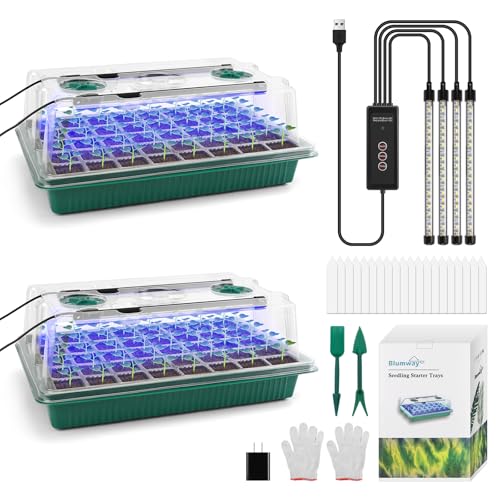
BlumWay
BlumWay Seed Starter Tray with Grow Light, Humidity Dome, 2 Pack 80 Cells | Vented Dome & Drainage Holes, Adjustable Brightness, Seedling Tray for Plant Germination, Seed Growing, Indoor Plant Starter
- 【360°Spectrum Seed Starter Tray with Grow Light】 The Larger 360°full-spectrum plant grow light in our seed start tray promotes hea…
- 【Higher Dome & Deeper Cell Trays】80 powerful lamp beads (40 per tray) provide full & even plant light for every seed. More grow li…
- 【Adjustable Humidity & Grow Light】Upgraded seed starting trays with adjustable grow light timer & ventilation vents, for superior…
BlumWay built this kit for people who grow tall seedlings. The humidity dome is 9cm (about 3.5 inches) tall, and the cells are 1.96 inches deep. That extra depth matters for tomatoes, peppers, and anything else that develops a substantial root system before transplant. Shallow trays force you to transplant earlier than you might want. This one gives you a couple extra weeks.
The light system is the most adjustable of the non-smart kits. You get 80 full-spectrum beads across two trays, with three lighting modes, three timer settings (3H, 6H, 12H), and five brightness levels. The remote indicator uses color coding: red for 3-hour, blue for 6-hour, red and blue together for 12-hour. It takes a day to remember the colors, but once you do, it’s intuitive. The 360-degree spectrum includes white and blue light, which supports faster germination and stronger stems. The ABS plastic is thicker than the PET used on cheaper kits, and the clear dome lets you monitor growth without lifting it.
The main drawback is that the light strips mount on the dome itself. That means when you remove the dome for watering or after germination, the light goes with it. You’ll need to find another way to light the seedlings once the dome comes off. Some people rig the strips to a shelf or use a separate grow light. It’s not a dealbreaker, but it’s a design quirk worth knowing. The 0.31-inch drainage holes are generous and help prevent root rot.
- 80 full-spectrum LED beads across two 40-cell trays
- 9cm tall dome and 1.96-inch deep cells for root growth
- 3 timer settings and 5 brightness levels with color-coded indicators
- Thick ABS plastic, anti-UV and corrosion-resistant
- USB or plug-in power with adapter included
Best for: Growers starting tomatoes, peppers, or other tall seedlings that need deep cells and a high dome.
LetPot Smart Seed Starter System
4th Pick

LETPOT
LetPot Smart Seed Starter with Humidity Dome, Germination Kit with Waterproof Seedling Mat, 24W Full Spectrum LED Grow Light, Smart Heating Base, EC Soil Sensor & App Control for Indoor Seed Starting
- All-in-One Smart Germination System: This smart seed starter integrates a 24W full-spectrum LED grow light, 24W smart heating base…
- 24W Full-Spectrum LED Grow Light – Even Coverage, No Leggy Seedlings: The built-in full-spectrum LED grow light delivers uniform l…
- Smart Heating Base – Stable Soil Temperature Day & Night: The integrated 24W smart heating base maintains consistent soil warmth t…
LetPot’s smart starter is the most advanced kit on this list. It’s the one you buy when you want the system to do the thinking. The 24W full-spectrum LED light panel is height-adjustable and rotates 180 degrees, so you can direct light exactly where it’s needed. The 24W heating base maintains consistent soil temperature day and night, with automatic day/night adjustment. For anyone starting seeds in a cold basement or garage, that heating base is the difference between germination and failure.
The soil EC and temperature sensors are what separate this from every other kit here. They feed real-time data to the display and the app, so you can see whether your soil is too hot, too cold, or running low on nutrients. For beginners, that data removes a lot of guesswork. For experienced growers, it’s a useful diagnostic tool. The app also controls the light schedule, brightness, and heating settings. The condensation-capture edge on the dome guides water back into the tray instead of onto your countertop, which is a small detail that makes a big difference in daily use.
The obvious trade-off is price. This kit costs significantly more than the others, and it only has 40 cells. You’re paying for the smart features, not capacity. The app requires a 2.4GHz Wi-Fi connection, which can be finicky in some homes. And the sensors measure EC, not pH, so you’ll still need a separate pH tester if you’re growing nutrient-sensitive plants. It’s not the right kit for someone who just wants to start a few tomatoes on a windowsill.
- 24W full-spectrum LED with adjustable brightness and 180-degree rotation
- 24W smart heating base with automatic day/night temperature control
- Soil EC and temperature sensors with real-time app monitoring
- Extra-tall humidity dome with condensation-capture edge
- Touch and app control for lights, heat, and scheduling
Best for: Tech-savvy growers and beginners who want a hands-off system with heating and real-time soil data.
Tryitsbest 120-Cell Self-Watering Kit
5th Pick

Tryitsbest
120-Cell Self-Watering Seed Starter Tray with Grow Light, Indoor Seed Starting Kit Trays with Heat Mat, Adjustable Brightness Plant Germination Trays Growing Kit with 4.13" Humidity Dome for Seed Grow
- Smart Control Sunlight-Simulating Grow Light: Plant starter trays growing kit full-spectrum lights with 8 level adjustable brightn…
- Fast Sprout Waterproof Heat Mat: Seed germination kit with seed heat mat provides consistent, even warmth for healthier, quicker g…
- Smart Self-Watering Design: Seed starting trays for planting seeds features a capillary mat and water reservoir, an efficient syst…
Tryitsbest combines two features that rarely appear together at this price point: a 120-cell self-watering system and a waterproof heat mat. The heat mat provides consistent, even warmth for faster germination, and it wipes clean easily. For anyone starting seeds in a cool room, that mat is essential. The 60-cell trays (two of them) use a capillary mat and water reservoir, so moisture stays consistent from germination through transplant. You fill the reservoir, and the mat does the rest.
The light system is more adjustable than most. You get full-spectrum LEDs with 8 brightness levels and a 0-24 hour timer. The lights can be controlled individually or together, which is useful if you’re starting different crops with different light needs. The 4.13-inch humidity dome is the tallest on this list, giving seedlings plenty of room before they touch the light. The two adjustable vents let you fine-tune humidity and airflow. The BPA-free PET construction is similar to the Patigrow, with a 1.5mm thickness that holds up to repeated use.
One quirk: the round vent covers need a firm press to seat properly. If you don’t push them in all the way, humidity escapes and the dome fogs unevenly. It’s a minor issue, but it’s worth knowing before you set it up. Also, the heat mat doesn’t have a thermostat, so you can’t dial in a specific temperature. It provides gentle warmth, which is fine for most seeds, but heat-sensitive varieties might germinate faster than you expect. Check the current price on Amazon, as availability fluctuates.
- 120 cells across two self-watering trays with capillary mats
- Waterproof heat mat for consistent germination warmth
- 8 brightness levels and 0-24h timer with independent light control
- 4.13-inch tall humidity dome with two adjustable vents
- BPA-free PET construction with enlarged drainage holes
Best for: Growers in cool rooms who want a large self-watering kit with a heat mat and flexible lighting.
Light Distance and PPFD/DLI Cheat Sheet by Crop
Light distance is the most misunderstood part of seed starting. Too far, and seedlings stretch. Too close, and you cook the leaves. The right distance depends on the crop and the light intensity. Here’s a practical starting point for the kits on this list.
Lettuce and herbs: These need the least light. Aim for 100-200 PPFD at the canopy, which means keeping the light 4-6 inches above the seedlings for most kits. A DLI of 10-14 mol/m²/day is plenty. Run the light 12-14 hours a day.
Tomatoes and peppers: These are heavy feeders. They need 300-500 PPFD and a DLI of 16-22 mol/m²/day. Keep the light 2-4 inches above the canopy for the Patigrow and BlumWay kits. For the Bonviee 12-LED strips, you’ll want the light as close as possible without touching the leaves, and you may need to run it 14-16 hours a day.
Flowers and slow starters: Petunias, impatiens, and similar flowers need 200-300 PPFD and a DLI of 12-16 mol/m²/day. Keep the light 3-5 inches above the canopy.
Watch for stretch. If seedlings grow tall and thin with wide gaps between leaves, they’re not getting enough light. Lower the fixture by an inch or two. If leaf edges curl or turn brown, the light is too close. Raise it. This back-and-forth is normal. The right distance changes as seedlings grow.
Heat Mat and Thermostat Safety
Heat mats speed up germination, but they can also cause problems if you’re not careful. The biggest risk is damping-off, a fungal disease that thrives in warm, wet, still air. A heat mat without ventilation is a damping-off factory. Always use the adjustable vents on your humidity dome to keep air moving. Once seedlings emerge, remove the dome entirely during the day.
If your heat mat doesn’t have a thermostat, like the one on the Tryitsbest kit, monitor soil temperature with a probe. Most seeds germinate best between 65-75°F. If the soil climbs above 80°F, unplug the mat for a few hours. For kits with smart heating bases, like the LetPot, the automatic day/night adjustment handles this for you, but you can still override it manually if you’re growing heat-sensitive varieties.
Damping-off looks like a seedling that suddenly collapses at the soil line. The stem pinches and the plant falls over. There’s no cure once it starts. Prevention is the only strategy: use clean trays, don’t overwater, keep air moving, and remove the dome as soon as most seeds have sprouted. If you see mold on the soil surface, scrape it off and increase ventilation immediately.
Cost Per Seedling and Energy Use
Seed starter kits save money compared to buying transplants, but the savings vary by kit. Here’s the math for a typical 60-cell tray.
A 60-cell tray of tomatoes from a nursery costs around $30-40. A packet of tomato seeds costs $3-5 and gives you 20-50 seeds. If you start 60 cells and 50 germinate, your cost per seedling is roughly 10 cents, plus the cost of soil and electricity. Even with a $40 kit, you break even after one season.
Electricity is minimal. The Patigrow’s 56-bead strips draw about 15-20 watts per tray. Running two trays for 14 hours a day for 6 weeks costs about $1-2 in electricity, depending on your rates. The LetPot’s 24W light and 24W heating base draw more, but even running both at full power for 6 weeks costs less than $5. The heat mat on the Tryitsbest kit draws around 20 watts, adding roughly $1-2 to your bill for the season.
The real savings come from repeat use. A kit that lasts three seasons cuts your cost per seedling by two-thirds. That’s why build quality matters. Thin plastic domes crack. Cheap LED strips burn out. The kits on this list use thicker materials, but even the best ones will eventually need replacement parts. Store them clean and dry between seasons, and you’ll get more years out of them.
After Germination: Transplant Timeline
Germination is the easy part. Keeping seedlings alive after they sprout is where most people struggle. Here’s a simple timeline for the kits on this list.
Week 1-2: Keep the dome on and the vents closed. Light 12-14 hours a day. Water from the bottom if your kit supports it. The soil should stay consistently moist, not soggy. Once you see green sprouts, open the vents halfway.
Week 3-4: Remove the dome during the day. Keep the light 2-4 inches above the canopy. Start fertilizing with a diluted liquid fertilizer once a week. If seedlings are crowded, thin them by snipping the weakest ones at the soil line. Don’t pull them, as that disturbs the roots of neighboring plants.
Week 5-6: Most seedlings are ready to transplant. Tomatoes and peppers should have at least two sets of true leaves. Lettuce and herbs can go out earlier. Harden them off by putting them outside for a few hours each day, gradually increasing the time over a week. Then transplant into larger pots or the garden.
If you’re using a self-watering kit, stop filling the reservoir about a week before transplant. You want the soil to dry slightly so the roots grow deeper. For kits with heat mats, turn the mat off once seedlings have their first true leaves. They don’t need the extra warmth anymore, and keeping it on can encourage weak, spindly growth.
How We Chose These Products
We evaluated these kits on five criteria: light output, moisture control, build quality, ease of use, and value. Light output was the most important. A kit with weak LEDs will produce leggy seedlings no matter how good the rest of the system is. We looked at LED count, spectrum, adjustability, and timer functionality. Moisture control came second. Self-watering systems, adjustable vents, and drainage holes all matter for preventing damping-off and root rot.
Build quality was assessed based on material thickness, dome fit, and reusability. Kits with thin plastic and loose-fitting domes were marked down. Ease of use covered setup time, clarity of instructions, and whether the kit required additional purchases (like a USB adapter or timer). Value was calculated by comparing features against the typical price range for each tier. We didn’t test these kits hands-on, but we analyzed the specifications, user feedback patterns, and design choices to identify the strengths and weaknesses that matter most.
Buying Guide: What Really Matters
Cell count is the first thing people look at, but it’s not the most important. A 120-cell kit with weak light will produce worse results than a 40-cell kit with strong light. Start with light output. Look for at least 30-50 LED beads per tray for tomatoes and peppers. For lettuce and herbs, 12-20 beads is fine. Adjustable brightness and a built-in timer are worth paying extra for, because they let you adapt the light as seedlings grow.
Moisture control is the second priority. Self-watering systems with capillary mats reduce daily maintenance and prevent the cycle of drought and flood that damages roots. If you choose a kit without self-watering, make sure it has drainage holes and a clear base so you can bottom water. Adjustable vents on the humidity dome are non-negotiable. Without them, you can’t control humidity as seedlings emerge, and you’ll be fighting damping-off.
Finally, consider your growing environment. If you’re starting seeds in a cold room, a heat mat or smart heating base is essential. If you’re in a warm, humid climate, you can skip the heat and focus on light and ventilation. If you travel often, a self-watering system with a large reservoir will save your seedlings. And if you’re new to seed starting, a kit with clear instructions and a simple setup will get you better results than a complex system you don’t understand. For more detailed comparisons, see this best seed germination kit guide.
Our Top Recommendation
The Patigrow 120-Cell Self-Watering Kit is our top pick for most people. It combines strong light (56 LED beads per tray), a self-watering system, and a sturdy build at a reasonable price. The 120-cell capacity is enough for a full garden, and the two independent trays give you flexibility. It’s not the cheapest option, and it doesn’t have app control or a heat mat, but it does the basics exceptionally well.
If you want smart features and heating, the LetPot Smart Seed Starter is the runner-up. It’s the best choice for anyone starting seeds in a cold space or who wants real-time soil data. The 40-cell capacity is smaller, so it’s better for herbs and flowers than a full vegetable garden.
For budget growers, the Bonviee 5-Pack is the best value. It lacks a timer and heat mat, but the modular design and clear inserts make it a solid starter kit. And if you need a heat mat without paying smart-kit prices, the Tryitsbest 120-Cell kit is the one to get. For more options, check out this seed starter tray with grow light roundup.
Frequently Asked Questions
How far should the light be from seedlings?
For most kits, keep the light 2-4 inches above the tallest seedling. Lettuce and herbs can handle 4-6 inches. If seedlings stretch, lower the light. If leaves curl or brown, raise it. Check the distance every few days, because seedlings grow fast.
How long should lights stay on?
Most seedlings need 12-16 hours of light per day. Tomatoes and peppers do best with 14-16 hours. Lettuce and herbs are fine with 12-14. Use a timer to keep the schedule consistent. Plants need darkness too, so don’t run the lights 24/7.
Are these kits reusable?
Yes, with care. Wash the trays, domes, and bases with warm soapy water between seasons. Rinse the capillary mats and let them dry completely. LED strips and controllers should be wiped with a damp cloth, not submerged. Store everything in a dry place. Most kits last 2-3 seasons with proper care.
Do I need a heat mat if my house is warm?
Not necessarily. Most seeds germinate fine at room temperature (65-75°F). A heat mat helps if your growing space is cooler than 65°F, or if you’re starting heat-loving crops like peppers and tomatoes in early spring. If your house stays warm, save the money and skip the mat.