

The Best UV Light for Indoor Plants: A Practical Guide to Spectrum, Safety, and Real Results
Contents
Your monstera is stretching toward a window that only gets four hours of weak winter sun. The leaves are pale, the stems are long, and nothing you do with the watering can fixes it. Light is the missing piece, and for many indoor growers, so is the ultraviolet portion of the spectrum that a windowsill never delivers.
Choosing a UV-capable grow light isn’t about chasing the highest wattage. It’s about matching the spectrum to the plant’s stage, keeping the fixture close enough to matter, and understanding that UV is a tool with real safety rules attached. Get those three things right and your indoor garden responds within weeks.
Below we break down five lights that cover the practical range — clip-on, halo, telescoping, tabletop, and bulb — plus the science behind UVA and UVB, a dosage chart, and the safety guidance most roundups skip entirely. The GooingTop takes the overall spot for its balance of price, spectrum, and timer flexibility.
| Features | GooingTop Grow Light | Kullsinss Halo Light | yadoker LED Light | FECiDA Bonsai Light | Briignite Grow Bulb |
|---|---|---|---|---|---|
| Mounting Style | Clip and gooseneck | Soil stake, no base | Telescoping pole stand | Free-standing tabletop base | Standard A19 socket |
| Spectrum Range | 6000K full spectrum | 380-760nm full spectrum | 380-800nm full spectrum | 3000K/5000K plus UV-IR | 4000K with red/blue |
| Dimming Levels | Not dimmable | 5 levels | 10 levels | Not dimmable | Not dimmable |
| Timer Options | 4/8/12 hours | 6/12/16 hours | 8/12/16 hours | Not specified | Not built in |
| Best Use Case | Small houseplants, desk setups | Tall statement plants | Large plants, hanging baskets | Bonsai, succulent collections | Standard lamp fixtures |
GooingTop Grow Light,6000…
1st Pick

GooingTop
GooingTop Grow Light,6000K Full Spectrum Indoor Plant Growing Lamp | Desk Lamp with White Red LEDs for Indoor Plants,Clamp with Flexible Gooseneck,Brightness Adjustable,Auto Timer 4 8 12Hrs
- 6000K White Light - equipped with 10 Red + 74 White LEDs, this growing Lamp is similar to the full-spectrum sunlight at noon,that…
- Timer Function & Multiple Settings - this plant spotlight offer the timer function with 3 options that is 4Hrs or 8Hrs or 12Hrs, i…
- Easy to Install - with flexible Gooseneck & strong clamp,it allows you to place the growth light in any direction to provide the b…
The GooingTop is a clip-on fixture with a flexible gooseneck and a 6000K white output that reads like midday sun. It suits anyone with a shelf of small houseplants, a desk herb pot, or a starter tray that needs consistent light without a permanent installation. The clamp grips most surfaces up to about two inches thick.
Two things stand out. First, the color rendering index sits at 95, which means foliage looks natural instead of washed out under purple LEDs. Second, the timer runs on a true 24-hour cycle — set it to 8 hours and it repeats daily without you touching it again. Power draw is roughly 10 watts, which works out to a couple of dollars a month at 12 hours daily.
The honest drawback: there’s no dimming. You get on or off, plus the timer. If your plants sit at different distances from the light head, you can’t compensate by lowering intensity. You’ll need to adjust the gooseneck instead. The 10-watt output also limits it to a small footprint — one or two pots, not a full shelf.
- 74 white LEDs plus 10 red for a balanced full-spectrum blend
- Three timer presets (4, 8, or 12 hours) on a repeating daily cycle
- USB or AC powered, so it works from a power bank in a pinch
- Flicker-free output rated safe for reading under
- One-year warranty with direct replacement service
Best for: Beginners with a handful of small houseplants who want a set-and-forget clip light under $30.
Kullsinss 6.3in Grow Ligh…
2nd Pick
Kullsinss
Kullsinss 6.3in Grow Lights for Indoor Plants, Full Spectrum Plant Light | Wood Grain Grow Lamp for Tall Plants, Auto Timer & Dimmable Setting, 10-60in Height Adjustable, Stylish Indoor Garden Decor
- Elegant Faux Woodgrain Design: This halo grow light has a unique faux woodgrain design that complements any interior space. Compar…
- Full Spectrum Grow Light: Equipped with 80 high efficiency diode LEDs, our halo plant light can provide all wavelengths from 380 n…
- Smart Controller: Our plant grow light features 5 dimmable levels, 3 spectra modes (white/ warm white+red/mix light), and upgraded…
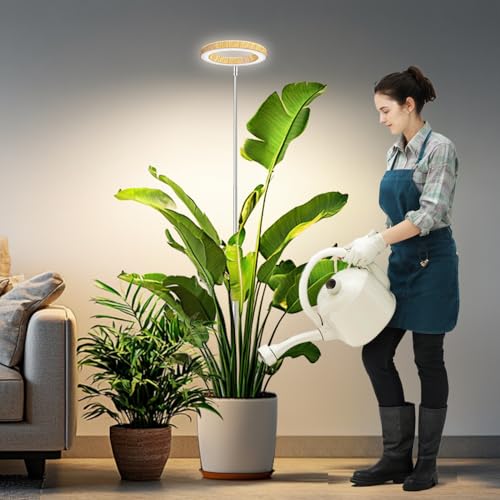
Kullsinss built a halo-style ring light with a faux woodgrain finish that looks more like a pendant lamp than grow equipment. It stakes directly into the soil, so there’s no base, no clamp, and no cord clutter on your shelf. This one is aimed at people who own a tall ficus, a rubber tree, or a monstera and want light hitting the canopy from above.
The height range runs from 10 to 65 inches, which covers most floor-standing plants. The smart controller gives you five dimming levels and three spectral modes — white, warm white with red, or a mixed blend. That mode switching matters more than most buyers realize. White light for vegetative growth, warm-plus-red for flowering, mixed for general upkeep. The 80 diodes span 380 to 760nm.
One caveat worth knowing before you buy: there’s no base included. The stake goes into soil, and that’s the only mounting option. If your plant sits in a small pot with shallow soil, the stake may not hold the light head steady at full extension. Heavy top growth can also cause the ring to lean.
- 80 LEDs covering 380-760nm for germination through fruiting
- Faux woodgrain housing resists cracking better than bamboo
- Three spectral modes with five brightness levels each
- Timer cycles at 6, 12, or 16 hours
- Adjustable from 10 to 65 inches tall
Best for: Owners of tall, single statement plants who want a clean-looking fixture that blends into the room.
Plant Grow Light,yadoker…
3rd Pick

yadoker
yadoker Grow Lights for Indoor Plants, Full Spectrum 6.3" Halo Plant Light | Bamboo Grow Lamp, 5V Low Volt, 10-100% Dimmable, 8/12/16H Auto Timer, 13.7"-61.1" Telescopic, 72 LEDs, for Tall Indoor Plants
- 72 LED Full Spectrum, 380nm-800nm – Built with 72 super bright LEDs covering the full 380nm-800nm spectrum: 36 white 5000K, 28 war…
- Height Adjustable 13.7"-61.1" – The telescopic pole extends from 13.7" to 61.1", so you can raise the halo as your plant grows and…
- 10-Level Dimmable 10%-100% – Ten brightness settings let you dial in the right intensity for each plant, from a soft 10% glow for…
The yadoker is a telescoping pole light with a 13-foot cord, which solves a problem most clip lights can’t: reaching a hanging basket or a plant tucked behind furniture. The pole extends from 13.7 to 61.1 inches, and the head covers a wider area as it rises. This is the pick for people with several plants grouped together or one large specimen that needs even coverage.
Dimming goes ten levels deep, from 10% to 100%, which gives you real control over intensity without moving the fixture. The 72-LED array blends 5000K white, 3000K warm white, red, and blue diodes across a 380-800nm range. That’s slightly wider than the Kullsinss, and the extra near-infrared edge can help with flowering triggers in photoperiod-sensitive plants.
The trade-off is footprint. A telescoping pole needs floor or table space, and the base isn’t small. In a tight apartment corner, that’s a real constraint. The 13-foot cord is generous, but you’ll still want an outlet within reach or a short extension.
- 72 LEDs spanning 380-800nm with a white/warm/red/blue mix
- Ten brightness steps from 10% to 100%
- Built-in timer with 8, 12, and 16-hour cycles
- 13-foot power cord reaches hanging plants and far corners
- Pole telescopes from 13.7 to 61.1 inches
Best for: Growers with hanging plants, large specimens, or a cluster of pots that need wide coverage from one fixture.
FECiDA Bonsai Grow Light,…
4th Pick

FECiDA
FECiDA Bonsai Grow Light, Table Grow Lights for Indoor Plants Collection
- Like A Small Sun Indoor, Plants Love---This sunlight lamp for plants designed with 208PCS LEDs, 2000 Lumen Brightness, 200W Incand…
- Natural Sunlike Full Spectrum---This full spectrum grow lights for indoor plants designed with 3000K, 5000K, 660nm, UV-IR LEDs. It…
- Stable Base and Widely Use---This desk grow light with stable base can free stand on desktop, tabletop, countertop, or cabinet for…
FECiDA’s tabletop light is the brightest option here by a wide margin. It pushes 2026 lumens from 208 LEDs and draws the equivalent of a 200-watt incandescent bulb. That output suits bonsai, succulents, cacti, and seed-starting trays — plants that want intensity, not just duration. The free-standing base sits on any desk or countertop.
The spectrum includes 3000K, 5000K, 660nm red, and UV-IR diodes, which is the closest thing to natural sunlight in this lineup. That UV-IR content is what separates it from the cheaper clip lights. It also supports daisy-chaining — connect up to three units on one outlet, which is genuinely useful if you’re running a seed-starting operation across multiple trays.
Downsides exist. There’s no built-in timer mentioned, so you’ll need an external outlet timer for consistent photoperiods. The 2026-lumen output also runs warmer than the low-wattage options, so airflow matters in a closed cabinet. And the base takes up real table space.
- 208 LEDs producing 2026 lumens of output
- 3000K, 5000K, 660nm, and UV-IR diodes for a sunlike blend
- Daisy-chain up to three units on a single outlet
- Stable free-standing base for desks and countertops
- Adjustable height stand for different plant sizes
Best for: Bonsai, succulent, and seed-starting growers who need high intensity and multi-unit scalability.
Briignite Grow Light Bulb…
5th Pick

Briignite
Briignite Grow Light Bulbs, LED Grow Light Bulb A19 Bulb, Full Spectrum | Grow Light Bulb, Plant Light Bulbs E26 Base, 11W Grow Bulb 100W Equivalent,Grow Light for Indoor Plants,Seed Starting, 2Pack
- FULL SPECTRUM & NATURAL LIGHT: A19 full spectrum grow light appears 4000K white to eyes but has a red/blue light spectrum. Same as…
- HIGH BRIGHTNESS & ENERGY SAVING: A19 LED plant grow light bulbs deliver 180-degree 1000LM bright light output. Use High Lumen LED…
- HIGHER EFFICIENCY: LED grow bulb with high light transmission improves plant absorption more effectively. Balanced lighting of ful…
Briignite takes a different approach: it’s a standard A19 bulb that screws into any lamp socket. No clamps, no poles, no stakes. If you already own a desk lamp or floor lamp with an adjustable arm, this is the cheapest way to convert it into a grow light. The 4000K output looks like normal white light to the eye, so it works in living spaces without the purple glow.
Output is 1000 lumens at 180 degrees, drawing 11 watts — roughly 90% less than a comparable traditional bulb. The PPF rating of 25 micromoles per second is modest but adequate for herbs, leafy greens, and low-light houseplants. Lifespan runs up to 25,000 hours, and the aluminum and plastic housing handles heat better than a bare LED chip.
Here’s the limitation: no timer, no dimming, no spectrum modes. You control it with a wall switch or an external timer. And the 1000-lumen output won’t drive flowering in demanding plants like tomatoes or peppers on its own. It’s a supplement, not a primary grow light for high-light crops.
- A19 base fits standard E26 lamp sockets
- 1000 lumens at 11 watts, equivalent to a 100W incandescent
- Full spectrum with red and blue content, 4000K visible color
- PPF of 25 micromoles per second
- Up to 25,000 hours rated lifespan
Best for: Anyone who already owns a lamp and wants to turn it into a grow light for herbs and low-light plants.
Why Indoor Plants Need UV Light (The Science)
Windows block most UVB and a good chunk of UVA. That’s why a plant sitting two feet from a south window still behaves like it’s in shade. Indoors, you’re essentially running a UV-free environment unless you add it deliberately.
UVA vs UVB — What Each Does
UVA (315-400nm) penetrates leaf tissue and influences pigment production, leaf thickness, and overall stress tolerance. UVB (280-315nm) is more energetic and triggers a different response — primarily the production of secondary metabolites like flavonoids and, in some species, resin compounds. Neither replaces PAR (photosynthetically active radiation) for raw growth. They modulate how the plant grows, not how fast.
For most houseplants, a light with some UV content in the 380-400nm range is enough to see benefits without risk. Dedicated UVB supplementation is a specialty tool for flowering crops and resin-producing plants, and it needs careful dosing.
How UV Triggers Blooming and Resin Production
Plants use UV as a signal. When UVB hits leaf surfaces, it activates a stress response that redirects energy into protective compounds. In cannabis and some herbs, that means more trichomes and terpenes. In flowering ornamentals, it can nudge the plant toward bloom. The effect depends on species, dose, and timing — UV is a trigger, not a fuel.
For a deeper look at how spectrum affects growth stages, see this guide to the best light spectrum for indoor plants.
How We Chose These Products
We evaluated each light on spectrum range, output, adjustability, timer functionality, and mounting flexibility. Products with UV-IR diodes or full 380-800nm coverage scored higher than those limited to visible white light. We also weighed real-world usability — cord length, clamp strength, base stability — because a light that’s awkward to position won’t get used.
Safety mattered too. Lights with flicker-free output, low heat generation, and reasonable power draw ranked above high-wattage fixtures that need ventilation. We cross-checked wattage against coverage claims and discarded any spec that didn’t hold up. For a broader look at wattage math, this breakdown of grow light wattage covers the numbers.
Buying Guide: What Really Matters
Spectrum range is the first filter. A light that stops at 700nm misses the far-red and UV content that influences flowering and resin. Look for 380nm on the low end and at least 760nm on the high end if you want full-stage coverage. White-only LEDs at 5000K or 6000K are fine for vegetative growth but won’t do much for bloom.
PPFD and wattage per square foot come next. For leafy greens and herbs, 100-200 PPFD is plenty. Fruiting plants want 400-600 PPFD. A 10-watt light covers roughly one square foot at useful intensity. A 200-watt-equivalent fixture covers three to four square feet. Match the light to your canopy size, not your shelf size.
Timer and dimming features separate lights you’ll actually use from ones you’ll fight with. A built-in 24-hour cycle timer means you don’t need an outlet timer. Dimming lets you adjust for plant height without moving the fixture. If you’re running multiple lights, daisy-chaining saves outlets. For bulb-based setups, check this roundup of the best grow light bulbs for indoor plants.
Safety: Protecting Eyes and Skin
UV light is not a toy. Even the low-level UV in full-spectrum grow lights can cause eye strain over long exposure. Never look directly into an active fixture. If you’re working under the light for more than a few minutes, wear UV-blocking glasses. Standard sunglasses block most UVA and UVB.
Skin exposure matters less at these intensities, but extended direct contact with a high-output UVB source can cause redness. Keep fixtures at least 12 inches from where you sit or sleep. For plants, distance is about intensity, not safety — closer means stronger light, and too close can bleach leaves.
How to Use UV Lights Correctly
Hanging Distance and Duration Chart
Distance depends on wattage. A 10-watt clip light should sit 4-8 inches above foliage. A 50-watt-equivalent fixture works at 12-18 inches. A 200-watt-equivalent light needs 24-36 inches. Start at the far end of the range and move closer if growth stalls.
Duration follows the plant’s natural photoperiod. Most houseplants want 10-14 hours of light. Seedlings want 14-16. Flowering plants want 12 hours of light and 12 of dark. Never run UV lights 24 hours — plants need darkness to respire and reset.
Timing UV Around Photoperiods
Run UV during the middle of the light cycle, not at the edges. That mimics natural midday sun, when UV intensity peaks. If you’re using a separate UVB source for flowering, run it for 2-4 hours in the middle of the light period. More isn’t better — UV is a signal, and plants can only process so much.
Frequently Asked Questions
Do I really need UV for houseplants like pothos or snake plants?
No. Low-light houseplants grow fine under standard full-spectrum LEDs. UV matters most for flowering crops, resin-producing plants, and high-light species that evolved under intense sun.
Can UV light burn my plants?
Yes, if the fixture sits too close or runs too long. Symptoms look like bleached or crispy patches on upper leaves. Move the light up 4-6 inches and shorten the cycle by two hours.
Is UVB the same as UVC?
No. UVC (200-280nm) is germicidal and dangerous to plants and people. Grow lights use UVA and UVB only. Never use a UVC sterilization lamp on plants.
Will a UV grow light help with mold or pests?
UV can suppress some surface fungi and pests, but it’s not a treatment. It won’t fix an active infestation or a humidity problem. Treat UV as prevention, not cure.
Our Top Recommendation
The GooingTop takes the top spot for most indoor growers. It’s cheap, the timer works reliably, the 6000K output looks like normal light, and the clamp fits almost anywhere. It won’t drive heavy flowering, but for everyday houseplant health it’s the easiest pick.
If you need more intensity, the FECiDA delivers 2026 lumens and UV-IR diodes for bonsai and succulents. For tall statement plants, the Kullsinss halo looks good and reaches 65 inches. And if you already own a lamp, the Briignite bulb is the cheapest way in. For a wider comparison of UV-specific options, this UV lights for plants guide covers additional models.