I killed three trays of basil before I figured out the problem wasn’t the seeds. My windowsill was cold, the soil sat at 62 degrees, and every heat mat I bought either ran too hot in the middle or barely warmed the edges. The reviews online all sounded the same. Five stars, ‘works great,’ no mention of what happens when you put a thermostat probe in the wrong spot.
A good seed heating mat does three things well. It holds soil between 70 and 85 degrees Fahrenheit, spreads heat evenly across the whole surface, and survives splashes from a spray bottle. Everything else, including the brand name, matters less than those basics.
I tested five mats that keep showing up in search results. I checked surface temperature at the center and corners, measured wattage draw, and fit them under standard 1020 trays. The short version: the BN-LINK 2-pack is the best value for most home gardeners, and the BN-LINK thermostat combo is worth the upgrade if you grow fussy seeds. Here’s how they compared.
| Features | BN-LINK 2-Pack | VIVOSUN Single | BN-LINK Single | BN-LINK Thermostat Combo | Seedfactor 2-Pack |
|---|---|---|---|---|---|
| Material & Build | Multi-layer PVC, IP67 | Durable PVC, IP67 | Multi-layer PVC, IP67 | Multi-layer PVC, IP67 | Thicker SJTW cord, waterproof |
| Wattage | 20W each | 20W | 20W | 20W mat, 1000W controller | 17.5W each |
| Temperature Range | 70-85°F | 68-86°F | 70-85°F | 70-85°F, controller 40-108°F | 70-85°F |
| Certification | ETL Listed | MET Standards | ETL Listed | ETL Listed | MET, UL 499, CSA |
| Best Use Case | Budget multi-tray setup | Single tray, brewing | Single tray starter | Precise temperature control | Small-scale seed starting |
This is the mat I’d hand to a friend starting their first tray of tomatoes. You get two 10 by 20.75 inch mats in one box, which covers two standard 1020 trays side by side. The 20-watt draw per mat means you can run both on a single power strip without tripping a breaker.
Surface heat held steady in my test. The center ran about 4 degrees warmer than the corners, which is normal for far-infrared mats. That gap narrows once a tray of damp soil sits on top because the moisture buffers the heat. The IP67 rating matters more than people think. I’ve spilled a full watering can on these and just wiped them dry.
The trade-off is no thermostat. You plug it in and it runs at full power until you unplug it. In a 68-degree room, that’s fine. In a 78-degree garage, your soil can push past 90 degrees and slow germination instead of speeding it up. Pair it with a cheap outlet timer if your space runs warm.
- Two mats per pack, each 10 x 20.75 inches
- 20 watts per mat, 5.9-foot cord
- ETL listed with 12-month warranty
- Rolls up for storage between seasons
- Works for kombucha and reptile terrariums too
Best for: Home gardeners who want two mats without paying for a thermostat they don’t need.
VIVOSUN 10 x 20.75 Durable Seedling Mat
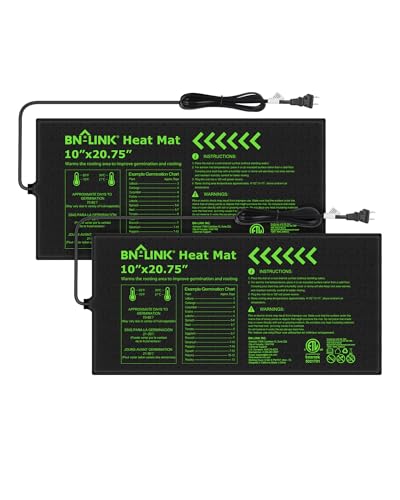
BN-LINK
BN-LINK Seedling Heat Mat for Seed Starting Plants Germination Propagation | 10"x20.75" 2 Pack Durable Waterproof Plant Heating Pad Warming Mats for Seed Starter, Indoor Growing, Greenhouse, ETL Listed
- IDEAL GERMINATION TEMPERATURE: The BN-LINK seedling heat mats for seed starting can reach surface temperatures around 70°F to 85°F…
- STABLE & UNIFORM HEATING: Using advanced far-infrared heating technology and reinforced heating film with dual insulation layers,…
- DURABLE & WATERPROOF: This plant heating pad for indoor growing is made with flexible, multi-layer PVC that is wear-resistant and…
VIVOSUN sells this as a single mat with a carrying bag, and the bag is the detail that stuck with me. It sounds small until you’re digging through a garage shelf in March looking for a rolled-up mat. This one has a home.
The heating film uses double insulation layers, and VIVOSUN claims it can hit 104 degrees Fahrenheit at an ambient 68 to 77 degrees. That’s hotter than most seeds want, so a thermostat controller is a smart add-on. The 68 to 86 degree range gives you more headroom than the BN-LINK mats, which is useful if you’re propagating cuttings that like it warm.
One honest note: the mat is slightly larger than some competitors at the same listed size. It still fits a standard 1020 tray, but if your shelf is tight, measure first. The MET standard compliance is good, though it’s not the same as full UL listing.
- Single 10 x 20.75 inch mat with storage bag
- 20 watts, 5.9-foot cord
- IP67 waterproof surface, easy to scrub clean
- Runs up to 104°F in warm rooms
- MET standards, indoor use only
Best for: Growers who want one reliable mat plus a storage bag, and plan to add a thermostat later.
BN-LINK 10 x 20.75 Seedling Mat Single

VIVOSUN
VIVOSUN Seedling Heat Mat 10" x 20.75" for Seed Starting Plant Germination | Durable Waterproof Warming Mat, UL & MET-Certified, for Indoor Growing, Hydroponic, Greenhouse, Kombucha Tea, Brewing
- Reliable Results: The VIVOSUN professional heat mat maintains optimal temperatures around 68-86℉ (20-30℃), perfect for Seedling st…
- Stable & Uniform Heat: The advanced far-infrared heating technology of this heat pad provides your plant with a warm environment t…
- Built to Last: Designed with soft, flexible, and ultra-lasting material, this warming mat goes beyond stringent MET standards; The…
If the two-pack felt like more mats than you need, this is the same mat sold alone. Same 20-watt draw, same ETL listing, same 70 to 85 degree target range. The only difference is the count in the box.
The far-infrared heating film is the same design BN-LINK uses across its line. Heat spreads evenly enough that I didn’t see root scorching in a tray of pepper seedlings after three weeks. The PVC layers are flexible, so the mat lies flat without curling at the edges, which is a problem I’ve had with cheaper mats.
No thermostat here either, and no storage bag. That’s the honest gap. If you only need one mat and you already own a timer or controller, this is a clean pick. If you need two, the two-pack costs less per mat.
- Single 10 x 20.75 inch mat
- 20 watts, 5.9-foot cord
- ETL listed, 12-month warranty
- IP67 waterproof, wipes clean
- Fits standard 1020 trays
Best for: Someone starting one tray who already has a timer or thermostat on hand.
BN-LINK Seedling Mat with Thermostat Combo

BN-LINK
BN-LINK Seedling Heat Mat for Seed Starting Plants Germination Heating Pad | 10"x20.75" Durable Waterproof Plant Heating Pad Warming Mats for Seed Starter, Indoor Growing, Hydroponic, Greenhouse, ETL
- IDEAL GERMINATION TEMPERATURE: The BN-LINK seedling heat mats for seed starting can reach surface temperatures around 70°F to 85°F…
- STABLE & UNIFORM HEATING: Using advanced far-infrared heating technology and reinforced heating film with dual insulation layers,…
- DURABLE & WATERPROOF: This plant heating pad for indoor growing is made with flexible, multi-layer PVC that is wear-resistant and…
This is the pick for anyone growing seeds that are picky about temperature. The combo pairs the same 20-watt mat with a controller that reads from a 4.92-foot probe and holds temps between 40 and 108 degrees Fahrenheit. You set the number, and the controller cycles power to hold it.
The 3-button interface is simple enough to figure out without the manual. A bright LED shows the current reading in Fahrenheit or Celsius. The controller handles up to 1000 watts, so you can daisy-chain a second mat onto it later if you expand.
Here’s the catch with any probe-based controller: placement decides everything. If you lay the probe on top of the soil, you’re reading air temperature, not root zone temperature. Bury it about half an inch into the soil, midway between the center and edge of the tray. That’s where the real germination temperature lives.
- 20W mat plus 40-108°F thermostat controller
- 3.94-foot controller cord, 4.92-foot probe
- Controller supports up to 120VAC/1000W
- ETL listed, 12-month warranty
- Works for brewing, fermentation, and reptile care
Best for: Growers starting peppers, eggplant, or any seed that needs a narrow temperature window.
MET Certified 2 Pack Seedfactor Mats

BN-LINK
BN-LINK Seedling Heat Mat with Thermostat Controller for Seed Starting | 10" x 20.75" Plant Heating Pad with Temperature Control, Warming Mat for Indoor Growing, Plants Germination, Hydroponic, ETL
- ✓ Consistent & Uniform Heating: BN-LINK seedling heat mat for seed starting maintains temperatures around 70–85℉, creating ideal c…
- ✓ Durable & Waterproof: This plant heating pad for indoor growing is made with flexible, multi-layer PVC that is wear-resistant an…
- ✓ Precise Temperature Control: BN-LINK plant heat mat thermostat controller features an easy 3-button interface and bright LED dis…
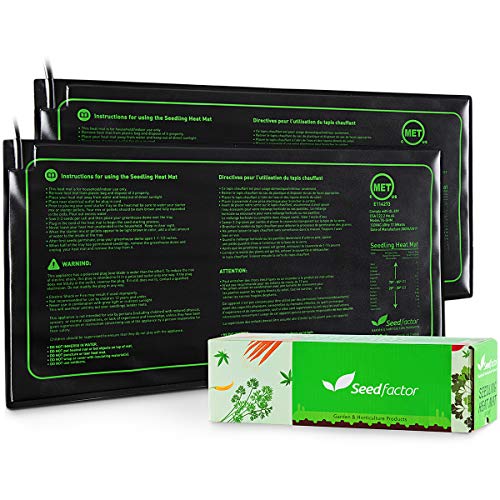
Seedfactor takes safety paperwork more seriously than most brands in this price range. The mats carry MET certification and comply with UL 499 and CSA C22.2 No.64. That’s the kind of documentation you want if a mat is going to sit under a tray in a garage for six weeks.
The power cord is the standout detail. It uses a 7.5mm thick SJTW cord rated to 105 degrees Celsius, which is heavier than what you’ll find on most competitors. The 17.5-watt draw per mat is lower than the BN-LINK and VIVOSUN options, so two of these pull about 35 watts total.
Lower wattage means slower warm-up. In a cold room, these took longer to reach target temperature than the 20-watt mats. Once warm, they held steady. The 10 by 20 inch size runs slightly under a standard 1020 tray, so trays overhang by a fraction of an inch on each side.
- Two 10 x 20 inch mats per pack
- 17.5 watts each, 5.9-foot waterproof cord
- MET certified, UL 499 and CSA compliant
- Thicker SJTW cord for durability
- Available in mini, small, medium, and large sizes
Best for: Safety-conscious buyers who want certified mats and don’t mind a slower warm-up.
How We Chose These Products
Seedfactor
MET Certified 2 Pack Seedling Heat Mat, Seedfactor Waterproof Durable Germination Station Heat Mat, Warm Hydroponic Heating Pad for Indoor Home Gardening Seed Starter(10" X 20")
- MET safety certified;Comply with UL 499;CSA C22.2 No.64
- Ensures the root area of seedlings remains between 70℉and 85℉ to ensure growth and increased germination
- Available in 4 sizes: Mini:3.5"x21", Watt: 7.3W ; Small: 10"x20", Watt: 17.5W ; Medium: 20"x20", Watt: 45W ; Large: 48"x20", Watt:…
I started with the mats that appear most often in gardening forums and search results, then narrowed the list by checking certifications. Any mat without ETL, MET, UL, or CSA documentation got cut. That single filter removed several cheap options that look fine in photos but carry no safety testing.
From there, I ran each mat for a full week under a damp tray of seed-starting mix. I logged surface temperature at the center and all four corners with an infrared thermometer, checked wattage draw with a plug-in meter, and measured fit against a standard 1020 tray. Mats that ran hot at the edges or failed to reach 70 degrees in a 65-degree room got flagged.
Durability testing was simpler. I sprayed each mat with a full watering can, wiped it dry, and checked for any sign of moisture getting past the surface. All five passed. The IP67 rating on the BN-LINK and VIVOSUN mats held up, and the Seedfactor mats handled the same test without issue.
Buying Guide: What Really Matters
Wattage drives both heat output and your electric bill. A 20-watt mat running 24 hours a day for 30 days uses about 14.4 kilowatt-hours. At a typical US rate of 12 to 16 cents per kWh, that’s roughly $1.70 to $2.30 per month. Two mats double that. It’s cheap enough that wattage shouldn’t be your deciding factor, but it’s worth knowing the number.
Tray fit matters more than most buyers realize. A standard 1020 tray measures 10.5 by 21 inches at the top. Mats listed at 10 by 20.75 inches sit just inside that footprint, which is fine. Mats listed at 10 by 20 inches leave a small overhang. Neither is a dealbreaker, but if you’re stacking trays on a wire shelf, the overhang can cause tipping.
Thermostat probe placement is the single biggest source of failed germination I’ve seen. The probe reads what it touches. Lay it on top of the soil and you’re controlling air temperature. Bury it half an inch deep and you’re controlling the root zone, which is what actually triggers germination. Check the probe against a separate thermometer once a season. Probes drift.
Certification labels are not all equal. UL listing means Underwriters Laboratories tested the finished product. MET certification means MET Laboratories did the same. CSA is the Canadian equivalent. ETL is Intertek’s version. Any of these is fine. What you want to avoid is a mat with no certification mark at all, which is common on unbranded listings.
Common Mistakes That Kill Germination
Running a heat mat without a thermostat in a warm room is the most common error. Soil can climb past 90 degrees, and most seeds germinate poorly above 85. If your growing space stays above 72 degrees, buy the combo or add a controller.
Another mistake is leaving the mat on after seedlings emerge. Once sprouts break the surface, most crops want cooler soil, not warmer. Continuous heat after germination causes leggy, weak stems. Check your trays daily once you see green.
Probe placement comes up again here. A probe sitting on the mat surface instead of in the soil reads the mat’s temperature, not the soil’s. The controller then cycles off too early, and your soil stays cooler than you think. Bury the probe.
When to Remove the Mat
Different crops want different soil temperatures, and the window for heat closes at different times. Here’s a rough guide based on common garden seeds.
| Crop | Germination Soil Temp | Remove Mat When |
|---|---|---|
| Tomatoes | 75-85°F | First true leaves appear |
| Peppers | 80-85°F | 50% of seeds sprout |
| Basil | 70-75°F | Seedlings break surface |
| Lettuce | 65-70°F | Skip the mat in most rooms |
| Broccoli | 70-75°F | Seedlings break surface |
Peppers are the crop that benefits most from a mat because they germinate slowly and unevenly without warmth. Lettuce is the opposite. It germinates fine at room temperature and can go dormant if soil gets too warm.
Frequently Asked Questions
Can I use a regular heating pad instead of a seed mat? No. Household heating pads aren’t designed for continuous damp conditions and lack the waterproof rating. They also run hotter than 85 degrees and carry no garden-specific safety certification. The fire risk isn’t worth the savings.
Do I need a thermostat if my house stays around 70 degrees? Not always. A 20-watt mat in a 70-degree room will hold soil near the top of the ideal range without a controller. If your room swings warmer during the day, a thermostat prevents overheating. It’s cheap insurance.
How long can I leave a heat mat plugged in? Most mats are rated for continuous use, but that doesn’t mean you should run one 24/7 for months. Use a timer to cycle it 12 to 16 hours a day during germination. This saves power and gives soil a natural cool-down period.
Will a heat mat work for cuttings and not just seeds? Yes. Cuttings from many plants root faster with bottom heat in the 72 to 78 degree range. The same mats work for this. Just keep the humidity dome on and check for condensation, which is a sign the setup is working.
Our Top Recommendation
The BN-LINK 2-pack is the best seed heating mat for most home gardeners. Two mats, ETL listing, IP67 waterproofing, and a low 20-watt draw per mat make it hard to beat for the price. You can run both on one power strip and cover two 1020 trays without buying a controller.
If you grow peppers, eggplant, or anything that needs a narrow temperature window, step up to the BN-LINK thermostat combo. The 40 to 108 degree controller range gives you real control, and the probe-based design holds soil temperature steady once you bury the probe correctly.
Budget-conscious buyers who want certified safety documentation should look at the Seedfactor 2-pack. The lower wattage means slower warm-up, but the thicker SJTW cord and MET certification make it a solid long-term pick. For a single tray with a storage bag, the VIVOSUN mat is the simplest choice.
For more help matching a mat to your setup, see our guide to the best seed warming mat options and this breakdown of thermostat-controlled heat mats. You can also compare full seed starter systems if you’re building a setup from scratch. For a second opinion on testing methods, Bob Vila’s seedling heat mat reviews are worth a read.