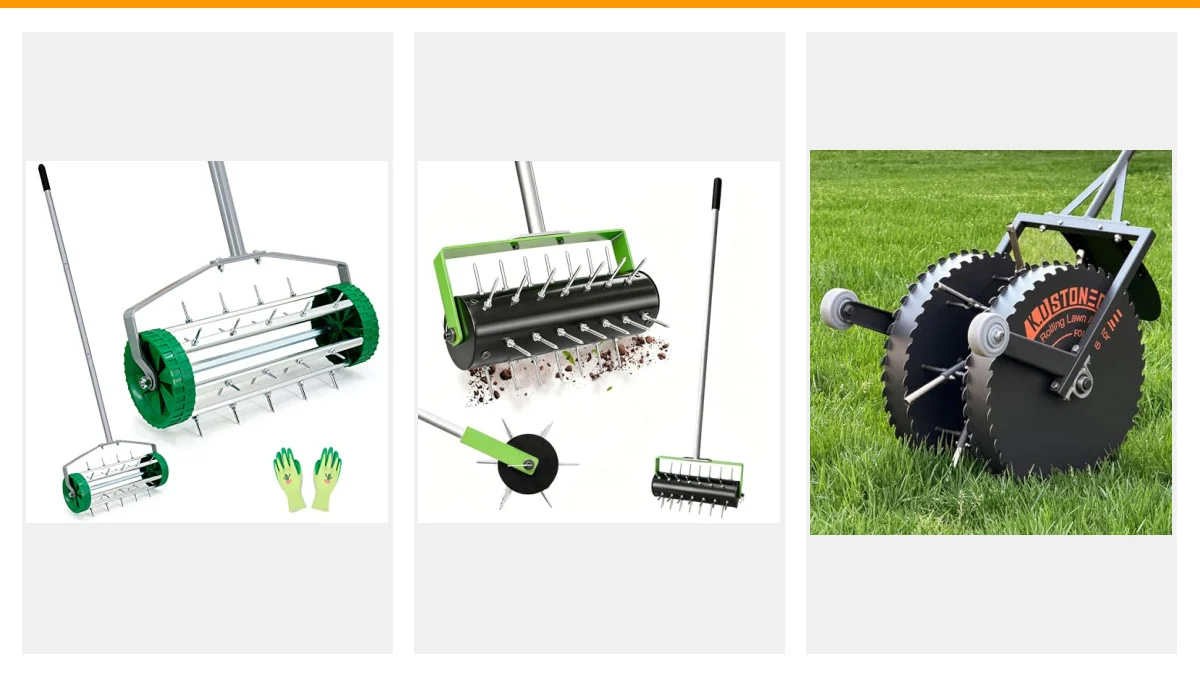
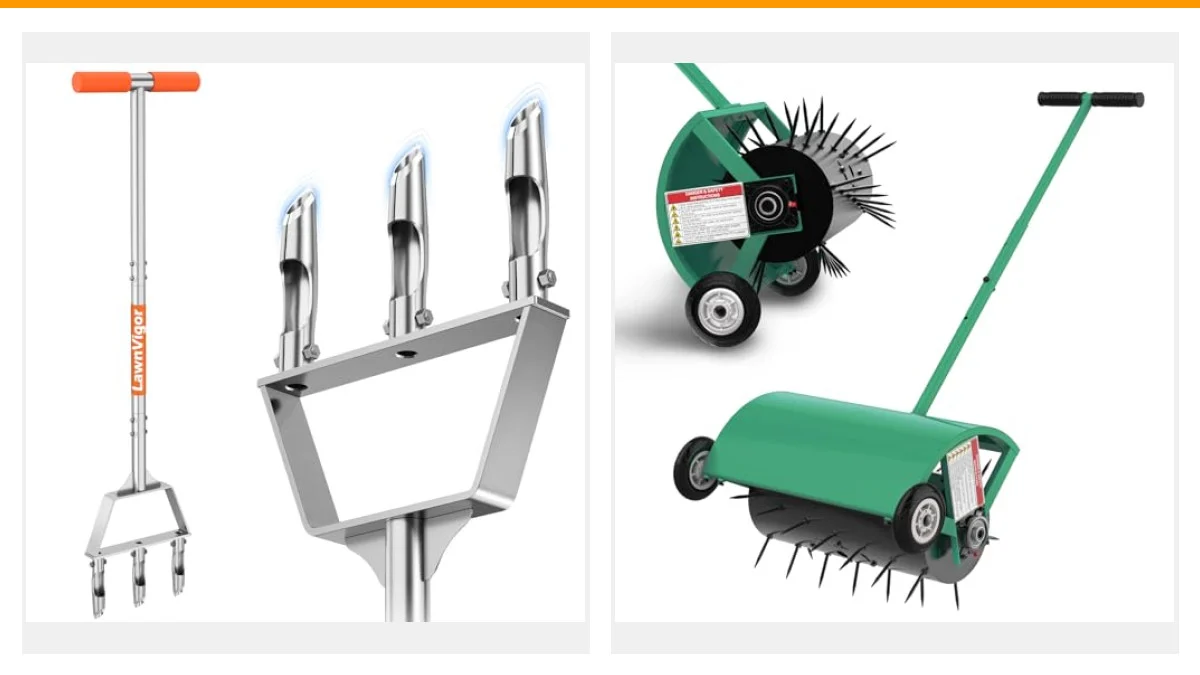
Half an acre of lawn looks great from the kitchen window until you drag a pair of aerator shoes across it and realize you’ve covered maybe twelve square feet in ten minutes. Your calves are burning, your back is complaining, and the lawn still has the same compacted, thirsty look it had before you started. That’s the moment most large-yard owners start shopping for something with wheels.
A rolling aerator solves the coverage problem because the drum does the work while you walk. The right one for a big lawn needs three things: enough roller width to cut down your pass count, enough weight capacity to punch through real soil, and a build that survives being dragged across a quarter acre every season. Tine length, spike arrangement, and handle height matter more than most listings admit.
We looked at five manual push spike aerators built for serious yard work, from the SENVERT heavy-duty drum to the Failenfeivp and Walensee 42-spike models. Below you’ll find honest notes on who each one suits, where they fall short, plus coverage math for a quarter acre and up, and a step-by-step aeration workflow you can pair with overseeding.
Here’s a quick side-by-side of the specs that actually drive the buying decision.
| Features | SENVERT Rolling Aera | Failenfeivp Rolling | K.D STONEDGE Coring | Walensee Rolling Aera | YihuaTop Rolling |
|---|---|---|---|---|---|
| Build and Material | Heavy-duty drum, TPR wheels | Galvanized rust-resistant steel | Heavy-duty patented rotary design | High-grade steel, heat-treated tines | Steel drum, rubber grip handle |
| Spike Count and Size | Spiral-spiked tread pattern | 42 reinforced 2-inch pegs | Rotary coring tines, plug pulling | 42 reinforced 2-inch tines | 42 spikes, matrix layout |
| Weight and Ballast | 32 lbs base, up to 55 lbs | Sand or rock loadable | Balanced manual push weight | Stones only, no sand | 32 lbs base, up to 70 lbs |
| Handle and Setup | Fully assembled, attach handle | 55-inch handle, no bending | Manual push operation | Adjustable four-part handle | Adjustable, pre-installed spikes |
| Best Use Case | Small to medium lawns, easy storage | Any soil type, long sessions | Small to medium compacted lawns | Wide soil range, moist ground | Large yards, compacted clay |
SENVERT Rolling Lawn Aera
The SENVERT rolling aerator is a smart match for the homeowner with a third of an acre who wants aeration to be a twenty-minute chore, not a weekend project. It suits anyone who stores equipment in a garage and has to roll it across a concrete driveway to reach the grass.
What separates this model from the pack is the auxiliary wheel setup. A pair of TPR wheels lets you lift the spikes off the ground and roll the unit to storage without gouging your driveway or your back patio. The spiral-spiked tread pattern also rolls smoother than straight-row designs, so steering around flower beds and trees feels less like wrestling a shopping cart. Setup is genuinely quick because the drum arrives assembled — you bolt on the handle and go.
The trade-off is size. With a 32-pound base weight and no stated drum width advantage, this isn’t the tool for a full acre. The drum also can’t take water as ballast, only sand or stones, so you’re capped at 55 pounds. On bone-dry clay that ceiling may not be enough for deep penetration.
- Base weight of 32 lbs, loadable to 55 lbs with sand or stones
- Auxiliary TPR wheels for quiet transport and driveway protection
- Spiral spike pattern for smoother rolling and easier direction control
- Drum arrives assembled; only the handle needs attaching
- Do not add water to the drum
Best for: Homeowners with small to medium lawns who need easy transport and quick setup.
Failenfeivp Rolling Lawn
The Failenfeivp is built for the person who owns a half-acre and doesn’t want to bend over once during the job. Its 55-inch handle keeps you upright, and the 42 reinforced pegs are heat-treated for hardness. That makes it a solid pick for anyone aerating a large yard with mixed soil types.
Galvanized steel construction sets this model apart from cheaper painted drums. Rust and corrosion resistance matters when you’re leaving a tool outside or in a damp shed between seasons. The spiral tine arrangement forms a near-perfect circle from the side, which cuts vertical runout and keeps the drum from hopping on uneven ground. You can load the drum with sand or rocks for deeper penetration on stubborn soil.
One honest caveat: 42 spikes on a standard drum means passes are still narrow, so a half-acre will take a while. There’s no tow-behind option here, and no auxiliary transport wheels mentioned, so moving it across pavement means lifting the drum. If you have a quarter acre or less, this is more tool than you need.
- 42 heat-treated 2-inch steel spikes for durability
- Galvanized steel drum resists rust and corrosion
- 55-inch handle eliminates bending during long sessions
- Loadable with sand or rocks for extra soil penetration
- Spiral tine layout minimizes vertical jumping
Best for: Large-yard owners with varied soil who want a rust-resistant drum and a tall handle.
Patented Rolling Lawn Aer
K.D STONEDGE takes a different approach. This is a coring tool, not a spike roller. It pulls actual soil plugs out of the ground instead of just poking holes, which matters if your lawn has serious compaction and you want the soil to actually decompress.
The patented rotary coring design is the standout feature. Plug removal opens channels that let air, water, and nutrients reach the root zone more effectively than spike aeration alone. For a lawn that’s been driven over, walked on for years, or sits on clay, that difference shows up within a season. The balanced weight design is tuned for efficient plug pulling on small to medium lawns.
Here’s the limitation you need to know: this is a workout. The listing itself calls it a sweat-inducing session, and that’s not marketing fluff. Plug aerators require more force per square foot than spike rollers, so a full half-acre will take real effort. It’s also positioned for small to medium lawns, not acreage. If your yard is huge, you’ll want to pair this with a tow-behind for the bulk of the work.
- Rotary coring design extracts soil plugs rather than just spiking
- Patented technology targets deep soil compaction
- Balanced weight for efficient plug pulling
- Heavy-duty construction for regular seasonal use
- Manual push operation — expect a genuine workout
Best for: Lawns with heavy compaction where you want true core aeration and don’t mind the physical effort.
Walensee Rolling Lawn Aer

Walensee
Walensee Rolling Lawn Aerator, Heavy Duty Manual Aerator with 42 Spikes
- Promoting Lawn Health: Our rolling lawn aerator can effectively resolve soil compaction issues and promote the growth of lawn root…
- Spiral Arrangement for Tines: The tines feature a unique spiral pattern, forming a perfect circle when viewed from the side during…
- Durable Steel Material: Our rolling lawn spike aerator adopts high-grade steel for sturdy durability and long service life. The so…
Walensee’s rolling aerator targets the homeowner who wants adjustability and clear instructions. The four-part handle adjusts to your height, which is a real comfort win if you’re tall or if multiple people in the house share the yard work. It’s a good fit for lawns up to about half an acre with reasonably workable soil.
The 42 heat-treated 2-inch tines resist deformation, and the spiral arrangement keeps rolling smooth and stable. Walensee includes two extra cotter pins as backup, which is a small but genuinely useful detail — those pins are the first thing to go missing. The company also pre-installs all spikes, so assembly is straightforward with the included tools.
Pay attention to the ballast rules. Walensee specifies stones only and explicitly forbids sand, which narrows your weight options compared to competitors. The brand also warns against using it on hard ground, clay, root-covered areas, or gravelly soil. That’s a real restriction for large yards with tough conditions. Watering the lawn beforehand is strongly recommended to soften the soil.
- 42 heat-treated 2-inch tines resist bending
- Four-part adjustable handle fits different user heights
- Spikes pre-installed; tools and two spare cotter pins included
- Stones only for ballast — sand is not permitted
- Avoid hard ground, clay, roots, and gravelly soil
Best for: Homeowners who want an adjustable handle and will prep the soil properly before aerating.
YihuaTop Rolling Lawn Aer
YihuaTop built this model with large yards and compacted clay in mind. The 13.5-inch wide drum covers more ground per pass than most competitors in this group, and the weight chamber accepts sand up to a 70-pound total. That combination makes it the strongest manual push option here for covering serious square footage.
Self weight sits at 32 pounds, which handles most common soils without any loading. Add sand and you’re at 70 pounds, enough to push spikes into harder ground. The 42-spike matrix layout creates evenly spaced holes and rolls continuously without vertical jumps. YihuaTop also gives a practical tip most brands skip: once you load the drum, pull the aerator instead of pushing it. That single change makes a heavy drum far less exhausting.
The honest trade-off is effort at full ballast. Seventy pounds is a lot to drag, and the pull-versus-push advice exists for a reason. The wide drum also means more resistance in soft, wet soil, so timing matters. And like all manual spike rollers, it won’t decompress soil the way a core aerator does.
- 13.5-inch wide drum for faster lawn coverage
- 32 lbs base weight; sand-loadable to 70 lbs
- 42 spikes in a matrix layout for even hole spacing
- Height-adjustable handle with pre-installed spikes
- Recommended to pull rather than push once weighted
Best for: Owners of large yards with compacted or clay-heavy soil who want maximum coverage and weight.
How We Chose These Products
We started with the fundamentals: roller width, spike count and length, ballast capacity, and build material. Those four specs determine how fast you cover ground and how deep the spikes actually go. A narrow drum with light weight looks fine in photos but stalls on real compacted soil.
Then we weighed practical factors — handle adjustability, assembly time, transport wheels, and whether the brand gives clear ballast rules. We also looked at who each tool genuinely fits. A coring aerator and a spike roller solve different problems, and pretending they’re interchangeable would mislead anyone with a big lawn. If you want a broader field of options, this tested lawn aerator roundup covers more models, and our own guide to tow-behind plug aerators is worth reading if you’re past the half-acre mark.
Buying Guide: What Really Matters
Roller width is the single biggest factor in how long aeration takes. A 13.5-inch drum covers roughly a foot of ground per pass. On a quarter acre — about 10,890 square feet — that’s over 800 linear feet of passes per strip, and you’ll need multiple strips. Wider drums cut that number fast. If you own an acre, no manual roller is truly efficient; consider a rolling aerator comparison that includes tow-behind options.
Ballast capacity decides penetration depth. A 32-pound drum works on loose, moist soil. Hard clay needs 55 to 70 pounds. Check what each brand allows — some permit sand, some stones only, and one forbids water entirely. Loading the wrong material can damage the drum or void the design intent.
Tine length and heat treatment affect longevity. Two-inch heat-treated spikes resist warping far better than untreated steel. Spiral or matrix arrangements roll smoother and reduce the hopping that makes long sessions miserable. Handle height matters too — a 55-inch handle keeps most adults upright, while adjustable handles suit shared households.
Our Top Recommendation
For large yards, the YihuaTop rolling aerator wins on coverage and ballast. The 13.5-inch drum and 70-pound capacity handle compacted soil that lighter models can’t touch, and the pull-don’t-push tip is the kind of practical advice that saves your back. If your lawn is smaller and you value easy transport, the SENVERT with its auxiliary wheels is the smarter pick — you’ll roll it to storage without damaging pavement.
Budget-conscious buyers with mixed soil should look at the Failenfeivp for its galvanized drum and tall handle. And if your real problem is deep compaction rather than surface thatch, the K.D STONEDGE coring tool addresses the root cause, even though it demands more effort. For more size-specific picks, see our guide to manual aerators for large lawns.
Frequently Asked Questions
How long does it take to aerate a quarter acre with a manual rolling aerator?
Expect two to four hours with a standard-width drum, depending on soil and how often you stop to clear debris. A 13.5-inch drum cuts that noticeably. Split the job across two sessions if your soil is hard.
Should I water the lawn before using a rolling spike aerator?
Yes. Moist soil lets spikes penetrate without bending or bouncing. Water deeply a day before, not right before, so the surface isn’t muddy. Walensee and YihuaTop both stress this in their instructions.
Can I aerate and overseed in the same pass?
Not in one pass, but you can aerate first, then spread seed and a light compost topdressing. The holes give seed-to-soil contact and shelter. Aerate, overseed, water, and keep traffic off for two weeks.
Spike or core aeration for a large compacted lawn?
Spike aeration is faster and cheaper for maintenance. Core aeration removes plugs and relieves compaction more effectively. On heavy clay, core first, then maintain with a spike roller in later seasons.
Where These Tools Fit Long-Term
None of these manual rollers is a one-and-done purchase. Rinse the drum after use, dry the spikes to prevent rust, and store indoors or under cover. Check cotter pins and tine tightness each spring. Treat a rolling aerator as a seasonal maintenance tool and it’ll last years. Treat it as a toy and the tines will tell you by bending on the first hard patch.