

Best Push Mowers for Large Yards and Hills: Expert Picks
Contents
Standing at the bottom of a sloping lawn, looking up at what feels like a 45-degree angle of grass, you know the next hour will be a workout. If you’re pushing a basic mower, that hour turns into a battle with gravity. Wheels spin, the deck scalps the top of every bump, and you end up pushing sideways just to keep the machine from running away downhill. It’s exhausting, and it’s hard on the equipment.
The right push mower for large, hilly yards solves most of that. You need traction to climb without wheel spin, enough power to cut thick grass on an incline, and a wide deck to cover serious ground without making multiple passes. The biggest mistake buyers make is grabbing the cheapest mower at the big-box store and hoping it handles the slope. It won’t. You need to match the mower’s drive system and wheel design to the severity of your hills.
We evaluated five mowers that take different approaches to this problem. One uses a continuously variable transmission for precise speed control on slopes. Another relies on a lightweight frame and aggressive tires to climb. We also included a manual reel mower and a corded electric for smaller sections of larger properties. After the reviews, we break down drive systems, slope safety, and maintenance so you can make a confident choice. For more context on how gas models compare, see our gas-powered push mower guide.
Here is a quick comparison of the key specs that separate these five mowers.
| Features | PowerSmart EasyCut | YARDMAX 22 in. | SENIX 20 in. | LawnMaster Reel | LawnMaster Corded |
|---|---|---|---|---|---|
| Engine/Power | 144cc 4-cycle gas | 201cc gas | 144cc 4-cycle gas | Manual, no motor | 11-amp electric |
| Drive Type | Push (manual) | Self-propelled CVT | Push (manual) | Push (manual) | Push (manual) |
| Cutting Width | 18 inches | 22 inches | 20 inches | 18 inches | 14 inches |
| Height Adjust | 5 positions | Single-lever | 3 positions | 9 positions | 5 positions |
| Wheel Size | 8 in. rear / 7 in. front | High-wheel w/ spiked tread | 7 in. all around | 10 in. front | 7.75 in. rear |
| Best Use Case | Flat, small-medium yards | Large, hilly terrain | Gentle slopes, tight spaces | Flat, small lawns | Small, flat yards |
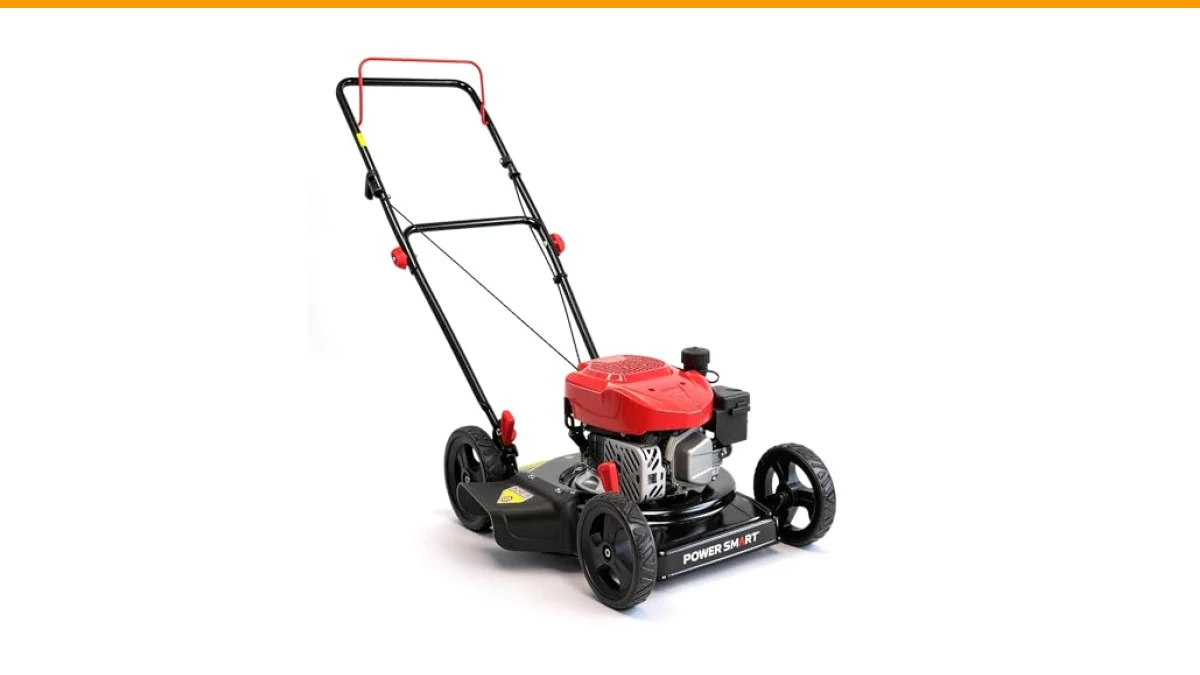
PowerSmart EasyCut 18-Inch
1st Pick

PowerSmart
PowerSmart EasyCut 18-Inch Gas Lawn Mower, 144cc 4-Cycle Engine, Walk-Behind Push Lawn Mower, Side Discharge, 5-Position Height Adjustment, Ideal for Small Yards
- Easy Start Engine: The144cc 4-stroke OHV engine delivers a reliable balance of high performance and ease. Equipped with auto choke…
- Side Discharge: Efficiently discharges grass clippings to keep you mowing through tall, thick grass with ease.
- 18-inch Steel Deck: The durable steel deck is built for long-lasting use, and the specialized blade delivers a clean, even cut for…
The PowerSmart EasyCut is a straightforward gas push mower built for flat, modest-sized properties. It’s the kind of machine you buy when you want the reliability of a gas engine without paying for self-propelled features you don’t need. For a yard under a quarter-acre with no serious incline, this mower gets the job done without fuss.
The 144cc engine with auto choke is genuinely easy to start. You don’t mess with a primer bulb or fiddle with a choke lever—pull the cord and it fires up. The 18-inch steel deck is durable and the side discharge handles tall grass without clogging as much as you’d expect. At 1.5 to 3.9 inches of cutting height across five positions, you have decent flexibility for seasonal grass changes.
Here’s the honest truth: this is not a hill mower. The 8-inch rear wheels help, but without a drive system, every incline becomes a leg workout. On a steep slope, the front wheels can lose contact with the ground, causing scalping. It’s also a side-discharge-only mower, so no mulching or bagging options. If your land is flat and you want a simple, affordable gas mower, this works. If you have hills, keep reading.
- 144cc 4-cycle OHV engine with auto choke
- 18-inch steel deck with side discharge
- 5-position height adjustment (1.5″ to 3.9″)
- 8-inch rear and 7-inch front wheels
- Primer structure aids cold-weather starting
Best for: Homeowners with flat, small-to-medium lawns who want a no-frills gas mower that starts easily and costs less than self-propelled models.
YARDMAX 22 in. 201cc Select
2nd Pick

YARDMAX
YARDMAX 22 in. 201cc Select PACE 6 Speed CVT High Wheel FWD 3-in-1 Gas Walk Behind Self Propelled Lawn Mower, Black (YG2860)
- Exclusive and industry-leading CVT (Continuously variable transmission) offers superior speed variability to adjust the mower pace…
- Exclusive rubber tires with aggressive spiked tread pattern significantly increase overall traction and maneuverability
- Starting made easier with the automatic choke system, no need to prime or choke the engine
The YARDMAX 22-inch is the heavy hitter of this group, and it’s the one we’d pick for a truly large, hilly property. The 201cc engine provides serious torque, and the 22-inch cutting width means fewer passes across a big yard. But the standout feature is the Select PACE CVT transmission—a six-speed system that lets you match your walking pace exactly without jerky gear changes.
On a hill, the CVT makes all the difference. You shift to a lower speed, the spiked tread tires bite into the turf, and the mower climbs steadily without you having to wrestle it. The high-wheel design (larger rear wheels) rolls over uneven ground better than standard wheels. The automatic choke means no priming, and the deck cleanout port lets you spray water to clear grass buildup—a small feature that saves real time during the season.
Trade-offs exist. This mower is heavier than the others, which helps traction but makes it harder to turn around at the end of a row. The single-lever height adjustment is convenient, but the range isn’t as wide as some competitors. And while the CVT is smooth, it takes a mowing session or two to get comfortable with the shift lever. For steep slopes, consider pairing this with a zero-turn mower with suspension if your yard is extremely large.
- 201cc engine with automatic choke
- 6-speed CVT transmission (Select PACE)
- 22-inch cutting deck, 3-in-1 capability
- Spiked tread rubber tires for traction
- Deck cleanout port and single-lever height adjust
Best for: Owners of large, sloped lawns who need self-propelled assistance, consistent traction, and a wide cut to finish faster.
SENIX Gas Lawn Mower 20-Inch
3rd Pick

SENIX
SENIX Gas Lawn Mower, 20" 144 cc Push Mower,cortadora de pasto | Ergonomically Handle Lawnmower, 4-Cycle Engine,for 1/4 Acre Yard
- 【Easy Start & Simple Assembly】 4-Cycle engine that delivers impressive performance. Real customers confirm it starts on the first…
- 【Lightweight & Nimble for Tight Spaces】Slim body and lightweight design make it a perfect fit for small yards, dog runs, and narro…
- 【Powerful & Versatile Performance】The 144CC engine tackles overgrown grass and weeds with ease. Handles both flat lawns and slopes…
The SENIX 20-inch push mower occupies a smart middle ground. It’s a lightweight gas mower that doesn’t pretend to be a self-propelled machine, but its design makes pushing it on mild slopes less painful than most. The 144cc engine delivers enough power for overgrown grass, and the 20-inch deck is a meaningful step up from 18-inch models in terms of coverage.
What stands out here is the weight and wheel design. The slim body keeps the center of gravity low, and the 7-inch wheels with decent tread handle bumpy terrain without bogging down. Several users note it starts on the first pull almost every time—a real plus when you’re dealing with a large yard and don’t want to waste energy yanking a cord. The three height positions (1.35″, 2.3″, 3.15″) are limited but cover the basics for warm-season and cool-season grasses.
Let’s be clear about the limitations. This is a push mower, so on anything beyond a gentle slope, you’ll feel it in your arms and back. The 7-inch wheels are uniform front and rear, which means no advantage from larger rear wheels for rolling over dips. Also, the height adjustment range tops out at 3.15 inches—if you let your grass get tall in the spring, you’ll need to take two passes. It comes with oil and tools in the box, which is thoughtful, and the 2-year warranty adds peace of mind.
- 144cc 4-cycle engine, no priming needed
- 20-inch cutting width
- 3-position height adjustment
- 7-inch front and rear wheels
- Includes oil, tools, and 2-year warranty
Best for: Budget-conscious buyers with small-to-medium yards that have only mild slopes and who want a gas mower that’s easy to push and start.
LawnMaster LMRM1801 Reel Mower
4th Pick

LawnMaster
LawnMaster LMRM1801 Push Reel Lawn Mower 18-Inch 5-Blade
- SCISSOR-LIKE CUT: No ripping or tearing of grass blades for a better and healthier lawn
- DESIGNED FOR SMALL LAWNS: CUSTOMIZE YOUR CUT: Effortlessly change the height of your cut with 9 cutting positions varying between…
- MAX MANEUVERABILITY: Features an 18-inch deck and 10-inch front wheels for easy navigation around the lawn
Including a reel mower in a roundup for large yards and hills seems odd at first. But the LawnMaster LMRM1801 earns its spot for a specific niche: the flat, open sections of a larger property where you want a perfect, golf-course-style cut without emissions or noise. It’s an 18-inch, 5-blade manual mower that runs on your muscle power alone.
The scissor-like cutting action is genuinely better for grass health than a rotary blade. It slices the blade cleanly rather than tearing it, which means less browning at the tips and a denser lawn over time. The 10-inch front wheels are large for a reel mower, making it easier to roll over minor imperfections in the ground. Nine cutting height positions between 1.1 and 2.5 inches give you fine control for different grass types.
But let’s be honest: this is not for hills. Pushing a reel mower uphill is significantly harder than pushing a gas mower because you’re providing all the energy for the blades to spin. On any slope over 10 degrees, you’ll likely stop and go back to the gas mower. It’s also not ideal for tall, thick grass—reel mowers struggle when the grass is wet or overgrown. This is a precision tool for a flat, well-maintained lawn, not a workhorse. For those interested in this style, our electric reel mower roundup covers powered versions that handle more terrain.
- 5-blade reel, scissor-style cut
- 18-inch cutting width
- 9 height positions (1.1″ to 2.5″)
- 10-inch front wheels
- No gas, oil, or batteries required
Best for: Eco-conscious homeowners with flat, smaller lawns who want the cleanest possible cut and don’t mind a manual workout.
LawnMaster MEB1114K Corded Electric
5th Pick

LawnMaster
LawnMaster MEB1114K Electric Corded Lawn Mower 15-Inch 11AMP
- POWERFUL PERFORMANCE: Tackle your yard with 3,300 RPM of power and a 14-inch cutting width
- ENVIRONMENTALLY FRIENDLY: No gas or batteries needed to power the mower
- CUSTOMIZE YOUR CUT: Effortlessly change the height of your cut with 5 cutting positions varying between 1.4-inches and 3-inches
The LawnMaster MEB1114K is a corded electric mower with a 14-inch cutting width and an 11-amp motor. It’s the smallest machine in this lineup, and it’s here for a reason: large properties often have a small, awkward patch near the house, a dog run, or a strip between fences where a full-size mower won’t fit. This fills that gap.
The 3,300 RPM motor spins fast enough for regular weekly cuts on normal grass. It’s quiet compared to gas mowers, and there’s no fuel to mix or oil to change. The 7-gallon collection bag is generous for the deck size, meaning fewer trips to the compost pile. Five height positions from 1.4 to 3 inches give you room to adjust for seasonal growth.
The flaws are obvious. The 14-inch deck means a lot of passes on any sizable area—this will take you twice as long as a 22-inch mower on the same lawn. The cord is a constant annoyance on large yards; you’ll be managing extension cords, avoiding running over them, and swapping outlets. And it’s not a hill mower. The motor provides no drive assist, and the small wheels can slip on damp slopes. This is a niche tool, not a primary mower, for most people with large properties.
- 11-amp motor, 3,300 RPM
- 14-inch cutting width
- 5 height positions (1.4″ to 3″)
- 7-gallon grass collection bag
- Corded electric—no gas or battery
Best for: Homeowners who need a lightweight, quiet mower for small flat areas or as a backup for tight spots on a larger property.
How We Chose These Products
We started by looking at the specific demands of large yards and hills: traction, torque, cutting width, and user effort. A mower that works great on a flat city lot often fails completely on a 20-degree slope. We prioritized machines with features that directly address those failure points—drive systems, wheel designs, and engine displacement.
We also considered real-world usability. That means how easy the mower is to start, how intuitive the height adjustment is, and whether the weight distribution helps or hurts on uneven ground. We read through owner experiences across multiple seasons, noting recurring complaints about wheel spin, scalping, and difficult starts. Products with consistent praise for hill performance rose to the top. We balanced that with honest assessments of each mower’s limitations so you know exactly what you’re getting.
Buying Guide: What Really Matters
Drive system is the first decision. For hills, self-propelled mowers with rear-wheel drive (RWD) or all-wheel drive (AWD) are your friends. RWD puts the weight over the drive wheels, giving better traction when climbing. AWD helps on uneven terrain where you need grip from all corners. Front-wheel drive (FWD) mowers are cheaper but tend to lose traction on slopes because the front wheels lighten as you push uphill. The YARDMAX with its CVT and spiked tires is an example of a system designed for slope work.
Engine power matters, but torque matters more. A 200cc engine with high torque will climb a hill better than a 160cc engine with the same horsepower rating. Look for engines with larger displacement (over 170cc) for hilly properties. Cutting width is a trade-off: a 22-inch deck covers more ground but makes the mower heavier and harder to turn. A 20-inch deck is a good balance for most yards. Deck material—steel is standard and durable; aluminum is lighter but less common at this price point.
Wheel size and type are critical on slopes. Larger rear wheels (10-12 inches) roll over bumps and holes better than small wheels. Aggressive tread patterns grab the turf and prevent slipping. Weight matters too—heavier mowers stay planted on hills but can damage soft turf and are harder to maneuver. Finally, consider noise. Gas mowers run around 90-95 decibels, which is loud enough to require hearing protection for extended use. If you’re mowing a large yard for an hour or more, that’s a real consideration. For related options, check out our four-wheel mower guide for more stability-focused designs.
Our Top Recommendation
The YARDMAX 22-inch with CVT is our clear winner for large yards and hills. The combination of a 201cc engine, 22-inch deck, and six-speed continuously variable transmission makes it the most capable machine in this group. The spiked tires provide the traction you need on slopes, and the self-propelled drive means you’re guiding the mower, not fighting it. It’s not the cheapest option, but for the demands of a large, hilly property, it’s worth the investment.
If your budget is tighter or your property is smaller with only gentle slopes, the SENIX 20-inch is a solid runner-up. It’s lighter, easier to push, and still has enough power for regular maintenance cuts. For those with flat, smaller lawns who want a gas mower without extra features, the PowerSmart EasyCut is a dependable budget pick. The LawnMaster reel and corded models serve specific niches—precision cutting on flat ground and tight-space trimming—but they’re not primary mowers for large, hilly terrain.
Frequently Asked Questions
How steep of a hill can I mow safely with a push mower?
Generally, you should avoid mowing slopes steeper than 15 degrees (about a 27% grade) with any walk-behind mower. On steeper slopes, the risk of the mower tipping or slipping out of your control increases significantly. For slopes between 10 and 15 degrees, mow side-to-side with a self-propelled mower with good traction. Always walk across the slope rather than up and down to reduce the chance of the mower rolling back onto you.
Is rear-wheel drive or all-wheel drive better for hills?
Rear-wheel drive is usually sufficient for most residential slopes because the engine weight sits over the rear wheels, maximizing traction. All-wheel drive shines on uneven terrain where a rear wheel might lift off the ground, or on very steep, smooth slopes where you need every bit of grip. If your yard has bumpy, rough sections on a hill, AWD is worth the extra cost. For mostly even slopes, RWD will save you money and weight.
Should I get a gas or electric mower for a large hilly yard?
For large yards (over half an acre) with hills, gas is still the practical choice. The energy density of gasoline means you can mow for an hour or more without recharging, and gas engines provide consistent torque on inclines. Battery mowers are improving, but a large battery that lasts an hour on flat ground will drain much faster on hills. Corded electric mowers are not viable for large areas due to cord management. Consider battery only if your hilly section is small and you have a spare battery.
How often should I sharpen the blade when mowing on hills?
Mowing on hills often means cutting grass that’s slightly stressed or dry, and you may also pick up small rocks or debris from erosion. Check the blade every 10-15 hours of use. If the grass tips look frayed or brown after mowing, it’s time to sharpen. A sharp blade is even more important on slopes because a dull blade tears grass, leaving it vulnerable to disease, and it puts extra strain on the engine as you climb.


