You spread a bag of fertilizer last spring, watched the grass jump, and then spent July wondering why the lawn looked tired again. Synthetic nitrogen does that. It feeds fast, fades fast, and leaves your soil no better than it found it. Natural fertilizers work differently. They feed the soil, and the soil feeds the grass.
A great natural lawn fertilizer does three things well. It delivers a sensible NPK ratio without a salt overload, it releases nitrogen slowly enough to avoid burn, and it stays safe for kids and pets once watered in. The best pick for your yard depends on your soil test, your grass type, and the season you’re feeding.
Below are five formulas worth your money, each suited to a different job. Scotts Natural Lawn Food is the all-rounder. O.M. Scott & Sons covers smaller yards with a 10-week feed. Scotts Turf Builder Starter is the reseeding specialist. Safer Brand Lawn Restore is the fast-greening option. Simple Lawn Solutions 16-4-8 is the liquid concentrate for quick corrections. Pair any of them with the soil-test framework and regional calendar further down.
Here’s a quick side-by-side of the specs that actually separate these five formulas.
| Features | Scotts Natural Lawn Food | O.M. Scott & Sons | Scotts Turf Builder Starter | Safer Brand Lawn Restore | Simple Lawn Solutions 16-4-8 |
|---|---|---|---|---|---|
| NPK Ratio | Natural blend, OMRI listed | Natural nutrient sources | 24-25-4 starter formula | 9-0-2 non-burning | 16-4-8 with seaweed and fish |
| Coverage | 4,000 sq. ft. | 2,000 sq. ft. | 5,000 sq. ft. | 5,000 sq. ft. | 32 oz concentrate |
| Form | Granular | Granular | Granular | Granular | Liquid spray |
| Feed Duration | Apply up to 4x yearly | Feeds up to 10 weeks | New grass establishment | Greens in 3-5 days | Fast foliar uptake |
| Best Use Case | All-season maintenance | Small yards, kids, pets | Seeding and overseeding | Stressed or heat-hit lawns | Quick greening and spot fixes |
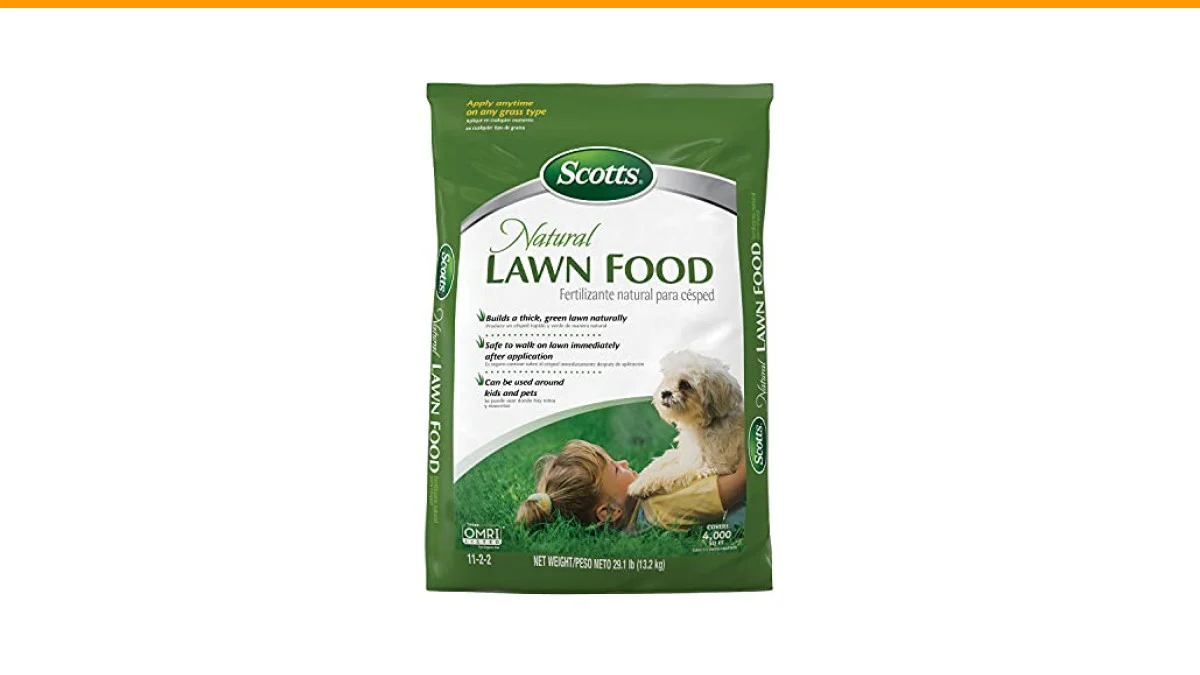
Scotts Natural Lawn Food, 29.1 lbs.
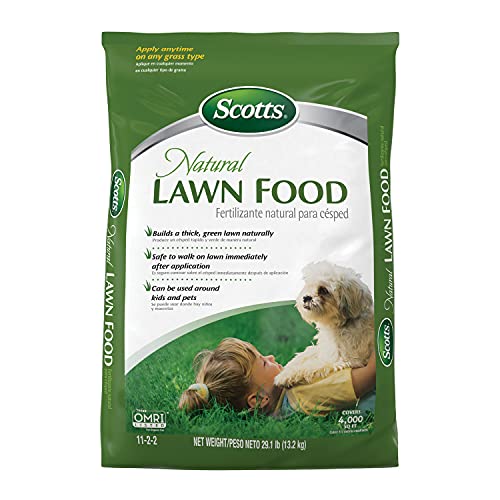
Scotts
Scotts Natural Lawn Food, Lawn Fertilizer, For All Grass Types, Apply Any Season, OMRI Listed, Covers 4,000 sq. ft., 29.1 lbs.
- Scotts Natural Lawn Food builds a thick, green lawn - naturally
- This lawn care product is safe to walk on immediately after application and can be used around kids and pets
- This grass fertilizer may be applied during any season, up to 4 times per year (see label for details)
The one you buy when you want a single bag that handles every season. Scotts Natural Lawn Food is OMRI listed, which matters if you’re trying to stay certified organic or just want a paper trail on what’s going into your soil. It’s built for homeowners with average-sized yards who don’t want to think too hard about timing.
What sets it apart is the flexibility. You can apply it in spring, summer, fall, or winter, up to four times a year. That’s rare for a natural formula, since many organic feeds are temperature-dependent and stall in cold soil. The 29.1-pound bag covers 4,000 square feet, which fits a typical suburban front-and-back yard with a little left over. It’s safe to walk on right after application, so you don’t have to keep the dog off the grass for a week.
The trade-off is speed. Natural nitrogen doesn’t green up a lawn in three days the way a synthetic 30-0-0 will. Expect two to three weeks before you see a real color shift, and longer in cool weather. The granules also need watering in to activate, so if rain isn’t coming, you’re dragging the hose out. That’s the price of a slow-release feed that won’t burn.
- OMRI listed for organic lawn programs
- Four-season application window, up to 4x per year
- Safe to walk on immediately after spreading
- Covers 4,000 sq. ft. from a 29.1 lb. bag
- Works with any Scotts drop or rotary spreader
Best for: Homeowners who want one natural bag for year-round feeding on a standard suburban lot.
O.M. Scott & Sons Natural Grass Food
The smaller-yard pick with a longer feed window. O.M. Scott & Sons Natural Grass Food comes in a 12.72-pound bag that covers 2,000 square feet, which is ideal for townhomes, courtyard lawns, or anyone who doesn’t want half a bag going stale in the garage. The formula uses premium nutrient sources found in nature, no added artificial ingredients, and no pesticides.
Ten weeks of feeding from a single application is the standout number here. That’s a long runway for a natural product, and it means fewer trips to the shed. Water it in right after spreading and the granules start releasing immediately. The packaging is a recyclable paper bag, which is a small thing but a real one if you’re trying to cut plastic waste from your lawn routine.
Coverage is the obvious limitation. At 2,000 square feet, you’ll need two bags for a quarter-acre lawn, and the cost per square foot climbs accordingly. The feed rate also assumes you water immediately, so if you skip that step, the release curve flattens out. It’s not a formula you can spread and forget before a dry week.
- Feeds for up to 10 weeks per application
- No artificial ingredients or pesticides
- Safe around kids and pets when used as directed
- 2,000 sq. ft. coverage from 12.72 lbs.
- Recyclable paper bag packaging
Best for: Small-yard owners who want a long-lasting natural feed and less frequent applications.
Scotts Turf Builder Starter Fertilizer
The reseeding specialist. Scotts Turf Builder Starter Food for New Grass is a 24-25-4 NPK formula designed specifically for planting, overseeding, sod, sprigs, and plugs. If you’re renovating a lawn or patching bare spots, this is the bag you want under the spreader, not a general-purpose feed.
The high phosphorus number is the point. New grass roots need phosphorus to establish, and most maintenance fertilizers skimp on it. Scotts claims this formula grows new grass 70% thicker and 35% quicker on average versus unfed lawns. Those numbers come from company trials, so treat them as directional, but the principle holds: starter fertilizer gives seedlings a real head start. One 15-pound bag covers 5,000 square feet, which is generous for the price point.
This isn’t a maintenance fertilizer. The 24-25-4 ratio is too phosphorus-heavy for established lawns, and using it repeatedly can push phosphorus runoff into storm drains. Save it for seeding windows. It’s also safe on all grass types, so you don’t need to match it to your cultivar.
- 24-25-4 NPK built for new grass establishment
- Works on seed, sod, sprigs, and plugs
- Safe for all grass types
- 5,000 sq. ft. coverage from 15 lbs.
- Apply at planting, not as routine maintenance
Best for: Anyone starting a new lawn, overseeding in fall, or patching bare spots with seed.
Safer Brand Lawn Restore Natural Fertilizer
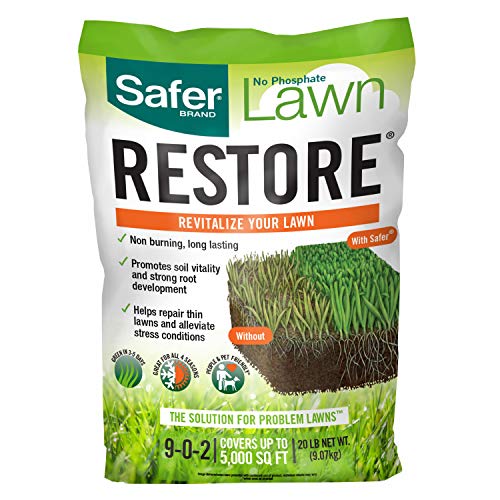
Safer
Safer Brand Lawn Restore Natural Lawn Fertilizer - 9335SR - Non-Burning Fertilizer - 9-0-2 NPK - Use for Healthy Grass - Covers up to 5,000 Sq Ft
- REVIVE GRASS ROOTS: Safer Brand Lawn Restore revitalizes lawn to a thick turf by strengthening root systems
- WORKS FAST: Lawns start to green up within 3 to 5 days of application
- NON-BURNING FORMULA: The 9335SR formula promotes soil vitality for a thicker, healthier lawn and is made from ingredients that wil…
The fast-greening natural option for stressed turf. Safer Brand Lawn Restore is a 9-0-2 formula that revives root systems and greens lawns in three to five days, which is unusually quick for an organic product. If your lawn came out of winter thin or got hammered by summer heat, this is the bag that pulls it back.
The non-burning claim is backed by the low nitrogen number. At 9% N, there’s very little salt load, so you can apply it in hot weather without frying the crown. It also helps grass withstand heat, cold, and drought stress, which makes it a solid choice going into a tough season. Kids and pets can return to the lawn immediately after application when used as directed. One bag covers up to 5,000 square feet.
Availability is the catch. This product is often listed as scarce on Amazon, so you may need to check back or buy from a local retailer. The 9-0-2 ratio also means it’s a lighter feed than a 16-4-8 or a starter formula, so don’t expect it to fix a severely nitrogen-deficient lawn in one pass. Two applications, spaced a few weeks apart, work better.
- 9-0-2 non-burning formula
- Greens lawns in 3 to 5 days
- Helps turf handle heat, cold, and drought
- Safe for kids and pets immediately after application
- Covers up to 5,000 sq. ft.
Best for: Reviving heat-stressed or winter-damaged lawns when you need visible green-up fast.
Simple Lawn Solutions Advanced 16-4-8

Simple Lawn Solutions
Advanced 16-4-8 Balanced NPK - Lawn Food Quality Liquid Fertilizer - Spring & Summer Concentrated Spray - Any Grass Type - Simple Lawn Solutions (32 Ounce)
- Complete NPK Lawn Food: 16-4-8 is the perfect blend of key macronutrients. This lawn liquid food turf fertilizer also contains Sea…
- Contains High Quality Feed Grade Ingredients: Nourish your lawn with pure liquid Nutrients in a ready to use sprayer
- Easy To Use: Designed to be easily applied. This complete Nitrogen, Phosphate and Potash formula gives your grass greening & growt…
The liquid concentrate for quick corrections. Simple Lawn Solutions 16-4-8 is a balanced NPK spray that also contains seaweed and fish, which feed soil microbes alongside the grass. It comes in a 32-ounce bottle and is designed for spring and summer applications on any grass type, including Bermuda, St. Augustine, Zoysia, Buffalo, Centipede, Palmetto, Bahia, Fescue, Ryegrass, and Kentucky Bluegrass.
Liquid fertilizer works differently from granules. It gets taken up through the leaf surface within days, so you see color response faster. That makes it useful for spot-treating a thin patch or pushing a lawn before a party. The seaweed and fish meal add a biological component that granular synthetics don’t have. The formula is manufactured in the US by a family-owned business with commercial turf experience.
Liquid concentrates have a shorter residual than granular slow-release. You’ll be reapplying every four to six weeks during the growing season, which adds up in both cost and labor. The 32-ounce bottle also requires a hose-end sprayer or tank sprayer, so there’s an upfront equipment cost if you don’t already own one. And the fish component has a smell, though it fades within a day or two.
- 16-4-8 balanced NPK with seaweed and fish
- Fast foliar uptake for quick greening
- Safe for all major grass types
- Made in the USA
- Requires hose-end or tank sprayer
Best for: Lawn owners who want fast visible results and don’t mind reapplying every few weeks.
How We Chose These Products
We started with the NPK ratio and asked whether it matched a real job. A 24-25-4 starter formula earns a spot because it does something a 10-10-10 can’t. A 9-0-2 earns a spot because it won’t burn in August. Formulas that tried to do everything usually did nothing well, so they got cut.
Next came coverage and form. Granular bags were judged on square footage per pound and whether the spreader settings were documented. Liquids were judged on how often you’d need to reapply. We also weighed pet and kid safety claims, OMRI listing, and whether the product was consistently in stock. A great formula you can’t buy is useless.
Buying Guide: What Really Matters
Read the NPK ratio first. The three numbers tell you the percentage of nitrogen, phosphorus, and potassium by weight. Nitrogen drives top growth and color. Phosphorus supports roots and seedlings. Potassium helps with stress tolerance and disease resistance. A maintenance lawn wants something like 10-1-5 or 16-4-8. A new seeding wants high phosphorus, like 24-25-4.
Slow-release nitrogen is the second thing to check. Natural fertilizers release nitrogen as soil microbes break them down, which is why they don’t burn. The trade-off is speed. If you want a fast green-up, you’ll need a liquid or a formula with some quick-release nitrogen in the mix. If you want steady feeding for months, granular slow-release wins.
Coverage area per bag determines your real cost. Divide the bag price by the square footage it covers, then multiply by 1,000 to get cost per 1,000 square feet. That number is the only fair way to compare a 12-pound bag against a 29-pound bag. Do that math before you buy, not after.
Soil Testing: Match Fertilizer to Your Results
A soil test costs about the same as a bag of fertilizer and tells you exactly what your lawn is missing. Most state extension offices offer one for a modest fee, and the report comes back with pH, phosphorus, potassium, and organic matter levels. Read the phosphorus number first. If it’s already high, skip starter formulas and high-P blends, because excess phosphorus runs off into waterways.
pH matters just as much. Most cool-season grasses want a pH between 6.0 and 7.0. Warm-season grasses tolerate slightly more acidity. If your pH is below 6.0, no fertilizer will work well until you add lime. If it’s above 7.5, iron chlorosis can set in and you’ll see yellow blades despite adequate nitrogen.
Use the test to pick your NPK. Low nitrogen and low phosphorus with adequate potassium? A 16-4-8 liquid is a good fit. Low everything? A balanced granular like Scotts Natural Lawn Food gives you a broad correction. High phosphorus already? Stick with a nitrogen-and-potassium feed and skip the starter blends.
Application Timing by Region and Season
Cool-season grasses like fescue, ryegrass, and Kentucky bluegrass do their heaviest growing in spring and fall. Feed them in early spring once soil hits 55°F, again in late spring, and heavily in early fall. Fall feeding is the most important one for these grasses, because it builds root reserves for winter.
Warm-season grasses like Bermuda, St. Augustine, and Zoysia wake up later and peak in summer. Feed them after full green-up in late spring, then again in early and mid-summer. Stop feeding about six weeks before your first expected frost so the grass can harden off.
Regional timing shifts the calendar. In the South, fall feeding happens in September and October. In the Northeast and Midwest, it’s late August through October. In the Pacific Northwest, spring feeding starts earlier and fall feeding runs later thanks to mild winters. Check your local extension office for a grass-specific schedule.
Organic vs Synthetic: Real Cost and Results
Organic fertilizers usually cost more per pound of nitrogen than synthetics. A 29-pound natural bag covering 4,000 square feet might cost two to three times what a synthetic 30-0-0 covers for the same area. That’s the honest math. The gap narrows when you factor in fewer applications and less need for lime or aeration over time.
Results differ too. Synthetics green up in three to five days and fade in four to six weeks. Organics green up in two to three weeks and keep feeding for eight to ten weeks. The organic lawn also builds organic matter, which improves water retention and microbial activity. That’s a slow payoff, but it’s real.
Many homeowners run a hybrid program: organic granular in spring and fall, a liquid organic boost in summer when the lawn needs a lift. That approach gets you the soil benefits of organics with the response time of a liquid. It’s also the least expensive way to stay mostly organic without sacrificing visible results.
Safety: Pets, Kids, and Watering-In
Natural fertilizers are safer than synthetics, but they’re not automatically safe the second they hit the grass. Granules can be eaten by dogs, and some organic ingredients like blood meal or feather meal can attract pets. Water the lawn in after application, then keep pets off until the granules dissolve, usually 24 hours.
Liquid formulas are different. Once the spray dries, typically within a few hours, the lawn is safe for foot traffic. Safer Brand Lawn Restore and O.M. Scott & Sons both state the lawn is safe for kids and pets immediately after application when used as directed, but watering in first is still smart.
Watering-in does two things. It moves the granules off the leaf surface and into the soil where roots can reach them. It also activates the microbial breakdown that releases the nitrogen. Skip the watering and you’re leaving fertilizer on top of the grass, where it does little good and can burn on a hot day.
DIY Organic Fertilizer Recipes
You can make a decent organic lawn feed at home for less than a bag of commercial product. A common base mix is one part blood meal, one part bone meal, and one part kelp meal, applied at about 10 pounds per 1,000 square feet. Blood meal supplies fast nitrogen, bone meal adds phosphorus, and kelp meal brings potassium and trace minerals.
Compost is the other workhorse. A quarter-inch topdressing of finished compost in early fall feeds the soil biology that makes all fertilizers work better. You can also brew compost tea by steeping a mesh bag of compost in a bucket of water for 24 hours, then spraying the liquid on the lawn. It’s not a complete fertilizer, but it boosts microbial activity.
Keep expectations realistic. DIY mixes are harder to calibrate than commercial blends, and the NPK varies with the source ingredients. Test your soil before and after a season to see whether the mix is actually moving the numbers.
Common Mistakes to Avoid
Over-application is the most common error. More fertilizer doesn’t mean a greener lawn. It means salt buildup, thatch, disease pressure, and runoff. Follow the bag rate exactly, and split applications if you’re unsure. A half-rate application repeated twice beats a full-rate application once.
Fertilizing before heavy rain wastes product. If a downpour is coming within 24 hours, wait. The nitrogen will wash into the storm drain instead of into your soil. Light watering is what you want, not a gully-washer.
Mowing timing matters too. Don’t mow immediately after fertilizing, and don’t mow so short you scalp the lawn. Grass needs blade surface to photosynthesize the nutrients you just applied. Keep the mower at the high end of your grass type’s recommended range during feeding season.
Frequently Asked Questions
How do I fix an over-fertilized lawn organically? Water deeply to flush excess salts past the root zone, then stop feeding for at least six weeks. Apply a thin layer of compost to reintroduce microbial balance. If the grass is burned, overseed the damaged patches in fall rather than trying to force recovery in summer.
How long does natural fertilizer last in storage? Granular organic fertilizers keep for one to two years if stored in a sealed container in a dry spot. Moisture is the enemy, because it activates the microbes early. Liquid concentrates last longer, often two to three years unopened, but check the label for a date.
Can I use natural fertilizer on a newly seeded lawn? Yes, but use a starter formula with high phosphorus, not a maintenance blend. Scotts Turf Builder Starter is designed for exactly this. Apply at seeding time and water lightly and frequently until the grass establishes.
Do I need to water in granular natural fertilizer? Yes. Watering activates the microbial breakdown that releases the nutrients. Without it, the granules sit on the surface and do little. Aim for about a quarter-inch of water right after spreading, either from rain or a hose.
Our Top Recommendation
Scotts Natural Lawn Food is the pick for most homeowners. It’s OMRI listed, covers 4,000 square feet, works in any season, and stays safe for kids and pets right after application. That combination of flexibility and safety is hard to beat for a general-purpose natural feed.
If you have a smaller yard, O.M. Scott & Sons Natural Grass Food gives you a 10-week feed in a bag that won’t go stale. If you’re overseeding or starting fresh, Scotts Turf Builder Starter is the right tool. For fast green-up on a stressed lawn, Safer Brand Lawn Restore earns its spot. And if you want liquid control and quick response, Simple Lawn Solutions 16-4-8 is the concentrate to keep on the shelf.
Whichever you choose, test your soil first and water in after applying. Those two steps matter more than the brand on the bag. For a deeper look at how these formulas compare against the wider organic market, see this independent roundup of organic lawn fertilizers and Bob Vila’s tested organic fertilizer reviews.