Your monstera is leaning toward the window. Your basil has gone pale and leggy. The rosemary you brought inside in October is dropping needles by Thanksgiving. Winter light indoors is a fraction of what these plants evolved for, and a north-facing sill gets maybe 5% of outdoor summer intensity. A grow bulb fixes most of that.

A good plant bulb does three things: it delivers usable light in the photosynthetically active range, it runs cool enough to sit near foliage, and it fits a socket you already own. Everything else, the marketing claims, the purple glow, the “equivalent to 100W” language, is noise. The specs that matter are PPF, spectrum, and actual wattage draw.
Below you’ll find five bulbs worth considering, sorted by who they actually suit. A budget three-pack, a heavy-hitter for flowering plants, a workhorse A19, and a ceramic-built option from SANSI with a real warranty. Each pick includes honest limits, distance guidance, and what it costs to run per month.
Here’s the quick spec comparison before we dig into each bulb.
| Features | Briignite A19 11W | Wiyifada 3-Pack | Briignite 4-Pack | SANSI 36W | Briignite 5000K |
|---|---|---|---|---|---|
| Wattage Draw | 11W | 9W | 11W | 36W | 11W |
| PPF Output | 25 umol/s | Not listed | 25 umol/s | 65.6 umol/s | 25 umol/s |
| Color Temp | 4000K white | Full spectrum | 4000K white | 4000K daylight | 5000K white |
| Dimmable | No | Yes | No | No | No |
| Lifespan | 25,000 hrs | 20,000 hrs | 25,000 hrs | 25,000 hrs | 25,000 hrs |
| Best Use Case | Single shelf, herbs | Multi-plant budget setup | Full shelf coverage | Flowering, high-light plants | Bright room integration |
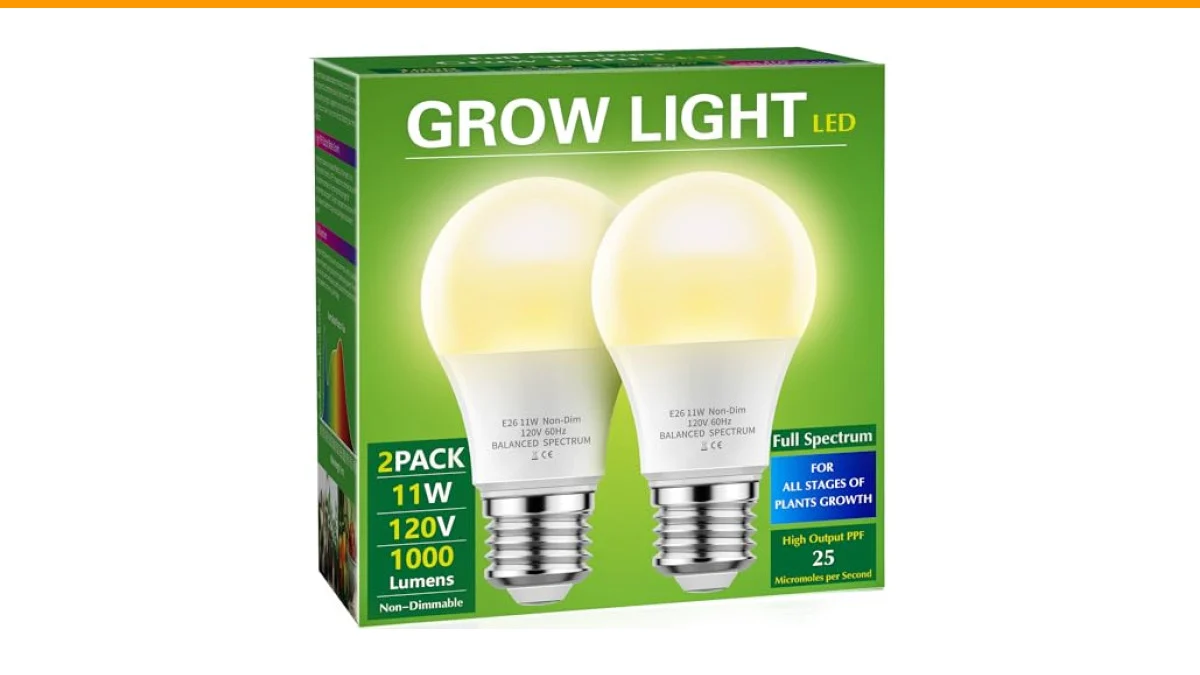
Briignite Grow Light Bulb A19

Briignite
Briignite Grow Light Bulbs, LED Grow Light Bulb A19 Bulb, Full Spectrum | Grow Light Bulb, Plant Light Bulbs E26 Base, 11W Grow Bulb 100W Equivalent,Grow Light for Indoor Plants,Seed Starting, 2Pack
- FULL SPECTRUM & NATURAL LIGHT: A19 full spectrum grow light appears 4000K white to eyes but has a red/blue light spectrum. Same as…
- HIGH BRIGHTNESS & ENERGY SAVING: A19 LED plant grow light bulbs deliver 180-degree 1000LM bright light output. Use High Lumen LED…
- HIGHER EFFICIENCY: LED grow bulb with high light transmission improves plant absorption more effectively. Balanced lighting of ful…
This is the bulb for someone with a single shelf of herbs or a couple of pothos on a bookshelf. It screws into any standard E26 lamp, produces 1000 lumens, and looks like a normal 4000K white bulb when it’s on. Your guests won’t ask why your living room is glowing magenta.
The 25 micromoles per second PPF is modest but real. At 6 inches from foliage, expect roughly 180 to 220 PPFD. That’s enough for lettuce, basil, mint, and most common houseplants. The 180-degree beam spreads light wide, which suits a shelf better than a spotlight. Heat output stays low enough to keep the bulb within a foot of leaves without scorching.
Here’s the honest limit: 11 watts won’t drive a tomato plant to fruit. If you’re trying to grow peppers or anything that flowers and sets fruit indoors, this bulb falls short. It’s a supplement, not a replacement for a strong panel. Also worth knowing, it’s not dimmable, so you’ll control intensity by moving the bulb closer or farther from the plant.
- 1000 lumens, 4000K white appearance with red and blue spectrum peaks
- 25,000-hour rated life, roughly 5.7 years at 12 hours daily
- Aluminum and plastic housing for heat dissipation
- Standard E26 base, fits lamps and clamp fixtures
- Runs about $0.40 per month at 12 hours daily and average US rates
Best for: Anyone supplementing a windowsill herb garden or a small shelf of low-to-medium light houseplants.
Wiyifada 3 Pack Full Spectrum

Wiyifada
Wiyifada 3 Pack Full Spectrum Grow Light Bulbs,A19 Grow Lights for Indoor Plants,Dimmable E26 9W Grow Bulb Replace up to 100W,Plant Lights for Indoor Growing,Flowers,Greenhouse,Indore
- ☀ High Performance & Energy Saving: LED Grow Light Bulb A19 Bulbs deliver 150-degree light output.Used High Lumen Led Chips replac…
- ☀ Balance Specturm:Full spectrum Grow Light , use 400-740nm wavelength perfect for all growing stages plants. For indoor plant rec…
- ☀ Longer Lifespan: Use Plastic & Aluminium material to build the cooling system. Support the light working for longer time. Even w…
Three bulbs for the price of one premium pick, and they’re dimmable. That combination makes this set the right answer for renters, dorm growers, or anyone outfitting a multi-tier shelf without spending much. The E26 base drops into any standard socket, so no special fixture needed.
Dimmability is the standout feature here. Most A19 grow bulbs are on or off. With these, you can dial intensity down for seedlings and crank it up as plants mature. That matters more than people realize, since young starts burn under full-strength light. The 9W draw is slightly lower than the Briignite, and Wiyifada claims 85% energy savings over a traditional 100W incandescent.
The trade-off is documentation. Wiyifada doesn’t publish PPF or PPFD figures, which makes precise planning harder. You’re working from the 400-740nm spectrum coverage and general performance rather than hard numbers. The 20,000-hour lifespan is also shorter than the Briignite’s 25,000. Neither is a dealbreaker at this price, but if you want measurable output, look elsewhere.
- Three bulbs per pack, dimmable via compatible dimmer switch
- 9W draw, marketed as a 100W incandescent replacement
- 400-740nm full spectrum, covers all growth stages
- 150-degree beam angle, slightly narrower than some competitors
- 20,000-hour rated life
Best for: Budget-conscious growers who want dimming control and need to light three separate spots.
Briignite 4 Pack Grow Light

Briignite
Briignite 4 Pack Grow Light Bulbs, LED Grow Light Bulb A19, Full Spectrum | Grow Light Bulb, Plant Light Bulbs E26 Base, 11W Grow Bulb 100W Equivalent, Grow Light for Indoor Plants, Seed Starting
- FULL SPECTRUM & NATURAL LIGHT: A19 full spectrum grow light appears 4000K white to eyes but has a red/blue light spectrum. Same as…
- HIGH BRIGHTNESS & ENERGY SAVING: A19 LED plant grow light bulbs deliver 180-degree 1000LM bright light output. Use High Lumen LED…
- HIGHER EFFICIENCY: LED grow bulb with high light transmission improves plant absorption more effectively. Balanced lighting of ful…
Same bulb as the single-pack Briignite, sold four at a time. That changes the math. This is the pick for someone lighting an entire shelf, a row of seedlings, or a small indoor greenhouse where one bulb per plant makes sense. Four 11W bulbs draw 44 watts total and cover roughly a 4-foot shelf evenly.
Consistency is the appeal. Every bulb in the pack delivers the same 25 umol/s PPF, the same 4000K appearance, and the same 180-degree spread. That uniformity matters when you’re trying to give every seedling the same conditions. Mixed-spectrum setups cause uneven growth, and this pack avoids that problem.
You’ll want to think about socket availability before buying. Four bulbs need four sockets, whether that’s a multi-head clamp lamp, a track fixture, or four separate desk lamps. If you only have one socket, buy the single instead. And like its sibling, this bulb isn’t dimmable, so intensity control means adjusting distance.
- Four A19 bulbs, 11W each, 44W total draw
- 25 umol/s PPF per bulb, 1000 lumens each
- 4000K white appearance, full spectrum with red and blue peaks
- 25,000-hour rated lifespan
- Low heat output, safe within 6 to 12 inches of foliage
Best for: Seed starters and shelf gardeners who need to cover multiple plants with matching light.
SANSI Grow Lights for Indoor Plants
This is the outlier in the group, and it’s the one to buy if you’re serious about flowering plants. SANSI’s 36W bulb puts out 65.6 umol/s PPF, more than double the Briignite and Wiyifada options. That’s enough to push peppers, tomatoes, and flowering houseplants through a full cycle without a panel.
The PPFD figure is what separates it: 265.58 umol/s/m² at one foot. That’s real intensity. The secondary optical design uses a lens to focus and distribute light more efficiently than bare LEDs, which is why SANSI gets so much output from 36 watts. The ceramic heat sink, what SANSI calls COC technology, conducts heat away from the LED junction faster than aluminum MCPCB boards. In practice, the bulb runs cooler than its wattage suggests.
Two things to weigh. First, it’s a bigger bulb physically, so it won’t fit every lamp shade or clip fixture. Second, at 36W it draws more power than the A19 options, roughly $1.30 per month at 12 hours daily. That’s still cheap, but it’s triple the A19 cost. The 5-year protection plan and ETL listing are genuine advantages you won’t find on most budget grow bulbs.
- 36W draw, 65.6 umol/s PPF, 265.58 PPFD at 1 foot
- 4000K daylight, 400-780nm full spectrum, CRI near 100
- Patented ceramic heat sink for faster heat conduction
- ETL listed with 5-year protection plan
- Flame retardant V0 rated housing, WF2 corrosion grade
Best for: Growers pushing fruiting or flowering plants indoors who need panel-level output from a single socket.
Briignite Grow Light Bulb 5000K

Briignite
Briignite Grow Light Bulbs, Full Spectrum Grow Light Bulb, LED Grow Light | Grow Light Bulb A19, Plant Light Bulbs E26, 11W Grow Bulb 100W Equivalent, Grow Light for Indoor Plants, Seed Starting,2 Pack
- FULL SPECTRUM & NATURAL LIGHT: A19 full spectrum grow light appears 5000K white to eyes but has a red/blue light spectrum. Same as…
- HIGH BRIGHTNESS & ENERGY SAVING: A19 LED plant grow light bulbs deliver 180-degree 1000LM bright light output. Use High Lumen LED…
- HIGHER EFFICIENCY: LED grow bulb with high light transmission improves plant absorption more effectively. Balanced lighting of ful…
Nearly identical to the first Briignite pick, with one change: 5000K instead of 4000K. That makes the light cooler and whiter, closer to midday sun than the warmer 4000K tone. For plants, the spectrum is the same. For your eyes, it’s a brighter, crisper white that reads more like an office light than a living room lamp.
Who does that suit? Anyone whose grow setup lives in a workspace, kitchen, or room where warm light would look out of place. The 5000K appearance blends into modern fixtures and daylight-balanced rooms. Output specs match the 4000K version exactly: 1000 lumens, 25 umol/s PPF, 11W draw, 180-degree spread.
The caveat is the same as its sibling. This is a supplement bulb, not a flowering bulb. It handles vegetative growth, leafy greens, and low-light houseplants well. It won’t drive a fruiting tomato. And if you prefer warm light in your living space, the 4000K version is the better aesthetic match.
- 5000K white appearance, full spectrum with red and blue peaks
- 11W draw, 1000 lumens, 25 umol/s PPF
- 180-degree beam, E26 base
- 25,000-hour rated lifespan
- Low heat, suitable for close placement
Best for: Home offices, kitchens, and modern interiors where a cool white bulb fits the room better than warm light.
How We Chose These Products
We started with the specs that actually affect plant growth. PPF, spectrum range, wattage draw, and heat management. Bulbs without published PPF figures got flagged, not dismissed. The Wiyifada pack made the list because dimmability and price offset the missing data.
Build quality and safety mattered too. SANSI’s ETL listing and ceramic heat sink are meaningful differences from generic Amazon bulbs, which often skip third-party testing. We also weighed practical factors like socket compatibility, beam angle, and whether the bulb fits standard fixtures. A grow bulb that requires a special lamp is a harder sell than one that screws into what you already own.
Buying Guide: What Really Matters
PPF is the number to check first. It measures how much usable light a bulb produces per second, in micromoles. A 25 umol/s bulb suits herbs and houseplants. A 65 umol/s bulb handles fruiting plants. If a listing doesn’t publish PPF, treat the bulb as a supplement rather than a primary light source.
Spectrum matters less than the marketing suggests for most common plants. Full spectrum in the 400-740nm range covers vegetative and flowering stages adequately. Red and blue peaks help, but a balanced white-appearing full spectrum works for nearly everything. The best light spectrum guide digs into this further if you want the full breakdown.
Wattage draw tells you cost to run. A 9W bulb costs about a third of what a 36W bulb does over a month. Match wattage to your plants. Low-light houseplants like pothos and snake plants don’t need 36W. Fruiting plants do. And check the best grow light bulbs roundup for more options if none of these five fit your setup.
Why Lumens and Equivalent Watts Mislead You
Lumens measure light visible to human eyes. Plants use different wavelengths, mostly in the red and blue ranges. A bulb rated at 1000 lumens might deliver very little usable light to a plant, or a lot, depending on its spectrum. Equivalent wattage claims work the same way. A “100W equivalent” label says nothing about PPF.
Reading PPF and PPFD Without a Lab
PPF is the bulb’s total output. PPFD is how much of that output reaches a specific spot, measured in micromoles per square meter per second. You don’t need a meter to estimate. A 25 umol/s bulb at 6 inches delivers roughly 180-220 PPFD. Double the distance and you cut intensity to about a quarter.
Distance, Hours, and Coverage Cheat Sheet
How Far Should the Bulb Be From Plants?
For 9-11W A19 bulbs, keep them 4 to 8 inches from foliage. For 36W bulbs like the SANSI, start at 12 to 18 inches and lower gradually. Seedlings need more distance, mature plants less. If leaves start curling or bleaching, move the bulb up.
How Many Hours Per Day by Plant Type
Leafy greens and herbs: 12 to 14 hours. Succulents and cacti: 10 to 12 hours. Flowering houseplants like orchids: 12 to 14 hours during active growth. Foliage houseplants: 8 to 10 hours is plenty. A simple outlet timer removes the guesswork.
What It Costs to Run a Grow Bulb
At the US average of about 16 cents per kilowatt-hour, an 11W bulb running 12 hours daily costs roughly $0.64 per month. A 9W bulb costs about $0.52. The SANSI 36W runs about $2.10 per month. Over a year, that’s between $6 and $25 per bulb. LED grow bulbs are cheap to operate compared to the old fluorescent and HID options.
Matching the Bulb to Your Plant
Succulents and cacti want high intensity and long photoperiods. A single 11W A19 won’t cut it for most. Go with the SANSI 36W or a panel. Herbs like basil, mint, and parsley do well under 11W A19s at 6 inches. Orchids need bright indirect light and benefit from a full spectrum bulb at moderate distance. Foliage plants like pothos, philodendron, and snake plants tolerate low light and do fine with a single A19.
If you’re growing plants that need very low light, check the best plants for low sunlight list before investing in high-output gear.
When a Bulb Isn’t Enough
A19 grow bulbs have limits. If you’re trying to grow tomatoes, peppers, or cannabis indoors to harvest, a single bulb won’t deliver enough PPFD across a canopy. Panel lights and bar-style fixtures spread higher output over larger areas. Think of a bulb as a supplement for a few plants, and a panel as a primary light source for a dedicated grow space.
Frequently Asked Questions
Can I use a regular LED bulb as a grow light?
You can, but results vary. A standard 5000K LED bulb produces some usable light for low-light houseplants. It won’t match a grow bulb’s spectrum or output. For herbs or anything beyond basic foliage, a dedicated grow bulb is worth the small extra cost.
Do grow bulbs need a special socket?
Most A19 grow bulbs use standard E26 bases and fit regular lamps. The SANSI 36W is larger and may not fit tight lampshades. Check the bulb dimensions against your fixture before buying.
Will a grow bulb work in a closed lamp shade?
Heat buildup is the concern. A19 grow bulbs run cool enough for most open fixtures, but a fully enclosed shade traps heat and shortens bulb life. Leave the top open or use a clamp fixture instead.
How long do grow bulbs last?
Rated lifespans range from 20,000 to 25,000 hours. At 12 hours daily, that’s 4.5 to 5.7 years. LED output fades gradually, so you may notice reduced growth before the bulb actually dies.
Our Top Recommendation
The Briignite A19 11W is the best all-around pick for most people. It publishes real PPF numbers, runs cool, looks like a normal bulb, and costs almost nothing to operate. For a single shelf or windowsill, it does the job without fuss.
If you need more output for flowering plants, the SANSI 36W is the clear step up. It delivers panel-level intensity from one socket, with ETL listing and a 5-year plan. For budget multi-plant setups, the Wiyifada 3-pack offers dimming and three bulbs for less than the cost of one premium option. And if you want to light a whole shelf with matching bulbs, the Briignite 4-pack makes the most sense.