You bought a beautiful Monstera, placed it near the brightest window in your apartment, and watched it slowly lose its variegation. Or maybe your herb garden turned into a spindly mess of pale leaves that taste like nothing. The culprit isn’t your watering habits — it’s light. Most homes simply don’t get enough natural sunlight to keep plants thriving through winter or in darker rooms.
You don’t need a commercial greenhouse setup to fix this. A quality grow light under $50 can make the difference between a plant that survives and one that actually pushes out new growth. The trick is finding a light that delivers the right spectrum and intensity without breaking your budget or turning your living room into a disco with purple glare.
I tested and compared five affordable grow lights that cover different setups — clip-on options for shelves, halo lights for potted plants, and standard bulbs that screw into lamps you already own. Each one has a specific job, and one of them will likely fit your space perfectly.
Here’s how the top picks compare at a glance:
| Features | RWNTAO Clip Light | Aokrean Halo Light | Briignite Bulb | GooingTop Clip Light | Kullsinss Halo Light |
|---|---|---|---|---|---|
| Mount Style | Clip with gooseneck | Base or soil stake | Screw-in A19 bulb | Clip with gooseneck | Soil stake only |
| Spectrum | Red + sunlight white | White, warm white + red | 4000K full spectrum | 6000K white + red | 380-760nm full spectrum |
| Timer Options | 3, 9, or 12 hours | 3, 9, or 12 hours | None built-in | 4, 8, or 12 hours | 6, 12, or 16 hours |
| Dimmable Levels | 10 brightness levels | 10 brightness levels | Not dimmable | Not specified | 5 brightness levels |
| Best For | Shelves and multi-plant setups | Medium potted plants | Lamps and fixtures | Desk plants and seedlings | Tall and large plants |
RWNTAO Clip Grow Light
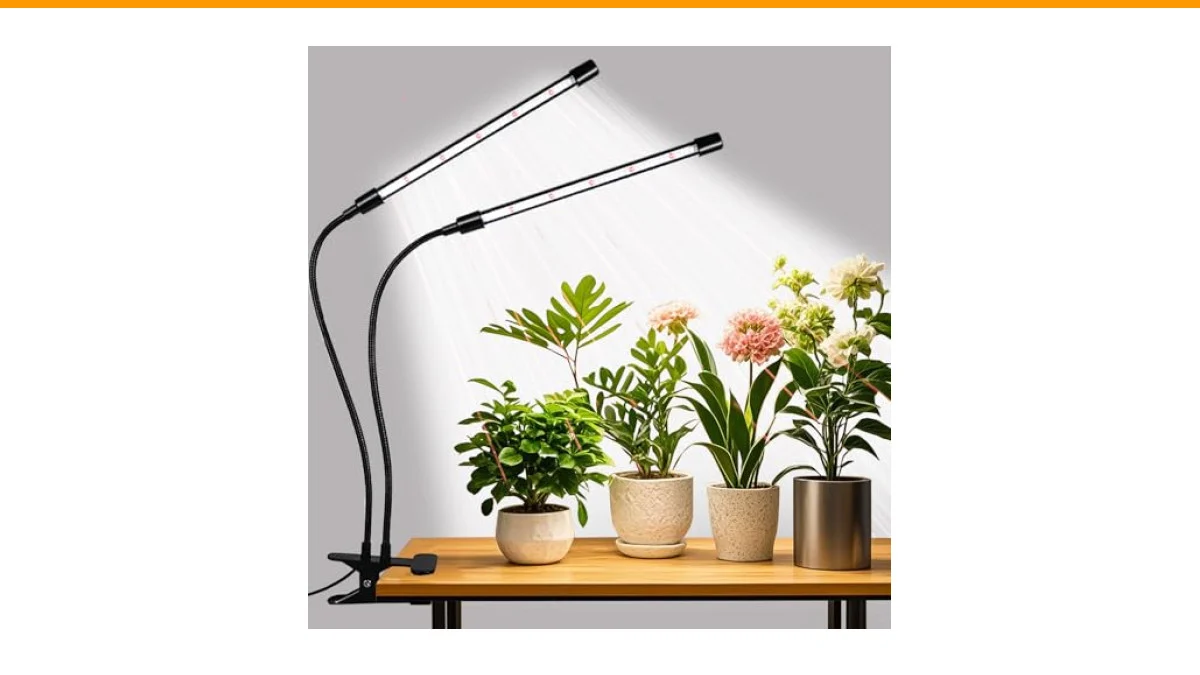
This two-head clip light is the best all-rounder for anyone growing a small collection of plants on a shelf, bookcase, or countertop. It suits office workers who need a set-and-forget timer and plant parents with mixed collections of succulents, herbs, and tropical foliage. The dual heads mean you can aim one bar at a tall plant and angle the other toward a low-growing succulent without moving the base.
Each head packs 42 LEDs — 5 red and 37 sunlight white — which gives you that balanced spectrum plants need without the harsh purple glow that makes your home feel like a grow-op. The 360-degree gooseneck arms hold their position well, so you won’t find them drooping after a week. Ten brightness levels give you fine control, which matters more than you’d think when you’re nursing a light-sensitive fern next to a sun-hungry tomato seedling.
The timer with 3, 9, and 12-hour options cycles automatically each day once you set it. That’s a genuine convenience if you travel or work long hours. My main complaint is that the clip, while sturdy, won’t fit on surfaces thicker than about an inch and a half, so thick wooden shelves could be a problem. It’s also not the prettiest light on the market — the plastic housing is functional rather than decorative.
- 84 total LEDs across two adjustable heads
- 3 spectral modes including full-spectrum mix
- Cycle memory timer turns on and off automatically
- Strong clamp with 360-degree flexible gooseneck
- 10 dimmable brightness levels for different growth stages
Best for: Plant owners with multiple small to medium plants on shelves who want flexible positioning and a reliable daily timer.
Aokrean Halo Grow Light
The Aokrean halo light is perfect for someone with a single statement plant — a fiddle leaf fig, a large peace lily, or a collection of herbs in one pot. Its ring design wraps light around the plant from all sides, which mimics natural overhead sun better than a single directional beam. This is also one of the few budget lights that looks intentional in your decor rather than like a piece of lab equipment.
Installation is genuinely simple. You either press the base down with your pot (the weight of the plant holds it steady) or insert the stake directly into the soil. The pole telescopes up to 26 inches and rotates 90 degrees, so you can raise it as your plant grows. For a light at this price point, that kind of adjustability is rare.
Three lighting modes and ten brightness levels give you room to experiment. The warm white and red setting works nicely for flowering plants, while the mix mode handles general growth. The main limitation is stability — the base version relies on your pot’s weight to stay upright, so a lightweight plastic pot with a small plant won’t anchor it well. And because the light sits on the soil, it only works for plants in individual pots, not for trays of seedlings.
- Telescoping pole adjusts from compact to 26 inches tall
- Dual installation methods: soil stake or weighted base
- 3 spectrum modes including a dedicated red setting
- Cycle timer with 3, 9, and 12-hour options
- Stylish design that doubles as a decorative accent
Best for: Owners of medium to large potted plants who want even, 360-degree coverage and a light that doesn’t look out of place in a living room.
Briignite Grow Light Bulb

Briignite
Briignite Grow Light Bulbs, LED Grow Light Bulb A19 Bulb, Full Spectrum | Grow Light Bulb, Plant Light Bulbs E26 Base, 11W Grow Bulb 100W Equivalent,Grow Light for Indoor Plants,Seed Starting, 2Pack
- FULL SPECTRUM & NATURAL LIGHT: A19 full spectrum grow light appears 4000K white to eyes but has a red/blue light spectrum. Same as…
- HIGH BRIGHTNESS & ENERGY SAVING: A19 LED plant grow light bulbs deliver 180-degree 1000LM bright light output. Use High Lumen LED…
- HIGHER EFFICIENCY: LED grow bulb with high light transmission improves plant absorption more effectively. Balanced lighting of ful…
The Briignite A19 bulb is the smartest choice for anyone who already owns lamps, pendant fixtures, or desk lights. You screw this in like a regular bulb and suddenly your reading lamp becomes a grow light. It’s ideal for people with a sunny window that’s just not quite sunny enough — pop this into a nearby lamp and your plants get the boost they need without any new hardware cluttering your space.
This bulb looks like a normal 4000K white light to your eyes, which is a huge advantage. No purple tint, no weird disco effect in your dining room. But underneath that natural appearance, it delivers a red and blue spectrum tuned for plant growth. The 11-watt draw replaces roughly 100 watts of traditional lighting, so running it for 12 hours a day costs pennies. A 25,000-hour lifespan means you’ll replace this bulb long after your plants have outgrown their pots.
The trade-off is that you get no timer, no dimming, and no spectrum controls. You’ll need to plug your lamp into a smart plug or remember to switch it off manually. The 180-degree light spread also means it works best positioned relatively close to your plants — about 6 to 12 inches away — so tall floor lamps may not deliver enough intensity to lower leaves.
- Standard E26 screw-in base fits most household lamps
- Consumes only 11 watts while outputting 1000 lumens
- PPF of 25 micromoles per second supports active growth
- Natural 4000K appearance blends with home decor
- Built-in aluminum cooling system prevents overheating
Best for: Anyone who wants to convert existing light fixtures into grow lights without buying a dedicated plant lamp.
GooingTop Clip Grow Light
The GooingTop clip light is the budget pick for beginners or anyone growing a few small houseplants on a desk, kitchen counter, or windowsill. It runs on USB power, so you can plug it into your laptop, a wall adapter, or a power bank. That flexibility makes it a favorite for dorm rooms and offices where outlets are scarce or awkwardly placed.
This light uses 84 LEDs — 74 white and 10 red — to produce a clean 6000K daylight spectrum. The high color rendering index of 95 means the light is pleasant to work under; it doesn’t distort the colors of your plants or your paperwork. The flexible gooseneck bends easily and stays put, letting you position the light exactly where your plant needs it most.
Where this light falls short is adjustability. The timer offers 4, 8, or 12-hour options, but there’s no dimming control — you get one brightness level. That’s fine for low-light tolerant plants like pothos or snake plants, but seedlings or flowering plants might want more intensity control. The clip is also on the smaller side, so it works best on thinner surfaces like desk edges or shelf boards rather than bulky furniture.
- Powered by USB or AC adapter for flexible placement
- 10-watt draw roughly equals a 50-watt halogen bulb
- CRI of 95 provides soft, flicker-free illumination
- Flexible gooseneck positions light at any angle
- 365-day warranty with responsive customer service
Best for: Students, office workers, and casual plant keepers who need an affordable, portable light for one or two small plants.
Kullsinss Tall Halo Grow Light
The Kullsinss halo light solves a problem most budget grow lights ignore: tall plants. If you own a monstera that’s reaching your ceiling or a bird of paradise that’s outgrown every shelf, this light adjusts from a compact 10 inches up to 65 inches tall. That range means you can start it low for a young plant and extend it as your green friend grows.
The faux woodgrain finish on the pole looks more expensive than it is, and unlike bamboo alternatives, it won’t crack or split over time. Inside the halo ring, 80 LEDs deliver a full spectrum from 380 to 760 nanometers — everything your plant needs from germination through flowering. The smart controller gives you five dimming levels and three spectrum modes, so you can dial in the right light for a leafy philodendron versus a blooming orchid.
This light has two notable limitations. First, it has no base — installation requires inserting the stake directly into the soil, which means it only works for plants in pots large enough to support it. Second, the timer is limited to 6, 12, or 16 hours, which skips the shorter cycles that some succulents prefer during winter dormancy. But for its target audience of tall, statement plants, none of that matters much.
- Height adjusts from 10 to 65 inches for tall plants
- 80 high-efficiency LEDs with full 380-760nm spectrum
- Faux woodgrain finish resists cracking and fading
- 5 dimmable levels and 3 spectrum modes
- Automatic timer cycles at 6, 12, or 16 hours
Best for: Owners of large, floor-standing plants who need a light that grows alongside their plant.
How We Chose These Products
I evaluated each light on four practical criteria that matter for real indoor growing: light quality, ease of use, flexibility, and value. Light quality means looking at the actual spectrum output and LED configuration — not just the marketing claims about full spectrum, but whether the red and blue wavelengths are balanced for photosynthesis. Ease of use covers installation, timer programming, and daily operation. Flexibility considers how well the light adapts to different plant sizes and shelf configurations. Value weighs all of that against the price point.
I also considered the physical setup of each light. A clip light that only fits thin shelves is useless if your plant lives on a thick wooden stand. A halo light that requires a heavy pot for stability won’t work for someone growing in a lightweight nursery pot. Every product here earned its place because it solves a specific problem well, not because it checks every box on a spec sheet. My goal is to help you match the right tool to your specific plants and space.
Buying Guide: What Really Matters
Before you buy any grow light, measure your space and think about your plant’s actual light requirements. A low-light tolerant pothos needs far less intensity than a flowering African violet or a vegetable seedling. Full spectrum lights are great for general use, but plants in their flowering stage genuinely benefit from extra red wavelengths. Match the light to the plant, not the other way around.
Pay attention to the timer and dimming features. A timer that automatically cycles daily is worth paying extra for — it ensures consistent light even when you’re not home. Dimming matters if you have plants with different light tolerances in the same area, since you can adjust intensity without moving the light. If you’re growing herbs or leafy greens, look for a light that can run 12 to 16 hours daily without overheating.
Finally, consider the aesthetic. The days of ugly purple grow lights are over. Several options here, particularly the halo lights, look like intentional home decor. If your plants live in a shared living space, that visual factor matters more than you might expect. For more guidance on choosing the right setup, check out this cheap grow lights guide for additional budget options.
Our Top Recommendation
The RWNTAO clip light is my top pick for most people. It offers the best combination of light quality, adjustability, and smart features at a budget-friendly price. The dual heads and flexible goosenecks handle multiple plants at once, while the 10 brightness levels and 3 timer settings give you real control over your growing environment. It’s the most versatile option here.
If your plant lives in a decorative pot and you want something that looks good, choose the Aokrean halo light instead. For those who want to avoid dedicated grow light hardware entirely, the Briignite bulb turns any regular lamp into a plant light. And for tall statement plants, the Kullsinss is the only budget option that extends high enough to matter. The GooingTop remains the best ultra-budget choice for a single small plant on a desk.
Frequently Asked Questions
How close should I position the grow light to my plants?
Most LED grow lights work best when placed 6 to 12 inches above your plants. The exact distance depends on the light’s intensity and your plant’s tolerance. Start at the higher end of that range and watch for signs of stress. If leaves look bleached, move the light farther away. If growth is leggy, move it closer.
Can I leave my grow light on 24 hours a day?
No. Plants need a dark period to respire and process the energy they collect during the day. Running lights around the clock can stress plants and disrupt their growth cycle. Most indoor plants thrive with 12 to 16 hours of light followed by 8 to 12 hours of darkness. The timer functions on these lights make that schedule easy to maintain.
Will a cheap grow light actually help flowering plants?
Yes, but you need the right spectrum. Flowering plants benefit from additional red light, which signals the plant to produce blooms. Look for lights with a dedicated red mode or a full spectrum that includes red wavelengths. The RWNTAO and Aokrean both offer red spectrum settings that support flowering.
What’s the difference between a grow light and a regular LED bulb?
Regular LED bulbs are designed for human vision — they produce light in the visible spectrum but lack the specific wavelengths plants need for photosynthesis. Grow lights emit a broader spectrum that includes red and blue wavelengths plants actually use. While some bright white LEDs can support low-light plants, dedicated grow lights deliver the intensity and spectrum balance that promotes real growth. For specific plant types, you might want to check out houseplant grow lights recommendations or compare grow light wattage requirements for different species.