
You just scored a used go-kart frame, but it lacks a heart. Or maybe you are staring at a dead lawn mower and wondering if that engine could power something far more fun. The problem is that picking the wrong engine means buying new mounting plates, a different clutch, and dealing with a kart that either crawls or shakes apart.


The good news is that the go-kart world has settled on a sweet spot: the 212cc horizontal shaft engine. This size delivers enough torque to move a full-size adult without demanding a reinforced frame or a second mortgage. A 6.5 to 7.5 horsepower engine in this class is the standard for a reason—it balances cost, reliability, and ease of installation.
I have broken down the top five options on Amazon, focusing on who each engine suits best and what you will need to get it running. You will also find a practical guide on shaft orientation, gear ratios, and the governor question. If you want to skip the details, the maXpeedingrods 7HP 212cc is the best all-around pick for a standard build, but the electric start version is worth the upgrade if you hate pulling ropes.
Here is a quick look at how the main engines compare on the specs that actually matter for a kart build.
| Features | maXpeedingrods 7HP | maXpeedingrods Electric | Knwigoe 7.5HP | YIYIBYUS 7.5HP |
|---|---|---|---|---|
| Shaft Diameter | 3/4 inch | 3/4 inch | 3/4 inch | 20mm (0.79 inch) |
| Starting Method | Recoil Pull | Electric & Recoil | Recoil Pull | Electric Start |
| Displacement | 212cc | 212cc | 212cc | 212cc |
| Fuel Efficiency | OHV Design | OHV Design | 395g/kw.h | 30% less consumption |
| Best Use Case | Standard Karts | Convenience Builds | Versatile Swap | Predator Replacements |
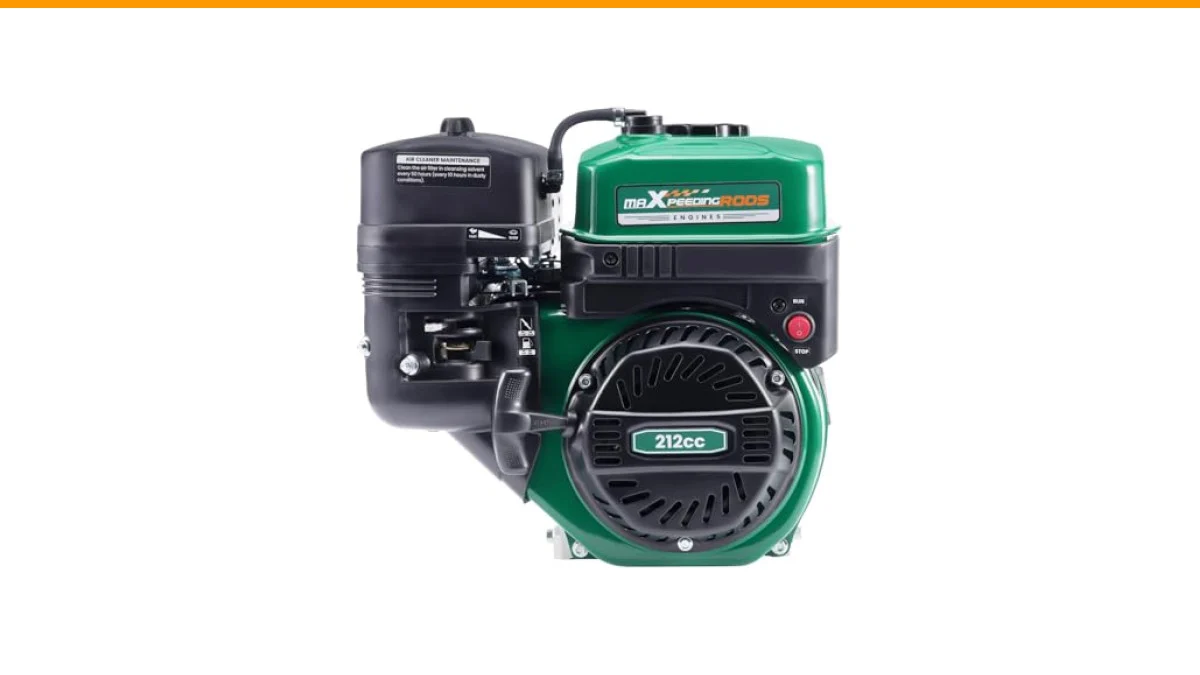
maXpeedingrods 7HP 212cc Engine
This is the engine most people picture when they plan a budget go-kart build. It is a direct clone of the ubiquitous Predator 212, which means the aftermarket support is massive. You will find countless videos and forums dedicated to hopping up this exact platform. It suits a first-time builder who wants a proven, simple powerplant that just works out of the box.
What stands out here is the build quality for the price. The ball-bearing supported crankshaft reduces vibration compared to cheaper bushing-based engines. That matters when you are bolting this to a small frame; less vibration means fewer loose bolts and a more comfortable ride. The low-oil shutoff sensor is a genuine lifesaver for new owners who forget to check levels, saving the engine from self-destruction during a long session.
You will be fine with this unless you have a physical limitation that makes pulling a recoil cord difficult. It is a pull-start only, so if you stall at the far end of a track, you are walking over to yank it again. Also, the standard 3/4-inch shaft requires a 3/4-inch bore centrifugal clutch, which is the most common size, so you likely will not need an adapter.
- 212cc OHV 4-stroke with 8.5:1 compression ratio
- 3/4-inch horizontal shaft with 3/16-inch keyway
- 3.6-liter fuel tank for extended run times
- Low oil sensor triggers automatic shutdown
- EPA certified for legal use in all states
Best for: The budget-conscious builder who wants a reliable, standard-size engine with a huge aftermarket for upgrades.
maXpeedingrods 7HP Electric Start

maXpeedingrods
maXpeedingrods 7HP 212cc Gas Engine, Electric Start 4 Stroke OHV | Horizontal Shaft Gasoline Engine, Shaft 3/4" (19mm) Diameter, Shaft 3/16" Keyway for Go-Karts Log Splitters Lawn Mowers
- 【Specification】Shaft Diameter(inch): 3/4; Shaft Keyway(inch): 3/16; Shaft length(inch): 2.43; Shaft End: 5/16"-24 Drilled and Tapp…
- 【Electric Start】Our gasoline engine is specially designed with electric start, just turn the key, you can start the engine easily…
- 【Powerful Engine】Our gasoline engine is a 4-stroke 212cc OHV engine, which provides you with strong power and ensures that your wo…
If you have ever flooded a small engine and spent ten minutes yanking the cord in frustration, this is your answer. The electric start version of the maXpeedingrods 212cc adds a keyed ignition that turns the engine over instantly. It comes with a recoil backup, so you are never stranded if the battery dies. This is the pick for taller or heavier riders who want to focus on driving, not on the physical effort of starting.
The core specifications are identical to the pull-start model, so you do not lose any performance. You get the same 212cc displacement, the same 7 horsepower rating, and the same efficient OHV design. The addition of the starter motor and solenoid does add a bit of weight, but the convenience far outweighs the extra pounds for most users. It is a fantastic option for a kart used by multiple family members, especially younger ones who lack the arm strength for a pull start.
The trade-off is the wiring. You need a 12V battery, which is not included, and you have to connect the key switch to the starter solenoid and ground it properly. It is not complicated, but it adds a step that a pure pull-start engine does not have. You will also need to find a spot on your frame to mount a small battery tray securely.
- Dual start options: key turn and recoil pull
- Requires an external 12V battery (not included)
- Same 3/4-inch shaft as standard models
- Includes starter motor, solenoid, and wiring harness
- Ideal for frequent stop-and-go driving
Best for: Riders who prioritize convenience and easy starting over the minimal weight savings of a pull-start engine.
Knwigoe 212cc Go Kart Engine
Knwigoe markets this as a dedicated go-kart motor, but the specs show it is a versatile workhorse. The 7.5 horsepower rating gives it a slight edge over the standard 7HP clones, which you might notice on longer straightaways or when climbing hills. It is a solid choice for someone who wants a bit more punch without stepping up to a larger frame or a racing engine.
This engine claims a specific fuel consumption rate of 395g/kw.h. While you will not measure that in your backyard, it suggests the tuning is efficient. It runs at 3600 RPM, which is the standard operating speed for these engines. The clockwise rotation shaft is the norm for go-karts, so you can use a standard clutch without worrying about reverse rotation issues.
You will be fine with this unless you are looking for a direct replacement for a specific brand. The mounting pattern is the standard 3-hole layout found on most frames, but it is always worth double-checking your existing plate. It is also a pull-start only, which keeps things simple but might be a downside for less physically able drivers.
- 7.5 horsepower at 3600 RPM
- Air-cooled, single-cylinder OHV design
- Clockwise shaft rotation for standard clutches
- Stated fuel consumption of 395g/kw.h
- Suitable for karts, mini bikes, and log splitters
Best for: Builders who want a slightly more powerful clone engine for a lively ride on flat terrain.
YIYIBYUS 7.5HP Electric Start

YIYIBYUS
7.5HP 212CC Gas Engine with Electric Start, Horizontal Shaft 20mm 4-Stroke OHV Motor for Go Kart Lawn Mower Compressor Pump Generator Gas Powered
- 【Application & Compatibility】7.5HP Horizontal Shaft Engine for Go Karts, Generators, Lawn Mowers, Pressure Washers, Water Pumps, C…
- 【High Efficiency Design】OHV Technology Reduces Fuel Consumption by 30% vs Standard Engines | Dual Air Filtration System Minimizes…
- 【Power Performance】212CC 4-Stroke Gas Motor Delivers 3600 RPM Max Speed | Industrial-Grade Crankshaft | Ideal for Heavy-Duty Appli…
This engine is a direct replacement for the Predator 212, which is excellent news if you are upgrading an existing kart that already uses that mounting pattern. The 7.5 horsepower rating and electric start make it a compelling package. It is positioned for users who want the convenience of a key start combined with a slight power bump over the baseline 6.5HP engines.
The standout feature here is the dual air filtration system. It is a small detail, but it means the engine is better protected from dust and debris, which is common when driving off-road or on dirt tracks. The manufacturer also claims a 30% reduction in fuel consumption compared to standard engines, thanks to the OHV design. Over a summer of driving, that efficiency adds up.
Here is the critical warning: the shaft is 20mm, not the standard 3/4-inch (19.05mm). This is a major gotcha. Most clutches and torque converters are bored for 3/4-inch shafts. While the package includes shims for a 3/4-inch adapter conversion, you must verify your clutch compatibility before buying. If you already own a 3/4-inch clutch, you will need to buy a new one or use the shims, which can introduce alignment issues.
- 20mm shaft diameter requires specific clutch or shims
- Electric start with recoil backup
- EPA and CARB compliant for cleaner operation
- Includes wiring instructions for battery connection
- Dual air filtration for dusty environments
Best for: Experienced builders who understand shaft size compatibility and want an electric start Predator alternative.
Strongthium Throttle Spring Kit

Strongthium
Strongthium 34Pcs Throttle Return Springs Assortment | for Honda Briggs and Stratton Small Engines Lawn Mower Mini Bike Go Kart Replacement
- 2 × Governor spring (262759, 692211, 690-239-0014) + 2 × Anti surge spring Governed Idle Spring (691859, BS-691859, 263109, BS-263…
- 2 x throttle return springs + 2 x speed control springs+ 2 x throttle rod(16561-Z0L-000 16562-ZM0-000 ), for Honda small engines G…
- 2 × air vane choke Spring + 2 × governor springs( 790849 699056 BS-699056),for Briggs & Stratton Toro MTD Craftsman Troy Bilt Cub…
This is not an engine, but it is the part you will likely need to finish your build. The Strongthium kit is a massive assortment of throttle return springs, governor springs, and linkage rods. If you are swapping a new engine onto an old kart frame, you will almost certainly find that the original throttle cable and springs do not line up perfectly with the new carburetor.
This kit solves that problem by providing a variety of spring sizes and lengths. It includes a set specifically for Honda GX160 and GX200 clones, which covers most 212cc engines on this list. It also has springs for Briggs & Stratton engines and specific throttle rods for mini bikes and go-karts. Instead of making a trip to a hardware store and guessing at spring tension, you have a full library of parts in one box.
The limitation is that you will only use a few pieces from this kit. The rest will sit in a drawer for future projects. That is not a bad thing, but do not expect a perfectly curated set for one specific engine. It is a generalist kit that covers a wide range of small engine applications. For the price, it is worth having on hand during the build process.
- Contains springs for Honda GX160, GX200, and 212cc engines
- Includes throttle rods and cable springs
- Also covers many Briggs & Stratton and Tecumseh models
- Essential for custom throttle linkage setups
- Prevents throttle sticking and runaway engines
Best for: Builders who are fabricating a custom throttle linkage and need a variety of springs to get the tension right.
How We Chose These Products
I started by looking at what engines actually fit a standard go-kart frame. The mounting pattern and shaft orientation are the first filters. If the engine does not sit flat and the shaft does not point horizontally, it is useless for a kart, regardless of horsepower.
From there, I narrowed the list to the 212cc class. This displacement offers the best balance of power and weight for a recreational kart. I reviewed each engine for starting convenience, fuel efficiency, and specific quirks like the YIYIBYUS shaft diameter. I also included the throttle spring kit because it addresses a common pain point that stops many first-time builders from finishing their project.
Buying Guide: What Really Matters
Horsepower numbers get all the attention, but torque is what actually pushes you off the line. A 7HP engine with good torque will feel faster than a poorly tuned 8HP engine. Look for engines with a longer stroke if you want low-end grunt for acceleration. The 212cc engines listed here all provide enough torque for a standard kart.
Your choice between a clutch and a torque converter is also critical. A centrifugal clutch is simple and cheap, but it slips when you are climbing hills or carrying a heavy load. A torque converter uses a belt and two pulleys to change the gear ratio automatically. It gives you better acceleration and hill-climbing ability. If your kart is heavy or your yard is hilly, budget for a torque converter instead of a clutch. You can read more about managing steep terrain to understand the demands on your engine.
Finally, consider the mounting plate. Most frames have a 3-hole or 4-hole pattern. The engines here use the standard Predator pattern, but always measure the distance between the bolt holes on your frame before ordering. A quick measurement saves you from buying an adapter plate or drilling new holes into a hardened steel frame.
How to Calculate Your Ideal Gear Ratio
Gear ratio is the secret to a fast kart. It is the number of teeth on the axle sprocket divided by the number of teeth on the clutch sprocket. If your clutch has 12 teeth and your axle sprocket has 60 teeth, your ratio is 5:1. This means the engine turns five times for every one rotation of the rear wheels.
For a 212cc engine, a ratio between 5:1 and 6:1 is a good starting point for a standard 18-inch tire. A lower ratio (like 4:1) gives you higher top speed but slower acceleration. A higher ratio (like 7:1) gives you quick acceleration but a lower top speed. If you are heavy or live in a hilly area, start with a 6:1 ratio and adjust from there.
You can calculate the right sprocket size by measuring your rear tire diameter. A larger tire covers more ground per rotation, which effectively lowers your gear ratio. If you install bigger tires, you may need a larger axle sprocket to maintain acceleration. This is a trial-and-error process, but starting with the math saves you money on parts.
Mounting, Wiring, and Throttle Linkage Essentials
Mounting the engine is straightforward, but wiring an electric start model takes care. The YIYIBYUS manual offers a simple guide: red wire to battery positive, black wire to battery negative, and green-yellow wire to the frame for grounding. If you mix these up, you risk frying the starter solenoid.
Throttle linkage is where most builds stall. The governor arm on the carburetor connects to your pedal via a cable. The spring kit I reviewed is essential here because it returns the throttle to idle when you release the pedal. A missing or weak spring can cause the engine to race, which is dangerous. Always use the strongest spring that still allows the carburetor to snap back to idle.
If you are using a pull-start engine, you avoid the wiring hassle entirely. This is why many builders choose the maXpeedingrods pull-start for their first project. It reduces the number of variables that can go wrong. You can always convert to electric start later if you find the pulling tiring.
The Governor Removal Question
Removing the governor is the most debated topic in the karting community. The governor is a mechanical device inside the engine that limits RPM to around 3600. Removing it allows the engine to rev higher, unlocking more horsepower. This is how you turn a 7HP engine into a 9HP engine without buying new parts.
The risk is real. The governor also protects the internal components from over-revving. Remove it, and you risk floating the valves or throwing a connecting rod at high RPM. If you ignore the governor, you must install a billet connecting rod and heavier valve springs to handle the extra stress. That is an extra $100 in parts and a full engine teardown.
My advice is to leave the governor intact for your first season. Learn how the kart handles at stock power. If you want more speed, upgrade your sprocket ratio first. If you still need more, then research a proper governor bypass and budget for the internal upgrades. Cutting corners here leads to a destroyed engine and a long walk home.
Our Top Recommendation
The maXpeedingrods 7HP 212cc pull-start engine is the clear winner for most builders. It hits the sweet spot of price, reliability, and compatibility. The 3/4-inch shaft fits standard clutches, the mounting pattern matches most frames, and the low-oil sensor protects your investment. It is the engine you can install on a Saturday and drive on Sunday.
If you want the convenience of a key start, the maXpeedingrods electric start version is a worthy upgrade. It is the same reliable engine with a starter motor bolted on. For those who need to replace a Predator engine and do not mind a shaft adapter, the YIYIBYUS offers a solid electric start option. And do not forget the Strongthium spring kit—it is a cheap insurance policy against throttle issues. For more context on engine care, check out this guide on engine oil to keep your new motor running smoothly.
Safety Checklist for Your First Test Drive
Before you hit the throttle, run through a quick safety check. Tighten all engine mounting bolts. A loose engine will shift and throw off your clutch alignment. Check the chain tension—it should have about half an inch of play. Too tight and it will bind; too loose and it will skip off the sprocket.
Test the throttle pedal. Press it down and release it. The engine should return to idle immediately. If it hangs, fix the spring before driving. Check the brakes. A go-kart with a powerful engine and weak brakes is a recipe for disaster. Finally, wear a helmet. A 7HP engine can push a kart past 30 mph, and that is fast enough to cause serious injury.
Start with a slow lap around your yard. Listen for unusual noises. Feel for vibration. If something seems off, stop and investigate. It is better to find a loose bolt in your driveway than at the end of a straightaway. For a final check on mower deck fit, you might review this lawn mower guide to see how these engines perform in their original role.
Frequently Asked Questions
Can I use a vertical shaft engine from a lawn mower?
No. A vertical shaft engine has the crankshaft pointing down. Go-karts need a horizontal shaft engine where the crankshaft points sideways. You cannot easily convert a vertical shaft engine because the carburetor and exhaust are oriented for a specific angle. You would need a complex oil pump modification to prevent starvation.
What size clutch do I need for a 212cc engine?
You need a clutch with a 3/4-inch bore to fit the standard shaft diameter. The clutch should be rated for the engine’s horsepower, typically a #35 chain clutch for up to 8HP. If you have a 20mm shaft like the YIYIBYUS, you need a clutch with a 20mm bore or a sleeve adapter.
How fast will a 212cc go-kart go?
With a standard 5:1 gear ratio and 18-inch tires, you can expect a top speed of around 30 to 35 mph. You can increase speed by changing the gear ratio or installing a torque converter. Removing the governor can push it past 40 mph, but that requires internal engine upgrades for safety.
Do I need a torque converter or a clutch?
A centrifugal clutch is fine for flat ground and light riders. It is cheap and simple. A torque converter is better for hills, heavy riders, or off-road use. It provides a variable gear ratio that keeps the engine in its power band. If you weigh over 180 pounds, start with a torque converter.


