
I spent three springs staring at a half-dead yard in central Wisconsin before I figured out the obvious: most fertilizer advice online is written for people in Georgia, not Green Bay. Big-box shelves stock the same national brands everywhere, but a lawn sitting on sandy glacial till in Adams County has almost nothing in common with a lawn on heavy clay near Madison. Add lake-effect snow, a short growing season, and cool-season grasses that go dormant fast, and the standard spring feeding schedule falls apart.
A good Wisconsin fertilizer has to do three things well. It needs slow-release nitrogen so grass doesn’t push tender growth right before a freeze. It needs a ratio that matches cool-season grasses like Kentucky bluegrass and tall fescue. And it needs to be timed around fall, not spring — the opposite of what most national guides tell you.
Below are five products that actually fit that brief, from a winterizer built for northern lawns to a starter food for overseeding. I’ve also included a month-by-month calendar for Wisconsin, a cost-per-coverage breakdown, and the soil pH issue almost nobody mentions before they buy a bag.
Here’s a quick side-by-side of the key specs before we dig into each pick.
| Features | Wisconsin Pesticide Signs | Scotts WinterGuard 32.3 lb | Scotts WinterGuard 10 lb | Scotts Turf Builder 12.5 lb | Scotts Starter Fertilizer 15 lb |
|---|---|---|---|---|---|
| Primary Use | Compliance signage, not fertilizer | Fall winterizer feeding | Fall winterizer, small yards | General all-season feeding | New grass and overseeding |
| Coverage | 500 stakes per pack | 12,000 sq ft | 4,000 sq ft | Not specified in data | 5,000 sq ft |
| Grass Types | N/A | Any grass type | Any grass type | Any grass type | Any grass type |
| Season | Year-round posting | Fall only | Fall only | Spring, summer, fall | Planting time |
| Best For | Applicator compliance | Large northern lawns | Small city lots | Maintenance feeding | Seeding and sod |

Wisconsin Pesticide Appli…

Great Lakes Marking Products
Wisconsin Pesticide Application Signs & Stakes (Economy Style Stakes / 500 pc. Pack)
- WISCONSIN-specific signage that meets state compliance requirements.
- 100% MADE IN THE USA.
- Stakes are 20" stick style ("Economy")
This one isn’t fertilizer, and I want to be upfront about that. It’s a 500-pack of Wisconsin-compliant pesticide application signs and stakes from Great Lakes Marking Products. If you hire a lawn service, apply weed-and-feed yourself, or run a small landscaping operation, state rules require you to post notice after certain applications. Skipping that step can mean a fine.
The practical value here is volume. Five hundred stakes at 20 inches tall with 5×4 inch cardstock signs covers a full season of residential work, or several years for a single homeowner who treats their own lawn. The stakes are recycled plastic, which holds up through freeze-thaw cycles better than wood. Signs are coated on one side for weather resistance, and each one is printed with the Wisconsin-specific language the state expects.
The trade-off is obvious: this is a compliance item, not a lawn-care product. The cardstock signs are economy-grade, so they’ll fade after a few weeks of direct sun and rain. If you need long-term posting, plan to replace them. Also, if you’re a homeowner who never applies restricted products, you probably don’t need this at all.
- Meets Wisconsin state posting requirements for pesticide application
- 500 stakes and signs per pack — sized for contractors or multi-season use
- 20-inch recycled plastic stakes resist frost heave
- Single-sided coating adds some rain resistance, but signs are paper-based
- Made in the USA
Best for: Lawn care pros and DIY weed-and-feed users in Wisconsin who need compliant posting signs in bulk.
Scotts Turf Builder Winte…
Scotts
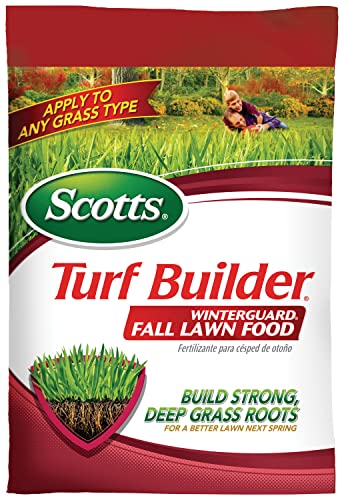
Scotts Turf Builder WinterGuard Fall Lawn Food, 32.3 lbs. | Lawn Fertilizer for All Grass Types, Covers 12,000 sq. ft., Autumn Lawn Care
- FALL LAWN FERTILIZER: Scotts Turf Builder WinterGuard Fall Lawn Food is a fertilizer that builds strong, deep grass roots for a be…
- SUMMER LAWN RECOVERY: Our fertilizer provides the plant food nutrients lawns need to help recover from summer heat, drought, and r…
- APPLY IN FALL TO PREPARE YOUR LAWN FOR WINTER: Apply this grass fertilizer to a wet or dry lawn in the fall
This is the pick I’d hand to most Wisconsin homeowners with a normal-sized yard. WinterGuard is a fall fertilizer designed to build root mass before dormancy, and that timing matters more here than anywhere. Grass in Zone 3 to 5 stops top growth around late October, but roots keep developing until the soil freezes. Feed during that window and you get a thicker lawn the following April.
The 32.3-pound bag covers 12,000 square feet, which is roughly a third of an acre. That’s a good match for suburban lots outside Milwaukee, Appleton, or Eau Claire. It works on any grass type, so you don’t have to worry whether your mix is mostly bluegrass or fescue. Application is simple — spread it on a wet or dry lawn in fall and water it in.
One honest limitation: this is a single-season product. Buy it in September, use it once, and store the rest. It won’t replace a spring feeding or a mid-summer touch-up. Some homeowners also find the granule size a bit dusty when pouring from the bag, so a spreader with a hopper screen helps.
- Formulated for fall root development, not top growth
- 32.3 lb bag covers 12,000 sq ft — good for larger suburban lots
- Safe on Kentucky bluegrass, tall fescue, and mixed cool-season lawns
- Apply September through November, before ground freeze
- Not a substitute for spring or summer feeding
Best for: Homeowners with a quarter-acre or larger Wisconsin lawn who want one strong fall feeding.
Scotts Turf Builder Winte…
Same formula, smaller bag. The 10-pound version covers 4,000 square feet, which fits a typical city lot in Madison, La Crosse, or a tight suburban parcel. If you’ve ever bought the big bag and watched half of it turn to brick in the garage over winter, this size solves that problem.
Everything about the performance is identical to the larger bag. It builds deep roots, helps grass recover from summer heat and drought stress, and preps the lawn for a Wisconsin winter. The smaller bag also makes it easier to apply at the correct rate without guessing. You get a cleaner spread pattern when you’re not trying to stretch a partial bag across too much ground.
The downside is cost efficiency. Per square foot, the 10-pound bag usually runs higher than the 32.3-pound version. If you have the storage and the lawn size, the bigger bag wins on value. This size is really about convenience and waste reduction, not savings.
- 10 lb bag covers 4,000 sq ft — sized for small yards
- Identical winterizer formula to the larger bag
- Easier to store without clumping over winter
- Works on all cool-season and warm-season grass types
- Higher cost per square foot than the bulk size
Best for: Small-lot homeowners or anyone who wants a single fall application without leftover product.
Scotts Turf Builder Lawn…

Scotts
Scotts Turf Builder Lawn Food, 12.5 lbs. | Fertilizer for Grass, For All Grass Types, Covers 5,000 sq. ft.
- WHERE TO USE: Lawn fertilizer for grass can be used on any grass type
- GRASS FERTILIZER FOR LAWNS: Scotts Turf Builder Lawn Food feeds and strengthens your grass to help protect against future problems
- STRONG ROOTS: Our pesticide-free lawn food for grass builds strong, deep roots, improving your lawn's ability to absorb water and…
This is the general-purpose feeder you’ll use more than once a year. Turf Builder Lawn Food is a maintenance fertilizer, not a seasonal specialist. It feeds grass, strengthens roots, and helps the lawn absorb water and nutrients more efficiently than an unfed yard. The 12.5-pound bag is a middle-ground size that works for lawns in the 4,000 to 5,000 square foot range.
What sets it apart is flexibility. You can apply it in spring, summer, or fall on a wet or dry lawn, and it’s safe for any grass type. For Wisconsin, that means you can use it as a light spring green-up feeding in late April, then again in early summer if the lawn looks tired after a dry stretch. It’s pesticide-free, so it won’t wipe out clover or beneficial insects.
The catch: it’s not a winterizer. It won’t deliver the potassium-heavy root support your lawn needs going into a hard freeze. Use it as your in-season workhorse and pair it with a fall product for the cold months. Also, on sandy soil, you’ll want to split applications rather than dumping the full rate at once.
- All-season granular fertilizer for any grass type
- Pesticide-free formula — safe around clover and pollinators
- Builds deeper roots for better drought tolerance
- 12.5 lb bag is a moderate size for mid-range lawns
- Not designed for winter root building
Best for: Homeowners who want one flexible fertilizer for spring, summer, and early fall touch-ups.
Scotts Turf Builder Start…

Scotts
Scotts Turf Builder Starter Fertilizer for New Grass, 15 lbs. | Use When Planting Seed, Covers 5,000 sq. ft.
- FERTILIZER FOR NEW LAWNS: Scotts Turf Builder Starter Food for New Grass is a specially formulated starter fertilizer for grass se…
- SAFE FOR ALL GRASS TYPES: This 24-25-4 NPK lawn care product is safe to use on any grass type
- WHEN TO USE: Apply this lawn food anytime you're planting new grass, whether it's starting a new lawn, reseeding an existing one,…
New grass needs different food than established turf. This starter fertilizer is built for seeding, overseeding, sod, sprigs, and plugs. The 24-25-4 NPK ratio pushes root development and early top growth, which is exactly what a Wisconsin lawn needs when you’re racing the first frost. If you’re overseeding in late August or early September — the best window in this state — this is the bag to grab.
Results are measurable. Scotts claims new grass grows 70% thicker and 35% quicker compared to unfed lawns, and that tracks with the phosphorus-heavy formula. One 15-pound bag covers 5,000 square feet, so a typical overseeding project fits in a single bag. It’s safe on all grass types, including the bluegrass-fescue blends most northern lawns use.
The limitation is timing. Starter fertilizer is not a maintenance product. Once the new grass matures, switch to a regular feeder like Turf Builder Lawn Food. Applying starter food to an established lawn wastes phosphorus and can encourage weeds. Also, some Wisconsin municipalities restrict phosphorus use on established turf, so check local rules before spreading.
- 24-25-4 NPK ratio tailored for root and shoot development
- Use when seeding, overseeding, or laying sod
- Covers 5,000 sq ft per 15 lb bag
- Safe on all grass types including cool-season blends
- Not intended for established lawns
Best for: Anyone overseeding or starting a new lawn in late summer or early fall in Wisconsin.
How We Chose These Products
I looked at three things: whether the product matches Wisconsin’s short growing season, whether the NPK ratio suits cool-season grasses, and whether the coverage math makes sense for real yard sizes. National bestseller lists are dominated by spring fertilizers, which is exactly backwards for this state. Fall feeding is the single most important application for a northern lawn, so winterizers got priority.
I also weighed practical factors. Bag size matters when you’re storing fertilizer in an unheated garage through a Wisconsin winter. Granule consistency matters when you’re pushing a spreader over uneven ground. And compliance items like pesticide signage matter if you’re applying anything restricted. The picks above cover the full range from a $10 compliance pack to a full-season feeding program.
Buying Guide: What Really Matters
Start with your grass type. Most Wisconsin lawns are Kentucky bluegrass, tall fescue, or a mix. All the products above work on these, but the timing changes. Bluegrass responds best to fall feeding. Fescue benefits from a lighter spring application plus a strong fall one. If you’re not sure what you have, a quick soil test through your county extension office will tell you.
Next, look at the NPK ratio. The three numbers represent nitrogen, phosphorus, and potassium. For established Wisconsin lawns, you want a higher first number (nitrogen) and a moderate third number (potassium) for winter hardiness. Phosphorus, the middle number, should only be high when you’re starting new grass. Many Wisconsin soils already have adequate phosphorus, and runoff from over-application is a real environmental issue in lake-heavy regions.
Slow-release nitrogen is worth the extra cost. Quick-release formulas green up fast but push tender growth that winter kills. Slow-release feeds over weeks, which matches the gradual temperature drop in a northern fall. Granular products are easier to apply evenly on larger lawns. Liquid fertilizers work faster but need reapplication more often and are trickier to time before a freeze.
One more thing: test your soil pH before you buy anything. Wisconsin soils range from acidic sandy loam in the north to neutral clay in the south. If your pH is below 6.0, no fertilizer will work well until you add lime. If it’s above 7.5, you may need sulfur. Fix the pH first, then fertilize. For more on matching fertilizer to soil conditions, see this guide on fertilizer for sandy soil.
Wisconsin Fertilization Calendar
Here’s the schedule that actually works in this state, month by month.
Late April to early May: Light spring feeding with a balanced fertilizer like Scotts Turf Builder Lawn Food. Skip this if your lawn came through winter looking strong. Too much spring nitrogen invites crabgrass and disease.
Late May to early June: If you didn’t feed in spring, this is your window. Apply at half rate on sandy soil. Watch for grub damage and treat only if you confirm the problem.
July: Skip fertilizer. Wisconsin lawns are heat-stressed and semi-dormant. Water deeply once a week if there’s no rain, but don’t push growth.
Late August to mid-September: This is the big one. If you’re overseeding, apply Scotts Starter Fertilizer at seeding time. If you’re not overseeding, apply a balanced feeder to help the lawn recover from summer.
Late September to early November: Apply winterizer. This is the most important application of the year in Wisconsin. Roots are still growing even as top growth slows. Scotts WinterGuard is built for this window. Aim for six weeks before the ground freezes — usually mid-October in the south, early October up north.
December through March: Nothing. Let the lawn sleep. Avoid walking on frozen turf, which causes crown damage.
For a deeper look at early-season timing, this early spring fertilizer guide covers the shoulder-season details.
Cost Per 1,000 Sq Ft Comparison
Prices change, so check the current price on Amazon for each item. But here’s how the coverage math breaks down so you can compare value.
The Scotts WinterGuard 32.3-pound bag covers 12,000 square feet. That’s three times the coverage of the 10-pound bag at roughly a similar per-pound cost, making it the better value if you have the lawn size and storage space. The 10-pound bag covers 4,000 square feet and makes sense for small lots where a big bag would go to waste.
Scotts Turf Builder Lawn Food at 12.5 pounds sits in the middle. The starter fertilizer covers 5,000 square feet from a 15-pound bag, which is efficient for its purpose but not comparable to maintenance fertilizers since it’s a one-time application.
The pesticide signage pack isn’t a fertilizer, so cost-per-square-foot doesn’t apply. Think of it as a compliance cost — one pack covers 500 postings, which for a small lawn care business is several seasons of work.
Why Wisconsin Lawns Are Different
Wisconsin sits in USDA hardiness Zones 3 through 5. That means winter lows of -30 to -40 degrees in the northern counties. Cool-season grasses survive these temperatures, but only if they go into dormancy with healthy root systems. Fall fertilization is what builds those roots.
Soil varies wildly across the state. The northern third is sandy and acidic. The central sands region drains fast and needs more frequent, lighter feedings. Southern Wisconsin has heavier clay and loam that holds nutrients longer. Around Lake Michigan, the lake-effect moderates temperatures and extends the fall growing window by a week or two.
This is why a generic national fertilizer schedule fails here. A lawn in Minocqua needs different timing than one in Kenosha. The products above all work statewide, but the application dates shift by two to three weeks depending on your location. If you’re in Minnesota or another northern state, the same principles apply — this Minnesota fertilizer guide covers the overlap.
Common Mistakes That Burn Wisconsin Lawns
Feeding too early in spring is the biggest one. A warm March day tricks people into spreading fertilizer, then a hard freeze in April kills the tender growth. Wait until the lawn has greened up and you’ve mowed twice.
Applying too much nitrogen at once causes lawn burn — brown patches that look like drought damage but are actually fertilizer salts drying out the roots. Always follow the bag rate, and water thoroughly after application. On sandy soil, split the rate into two applications two weeks apart.
Skipping the fall feeding is the third common error. It’s the opposite of what most people expect. Spring feels like the time to feed, but in Wisconsin, fall is when roots grow. A lawn that gets one strong fall feeding will outperform a lawn that gets three spring feedings.
Finally, don’t fertilize a dry, dormant lawn in summer. It won’t help and may cause burn. Wait for cooler weather in late August.
Frequently Asked Questions
Can I use the same fertilizer on both my front lawn and my garden? No. Lawn fertilizers are formulated for grass and can burn vegetables and flowers. Use a garden-specific product for beds.
How long after applying winterizer should I wait before the first snow? Ideally six weeks. The grass needs time to absorb nutrients before the ground freezes. If snow comes early, the fertilizer will still break down in spring, but you lose some benefit.
Do I need a soil test before buying fertilizer? Yes, if you haven’t tested in three years. A basic test costs less than a bag of fertilizer and tells you exactly what your lawn needs. Wisconsin county extension offices offer them.
Is milorganite a good option for Wisconsin lawns? It’s a popular organic choice in this state because it’s produced in Milwaukee. It’s slow-release and won’t burn, but it’s low in potassium, so pair it with a winterizer in fall if you use it.
Our Top Recommendation
For most Wisconsin homeowners, Scotts Turf Builder WinterGuard in the 32.3-pound bag is the single best purchase. It matches the state’s most important feeding window, covers a real suburban lot, and works on every cool-season grass type. Buy it in September and apply by mid-October.
If your lawn is small, grab the 10-pound WinterGuard instead. If you’re overseeding this fall, start with the Starter Fertilizer, then switch to WinterGuard after the new grass is established. And if you apply any restricted products yourself, the Wisconsin pesticide signage pack keeps you compliant.
One final note: no fertilizer fixes a pH problem. Test your soil first, correct it if needed, then feed. That order matters more than any brand choice.

