
Saturday morning. You pull the cord once, twice, three times. Nothing. The grass is already knee-high, and the neighbor’s riding mower is making its third pass. If this scene feels familiar, you’re not alone. Gas walk-behind mowers have powered American lawns for decades because they deliver something batteries still struggle with — raw, sustained torque and the freedom to mow until the job is done, not until the charge runs out.
But choosing the right one today is harder than it used to be. The category has split into push models for small flat lots, self-propelled units with six-speed transmissions for hills, and a growing list of features like auto-choke engines and deck washout ports that sound great in the store but matter less once you’re actually pushing. What really separates a great mower from a frustrating one? Engine reliability, wheel size, deck width, and how much effort you want to expend every single week.
We tested and compared five top contenders, from the budget-friendly PowerSmart push mowers to the premium YARDMAX self-propelled model with its exclusive CVT transmission. Each one serves a different buyer. Below you’ll find a spec comparison, detailed reviews that cover real-world trade-offs, and a maintenance guide that most reviews skip. If you’re in a hurry, the YARDMAX 22-inch is our overall pick for most homeowners — but read on, because a push mower might actually save you money and effort if your lawn is under a quarter acre.
Here’s how these five stack up on the specs that matter most:
| Features | PowerSmart EasyCut | YARDMAX 22 in. | PowerSmart 18 in. | SENIX 21 in. | PowerSmart 22 in. |
|---|---|---|---|---|---|
| Engine | 144cc OHV | 201cc OHV | 144cc OHV | 144cc 4-cycle | 170cc OHV |
| Deck Width | 18 inches | 22 inches | 18 inches | 21 inches | 22 inches |
| Drive Type | Push | Self-propelled CVT | Push | Push | Self-propelled RWD |
| Discharge Options | Side only | 3-in-1 | Side only | Mulch/Side | 3-in-1 |
| Height Adjust | 5 pos, 1.5-3.9 | Single-lever | 5 pos, 1.5-3.9 | 6 pos, 1.25-3.75 | 6 pos, 1.5-3.9 |
| Wheel Size | 8″ rear/7″ front | High-traction rubber | 8″ rear/7″ front | 11″ rear/8″ front | Rear-wheel drive |
| Best For | Small flat yards | Medium yards, hills | Budget, small lots | Rough terrain | Larger lawns |

PowerSmart EasyCut 18-Inch

PowerSmart
PowerSmart EasyCut 18-Inch Gas Lawn Mower, 144cc 4-Cycle Engine, Walk-Behind Push Lawn Mower, Side Discharge, 5-Position Height Adjustment, Ideal for Small Yards
- Easy Start Engine: The144cc 4-stroke OHV engine delivers a reliable balance of high performance and ease. Equipped with auto choke…
- Side Discharge: Efficiently discharges grass clippings to keep you mowing through tall, thick grass with ease.
- 18-inch Steel Deck: The durable steel deck is built for long-lasting use, and the specialized blade delivers a clean, even cut for…
The PowerSmart EasyCut 18-inch is the entry-level workhorse for the homeowner with a flat, modest lawn — think under a quarter acre. It’s a pure push mower, which means you supply the locomotion. For someone who wants a simple machine without belts, cables, or a transmission to fail, this is a smart buy. The 144cc engine is small but honest; it won’t win races, but it will start reliably thanks to the auto choke and primer bulb.
What stands out here is the balance between weight and maneuverability. With 8-inch rear wheels and 7-inch fronts, it rolls easily over level ground and around flower beds. The 18-inch steel deck is narrow enough to slip through garden gates and tight corners. Side discharge handles tall grass without clogging, and the five height positions (1.5 to 3.9 inches) give you enough range for spring and fall cuts. The blade is specialized for a clean slice, not just tearing the grass tips.
The trade-offs are clear. No mulching or bagging option means you’ll either leave clippings on the lawn or rake them yourself. The 18-inch deck also means more passes. On a 5,000-square-foot yard, you’ll add maybe ten minutes compared to a 21-inch mower. And because it’s a push model, avoid this if your yard has any real slope — pushing a gas mower uphill gets old fast. That said, for a flat city lot, this mower is light enough for most adults to manage.
- 144cc 4-stroke OHV engine with auto choke and primer for easy starts
- 18-inch steel deck with side discharge only
- 5 cutting heights from 1.5 to 3.9 inches
- 8-inch rear and 7-inch front wheels
- Weight is manageable for most users — no self-propulsion to add bulk
Best for: The budget-conscious homeowner with a small, flat lawn who values simplicity and easy starting over extra features.
YARDMAX 22 in. 201cc Select

YARDMAX
YARDMAX 22 in. 201cc Select PACE 6 Speed CVT High Wheel FWD 3-in-1 Gas Walk Behind Self Propelled Lawn Mower, Black (YG2860)
- Exclusive and industry-leading CVT (Continuously variable transmission) offers superior speed variability to adjust the mower pace…
- Exclusive rubber tires with aggressive spiked tread pattern significantly increase overall traction and maneuverability
- Starting made easier with the automatic choke system, no need to prime or choke the engine
The YARDMAX 22-inch with the Select PACE CVT is the most sophisticated mower in this lineup, and it earns the top spot for anyone with a medium to large yard or gentle hills. The 201cc engine provides serious torque, and the 22-inch deck cuts a wide path. But the real star is the Continuously Variable Transmission (CVT) — instead of a few fixed speeds, you get a smooth range of six speeds via a shift lever. That means you can match your exact walking pace, whether you’re strolling or hustling.
The high-traction rubber tires with aggressive tread make this a genuine option for slopes. Rear-wheel drive pushes the mower forward, so you’re not fighting the weight on inclines. The automatic choke system eliminates the prime-and-pull ritual — just start and go. A single-lever height adjustment lets you change the cut in seconds, and the deck cleanout port is a thoughtful addition. Spray a hose in there, and the caked grass washes away, which extends blade life and prevents rust.
You’ll pay more for this level of engineering, and the mower is heavier than a basic push model. If your lawn is perfectly flat and under 5,000 square feet, the extra cost and weight of the CVT system might not be worth it. But for a half-acre with a slope, this mower saves your back every single week. The 3-in-1 capability (mulch, bag, rear discharge) adds versatility, though switching between modes requires an adapter, which takes a couple of minutes to get used to.
- 201cc engine with automatic choke — no priming needed
- Exclusive CVT with 6-speed shift lever for precise pace control
- Aggressive tread rubber tires for traction on slopes
- Deck cleanout port for quick underside washing
- Single-lever height adjustment for fast changes
Best for: The homeowner with a quarter-acre or larger lawn, especially if you’ve got hills and you want a mower that does the pushing for you.
PowerSmart 18-inch 144cc Push

PowerSmart
PowerSmart 18-inch 144cc Gas Lawn Mower, Push Mower with Side-Discharge
- 【Starts with Less Effort】 The dependable 144cc 4-stroke OHV engine features an auto choke and primer bulb for quick, reliable star…
- 【Cuts Through Thick Grass】 The 18-inch heavy-duty blade delivers clean, even cuts while handling tall grass and overgrown areas wi…
- 【Built for Season After Season】 The durable steel deck is built for lasting durability, helping withstand regular mowing season af…
This second PowerSmart 18-inch model is nearly identical to the EasyCut, but it’s positioned as a value pick with a slightly different feature set. It shares the same 144cc engine, auto choke, and primer bulb. The deck is the same durable steel, and the wheels are the same 8-inch rear/7-inch front setup. The key difference is the dual-lever height adjustment system, which lets you set the front and rear heights independently. That’s useful for leveling the cut on uneven ground.
This mower is best for the same person as the EasyCut: someone with a small yard who wants a reliable, no-frills machine. It cuts through thick, overgrown grass without stalling, thanks to the heavy-duty blade. The side discharge keeps clippings moving even in damp conditions. Assembly takes about 20 minutes out of the box, and the controls are intuitive enough for a first-time mower owner.
Where this model falls short is the lack of any bagging or mulching option. You’re stuck with side discharge, which means clippings end up on walkways or flower beds unless you’re careful about direction. Also, the 18-inch deck means more laps around the yard. If you’re choosing between this and the EasyCut, look at the price difference — they’re so similar that the cheaper one wins unless you specifically want the dual-lever adjustment.
- 144cc 4-stroke OHV engine with auto choke and primer
- 18-inch steel deck with heavy-duty blade for thick grass
- Dual-lever height adjustment with 5 positions (1.5-3.9 inches)
- Lightweight design with 8-inch rear wheels
- Side discharge only — no mulching or bagging
Best for: The bargain hunter who wants a dependable push mower for a small, flat lawn and doesn’t need fancy discharge options.
SENIX 21-Inch Gas Push Mower
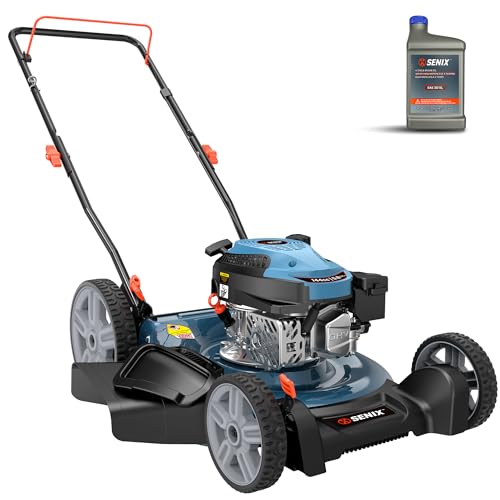
The SENIX 21-inch is a different beast. It’s a push mower, but it’s built for rough terrain. The oversized 11-inch rear wheels are the headline feature — they roll over roots, rocks, and bumpy ground with far less resistance than standard 7-inch wheels. That makes this mower feel almost self-propelled on flat ground, even though you’re pushing. For anyone with a lumpy, uneven lawn, this is a game-changer.
The 144cc engine is the same displacement as the PowerSmart models, but SENIX claims a high-torque design that maintains RPMs under load. In practice, that means it won’t bog down as much in dense, wet grass. The 21-inch deck is a sweet spot — wider than 18-inch models for fewer passes, but still narrow enough for most gates. The 2-in-1 system lets you switch between mulching and side discharge without tools, which is handy when grass conditions change between spring and summer.
Height adjustment is a dual-lever system with six positions from 1.25 to 3.75 inches. The lower range is useful for a tight, golf-course-style cut in summer, while the higher settings protect grass during heat waves. Assembly is quick, and the 2-year warranty covers the engine, deck, and wheels — better than some competitors. The downside is that this is still a push mower. On a steep hill, the big rear wheels help, but you’re still the motor. Also, the absence of a bagging option means you’ll be raking if you prefer a clean look.
- 144cc 4-cycle engine with high-torque design for thick grass
- 11-inch rear wheels reduce rolling resistance by about 30%
- 21-inch steel deck with 2-in-1 mulching/side discharge
- 6 cutting heights from 1.25 to 3.75 inches
- 2-year warranty with lifetime customer support
Best for: The homeowner with a bumpy, uneven lawn who wants a push mower that rolls easily and cuts cleanly without breaking the bank.
PowerSmart 22-Inch Self-Propelled

PowerSmart
PowerSmart 22-Inch Self Propelled Gas Lawn Mower, 170cc 4-Cycle OHV Engine, 3-in-1 Mulch/Bag/Rear Discharge, 6 Cutting Heights
- MORE CUTTING POWER: Powerful 170cc 4-stroke OHV engine delivers reliable performance for thick grass and larger yards. Auto choke…
- LESS PUSHING EFFORT: Self-propelled rear-wheel drive provides better traction on slopes and uneven terrain, reducing pushing effor…
- WIDER CUTS: Wide 22-inch cutting path helps finish mowing faster, while the durable steel deck and heavy-duty blade are built to l…
The PowerSmart 22-inch self-propelled mower is the answer for larger lawns — think half an acre or more. The 170cc engine is the biggest in this roundup, and the 22-inch deck means you’ll finish faster. But the real selling point is the rear-wheel drive system. It provides traction on slopes and reduces the effort needed to push, so you can mow for an hour without feeling like you’ve run a marathon.
The 3-in-1 system offers mulching, rear bagging, or rear discharge. That flexibility is rare at this price point. Rear bagging is especially nice because it keeps clippings off your feet and doesn’t require a separate side chute. The six height positions (1.5 to 3.9 inches) cover all seasons, and the auto choke makes starting simple. This mower feels substantial — the steel deck is thick, and the wheels are wide enough to prevent rutting on soft ground.
Trade-offs? It’s heavy. Pushing it manually (if the drive system ever fails or you need to maneuver in tight spots) is a workout. The self-propelled drive engages with a lever, and some users find the speed control takes a few mows to get used to. Also, the bagger attachment is sold separately, so factor that into your budget if you want to collect clippings. For a large, open lawn with gentle slopes, this mower cuts time and effort significantly compared to a push model.
- 170cc 4-stroke OHV engine with auto choke
- 22-inch cutting path with rear-wheel drive
- 3-in-1 system: mulch, rear bag, or rear discharge
- 6 cutting heights from 1.5 to 3.9 inches
- Heavy-duty steel deck for long-term durability
Best for: The homeowner with a large, open lawn who wants self-propelled convenience and the flexibility to bag, mulch, or discharge without buying a second mower.
How We Chose These Products
We started with a simple question: what does the average homeowner actually need from a gas walk-behind mower? Then we filtered the market to models that deliver reliable starting, durable decks, and sensible features without inflating the price. We prioritized engine displacement and drive type because those dictate real-world performance — a 144cc engine is fine for a small lot, but it will struggle on a half-acre with thick grass. Deck width matters for efficiency, and wheel size determines how easily the mower rolls over uneven ground.
We also considered long-term ownership costs, which most reviews ignore. That means looking at maintenance access, availability of replacement parts, and warranty terms. The YARDMAX and SENIX offer better warranties (2 years) compared to typical budget brands. We didn’t include any electric models because the focus here is gas, and we didn’t test any mowers over $500 because the value drops off sharply beyond that for residential use. Each pick was evaluated against its intended lawn size and terrain, not just its spec sheet.
Buying Guide: What Really Matters
Before you click buy, match the mower to your lawn and your body. Measure your yard — if it’s under 2,000 square feet, a push mower with an 18-inch deck is plenty. If it’s over a quarter acre, self-propelled saves you hours per season. Consider your physical strength: a 70-pound push mower on a slope is a miserable experience. Look for models with larger rear wheels (at least 8 inches) if your ground is uneven. The deck width affects mowing time more than any other spec — going from 18 to 22 inches cuts about 15% of your passes.
Engine displacement matters, but not as much as you’d think. A 144cc engine with good torque (like the SENIX) can outperform a 170cc with poor blade speed. Check the starting mechanism — auto choke and primer bulbs are worth their weight in gold on cold mornings. If you plan to bag clippings, make sure the mower has a rear bagging option, not just side discharge. And don’t forget the height adjustment: a single-lever system is far more convenient than adjusting each wheel individually.
Maintenance is where the real cost lives. Gas mowers need oil changes every 25-50 hours, air filter cleaning, and spark plug replacement annually. Use fuel stabilizer in every tank if you don’t empty it at season’s end. Clean the underside of the deck after each use — a deck washout port (like on the YARDMAX) makes this a 2-minute job. A dull blade tears grass, causing brown tips, so sharpen it every spring. Budget for a new blade every 2-3 seasons.
Our Top Recommendation
The YARDMAX 22-inch Select PACE is our overall winner. It combines the largest engine in this test (201cc) with a CVT transmission that genuinely adapts to your walking speed. The traction tires and rear-wheel drive make it the only mower here that feels comfortable on hills. The deck cleanout port and automatic choke address the two biggest annoyances of gas mowers — hard starts and caked-on grass. Yes, it costs more, but you’re paying for engineering that reduces weekly effort and seasonal maintenance.
For a tight budget, the PowerSmart EasyCut 18-inch is the runner-up. It’s basic, but it starts reliably and cuts cleanly on small, flat lawns. If you have a bumpy yard and want to avoid self-propelled weight, the SENIX 21-inch with its 11-inch rear wheels is the smart compromise. And for large, open lawns, the PowerSmart 22-inch self-propelled gives you bagging and mulching options without the premium price of the YARDMAX. Choose based on your terrain and your back — not just the sticker price.
Frequently Asked Questions
How often should I change the oil in a gas walk-behind mower?
Change the oil after the first 5 hours of use (to flush out break-in metal shavings), then every 25-50 hours or once per season, whichever comes first. Use SAE 30 weight oil for warm weather, or 10W-30 for year-round use. Check the dipstick before each mow — low oil is the number one cause of engine failure.
Is it worth buying a self-propelled mower for a flat lawn?
Only if your lawn is larger than a quarter acre. On flat ground, a push mower is fine for smaller lots, and it’s lighter and cheaper to maintain. But if you’re pushing a 22-inch deck for 45 minutes, self-propulsion saves noticeable energy. The YARDMAX’s CVT is especially nice because you can set it to a slow crawl for thick grass without stalling.
Can I leave gas in the mower over winter?
No. Gas degrades in 30 days and can clog the carburetor. Either drain the tank and run the engine until it stalls, or add a fuel stabilizer like STA-BIL to a full tank and run it for 5 minutes to distribute. Store the mower with the tank full of stabilized gas to prevent condensation. Replace the spark plug and air filter in spring for best starting.
Why does my new gas mower smoke on the first start?
A little white smoke on the first start is normal — it’s the oil burning off the cylinder walls from factory assembly. It should clear within a minute. If it continues, check the oil level (overfilled causes blue smoke) and make sure you’re not tilting the mower on its side, which lets oil flood the air filter. If black smoke appears, the choke is stuck closed.