


Best Compost Bin for Garden Soil: 5 Top Picks That Actually Build Living Soil
Contents
You’ve been feeding your plants synthetic fertilizer for years, yet the soil feels dead. It’s hard, drains poorly, and every season you need more chemicals to get the same results. The problem isn’t your plants—it’s the soil itself. Compost is the only amendment that feeds the biology underground, and choosing the right bin determines whether you actually follow through and produce that dark, crumbly material your garden craves.
A great compost bin balances three things: capacity, aeration, and ease of turning. Too small and you can’t generate enough heat. Too hard to turn and you’ll abandon it by August. The best units also match your soil type—clay needs coarse, unfinished organic matter while sandy soil benefits from fully cured humus that holds moisture.
Below we break down five very different approaches, from a 43-gallon dual-chamber tumbler to an underground worm system. Each solves a specific problem. Read the quick comparison table first, then dive into the reviews to find the bin that fits your yard, your schedule, and your soil’s biggest weakness.
Here is a quick look at how these five composters stack up against each other.
| Features | VIVOSUN Tumbler | Roebic Accelerator | MyLifeUNIT Bags | JupiterForce 120 Gal | HTtoy Worm Bin |
|---|---|---|---|---|---|
| Material | PP plastic + metal frame | Bacterial powder | Tear-resistant fabric | BPA-free plastic | Stainless steel |
| Capacity | 43 gallons (dual) | 2.5 pounds | 34 gallons (2 pack) | 120 gallons | Small, 2 sizes |
| Mechanism | 360° tumbling | Add to pile | Static bag | Top load, bottom door | In-ground vermicomposting |
| Best For | Fast, batch compost | Slow or cold piles | Yard waste storage | Large gardens | Small spaces |
| Assembly | Minimal | None | None | Tool-free, 4 steps | Dig hole only |
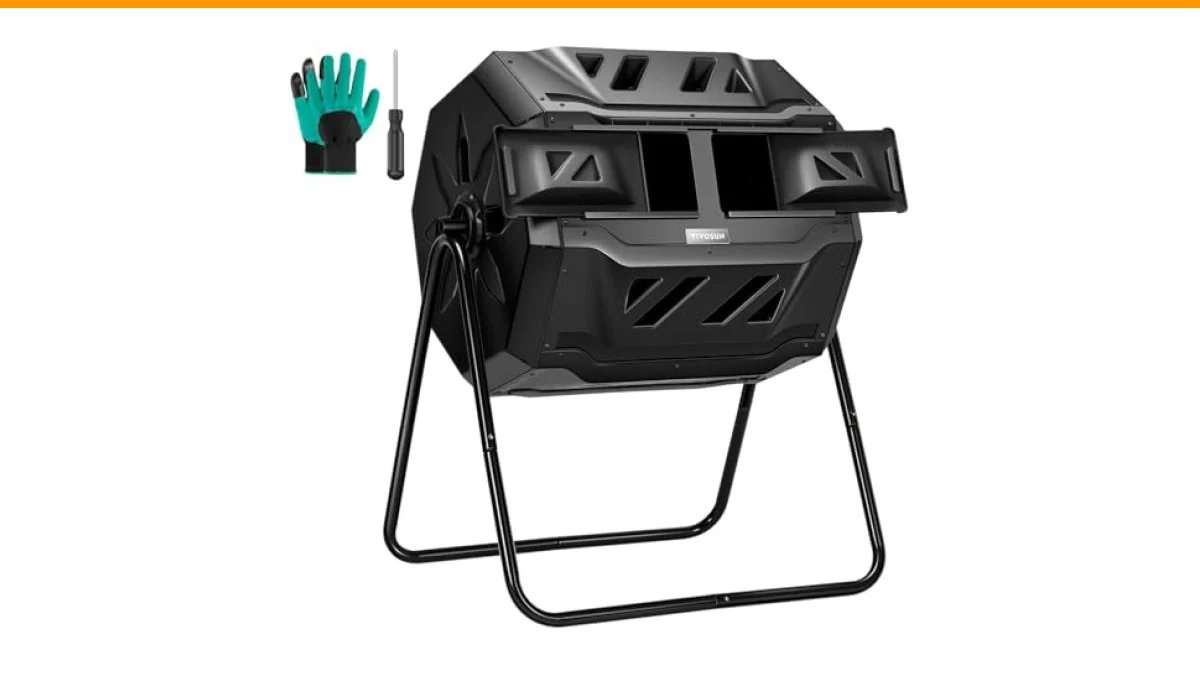
VIVOSUN Outdoor Tumbling Composter
1st Pick

VIVOSUN
VIVOSUN Outdoor Tumbling Composter Dual Rotating Batch Compost Bin, 43 Gallon Black Door
- Twin chambers: Two separate chambers allow one side to finish composting while leaving the other side available to add fresh waste…
- 360⁰ Tumbling Design: The rotating design prevents you from digging or mixing the pile by hand; And the deep fins on eight panels…
- Excellent Aeration: Air vents can make the air fully circulate and will not cause an explosion due to excessive internal pressure;…
This dual-chamber tumbler suits the gardener who wants finished compost in weeks, not months. If you have a vegetable garden with moderate waste—kitchen scraps plus seasonal yard trimmings—the two 21.5-gallon drums let you fill one side while the other cures. You never mix fresh material with finished compost, which means every batch finishes at the same time.
The 360-degree rotation is genuinely effortless. Eight internal fins break up clumps as you spin, so you rarely need to poke or stir the pile by hand. Air vents run along each panel, feeding oxygen deep into the material. That aeration is what keeps aerobic bacteria active and prevents the sour, ammonia smell that plagues static bins. The powder-coated metal frame holds steady even when the drum is packed full, and the black plastic body absorbs sunlight to keep internal temperatures warm during shoulder seasons.
Honest limitations? A 43-gallon total capacity (roughly 21.5 gallons per side) might feel small if you have a large yard with heavy leaf drop. You’ll also need to give it a spin every two to three days to get the fast results it promises. And while the included gloves and ABS claws are nice extras, the claws are a bit flimsy for heavy digging.
- Dual chambers allow continuous batch composting without re-mixing
- Eight internal fins and full-length air vents speed up breakdown
- Corrosion-resistant metal frame with weatherproof PP plastic body
- Includes waterproof garden gloves and four ABS digging claws
- Black color retains heat to extend the composting season
Best for: The home vegetable gardener who wants reliable, fast compost without the back strain of turning a pile by hand.
Roebic CA-1 Bacterial Compost Accelerator
2nd Pick

Roebic
Roebic CA-1 Bacterial Compost Accelerator, 2.5 lb
- Complete formula for composting. Enhances decomposition process for nutrient-rich compost
- Buffered to maintain pH levels, ensuring optimal conditions for beneficial bacteria, accelerating composting process
- Effective in wide temperature ranges, ensuring consistent composting performance year-round
This is not a bin, but it deserves a spot here because it solves the most common reason compost fails: a pile that sits there doing nothing. If you already own a static bin or an open pile and your material looks dry and unchanged after three months, Roebic CA-1 kickstarts the biology. It’s a 2.5-pound box of concentrated bacteria designed to break down tough organic matter like woody stems and leaves.
What makes this different from random garden additives is the pH buffering. Compost piles often turn too acidic as they decompose, which stalls microbial activity. Roebic keeps the environment stable so the bacteria keep working. It also functions across a wide temperature range, so you can use it in early spring or late fall when your pile isn’t hot enough to decompose on its own. Just sprinkle it over the pile and water it in—no mixing or special equipment required.
The trade-off is that this accelerates decomposition but doesn’t create compost from nothing. You still need a balanced mix of greens and browns. And if your pile is already healthy and steaming, adding this won’t speed it up dramatically. It’s a rescue tool, not a magic powder. One box treats a decent-sized pile, but heavy composters may need multiple applications per season.
- Buffered formula maintains optimal pH for beneficial bacteria
- Works in cold weather when natural decomposition slows down
- Simple application: sprinkle over pile and add water
- Enhances biological activity for nutrient-rich finished compost
- Useful for both new piles and stalled or old ones
Best for: Gardeners with an existing static bin or open heap that’s breaking down too slowly, especially in cooler climates.
MyLifeUNIT Compost Bins Outdoor
3rd Pick

MyLifeUNIT
MyLifeUNIT Compost Bins Outdoor, Composting Bin for Outside Garden, Reusable Garden Yard Waste Bag, 34 Gallons (2 Pack, Green)
- 34 Gallon compost bag, large capacity design for organizing a large amount of kitchen waste and garden waste
- Fast fermentation, suitable for organizing fruit peels, weeds, leaf and plant waste, garden waste, wilted parts, and other materia…
- Also great for storing children’s toys, clothes, laundry, garage tools, shopping, moving, camping and more
These 34-gallon fabric bags are the most flexible option here. They are essentially heavy-duty grow bags for compost. If you have an abundance of leaves, grass clippings, and garden trimmings but not enough kitchen scraps to fill a traditional bin, these let you store and process yard waste in a contained space. The two-pack means you can run one bag while filling the second, creating a simple two-stage system.
The genius is in the dual openings. A large top opening makes it easy to dump in waste, and a bottom opening lets you harvest finished compost without disturbing the active layers above. The fabric is water-resistant and tear-resistant, so it holds up to weather and rough handling. Because the bags are lightweight and portable, you can move them around your yard to wherever you need compost next—or even use them to store tools, toys, or firewood when they’re not processing waste.
You should know that these are not hot-composting systems. They rely on slow, cool decomposition, which takes several months. The fabric does allow some airflow, but not enough to sustain thermophilic bacteria. Also, the self-adhesive strips on the bottom opening can catch compost as you pull it out—the manufacturer warns you to avoid letting soil touch them. And if you have raccoons or rodents, these bags won’t stop them.
- Large 34-gallon capacity per bag, two bags included
- Top and bottom openings for easy filling and harvesting
- Lightweight, water-resistant, and tear-resistant fabric
- Also functions as storage for toys, laundry, tools, or moving
- Fast fermentation for fruit peels, weeds, leaves, and plant waste
Best for: Leaf-heavy yards and gardeners who want a cheap, portable, low-effort way to turn yard waste into coarse soil amendment.
JupiterForce 120 Gallon Large Compost Bin
This is the workhorse for serious gardeners. A 120-gallon capacity means you can process a massive volume of kitchen scraps, grass, leaves, and even small prunings. If you have a large vegetable patch, multiple raised beds, or a yard with mature trees, this bin produces enough compost to actually make a difference in your soil. It’s also a good choice for sandy soil, which needs large amounts of organic matter to hold water and nutrients.
The design is simple but effective. A wide top lid lets you dump material in easily, and a sliding bottom door gives you access to finished compost without disturbing the top layers. Four vents on each side provide passive airflow, which is enough for slow, steady decomposition. The BPA-free plastic is frost-proof and rainproof, so you can leave it outside all year. Assembly takes about four steps with no tools—just snap the panels together and lock them in place.
The main drawback is that this is a static bin. Without tumbling, you’ll need to turn the pile manually with a pitchfork or compost aerator to get even decomposition. The lack of a bottom means worms and soil organisms can enter from below, which helps, but also means you can’t move the bin once it’s in place. And while 120 gallons is great for volume, the plastic walls are relatively thin—sturdy enough, but don’t lean on them heavily.
- Massive 120-gallon capacity for large-scale composting
- BPA-free, all-weather plastic resists frost and rain
- Top lid for loading, sliding bottom door for harvesting
- Four vents per side provide passive aeration
- Tool-free assembly in four simple locking steps
Best for: Owners of large gardens or sandy soil who need bulk compost to improve water retention and soil structure.
2 Pack Underground Worm Composting Bin
5th Pick

HTtoy
2 Pack Underground Worm Composting Bin with Gardening Gloves - Small Round Metal Stainless Steel Composter for Family Garden, Outdoor Compost Bins (2)
- 【In Ground Compost Bin】Transform kitchen scraps and organic waste into rich, nutrient-packed compost with this buried compost bin.…
- 【Compact & Family-Friendly Design】Perfect for small spaces, this compost bin comes in two convenient sizes (11.8x3.74 inches and 1…
- 【Durable Metal Wire Material】Crafted from high-quality metal, this compost bin is built to last. The stainless steel material resi…
This in-ground system takes a completely different approach. Instead of a freestanding bin, you bury these stainless steel cylinders in your garden beds, leaving the top edge and lid exposed. Worms from the surrounding soil enter through the ventilation holes, eat your kitchen scraps, and then distribute their castings directly into the root zone as they move around. This is the ultimate low-effort way to improve soil biology.
The set includes two bins of slightly different sizes, letting you place one near your tomatoes and another by your lettuce. The metal construction resists rust and corrosion even in constantly moist soil, making it far more durable than plastic. Installation is just a matter of digging a hole, dropping the bin in, and adding waste. No turning, no harvesting, no complex maintenance. The included gardening gloves are a practical bonus for handling raw scraps.
The limitation is volume. These are small bins—roughly 12 inches in diameter—so they handle daily kitchen scraps for a family of two or three, but not yard waste. You also need healthy, active soil for worms to find the bin; brand-new raised beds with sterile potting mix won’t attract them. And while the lids keep out larger pests, they don’t seal completely, so ants can become an issue in dry conditions.
- Two stainless steel bins with lids for multiple garden locations
- 360-degree ventilation holes promote airflow and worm access
- Partially buried design allows worms to loosen surrounding soil
- Rust and corrosion-resistant metal for moist environments
- Includes one pair of gardening rubber gloves
Best for: Container gardeners, raised bed owners, and anyone who wants to feed plants directly without maintaining a separate compost pile.
How We Chose These Products
We started with the premise that the best compost bin depends on your soil’s specific needs. Clay soil requires large amounts of coarse organic matter to create pore space and improve drainage. Sandy soil needs fully decomposed humus to hold moisture and nutrients. So we selected products that address different stages of the composting journey, from raw yard waste to finished black gold.
Each product was evaluated on four criteria: capacity relative to typical household waste, ease of use over a full season, durability of materials, and the quality of the finished compost it produces. We also considered the physical effort required—tumblers win for convenience, but static bins and worm systems require less frequent attention. Products with clear design flaws or unrealistic promises were excluded.
Buying Guide: What Really Matters
Capacity is the first decision point. A family of four generates roughly 2 to 3 gallons of kitchen scraps per week. Add yard waste and you’ll want at least 30 gallons of capacity just to keep up. For serious soil building, larger is better, but only if you can fill it. An underfilled composter won’t heat up, and a cold pile takes a year to break down.
Aeration and turning method determine your maintenance routine. Tumblers make oxygen available with a quick spin, but require you to actually do it. Static bins with good ventilation can be left alone, but you’ll need to fork them over periodically to prevent anaerobic pockets. In-ground worm bins handle aeration naturally through worm movement, but they have limited capacity.
Think about your soil type before buying. For clay soil, any bin that lets you produce large volumes of semi-composted mulch is ideal. For sandy soil, focus on producing fully cured, fine compost that can be mixed deeply into the root zone. If you have both, consider running a tumbler for kitchen scraps and a larger static bin for yard waste.
Our Top Recommendation
The VIVOSUN Outdoor Tumbling Composter is the best overall choice for most gardeners. Its dual-chamber design solves the biggest problem with single-bin systems: you never have to mix fresh waste with nearly-finished compost. The tumbling action delivers the aeration that accelerates decomposition, and the 43-gallon total capacity is right for a typical suburban yard. It’s the easiest way to produce usable compost in six to eight weeks.
If you need more volume for a large property, the JupiterForce 120-gallon bin is the runner-up. For small spaces or container gardens, the underground worm system from HTtoy is the smartest pick. And if your existing pile has stalled, the Roebic accelerator is your best fix.
Frequently Asked Questions
How do I know when my compost is finished and safe for seedlings?
Finished compost is dark, crumbly, and smells like earth. It should not hold its original shape—you shouldn’t recognize a banana peel or leaf. For a definitive test, place a handful in a sealed plastic bag for three days. If it smells sour or ammonia-like when you open it, it’s not ready. If it smells earthy, it’s safe to use. For seedlings, always mix compost with potting soil at no more than 20% by volume.
Can I compost directly in my garden beds without a bin?
Yes, this is called trench composting or direct burial. Dig a hole or trench about 12 inches deep, add your kitchen scraps, and cover with soil. Worms and soil organisms will do the rest. The underground worm bin from HTtoy is essentially a contained version of this method. Direct burial works best in established beds where soil biology is already active.
What’s the difference between compost, mulch, and fertilizer?
Fertilizer feeds the plant directly with soluble nutrients. Mulch sits on top of the soil, suppressing weeds and retaining moisture. Compost does both—it feeds the soil food web, improves soil structure, and can be used as a top dressing or mixed into the root zone. For long-term soil health, compost is superior because it builds the biological community that makes nutrients available over time.
Why does my compost smell bad and attract flies?
That’s a sign of anaerobic decomposition, which happens when the pile is too wet or lacks oxygen. Turn the pile to introduce air, and add dry browns like leaves, straw, or shredded cardboard to absorb excess moisture. If you’re using a static bin like the JupiterForce, this means manual turning. If you’re using a tumbler like the VIVOSUN, give it a spin every couple of days. For a deeper dive into choosing the right system, check out this soil amendment guide.
For those working with limited space, our small garden composter roundup covers compact options. And if you’re producing large volumes of yard waste, this large garden bin review will help you scale up.


