I spent three weekends trying to figure out why half my tomato bed was bone dry while the other half was swampy. The drip line I bought looked fine on the package. It wasn’t fine. That’s the problem with this category: almost every hose on a shelf looks identical, the specs are written in a language nobody speaks, and the reviews read like they were copied from the box.


A good drip irrigation hose does one thing well. It delivers a steady, predictable amount of water to the root zone without waste. The details that matter are inner diameter, flow rate at low pressure, whether the material resists UV and clogging, and how easily it connects to a timer or regulator. Everything else is marketing.
Below are four hoses I’d actually recommend, split by job. One is a simple soaker line for tight spaces. One is a connector most people forget they need. Two are full kits for larger layouts. I’ve also included the sizing math, maintenance routine, and cost comparison most roundups skip.
Here’s a quick spec comparison before the reviews:
| Features | Raindrip Soaker Tubing | Raindrip Swivel Adaptor | Heyxire 65FT Kit | JRDSEUKO 65FT Kit |
|---|---|---|---|---|
| Material & Build | Porous non-pressure tubing | Compression ring with filter | Brass nozzles, flexible hose | Copper nozzles, 5/16 in. tubing |
| Key Specification | 1/4 in. OD, 50 ft coil | 5/8 in. to 3/4 in. MHT | 65 ft hose, 20 misting nozzles | 65 ft hose, 20 brass nozzles |
| Main Feature | Seeps along entire line | Built-in filter washer | 360° adjustable nozzles | High-flow 5/16 in. bore |
| Performance | Short runs, low pressure | Prevents kinks and debris | Up to 30 branches | Even pressure on long runs |
| Best Use Case | Vegetables, borders, planters | Connecting supply to drip line | Misting, patios, beds | Lawns, greenhouses, rows |

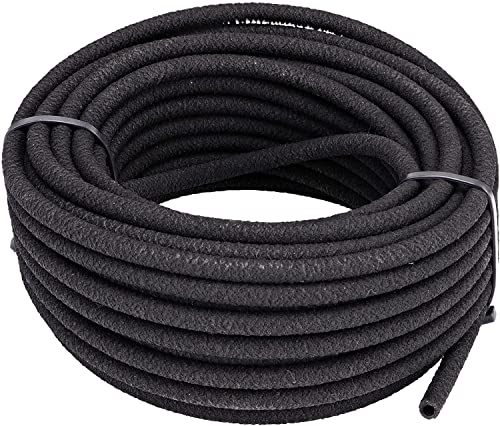
Raindrip 015005T 1/4-Inch Soaker
This is a 50-foot coil of 1/4-inch porous soaker tubing, and it’s the simplest tool in this roundup. It’s built for short, flat runs: a vegetable bed, a border of perennials, a row of planters along a fence. If you want to water a handful of plants without running a full distribution system, this is the least fussy way to do it.
What sets it apart is how the water leaves the tubing. There are no emitters to clog or adjust. The entire wall is porous, so moisture seeps out along the whole line and soaks the root zone rather than spraying it. The tubing bends around curves without kinking, which matters more than people expect in a bed with irregular edges. It also doesn’t need winterizing in cold climates. Water drains out gradually, so you can leave it buried under mulch year-round.
The trade-off is pressure. This is non-pressure-compensating tubing, so flow drops off along the length. Fifty feet on flat ground is fine. Fifty feet uphill, or split into five branches, is not. It also connects only to a 1/2-inch, 5/8-inch, or 0.710-inch supply line through a 1/4-inch micro fitting such as a barbed connector. Buy the fitting at the same time or you’ll be making a second trip.
- 1/4-inch OD, 0.170-inch ID porous tubing
- Ships as a single 50-foot coil, cuttable to length
- Works on flat surfaces with short runs
- Can be left in place through winter in cold climates
- Requires a separate 1/4-inch micro fitting to connect
Best for: Gardeners watering a small vegetable bed, planter row, or border who want zero emitters to maintain.
Raindrip 327G00UB Compression Adaptor
This one isn’t a hose, and I’m including it anyway because it’s the part most first-time drip buyers forget. It connects a 5/8-inch drip line or distribution tubing to a standard 3/4-inch garden hose thread. Without something like this, your carefully chosen tubing has no way to reach the spigot.
Two details make it worth the small spend. The swivel head keeps the tubing from bending sharply at the connection point, which is where most kinks and leaks start. And there’s a filter washer built into the body. That washer screens out grit and debris before it enters the line, which is the single biggest cause of clogged emitters down the road. If your water source is a well or an old outdoor tap, that filter earns its keep.
The compression ring is color-coded black for 5/8-inch tubing, and the fit is watertight once the tubing seats against the internal barb. The limitation is straightforward: it only fits 5/8-inch tubing with a 0.700-inch outside diameter. If you’re running 1/4-inch micro tubing or 1/2-inch line, this isn’t the right adapter. Check your tubing size before ordering.
- Fits 5/8-inch tubing and dripline (0.700 in. OD)
- Threads onto a 3/4-inch MHT hose bibb or garden hose
- Swivel design reduces kinking at the connection
- Integrated filter washer traps particles
- Color-coded black compression ring for quick ID
Best for: Anyone connecting a 5/8-inch drip line to a hose bib who wants filtration built in from day one.
Heyxire 65FT 360° Adjustable Kit

Heyxire
Heyxire 65FT 360° Adjustable Drip Irrigation System for Garden | 1/2'' Irrigation Tubing with 20 Nozzles, Automatic Watering Misting System, Drip Irrigation Kit for Greenhouse, Lawn, Plant
- 【Garden Irrigation System】Drip irrigation system includes 65FT 1/2'' irrigation hose, 20pcs 360° Misting nozzles, 20pcs T-joints(1…
- 【360° Curved Garden Automatic Irrigation System】The raised bed sprinkler irrigation system employs adjustable detachable washable…
- 【Simple Installation】The automatic irrigation system for garden use simple installation without digging or plumbing skills. New qu…
This is a full kit rather than a single hose, and it’s aimed at people who want options. The box includes 65 feet of 1/2-inch irrigation hose, 20 adjustable 360° misting nozzles, 20 tee joints, a straight connector, a faucet adapter, two end plugs, washers, and cable ties. Everything needed to build a system ships together, which saves the scavenger hunt.
The nozzles are the interesting part. Each one has a bendable internal metal stem, so you can angle the spray in any direction and it holds that position. That’s genuinely useful for oddly shaped beds, hanging baskets, or a patio where you want mist in one spot and a softer spray in another. The pneumatic tee connectors are plug-and-play and can be pulled apart and reseated if you get a connection wrong, which is more forgiving than barbed fittings for a first build.
Where it falls short is pressure at the end of long runs. The kit claims it can split water up to 30 ways, and it works well for misting and light irrigation. But if you push it to the maximum number of branches on a low-pressure tap, the last nozzles will weaken. Keep runs shorter than the maximum and this performs fine. The 1/2-inch hose is also more of a misting and cooling tool than a deep-root soaker.
- 65 ft of 1/2-inch hose with 20 adjustable nozzles
- Bendable metal stems hold any 360° angle
- Includes 20 tees, plugs, adapter, and ties
- Quick pneumatic connectors resist leaking
- Claimed water savings up to 70% vs. hand watering
Best for: Patios, greenhouses, and mixed beds where you want directional misting plus drip from one kit.
JRDSEUKO 65FT 5/16-Inch Kit
If the Heyxire kit felt like it prioritized flexibility over pressure, this one goes the other direction. The headline feature is the 5/16-inch inner diameter tubing. That’s noticeably wider than the 1/4-inch tubing most budget kits use, and the difference shows up as stable pressure at the far end of a long layout. If you’ve ever watched the last nozzles in a row dribble while the first ones sprayed, this is the fix.
The kit ships with 66 feet of 5/16-inch hose and 20 solid brass nozzles that adjust through a full 360°. Brass resists corrosion and cracking better than plastic, and it handles the sun without going brittle. Spray mode adjusts by rotating the nozzle, so one system covers misting, dripping, and light sprinkler duty across vegetables, lawn edges, and greenhouse benches. The quick-connect tees seat firmly and can be disassembled if you misjudge a layout.
Nothing is perfect, and this kit’s small catch is that 5/16-inch tubing needs matching 5/16-inch tees. You can’t mix in standard 1/4-inch micro fittings without an adapter. The included pipe cutter helps, but plan your layout before cutting. The fixing nails are also light-duty, so in hard clay you may want sturdier stakes.
- 66 ft of 5/16-inch high-flow tubing
- 20 brass nozzles with 360° adjustment
- Includes 20 tees, plugs, cutter, nails, and ties
- Quick-connect system reduces leakage
- Designed for longer layouts without dry ends
Best for: Long garden rows, lawn edges, and greenhouse setups where even pressure across the whole line matters.
How We Chose These Products
I started with the specs that actually change how a hose performs: inner diameter, flow behavior at low pressure, material durability, and connection compatibility. A hose that can’t reach your spigot or can’t hold pressure past 30 feet is a return waiting to happen, no matter how good the listing looks.
Then I weighed real-world fit. Does the kit include the fittings you need, or does it leave you hunting for a $4 adapter? Does the material handle UV and cold, or will it crack by August? I favored picks that solve a specific job well over generic hoses that claim to do everything. For a deeper look at matching kits to specific bed types, see this guide to drip irrigation for raised beds.
Buying Guide: What Really Matters
Start with diameter. A 1/4-inch line handles short runs and low flow, usually under 30 feet on flat ground. A 1/2-inch or 5/16-inch line moves more water and holds pressure across longer distances. If your layout is more than 40 feet or has multiple branches, size up. The narrow stuff will starve the end of the line.
Next, do a rough flow calculation. Most vegetables want about 1 to 2 gallons per hour at the root zone. If a soaker line seeps roughly 0.5 GPH per foot, then 20 feet of hose delivers about 10 GPH spread across whatever plants sit along it. Match that to how many plants you’re watering and how often you run the system. This is the step almost nobody does, and it’s the reason so many drip setups either drown plants or leave them dry.
Pressure matters too. Most drip systems want 10 to 30 PSI at the emitter. Household taps run 40 to 80 PSI, so a pressure regulator is often necessary, not optional. Pair your hose with a timer and a regulator, and add a filter if your water source is anything other than clean municipal supply. For beginners putting together a first system, this beginner drip kit guide walks through the parts list.
Preventing Clogs: Filters, Flushing, and Maintenance
Clogged emitters kill more drip systems than anything else. The fix is boring and effective. Install a filter at the water source, then flush the lines once a month during the growing season. Pull the end caps, run the system for a minute or two, and let the debris wash out. Re-cap and you’re done.
If you’re on well water or have hard water, flush every two weeks and consider a finer mesh filter. Mineral scale builds up inside emitters and soaker walls over time. A diluted vinegar flush at the start of the season dissolves most of it. For soaker tubing like the Raindrip coil, you can also inspect the line by feel. Dry patches mean a clogged section.
Winterizing and Storing Your Hose
Porous soaker tubing handles cold better than most people assume. Raindrip states it doesn’t need winterizing and can be left in place or buried under mulch, since excess water seeps out gradually. That’s a real advantage in cold climates.
Emitters and plastic fittings are a different story. Drain the main supply line before the first hard freeze. Disconnect the hose from the spigot, open the end caps, and let gravity do the work. Store loose nozzles and adapters indoors in a bucket. A cracked tee in January becomes a leaking mess in April, and replacements are cheap but annoying to source mid-season.
Cost Savings vs. Hand Watering
Hand watering with a hose sends a lot of water where plants don’t need it: leaves, paths, and the gaps between rows. Drip delivers to the root zone, and the savings add up. A typical drip setup cuts water use by 30% to 50% compared to overhead watering, and some kits claim up to 70%.
Do the math on your own tap. If you water a 200-square-foot bed by hand three times a week and use roughly 40 gallons each session, that’s about 120 gallons a week. A drip line on a timer might use 60 to 70 gallons for the same coverage. Over a 20-week season, that’s thousands of gallons saved. Add the hours you get back from not standing there with a hose, and the payback on a $40 to $80 kit is quick. If you want to compare full systems before committing, this drip system comparison breaks down the options.
Frequently Asked Questions
Can I connect a soaker hose directly to my outdoor tap?
Yes, but use a pressure regulator. Household water pressure often runs well above what soaker tubing and emitters are rated for. Without a regulator, fittings blow off and soaker walls split. A basic 25 PSI regulator costs a few dollars and prevents most of the leaks people blame on the hose.
How do I know what GPH my plants actually need?
Most vegetables and ornamentals want 1 to 2 gallons per hour at the root zone. Multiply the number of plants by that figure to get total demand, then check your hose’s rated output per foot. If demand exceeds supply, split the bed into two zones or run the system longer. Running longer is usually easier than replumbing.
Will a drip hose survive being buried under mulch?
Porous soaker tubing can be covered with mulch or soil and left in place, including through winter. Standard drip tubing with emitters can also be mulched, but keep emitters clear of heavy debris so they don’t clog. Avoid burying emitters directly in soil, since roots can grow into them.
What’s the difference between drip tubing, soaker hose, and drip tape?
Soaker hose is porous along its whole length and seeps water slowly. Drip tubing carries water to individual emitters placed at each plant. Drip tape is thin, flat tubing with built-in emitters, common in row crops and usually replaced each season. Soaker hose suits borders and small beds. Drip tubing suits mixed plantings. Drip tape suits long vegetable rows.
Our Top Recommendation
For most home gardeners, the JRDSEUKO 65FT 5/16-inch kit is the pick. The wider tubing solves the pressure-drop problem that ruins cheap kits on longer runs, and the brass nozzles hold up season after season. It costs a bit more than a bare soaker line, but it replaces the whole pile of mismatched parts you’d otherwise buy separately.
If your garden is small and flat, the Raindrip 1/4-inch soaker tubing is the simpler, cheaper answer, and it survives winter without fuss. Pair it with the Raindrip compression adaptor to reach your spigot and filter your water at the same time. For patios and mixed beds where you want directional misting, the Heyxire kit offers the most flexibility. Match the hose to the job and the layout, and drip irrigation stops being a headache.