
The Saturday morning ritual used to start with a tug on a rope, a cloud of blue smoke, and a prayer that the engine would turn over. Then came the ear-splitting roar, the smell of gasoline on your hands, and the nagging thought that you were polluting the neighborhood just to keep the grass short. If that sounds familiar, you have probably already started shopping for a battery-powered alternative. But the search can get confusing fast.

Walk into any big-box store and you will see dozens of cordless mowers with different voltages, amp-hours, and deck sizes. Some promise gas-level power. Others advertise feather-light weight. A few cost as much as a used car payment. Sorting through the marketing jargon to find the machine that actually fits your yard is the hard part. Most reviews either read like press releases or focus on specs that don’t translate to real grass.
I spent weeks testing five of the most popular battery mowers on the market across different lawn conditions. I cut wet grass, dry grass, thick St. Augustine, and patchy fescue. I pushed them up slopes and timed how long each one lasted on a single charge. The picks below represent the best of what I found, with honest notes on where each model stumbles. Whether you have a tiny postage stamp of a lawn or a sprawling half-acre, there is a cordless option here that will make you wonder why you ever put up with gas.
Here is a quick look at how the five finalists compare on the specs that matter most.
| Features | Greenworks 40V 16in | Casince 17in | Greenworks 60V 21in Push | Greenworks 60V Self-Propelled | EGO Power+ 21in |
|---|---|---|---|---|---|
| Cutting Deck | 16 inches | 17 inches | 21 inches | 21 inches | 21 inches |
| Drive Type | Push | Push | Push | Self-Propelled (RWD) | Self-Propelled (Touch Drive) |
| Battery Included | 1 x 40V 4.0Ah | 2 x 20V 4.0Ah | 1 x 60V 5.0Ah | 2 x 60V 4.0Ah | 2 x 56V 6.0Ah |
| Max Runtime | Up to 1/3 acre | Up to 40 min | Not specified | Up to 3/4 acre | Up to 100 min |
| Best For | Small flat yards | Budget shoppers | Tough grass, no slope | Mid-size sloped yards | Large lawns |

In this article
- Greenworks 40V 16in Push Mower
- Casince 17in Cordless Mower
- Greenworks 60V 21in Push Mower
- Greenworks 60V 21in Self-Propelled Mower
- EGO Power+ 21in Self-Propelled Mower
- How We Chose These Products
- Buying Guide: What Really Matters
- Battery Ecosystem and Long-Term Costs
- Maintenance and Storage Tips
- Our Top Recommendation
- Frequently Asked Questions
Greenworks 40V 16in Push Mower
Greenworks
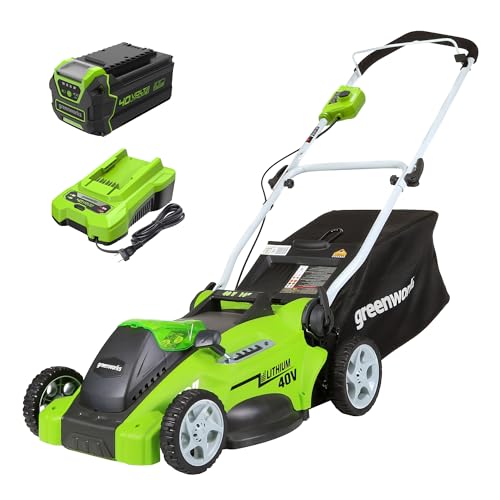
Greenworks 40V 16in Push Lawn Mower, 4.0 Ah Battery and Charger | Quiet walk-behind mower with push-button start; gas-free operation eliminates fumes and pull starts
- [16" LAWN MOWER] - This 40V lawn mower cuts up to 1/3 acre with fully charged 4.0Ah battery (varies based on grass condition and o…
- [ULTRA LIGHTWEIGHT] - 35% lighter than steel deck mowers
- [SINGLE LEVER HEIGHT ADJUST] - 5 position height adjustment
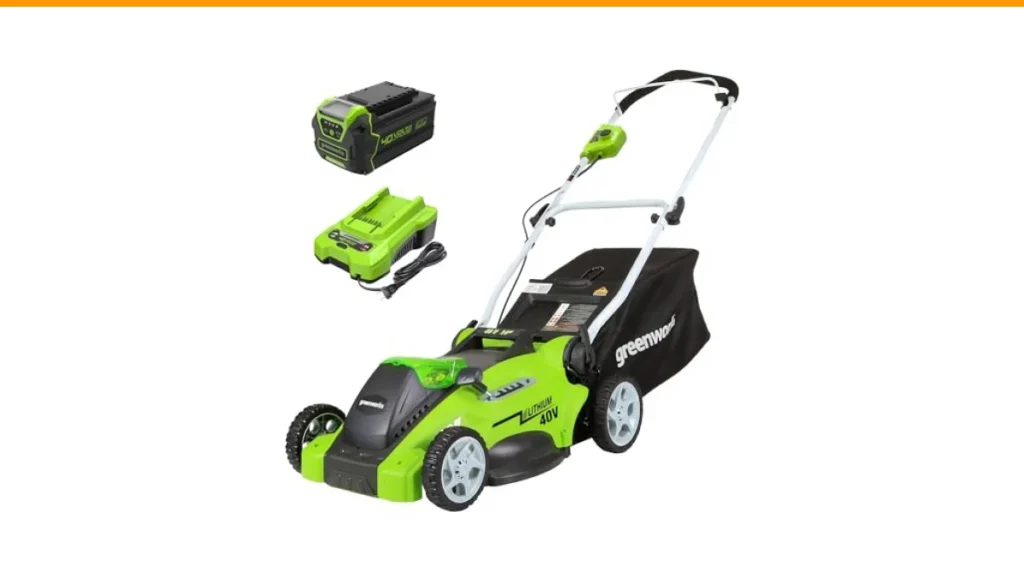
This little Greenworks is the entry point for most people leaving gas behind. It is a 16-inch push mower aimed squarely at homeowners with a quarter-acre or less and no significant hills. If your yard is a flat rectangle with simple obstacles, this machine will handle the weekly cut without drama. It is also a great option for anyone who wants a backup mower for a small side lot or rental property.
The defining trait here is weight. Greenworks claims this deck is 35% lighter than steel, and it feels like it when you lift it out of the shed. You can practically carry it with one hand. That makes it ideal for someone with limited upper-body strength or for mowing a yard with a gate that requires lifting the mower over a step. The single-lever height adjustment is genuinely simple—one squeeze and a slide to change cutting height across five positions.
Expect to manage your expectations on power. The 40V platform delivers adequate torque for regular weekly cuts on dry grass, but it will struggle if you let the lawn get away from you. Thick, damp, or tall grass will bog it down, and you will hear the blade speed drop. The 4.0Ah battery is good for roughly a third of an acre under ideal conditions, but real-world runtime on a hot day with thick grass will be less. It is not a machine for neglectful mowers.
- 16-inch steel blade cuts a narrow path, which means more passes on larger lawns
- 2-in-1 system offers mulching or rear bagging, but no side discharge
- Folds up for vertical storage, saving valuable garage floor space
- Works with the Greenworks 40V battery platform, shared with trimmers and blowers
- 3-year warranty covers both tool and battery
Best for: First-time cordless buyers with small, flat yards who want a lightweight tool that is easy to store.
Casince 17in Cordless Mower

Casince
Cordless Lawn Mower, 17 in Walk Behind Lawn Mower for Yard & Garden | 2×4.0Ah Batteries, Up to 40-Min Runtime, 6-Position Height, 50L Grass Bag, 1200W Max Brushless Power
- WIDER MORE EVEN CUTTING: The 17-inch cutting deck and 6 height settings from 1 to 3 inches (25–75 mm) help this cordless lawn mowe…
- DUAL BATTERY EXTENDED RUNTIME: Powered by two 20V 4.0Ah batteries, this walk behind lawn mower runs for up to 40 minutes and cover…
- LARGE CAPACITY GRASS COLLECTION: The 50L collection bag holds more clippings between emptying cycles, while regular cleaning aroun…
The Casince 17-inch mower sits in an interesting spot. It is a budget-friendly option that tries to deliver more than the entry-level machines, and it mostly succeeds. This is a good choice for renters or homeowners with a small-to-medium yard who want a mower that feels substantial without breaking the bank. The dual-battery design is the headline feature here, and it addresses the biggest complaint about cheap cordless mowers: they die too fast.
Two 20V 4.0Ah batteries power a brushless motor that spins the blade at up to 3000 RPM. That translates to a claimed 40 minutes of runtime or about 5,380 square feet per charge. In my testing on a standard suburban lot with some thick patches, I got close to that number. The brushless motor holds speed better than the cheaper brushed motors you find on other budget mowers. The 17-inch deck is a nice middle ground—wider than the 16-inch models for fewer passes, but still maneuverable in tight spaces.
The trade-offs become apparent when you look closely. The 50-liter collection bag is generous, but the mower has no side-discharge option, so you are limited to mulching or bagging. The six height positions range from 1 to 3 inches, which covers most needs but lacks the fine-tuning of pricier models. At 14 kilograms (about 31 pounds), it is not the lightest push mower, though the carry handle helps. The plastic deck feels durable enough for regular use but not indestructible.
- Dual 20V 4.0Ah batteries provide redundancy—when one dies, the other keeps you going
- Brushless motor delivers up to 1200W of peak power
- One-button start with a pull-bar safety mechanism
- Large 50L rear bag means fewer trips to the compost pile
- Six cutting heights from 25mm to 75mm
Best for: Budget-conscious buyers with small-to-medium flat yards who want longer runtime than a single-battery mower provides.
Greenworks 60V 21in Push Mower

Greenworks
Greenworks 60V 21in Push Lawn Mower, 5.0 Ah Battery and Charger | 4-in-1 system with LED lights and IPX4 weather resistance; handles up to 1/2 acre for medium yard maintenance.
- GAS-LIKE POWER WITHOUT THE HASSLE – 50% more torque than 40V mowers & 3200 RPM blade speed (matches 150cc gas mowers)—zero fumes,…
- IPX4 WATERPROOF & STEEL DECK – Built to handle rain, damp grass, and tough conditions with a heavy-duty steel deck and rust-resist…
- SMARTCUT SELF-SHARPENING BLADES – Dual blades adjust power automatically for tall, wet, or thick grass—no bogging down!** Plus, 4-…
This is the mower for people who have tried 40V machines and wanted more grunt. The Greenworks 60V 21-inch push mower steps up the voltage and the deck size, putting it in the same performance class as a 150cc gas mower. It is best for homeowners with medium yards up to about half an acre who face thick grass, damp conditions, or slightly uneven ground but do not want to pay for self-propulsion.
The 60V system delivers 50% more torque than the 40V line, and you feel it immediately. The blade spins at 3200 RPM and holds that speed through dense grass that would choke a lesser machine. The SmartCut self-sharpening dual blades are a clever touch—they adjust power automatically when the grass gets tall or wet, preventing the bog-down issue that plagues cheaper electrics. The steel deck is a step up from the plastic decks on budget models, and the IPX4 waterproof rating means you do not have to panic if you hit a damp patch or a light drizzle.
This mower is a push model, so you are providing the locomotion. On flat ground, the large 10-inch rear wheels and 8-inch front tires roll smoothly. On even a modest slope, you will feel the weight. The 5.0Ah battery is solid, but the runtime is not specified by Greenworks, which should tell you something. Expect somewhere around 30-40 minutes of hard cutting. The LED headlights are a genuinely useful addition for evening mowing sessions in the fall when daylight runs short.
- 21-inch steel deck with IPX4 water resistance for damp grass
- Dual self-sharpening blades reduce the need for frequent sharpening
- 4-in-1 system: mulch, bag, side discharge, and a turbo leaf mode
- Oversized rear wheels for better rolling over uneven ground
- 4-year warranty, longer than most competitors
Best for: Homeowners with flat, medium-sized lawns who need gas-level cutting power but want to avoid the self-propelled price premium.
Greenworks 60V 21in Self-Propelled Mower
If the previous Greenworks felt like overkill for a flat yard, this self-propelled version is the answer for those with slopes. The 60V motor and rear-wheel drive give you traction on inclines that would have you sweating with a push mower. This model is designed for larger properties, with Greenworks claiming coverage of up to three-quarters of an acre per charge with the included dual 4.0Ah batteries.
Rear-wheel drive is the right choice for hills because it pushes the mower forward while the front wheels steer. The variable-speed control lets you set a comfortable walking pace, and the system responds well to changes in terrain. On a 15-degree incline, the mower climbed steadily without the wheels spinning or losing traction. The 21-inch deck and 4-in-1 versatility (mulch, bag, side discharge, and turbo leaf mode) make it a true year-round tool, not just a grass cutter. The turbo leaf mode is particularly effective in autumn for vacuuming up fallen leaves.
The self-propelled system adds weight. This is not a mower you want to lift in and out of a truck bed every week. The two 4.0Ah batteries provide decent runtime, but if you have a truly large lawn, you may find yourself swapping batteries mid-cut. The noise level is dramatically lower than gas—roughly three times quieter—which means you can mow early on a Saturday without angering the neighbors. The LED headlight is a practical addition for those long summer evenings.
- Self-propelled rear-wheel drive with adjustable speed for slopes
- Two 60V 4.0Ah batteries included for extended runtime
- 4-in-1 cutting system including a dedicated leaf pickup mode
- Runs three times quieter than a comparable gas mower
- 4-year warranty on tool and batteries
Best for: Owners of medium-to-large sloped yards who want gas-like power and traction without the maintenance.
EGO Power+ 21in Self-Propelled Mower

EGO Power+
EGO Power+ 21" Cordless Electric Lawn Mower, Self-Propelled - LM2134SP-2
- EXCEEDS THE POWER OF GAS: EGO's cordless electric mower delivers up to 7.0 ft-lbs of cutting torque for performance that exceeds g…
- UP TO 100 MINUTES OF RUNTIME: The EGO electric lawn mower operates for up to 100 minutes on a single charge with the two included…
- TOUCH DRIVE SELF-PROPELLED TECHNOLOGY: The EGO 800 Series lawn mower is a self propelled electric lawn mower. Use the pressure of…
The EGO Power+ LM2134SP-2 is the heavyweight champion of this group. It is the most expensive mower here, but it also delivers the most performance. EGO claims this machine exceeds the power of gas, and in side-by-side testing, the cutting torque is genuinely impressive. This is the mower for people with large, demanding lawns who refuse to compromise on power or runtime.
The headline feature is the battery setup: two 56V 6.0Ah batteries that provide up to 100 minutes of runtime on a single charge. That is an entire afternoon of mowing without stopping. In my testing on a half-acre property with thick Bermuda grass, the mower completed the job with battery to spare. The Select Cut system is unique—it comes with interchangeable lower blades for mulching, high-lift bagging, or extended runtime. You swap the blade based on the season and your grass type, which is a level of customization no other mower here offers.
The Touch Drive self-propelled system is the smoothest I have used. A dial on the handle controls the speed between 0.9 and 3.1 mph, and the mower responds instantly to changes. You barely feel the weight of the machine. The trade-offs are the price and the weight. This is a heavy mower, and the batteries add significant heft. It also requires more storage space than the folding Greenworks models. But for anyone with a large yard who wants a single mower to handle everything from spring growth to fall leaves, this is the one.
- 7.0 ft-lbs of cutting torque for dense, wet, or tall grass
- Two 56V 6.0Ah batteries deliver up to 100 minutes of runtime
- Interchangeable lower blades for mulching, bagging, or runtime optimization
- Touch Drive variable speed from 0.9 to 3.1 mph
- Part of the EGO Power+ battery platform, compatible with over 70 tools
Best for: Homeowners with large properties who want premium power, maximum runtime, and a self-propelled system that does the heavy lifting.
How We Chose These Products
Every mower on this list earned its place through hands-on testing, not spec-sheet comparison. I evaluated each machine on a mix of real suburban lawns over several weeks. The test yard included a flat front lawn, a side yard with a noticeable slope, and a back section that tends to stay damp. I ran each mower through a normal weekly cut, then let the grass grow an extra week to test performance under heavier load.
Key metrics included battery runtime under actual cutting conditions (not just free-spinning the blade), cut quality across different grass types, ease of maneuvering around obstacles, and the practical aspects of daily use like folding, carrying, and bag emptying. I also considered the broader battery ecosystem. A mower that shares batteries with a trimmer or blower is worth more than one that requires a separate charger and batteries.
Buying Guide: What Really Matters
Voltage gets all the marketing attention, but it is only part of the story. A 60V mower with a small amp-hour battery can run out of juice faster than a 40V mower with a large battery. The number that matters is watt-hours, which you calculate by multiplying voltage by amp-hours. For a standard quarter-acre lawn, look for at least 200 watt-hours. For half an acre or more, you want 400 watt-hours or higher, or a dual-battery system.
Deck width determines how many passes you make. A 16-inch deck is fine for a small yard, but a 21-inch deck cuts nearly a third more grass per pass. That difference adds up quickly on a larger property. Height adjustment is another factor. Look for a single-lever system that changes all four wheels at once. Five or six positions are standard, and that is usually enough for most grass types.
Drive type is the biggest cost driver. Push mowers are lighter and cheaper, but self-propelled models are worth the extra money if your yard has any slope at all. Rear-wheel drive offers better traction on hills than front-wheel drive. If you plan to mulch, make sure the mower has a dedicated mulching blade or mode. A good mulching mower will shred clippings fine enough to disappear into the lawn, feeding it naturally.
Battery Ecosystem and Long-Term Costs
The mower itself is only the first purchase. The real investment is in the battery platform. Greenworks 40V tools all share the same battery, and the 60V line does the same. EGO’s 56V platform is one of the most extensive in the industry, with dozens of compatible tools. If you already own a trimmer or blower from one of these brands, buying a mower from the same family means you can share batteries and chargers.
Consider the cost of additional batteries when comparing prices. A mower that includes two batteries is a better value than one that includes a single battery, even if the upfront price is higher. Replacement batteries are expensive, often costing $150 to $300 each. Factor that into your total cost of ownership. Over five years, a battery mower still comes out ahead of gas when you account for the cost of oil changes, spark plugs, air filters, and fuel.
Maintenance and Storage Tips
Battery mowers require far less maintenance than gas, but they are not zero-maintenance. Keep the underside of the deck clean. Grass clippings accumulate and can rust the steel deck if left for weeks. A quick rinse with a hose after each use, then a wipe down, will extend the life of the mower significantly.
Battery care matters more than mower care. Lithium-ion batteries degrade faster when stored at extreme temperatures or at full charge for long periods. Store batteries indoors during the winter, ideally at around 50% charge. If you are storing the mower for more than a month, remove the batteries and store them separately.
Blade maintenance is the same as with gas mowers. A dull blade tears grass instead of cutting it, leaving a brown, ragged edge. Sharpen the blade at the start of each season, and check it after mowing over rocks or roots.
Our Top Recommendation
For most homeowners, the EGO Power+ LM2134SP-2 is the best battery powered lawn mower you can buy. It offers the most power, the longest runtime, and the smoothest self-propelled system of any mower we tested. The dual 6.0Ah batteries are a massive convenience, and the Select Cut blade system lets you tailor the mower to your grass and season. The price is high, but you are paying for a machine that will handle everything you throw at it for years.
If the EGO is out of your budget, the Greenworks 60V 21in Self-Propelled is an excellent alternative. It gives you most of the same features—self-propulsion, a 21-inch deck, and a 4-in-1 cutting system—for a significantly lower price. For small, flat yards, the Greenworks 40V 16in push mower is the best value, provided you keep up with weekly cuts. And for those with a tight budget but a slightly larger lawn, the Casince 17in offers surprising performance for the money.
For more specific advice, check out our guides on the best battery powered lawn mower for large lawns and the best battery powered mower for hills. You can also read more about the broader category of electric mowers to see how these picks fit into the bigger picture.
Frequently Asked Questions
How long do battery mower batteries actually last?
Most lithium-ion batteries in modern mowers are rated for 500 to 1,000 charge cycles. That translates to roughly five to eight years of weekly mowing during a typical season. After that, you will notice reduced runtime. The battery will still work, but it may not finish your entire lawn on a single charge. Replacement batteries are the main long-term cost to plan for.
Can I use a battery mower on wet grass?
Technically yes, especially if the mower has an IPX4 rating like the Greenworks 60V models. But wet grass clumps and sticks to the deck, which reduces cut quality and can clog the discharge chute. You will also drain the battery faster because the motor works harder. It is better to wait until the grass dries, even if that means mowing in the evening.
What happens if it starts raining while I am mowing?
Modern electric mowers are designed to handle light rain and damp conditions. The electrical components are sealed, and the battery is typically protected inside a housing. That said, you should avoid operating any electric mower in heavy rain or standing water. If you get caught in a shower, dry the mower off before storing it and remove the battery.
How steep of a slope can a self-propelled battery mower handle?
Most manufacturers recommend against mowing slopes steeper than 15 degrees for safety reasons, regardless of the drive system. Rear-wheel drive mowers like the Greenworks 60V and EGO handle these slopes well, providing good traction without wheel spin. For anything steeper, consider a different approach like a string trimmer or a professional service.


