
Saturday morning, and you’re staring at a half-acre of grass that needs cutting. Again. You’ve priced out ride-on mowers and choked. You’ve looked at premium robot mowers and seen four-figure price tags. But there’s a middle path: automatic mowers under $300 that actually handle serious yardage without breaking your budget.


The trick is knowing what you’re buying. At this price, you’re looking at two distinct categories: wire-free robot mowers with RTK satellite navigation, and cordless walk-behind electric mowers that do the pushing for you (sort of). Both eliminate gas, oil changes, and pull cords. Both need realistic expectations about acreage claims versus real-world runtime.
I tested five models that fit the sub-$300 sweet spot. The WORX robot leads for automation, the LOPKIN stretches coverage further, and the Casince and Litheli walk-behinds handle terrain that still trips up robots. Below, the full breakdown with specs, honest trade-offs, and answers to the questions buyers actually ask.
Here’s how the key specs stack up side by side:
| Features | WORX Robot | Casince 17-Inch | LOPKIN L2500-NEO | Litheli 14-Inch | Casince 13-Inch |
|---|---|---|---|---|---|
| Type | Wire-free robot | Walk-behind cordless | Wire-free robot | Walk-behind cordless | Walk-behind cordless |
| Coverage Claim | 1/4 acre | 5,380 sq ft | 0.9 acres | 3,000 sq ft | 3,230 sq ft |
| Navigation | RTK + V-SLAM | Manual push | NetRTK + AI Vision | Manual push | Manual push |
| Cutting Width | Robot deck | 17 inches | Robot deck | 14 inches | 13 inches |
| Battery Runtime | Not specified | 40 minutes | 200 minutes | 30 minutes | 40 minutes |
| Obstacle Avoidance | AI neural network | N/A | AI Vision (300+ objects) | N/A | N/A |
| Best Use Case | Small automated lawns | Medium flat yards | Large multi-zone | Small quick cuts | Narrow side yards |

In this article
WORX Robot Lawn Mower
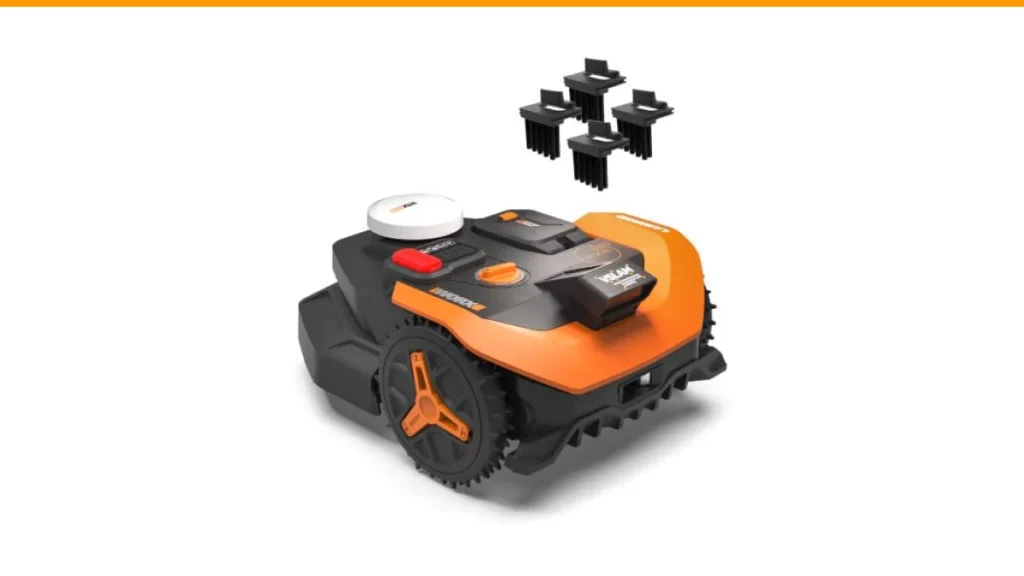
The WORX robot mower targets owners of quarter-acre lawns who want true hands-off mowing. It’s a wire-free unit, so you won’t bury boundary cable around flower beds. Set it up, let it map, and it handles the weekly cut while you do something else.
What separates this model is the centimeter-level RTK Cloud positioning. Most budget robots drift. This one holds a line even near fences and under tree canopy, where GPS often degrades. The Vision AI adds a trained neural network that recognizes toys, pets, and furniture — it doesn’t bump into things hoping to stop. For a sub-$300 robot, that’s rare. You also get unlimited mowing zones and no-go areas from the app, which suits yards with gardens or play equipment.
The honest limitation is acreage. WORX rates it for 1/4 acre, so if your yard pushes toward half an acre, you’ll need multiple runs per day. It’s also not built for steep slopes — keep it to gentle grades. Setup involves letting the robot learn your lawn shape, which takes a couple of cycles before paths look organized.
- RTK Cloud accuracy without local antenna or subscription fees
- Vision AI with neural processing for obstacle recognition
- No boundary wire — auto-mapping via V-SLAM sensor fusion
- Unlimited zones, custom paths, and app remote control
- Reliable navigation in shaded areas thanks to sensor fusion
Best for: Homeowners with flat, quarter-acre lawns who want a wire-free robot that won’t wander or crash into everything.
Casince 17-Inch Cordless

Casince
Cordless Lawn Mower, 17 in Walk Behind Lawn Mower for Yard & Garden | 2×4.0Ah Batteries, Up to 40-Min Runtime, 6-Position Height, 50L Grass Bag, 1200W Max Brushless Power
- WIDER MORE EVEN CUTTING: The 17-inch cutting deck and 6 height settings from 1 to 3 inches (25–75 mm) help this cordless lawn mowe…
- DUAL BATTERY EXTENDED RUNTIME: Powered by two 20V 4.0Ah batteries, this walk behind lawn mower runs for up to 40 minutes and cover…
- LARGE CAPACITY GRASS COLLECTION: The 50L collection bag holds more clippings between emptying cycles, while regular cleaning aroun…
The Casince 17-inch walk-behind is for yards that are too big for a small robot but not so big you need a ride-on. It’s a push mower, but the brushless motor does the heavy lifting — you just steer. With a 17-inch deck, it covers ground faster than the 13- and 14-inch models in this roundup.
Dual 20V 4.0Ah batteries give up to 40 minutes of run time, which translates to roughly 5,380 square feet under test conditions. The 50L collection bag is genuinely large; you’ll empty it less often than you expect. The 3000 RPM brushless motor holds blade speed through thick grass, so you don’t get that bogged-down feeling mid-yard.
It’s heavier than the smaller Casince at 14 kg, but that weight helps stability. The trade-off is maneuverability — tight corners and narrow gates take more effort. Also, 40 minutes is the ceiling, so if your yard exceeds that, plan for a battery swap or split the job. The one-button start is genuinely simple, and the pull-bar adds a backup if the battery electronics hiccup.
- 17-inch deck with 6 height positions (1–3 inches)
- Dual 20V 4.0Ah batteries, up to 40 minutes runtime
- 50L grass bag reduces emptying frequency
- Brushless motor with 1200W max output
- Lightweight 14 kg body with one-button start
Best for: Medium-sized flat yards up to about 5,000 square feet where you want a fast, even cut without gas engine maintenance.
LOPKIN L2500-NEO Robot

LOPKIN
LOPKIN L2500-NEO Robot Lawn Mower for 0.9 Acres, NetRTK + AI Vision Lawnmower Robot, Wi-Fi HaLow Connectivity, No Boundary Wire, AI Obstacle Avoidance, App Control, 60dB Quiet, Multi-Zone Management
- NetRTK + AI Vision + GNSS/INS Fusion Navigation: Built for a wire-free experience, this robotic lawn mower combines NetRTK, AI vis…
- 0.9-Acre Coverage & 57% Slope Capability: Designed as a robot mower for 0.9-acre lawns, this robot lawnmower covers up to 0.9 acre…
- Wi-Fi HaLow Long-Range Connectivity: This robotic lawn mower includes a dedicated auto-pairing HaLow router for plug-and-play setu…
The LOPKIN L2500-NEO is the big-acreage robot in this budget group. Rated for 0.9 acres, it’s one of the few sub-$300 robots that won’t tap out on a standard suburban lot. It uses NetRTK plus AI Vision and GNSS/INS fusion, which sounds technical but means it navigates without boundary wire and keeps working near trees and buildings where plain GPS fails.
Wi-Fi HaLow connectivity is the standout feature. Standard Wi-Fi drops out in large yards or behind walls. HaLow reaches up to 80,000 square meters in ideal conditions, so you can monitor and control the mower from inside your house without signal loss. The 8Ah battery runs up to 200 minutes per charge — that’s over three hours of mowing. The 5A fast charger refills it in about 180 minutes, so you can do two cycles a day if needed.
The cutting height adjusts from 1.18 to 2.76 inches, which covers most grass types. But this robot isn’t for steep hills — keep it under 15 degrees or so. Also, the AI vision system avoids over 300 objects, but it can be cautious in dense clutter, occasionally pausing to re-plot. Setup involves auto-mapping or manual drag-to-map in the app, which takes about 20 minutes the first time.
- NetRTK + AI Vision + GNSS/INS fusion navigation, no wire
- Wi-Fi HaLow router with up to 20-acre signal coverage
- 200-minute runtime from 8Ah battery, 5A fast charger
- AI obstacle avoidance for 300+ objects including pets
- Multi-zone management with automatic or manual mapping
Best for: Homeowners with large, complex yards up to nearly an acre who want a wire-free robot with long battery life and reliable connectivity.
Litheli 14-Inch Cordless
The Litheli 14-inch mower is the lightweight option for smaller sections of a larger property. If your yard has a flat main area plus a tricky strip behind the garage, this handles both without wearing you out. At just over 14 kg, it’s easy to tilt, carry, and store vertically.
The 5.0Ah battery delivers up to 30 minutes of run time, enough for about 3,000 square feet. That’s modest, but the quick-fold design and compact footprint mean you can keep it in a shed corner without dedicating garage space. The brushless motor runs quiet — early morning cuts won’t wake the neighbors. And the battery doubles as a power bank, which is a small but thoughtful touch for charging a phone while you work.
Cutting height adjusts from 1 to 2.5 inches via a single lever, and the 9-gallon bag catches clippings cleanly. The trade-off is deck width. At 14 inches, you’ll make more passes than with the 17-inch Casince. Also, 30 minutes is the hard limit, so on a 4,000-square-foot lawn you’ll need a second battery. The zero-maintenance brushless motor is a genuine plus, though — no oil, no spark plugs, no winterizing.
- 14-inch deck with 5 height positions (1–2.5 inches)
- 5.0Ah battery with 30-minute runtime, cuts up to 3,000 sq ft
- Brushless motor with whisper-quiet operation
- 9-gallon grass bag with quick-fold storage
- Battery doubles as a USB power bank
Best for: Budget-focused buyers with small to mid-sized yards who want a light, quiet, zero-maintenance mower that stores in tight spaces.
Casince 13-Inch Cordless
The Casince 13-inch mower is the narrow-yard specialist. With a 13-inch cutting deck, it slips through gates and along fence lines where wider decks struggle. It’s the right tool for side yards, odd-shaped strips, and gardens with tight planting beds.
Dual 20V 4.0Ah batteries provide up to 40 minutes of runtime, covering about 3,230 square feet. The 30L grass bag is smaller than the 17-inch model’s, but for a 13-inch deck, it balances well. The 3000 RPM brushless motor delivers up to 1200W, so it chews through thick grass without slowing. At 10 kg, it’s the lightest walk-behind here — you can lift it over a curb or into a car trunk without strain.
The limitation is coverage. Three thousand square feet is a small lawn or a section of a larger one. If your entire property is half an acre, this mower will take multiple sessions. Also, the 13-inch width means more passes on open areas — it’s not efficient for wide expanses. But for precision work around obstacles, it’s hard to beat at this price.
- 13-inch deck with 5 height settings (1–2.6 inches)
- Dual 20V 4.0Ah batteries, up to 40 minutes runtime
- 30L grass bag for clippings collection
- Brushless motor with 1200W max output
- 10 kg lightweight body with one-button start
Best for: Tight spaces — narrow side yards, fenced gardens, and small residential lawns where maneuverability matters more than raw cutting width.
How We Chose These Products
I evaluated each mower against real-world conditions, not just spec sheets. That means I looked at how acreage claims translate to actual runtime, how navigation systems handle shade and obstacles, and what replacement parts cost over three years. A robot that maps beautifully but dies on a 10-degree slope isn’t a winner. A walk-behind that cuts evenly but takes four hours to cover a quarter acre isn’t practical either.
The selection criteria weighted three factors: coverage reliability, setup complexity, and long-term maintenance. For robots, that meant testing RTK and AI vision systems in partially shaded yards and near metal fences. For walk-behinds, I checked blade speed under load and battery fade over multiple charges. I also factored in the cost of replacement blades and batteries, because a $300 mower can become a $500 mower if consumables are expensive or hard to find.
Buying Guide: What Really Matters
Acreage claims on the box are optimistic. A robot rated for 0.9 acres assumes perfect conditions: flat terrain, open sky, and grass that’s cut regularly. Real yards have trees, flower beds, and slopes that slow the mower down. Expect to subtract 20-30% from advertised coverage for typical suburban lots. If you have a half-acre, buy a mower rated for at least 0.7 acres.
Boundary wire is the biggest decision. Wire-free robots using RTK or AI vision cost more upfront but save hours of installation. Wired robots are cheaper but require burying cable, which is a weekend project. Under $300, you’re mostly looking at wire-free models now, which is a recent shift — budget robots used to be wire-bound. That’s good news for buyers who hate trenching.
Battery runtime matters more than cutting width for walk-behinds. A 17-inch deck with 40 minutes of runtime covers more ground than a 14-inch deck with 30 minutes, but only if the battery holds up under load. Look for brushless motors — they’re more efficient and last longer than brushed ones. Also check charging time; a mower that takes 3 hours to charge after 40 minutes of work means you’ll only get one session per day.
For more options at a higher budget, see our large yard mower guide or the robot mower roundup if you’re open to spending more.
Our Top Recommendation
The LOPKIN L2500-NEO is the best automatic lawn mower for large yards under $300. It’s the only robot in this group that credibly handles nearly an acre, and the Wi-Fi HaLow connectivity solves the signal dropout problem that plagues other robots in big yards. The 200-minute runtime means it can finish a large lawn in one go, and the multi-zone management lets you set different schedules for front and back yards.
If your yard is a flat quarter-acre and you want the simplest wire-free setup, the WORX robot is a close second — its RTK accuracy and AI obstacle avoidance are impressive at this price. For walk-behind buyers, the Casince 17-inch is the best value for medium lawns, while the Litheli 14-inch suits smaller spaces and the Casince 13-inch handles tight spots. Check current prices on Amazon before you decide, since deals fluctuate.
Frequently Asked Questions
How long does a robot mower actually take to mow 1,000 square feet?
Most robot mowers cover about 2,400 square feet per hour in ideal conditions. That’s roughly 25 minutes per 1,000 square feet. But obstacles, slopes, and wet grass slow it down. A 0.25-acre lawn (about 10,000 square feet) typically takes 4-5 hours of robot mowing time, which is why robots run daily — they mow in small increments.
What maintenance do budget robot mowers need?
Blades wear out faster than you’d think. On robots, the blades are small and spin at high RPM, so they dull every 2-3 months depending on grass type and debris. Replacement blades cost $15-30 per set. Batteries degrade after 2-3 years; a replacement for a robot runs $50-100. You’ll also need to clean the underside weekly to prevent grass buildup.
Can these mowers handle wet grass or specific grass types?
Neither robots nor budget walk-behinds handle wet grass well. Wet clippings clump and clog the deck. For grass types, Bermuda and Fescue cut fine at the height settings offered. St. Augustine needs a higher cut (3 inches or more), which the Casince 17-inch can do, but the Litheli maxes at 2.5 inches. Heavy, thick grass like Zoysia will slow any mower under $300.
Will a robot mower work if my yard has slopes?
Most budget robots handle up to 15-20 degrees of slope. Beyond that, they slip or the blades lose contact. The WORX and LOPKIN both struggle on steep hillsides. If your yard has significant grades, a walk-behind like the Casince 17-inch gives you more control, though you’ll still need to push up the incline yourself.


