
You’ve probably stared at that patch of rock-hard clay in your yard, wondering if anything can actually grow there. You’ve bought a bag of fertilizer, spread it, watered it in, and watched it sit on the surface like you’d just poured it on a driveway. Clay soil is a different beast. It binds nutrients, drains poorly, and compacts so hard that roots struggle to push through. Finding a product that actually helps feels like a guessing game.

A good fertilizer for clay soil does more than feed grass. It needs to improve soil structure, or at least work with it. The best options either supply calcium and sulfur to flocculate clay particles, add organic matter to create pore space, or use liquid formulas that penetrate where granular products can’t. The NPK ratio matters too. High-phosphorus blends are mostly wasted in clay because phosphorus binds tightly to clay particles. Potassium leaches away in waterlogged conditions. So the right product often looks different from what you’d use on sandy loam.
We dug through the options and picked five that solve specific clay-soil problems. Some are granular soil amendments, others are liquid conditioners. One is a microbial booster. We’ll explain what each does, who it’s for, and where it falls short. You’ll also find a comparison table, a buying guide that covers NPK ratios and application timing, and a season-by-season amendment timeline. No fluff, just the info you need to make a smart choice.
Here’s a quick side-by-side look at the key specs that separate these five products.
| Features | Earth Science Gypsum | Down To Earth Gypsum | Simple Lawn Loosener | Farmer’s Secret Revitalizer | Covington Liquid Aerator |
|---|---|---|---|---|---|
| Primary Function | Loosen clay, add calcium | Loosen clay, add calcium | Liquid soil conditioner | Microbial soil booster | Liquid soil softener |
| Form | Granular pellets | Prilled granules | Concentrated liquid | Concentrated liquid | Concentrated liquid |
| Key Ingredients | Gypsum, Nutri-Bond | Gypsum | Proprietary blend | Activated humics | Humic acid, kelp, amino acids |
| Coverage | 5 lb bag | 5 lb bag | Up to 32,000 sq ft | 128 oz concentrate | 32 oz concentrate |
| Best Use Case | Salt-damaged clay, quick loosen | Organic gardening, pH-sensitive | Large lawns, standing water | Reviving dead soil, monthly | Small lawns, hard clay |

Earth Science Fast Acting Gypsum

Earth Science
Earth Science Fast Acting Gypsum Granules—5 lb— Soil Conditioner Adds Calcium, Repairs Salt Damage & Root Growth with Nutri-Bond Runoff Reduction Technology
- Loosen Clay: Earth Science Fast Acting Gypsum granules start immediately to loosen clay and other compact soils for improved water…
- Support Healthy Plants: Loosening soil allows for better soil structure, water retention, and airflow which helps to support healt…
- Finely Ground & Pelletized: Earth Science Fast Acting Gypsum starts working immediately to loosen compact soil. Earth Science gyps…
This is the go-to granular gypsum for anyone dealing with hard, compacted clay that’s also been hit with road salt or pet urine. It’s a soil conditioner, not a fertilizer in the traditional NPK sense. The calcium in gypsum displaces sodium on clay particles, which helps them clump together into larger aggregates. That opens up pore space, so water and air can move. If your clay is slick and sticky when wet, gypsum can help flocculate it.
What sets Earth Science apart is their Nutri-Bond technology. It’s a polymer that bonds with soil to reduce nutrient runoff by up to 50%. On clay, where water often sheets off the surface instead of soaking in, that’s a real benefit. The pellets are finely ground and pelletized, so they break down fast. You can spread them with any standard spreader. And it’s safe for kids and pets immediately after application, which is a nice bonus if you have a dog that treats the lawn like a salad bar.
The main trade-off is that gypsum doesn’t add nitrogen, phosphorus, or potassium. It’s a conditioner, not a complete fertilizer. You’ll still need to fertilize separately. Also, it works best on sodic clay (high sodium). If your clay is just heavy but not salty, the results may be less dramatic. And while it starts working immediately, you won’t see a total soil transformation overnight. It takes a few applications and a season or two to really change structure.
- Granular gypsum with Nutri-Bond to cut runoff
- Adds calcium and sulfur without changing soil pH
- Safe for all grass types and pets
- 5 lb bag covers a modest area; larger lawns need multiple bags
- Does not supply NPK, so pair with a separate fertilizer
Best for: Homeowners with salt-damaged or sodic clay who want a fast-acting granular conditioner they can spread easily.
Down To Earth All Natural Gypsum

Down To Earth All Natural Fertilizers
Down to Earth All Natural Fertilizers Organic Prilled Garden Gypsum - Calcium Sulfate Loosens Clay Soil Greens Grade Mini Granules, 5 lb
- Enhances Soil Structure: Loosens heavy clay soils, improving aeration, drainage, and root penetration.
- Provides Essential Calcium & Sulfur: Supplies key nutrients needed for strong cell walls and healthy plant growth.
- Does Not Alter Soil pH: Acid-neutral and safe for pH-sensitive plants.
Down To Earth’s prilled gypsum is the organic gardener’s choice. It’s OMRI listed, so it’s approved for certified organic use. The prilled form is dust-free and easy to spread, which matters if you’ve ever dealt with a cloud of gypsum powder on a windy day. Like the Earth Science product, it loosens heavy clay and improves aeration and drainage. But it’s a simpler formula: just gypsum, no added polymers.
This one shines for pH-sensitive plants. Gypsum is acid-neutral, so it won’t swing your soil pH up or down. If you’re growing acid-loving plants like blueberries or azaleas in clay, this is a safe way to improve structure without messing with pH. It also helps reduce soil crusting, which is a common problem in clay. That crust can prevent seedlings from emerging, so if you’re overseeding, this helps.
The downside? It’s slower to break down than the Earth Science pellets. The prills dissolve over time, so you won’t see instant results. And like all gypsum products, it doesn’t add nitrogen, phosphorus, or potassium. You’ll need a separate fertilizer for nutrition. The 5 lb bag is also on the smaller side, so for a large lawn, you’ll be buying multiple bags. It’s a bit more expensive per pound than some alternatives, but you’re paying for the organic certification and the dust-free prills.
- OMRI listed for organic use
- Prilled for easy, dust-free spreading
- Does not alter soil pH
- Reduces crusting and compaction
- No NPK; use with a separate fertilizer
Best for: Organic gardeners and anyone with pH-sensitive plants who needs a gentle, natural clay conditioner.
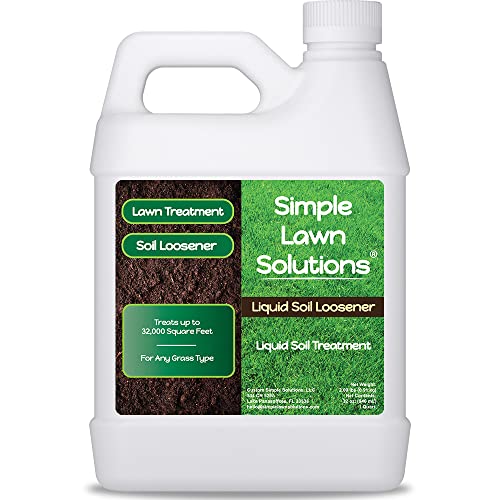
Simple Lawn Solutions Liquid Soil Loosener
Simple Lawn Solutions
Liquid Soil Loosener- Soil Conditioner-Use alone or when Aerating with Mechanical Aerator or Core Aeration- Simple Lawn Solutions- Any Grass Type-Great for Compact Soils, Standing water, Poor Drainage
- Liquid Soil Loosener: Can be used Alone or with Mechanical or Core Aeration, Aerating and Aerate Tools. Liquid Soil Loosener Condi…
- Concentrated Soil Conditioner: Soften Your Soil with this Advanced Lawn Solution, Easy To Use Treatment. Liquid Soil Loosener is C…
- Helps Standing Water, Promotes Drainage: Improves Water and Liquid Infiltration. Use Alongside Any Turf Grass Fertilizer Nutrient…
If you’ve got a large lawn and you’re tired of hauling bags of granular product, this concentrated liquid is a practical alternative. One 32-ounce bottle covers up to 32,000 square feet. That’s a lot of coverage for a small bottle. You mix it with water and spray it on. It’s designed to be used alone or in conjunction with mechanical aeration. It helps water move downward through the soil profile, which is exactly what clay needs.
The formula is a proprietary blend, but the results people report are consistent: less standing water, better drainage, and softer soil. It works on all grass types, from Bermuda to fescue to St. Augustine. And it’s made in the USA by a family-owned business with decades of turf experience. For a large property, the convenience factor is huge. You can treat the whole lawn in under an hour with a hose-end sprayer.
But liquid conditioners aren’t a magic bullet. They don’t change the fundamental structure of clay the way gypsum or organic matter does. They’re more of a temporary fix that improves water movement. You’ll need to reapply regularly, especially during heavy rain periods. And if your clay is extremely compacted, you may still need core aeration. The product helps, but it’s not a substitute for mechanical intervention in severe cases.
- 32 oz covers up to 32,000 sq ft
- Concentrated liquid; mixes with water
- Works with all grass types
- Can be used alone or with core aeration
- Requires regular reapplication for lasting effect
Best for: Owners of large lawns who want a quick, easy-to-apply liquid that improves drainage without hauling bags.
Farmer’s Secret Soil Revitalizer

Farmer's Secret
Farmer’s Secret Soil Revitalizer - Organic (OMRI Listed) Dirt Health Booster - Liquid Compost Soil Amendment - Activated Humic Acid - Great for Fall/Spring Application (128oz)
- Feed the soil not the plants - stimulate microbial activity in your soil and boost probability of success with all types of plants…
- For best results, apply monthly throughout the growing season, especially in the fall and spring
- No synthetic chemicals - main ingredient in this product is activated humics derived from organic sources (OMRI certified organic)
This is a different kind of product. It’s not a fertilizer or a gypsum substitute. It’s a liquid compost extract, essentially. The main ingredient is activated humic acid derived from organic sources. Humic acid is a powerhouse for clay soil. It chelates nutrients, making them more available to plants, and it stimulates microbial activity. In clay, where beneficial microbes often struggle due to lack of oxygen, this can kickstart the natural soil-building process.
Farmer’s Secret is OMRI listed and made in Kentucky. The idea is to feed the soil, not just the plants. You dilute it at 1 ounce per gallon and spray or pour it on. For best results, apply monthly during the growing season, especially in fall and spring. It’s like composting, but faster. If your clay is dead and lifeless, this can bring it back. It’s also great for gardens, not just lawns.
The catch is that it’s not a quick fix. You won’t see dramatic changes in a week. It’s a long-term soil health product. And it doesn’t provide the macronutrients grass needs in large amounts. You’ll still need a traditional fertilizer for nitrogen, phosphorus, and potassium. The 128-ounce bottle makes a lot of diluted solution, but if you have a huge lawn, you might go through it faster than you’d like. It’s an investment in soil biology, not a bag of lawn food.
- Activated humic acid, OMRI listed
- Stimulates microbial activity
- Dilute 1 oz per gallon of water
- Apply monthly during growing season
- Not a complete fertilizer; use alongside NPK
Best for: Gardeners and lawn owners who want to rebuild dead clay soil from the ground up using organic, biological methods.
Covington Liquid Lawn Aerator
Covington’s liquid aerator is similar in concept to the Simple Lawn Solutions product, but it’s positioned as a direct alternative to core aeration. It’s a 32-ounce concentrate that you mix and spray. The formula includes humic acids, amino acids, and kelp. That’s a nice trio for clay. Humic acid improves nutrient uptake, amino acids feed microbes, and kelp adds growth hormones and trace minerals. It’s safe for pets and kids, which is always a plus.
This one is designed for lawns, gardens, and hard clay soil. It softens the soil, improves water movement, and increases air circulation. If you hate the idea of renting a core aerator or pushing those spike shoes around, this is a low-effort alternative. It’s made in the USA by a family-owned business, and it’s used by landscapers and golf courses, not just homeowners. That’s a good sign for its effectiveness.
But again, it’s not a permanent fix. Liquid aeration is a supplement, not a replacement for mechanical aeration in severely compacted clay. You’ll need to apply it regularly, and it works best when used consistently over a season or two. The 32-ounce bottle covers a decent area, but for very large lawns, you’ll need multiple bottles. And it doesn’t add significant NPK, so you’ll still need a fertilizer program.
- Contains humic acid, amino acids, and kelp
- Safe for pets and kids
- Liquid alternative to core aeration
- Works on all soil types, especially clay
- Requires regular application; not a one-time fix
Best for: Homeowners who want an easy, pet-safe liquid aerator that softens clay and improves water absorption without machinery.
How We Chose These Products
We started by looking at what clay soil actually needs. It’s not just about NPK. Clay binds phosphorus, leaches potassium, and suffocates roots. So we prioritized products that address structure, drainage, or microbial health, not just nutrient content. We also considered form factor. Granular products are easy to spread but may sit on the surface if clay is too hard. Liquids penetrate better but need reapplication. We wanted a mix of both.
Next, we looked at ingredient transparency and certifications. OMRI listing matters for organic growers. We also checked coverage rates and value. A product that costs a little more but covers 32,000 square feet is often a better deal than a cheap bag that covers 2,000. We read through user feedback to identify common complaints, like dust, slow results, or clogged sprayers. Every product here has a clear strength and a clear limitation. No hype.
Buying Guide: What Really Matters
The first thing to understand is that clay soil fertilizer isn’t just about feeding grass. It’s about fixing the soil. High-phosphorus fertilizers are a waste in clay because phosphorus binds to clay particles and becomes unavailable. Look for products with a lower phosphorus ratio, or use a soil test to determine what you actually need. Potassium is also easily leached in waterlogged clay, so slow-release potassium is better than a quick hit.
Granular vs liquid is a big decision. Granular gypsum and organic amendments are great for long-term structure. They break down slowly and improve soil aggregation. Liquids are better for quick penetration and immediate improvement in water movement. For best results, many people use both: a granular amendment in spring and fall, and a liquid conditioner monthly during the growing season.
Don’t overlook organic matter. Compost, humic acid, and microbial inoculants are the real long-term fix for clay. They create pore space, feed earthworms, and build humus. Fertilizers alone won’t fix clay. They just feed the grass. If you want a permanently better lawn, you need to add organic matter every year. That’s why products like Farmer’s Secret and Covington are valuable, even though they don’t supply much NPK.
Our Top Recommendation
For most people with clay soil, we recommend starting with Earth Science Fast Acting Gypsum. It’s a proven clay breaker, it’s easy to spread, and the Nutri-Bond technology reduces runoff. It’s safe for pets and kids, and it works on any grass type. It won’t feed your lawn, but it will make your soil more workable. Pair it with a balanced slow-release fertilizer for nutrition.
If you prefer organic, Down To Earth Gypsum is the better choice. It’s OMRI listed and pH-neutral. For large lawns, Simple Lawn Solutions Liquid Soil Loosener offers the best coverage per dollar. And if your soil is biologically dead, Farmer’s Secret Soil Revitalizer is worth the investment. Covington Liquid Lawn Aerator is a solid alternative for small yards and pet owners. No single product does everything, but combining a gypsum product with a liquid conditioner and a good fertilizer program will get you the best results.
Frequently Asked Questions
How often should I fertilize clay soil?
Clay soil holds nutrients longer than sandy soil, but it also binds them. A slow-release fertilizer applied twice a year, once in early spring and once in early fall, is usually enough. If you use a liquid fertilizer, you may need to apply every 6-8 weeks during the growing season. Always water it in thoroughly to move nutrients past the surface.
Can fertilizer alone fix clay?
No. Fertilizer feeds the grass, but it doesn’t change soil structure. Clay will still compact and drain poorly. You need to add organic matter, gypsum, or a liquid soil conditioner to actually improve the soil. Think of fertilizer as food and soil amendments as medicine. You need both.
Is weed-and-feed safe on clay?
Weed-and-feed products can be risky on clay because the herbicide can run off into storm drains if it rains before it absorbs. Clay’s poor drainage increases that risk. It’s safer to apply a separate pre-emergent and a separate fertilizer, timed when no rain is forecast for 24-48 hours. Also, weed-and-feed can stress grass if the clay is already waterlogged.
How long does it take to improve clay soil?
It depends on how bad the clay is and what you use. Gypsum can start loosening soil in a few weeks, but you won’t see major structural changes for a full season. Organic matter takes longer, often 2-3 years of consistent applications. Liquid conditioners give quick but temporary results. The key is consistency. One application won’t fix decades of compaction.

